
Reporter: Wu Chunbo, Dahe Finance
Recently, Hanwei Technology released its 2024 annual report, in which Chairman Ren Hongjun mentioned in a “letter to all shareholders” that the company will intensify its efforts in the robot sensor market and accelerate the release of new technology performance.
As an important symbol of Hanwei Technology’s heavy investment in embodied intelligence, the first humanoid robot manufacturer invested by Hanwei Technology has emerged. On July 3, Dahe Finance learned that the National Enterprise Credit Information Publicity System approved information showing that Hanwei Technology has become a shareholder of Shanghai Kepler Robotics Co., Ltd. (hereinafter referred to as Kepler Robotics).
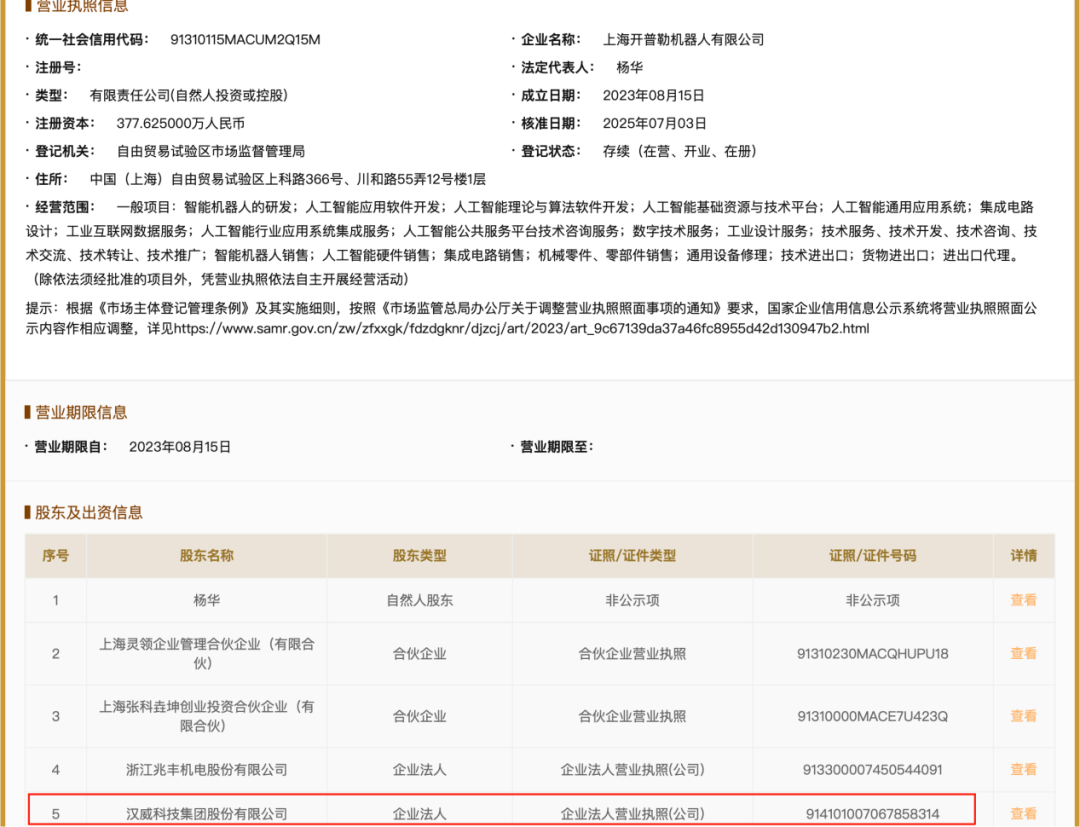

Strategic Investment in Kepler
Hanwei Technology Advances in Embodied Intelligence
As a leader in gas sensors and a comprehensive sensor solution provider, Hanwei Technology’s sensor categories have long exceeded gas sensors and are continuously extending into fields such as home appliances, automotive, and embodied intelligence.
Hanwei Technology’s Senior Vice President and Board Secretary, Xiao Feng, introduced that prior to this investment in Kepler, the company had already laid out flexible tactile sensors, inertial measurement units, MEMS pressure strain gauges, olfactory sensors (electronic noses), and uncooled infrared thermal imaging modules for the robotics field, constructing a multi-dimensional product matrix covering “tactile – balance – force control – olfaction”.
This means that in the direction of embodied intelligence sensors, Hanwei Technology has already built a complete technological innovation system and a mature industrial foundation through endogenous incubation and external mergers and acquisitions.
Why would a sensor company invest in downstream robotics companies? Sources close to Hanwei Technology told Dahe Finance that prior to this investment, Hanwei Technology had established an embodied intelligence sensor research institute to aggregate innovative resources for the development of humanoid robot-related sensors. This investment will help Hanwei Technology gain a more accurate understanding of the real needs of embodied intelligence sensors, thereby enhancing innovation progress and developing more suitable sensor products for embodied intelligence.
As for the investee, Kepler Robotics was established in August 2023, and co-founder Hu Debo previously worked at Huawei. Although this company has been established for less than three years, it has already become a representative enterprise in the research and application of industrial humanoid robots.
It is reported that Kepler’s humanoid robots take the industrial application route, aiming to solve practical needs in enterprise production, adopting a dual strategy of “technology-driven + demand-oriented”, with industrial scenarios as the core breakthrough.
Notably, its developed K2 Bumblebee humanoid robot was recently recommended by Brett Adcock, CEO of the leading global humanoid robot company, Figure.
Dahe Finance noted that the cooperation between the two parties had been signaled earlier. On June 9 of this year, Kepler’s WeChat public account announced that it had officially signed a cooperation agreement with Hanwei Technology, and the two parties would carry out in-depth cooperation in the field of embodied intelligence humanoid robots, integrating advanced perception systems and intelligent execution technologies to promote the large-scale application of humanoid robots in industrial scenarios.
Kepler Robotics stated that this cooperation marks the entry of both parties into a stage of collaborative innovation in industrial automation and embodied intelligence.
Accelerating Commercialization of Embodied Intelligence
Industrial Scenarios May Be the First to Land
Public information shows that in the past two years, many technology and startup companies at home and abroad have entered the humanoid robot track. In the past 2024, it has been a year of prototype releases for humanoid robots both domestically and internationally.
In addition to the aforementioned K2 Bumblebee, there are NEOBeta launched by 1X Tech, the electric version of Atlas launched by Boston Dynamics, Walker S1 launched by UBTECH, Iron launched by Xpeng Motors, TORA-ONE launched by Pashini Perception Technology, Galbot G1 launched by Galaxy General Robotics, and “Xialan” launched by Digital Huaxia.
In terms of commercialization, due to the singularity and repetitiveness of industrial manufacturing scenarios, they have become the easiest scenes for humanoid robots to implement, and are conducive to obtaining high-quality training data for humanoid robot training.
Hu Debo, co-founder and CEO of Kepler Robotics, publicly stated that although the humanoid robot industry is booming, achieving a closed loop of commercial value is the focus of the next stage, and industrial scenarios are the ideal scenes for the current and near-term commercial closed-loop landing.
He further introduced that currently there are two major categories that are more suitable for humanoid robots to explore at this stage: one is warehousing logistics, and the other is industrial manufacturing. Warehousing logistics has a large labor demand, and the work environment and task monotony are strong, making it suitable for robots to replace; industrial manufacturing has many categories, and at this stage humanoid robots should look for opportunities from discrete industrial branch tasks.
Goldman Sachs’ related research report shows that humanoid robots are expected to be first applied in factories from 2024 to 2027.
Public information shows that Tesla’s Optimus, UBTECH’s Walker S, and Leju’s Kua Fu humanoid robots have already begun to be applied in automotive factories, responsible for repetitive tasks such as handling and quality inspection.
Notably, the K2 “Bumblebee” developed by Kepler has performed well in actual deployment in industrial scenarios, with its innovative “series-parallel structure” design and dual support of rolling screw, allowing the K2 “Bumblebee” to carry 15 kg with a single arm and achieve a collaborative load of 30 kg with both arms, working continuously for 8 hours on a 1-hour charge, meeting the demands of high-intensity industrial operations.
Hu Debo stated that the humanoid robot developed by Kepler has iterated to the fifth generation and has entered the small-batch production stage.
Empowering Humanoid Robots
Accelerating Release of Sensor Market Potential
It is noteworthy that humanoid robots, in the process of intelligent development, have higher requirements for multiple modules such as perception, interaction, movement, and control, and sensors play an important role in these modules.
For example, the tactile dexterous hand of the K2 Bumblebee robot has 11 degrees of freedom in a single hand, with 25 force touch points per finger, and is equipped with a six-dimensional force wrist, enabling it to have bionic tactile perception and precise force control capabilities, allowing the robot to perform tasks such as holding an egg or twisting a bottle cap steadily.
In fact, it is not just Kepler Robotics. Using more sensors in the “dexterous hand” to achieve high precision force control and multi-action capabilities has become a common option for domestic humanoid robot manufacturers.
For instance, Shanghai Silicon Step’s Shadow dexterous hand is equipped with over 100 sensors, with a running frequency of up to 1 kHz, a repeat positioning accuracy of 0.2 mm, and has 20 degrees of freedom and 24 actions; Risen’s freehand dexterous hand uses multi-array pressure sensors to achieve precise perception of touch and slip; it has 6 degrees of freedom and can independently control each finger.
Industry insiders believe that as humanoid robots develop rapidly, their demand for external environmental perception is becoming increasingly urgent, and the market opportunities related to visual sensors, auditory sensors, olfactory sensors, tactile sensors, and force sensors will accelerate, releasing related market potential and benefiting outstanding domestic sensor companies.
Currently, in practice, olfactory sensors can allow robots to smell odors, while force sensors can provide high-precision force feedback, inertial measurement units can assist robots in achieving posture control, and tactile sensors represented by electronic skin can perceive pressure, shear force, contact force, etc., helping robot hands achieve more precise operations.
“Currently, the company’s flexible electronic skin products are cooperating with several humanoid robot manufacturers and have already supplied small batches to some robot manufacturers,” Xiao Feng stated. In the future, the company will continue to deepen its efforts in the field of embodied intelligence, promoting innovation and application of sensor technology to provide more efficient and precise perception support for intelligent robots and intelligent manufacturing fields.
Kepler Robotics stated that cooperation with Hanwei Technology will further release both parties’ technological accumulation in perception systems and embodied intelligence, by deeply integrating high-precision sensor technology with autonomous controllable robot platforms, creating next-generation humanoid robot solutions with commercial landing capabilities, and promoting the humanoid robot industry into a stage of large-scale application.

Editor: Ren Haopeng丨Reviewed by: Chen Xiaojun 丨Audit: Xu Jiao
Supervision: Gu Zheng丨Produced by: Wang Lufeng
Recommended Reading1 Vanke borrows again! This year has borrowed over 20 billion from Shenzhen Metro Group2 The U.S. President plans to visit China with a business delegation? The Ministry of Commerce responds3 Henan Province plans to introduce regulations to promote the private economy<img src=”https://mmbiz.qpic.cn/sz_mmbiz_jpg/YUsw6GWibWgfGUxwvC7d2ic4H7Gz0kI4iaeibJmkywz1edSUNl8Rp8Y9Oy9bytrZfoKJsAGx77vNUzUDjcQax33dVw/640?wx_fmt=jpeg&from=appmsg&&tp=webp&wxfrom=5&wx_lazy=1&wx_co=1″