The 4th Lecture of World History: The Development of Humanism and the Scientific Era
1.(2023 Zibo Second Mock Exam)12. “They believe that humans can achieve the highest level of superiority through their own efforts, shape their own lives, and earn fame through their own achievements. They are committed to revealing and celebrating the charm and independent value of the natural world itself, no longer viewing humanity merely as an appendage of God.” “They” refers to
A. Artists of the Renaissance B. Protestants of the Reformation
C. Thinkers of the Enlightenment D. Scientists in the field of natural sciences
2.(2023 Tai’an Second Mock Exam)11. In medieval Europe, children were seen as the property of their parents and were considered inherently evil. Beating and corporal punishment of children were viewed as reasonable and legal. It was not until after the 14th century that people began to view children from the perspective of their natural state, demanding respect for children’s rights to survival, development, and education. This change
A. Reflects the influence of humanism B. Benefited from the development of the Enlightenment
C. Inherits the traditional European view of children D. Safeguards children’s legal rights
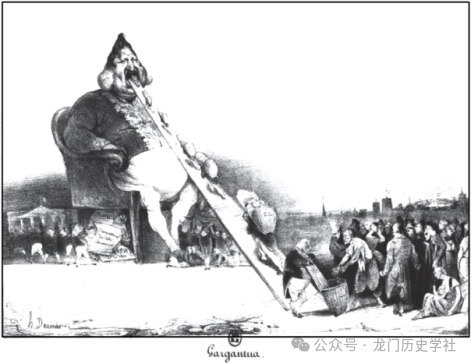
3.(2023 Jinan Third Mock Exam)13. In the 16th century, French novelist Rabelais depicted a gluttonous king, Gargantua, in “Gargantua and Pantagruel,” who from birth continuously consumed the wealth of the people. In 1832, French cartoonist Daumier used this image to create the famous painting “Gargantua” (Figure 3). Daumier’s intention in creating this cartoon was to
Figure 3
A. Inherit humanist thought B. Show sympathy for the impoverished masses
C. Promote the realist painting style D. Satirize social realities and inspire revolution
4.(2023 Heze Second Mock Exam)12. Italian politician Machiavelli (1469-1527) published “The Prince,” proposing the principle that the prince is above the law and parliament. After the widespread dissemination of this book, many ambitious rulers acted according to this principle. The emergence of this phenomenon
A. Facilitated the formation of nation-states B. Promoted the rise of the Renaissance
C. Accelerated the spread of Protestant thought D. Led to the decline of parliamentary politics
5.(2024 Rizhao First Mock Exam)11. The image below is the painting “The Adoration of the Magi” by Italian painter Botticelli (approximately created in 1477). The painting depicts the scene of the three wise men from the East coming to worship after the birth of Jesus in the Bible. The work emphasizes
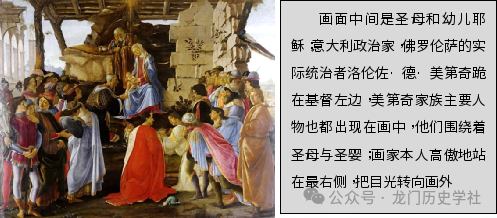
A. Secularism B. Classicism C. Theocracy D. Individualism
6.(2025 Qingdao First Mock Exam)11. In 1615, Galileo stated: “Once we gain some certainty in nature, we should use it appropriately to help interpret the Bible and examine those meanings that may be hidden behind it, as they must be consistent with the proven truths.” This assertion reflects ( )
A. The connotation of humanism B. The tolerance of the Roman Catholic Church
C. The thought of rationalism D. The breakthrough of scientific theory
7.(2023 Weifang Second Mock Exam)11. In 1543, King Henry VIII of England issued a decree stating that the content of dramas should not involve interpretations of the Bible, encouraging playwrights to focus on secular life and create dramas that promote Protestantism and reflect the characteristics of the times. This measure aimed to
A. Consolidate the king’s rule B. Establish a nation-state
C. Promote humanism D. Regulate drama creation
8.(2023 Yantai Second Mock Exam)12. Figure 2 is a cartoon related to European society in the early 16th century. This cartoon reflects
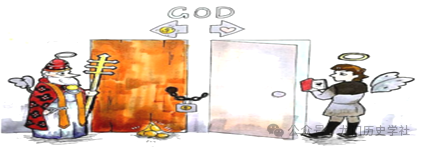
Figure 2
Note: On the left side of a door is a Catholic clergy member, and on the right side is an ordinary person holding a Bible
A. Citizens pursuing secular life B. Colonial expansion intensifying civilizational conflict
C. Increasing social stratification D. Rational reflection on faith
9.(2023 Shenzhen Second Mock Exam)13. In the mid-16th century, King Gustav I of Sweden appointed clergy with Protestant ideas as bishops, supported the spread of Martin Luther’s Protestant thought in Sweden, issued decrees to secularize church property, and hired German experts as advisors to reform the national administrative system, strengthening the political consultative role of the national parliament. These measures were mainly aimed at
A. Spreading Protestant thought B. Strengthening secular royal power
C. Cultivating national consciousness D. Establishing parliamentary politics
10.(2023 Beijing Dongcheng Second Mock Exam)12. In the 16th century, Calvin established a theocratic republic in Geneva, proposing that the ability to become wealthy through commerce is a gift from God. His “Catechism” was established as a guideline for citizens’ words and actions. Engels commented on him: “Protestants surpassed Catholics in persecuting the freedom of natural scientific research. When Servetus was about to discover the process of blood circulation, Calvin burned him.” This shows that Protestantism
① Adapted to the demands of the emerging bourgeoisie
② Still controlled people’s thoughts and constrained their actions
③ Established the legislative foundation for nation-states
④ Laid the theoretical foundation for the establishment of capitalist political systems
A. ①② B. ①③ C. ②③ D. ②④
11.(2025 Provincial Experiment First Mock Exam)11. From the 15th to the 16th century, the public buildings of European cities not only showcased superb artistic standards but also demonstrated the city government’s comprehensive control over urban space. At the same time, the military facilities of the cities were no longer limited to traditional defensive functions; their design and layout increasingly considered the needs for external warfare, showing enhanced offensive characteristics. This indicates that at that time in Europe ( )
A. The feudal fragmentation situation was disintegrating B. The urban economic structure was transforming
C. Secular power was significantly increasing D. The decline of religious theocratic rule
12.(2023 Jining Second Mock Exam)11. A famous figure in 18th century Europe stated: “Through a revolution, it may be possible to overthrow personal despotism and the oppression of greed and power, but it cannot achieve a true reform of ways of thinking. New prejudices will, like mirrors, become traps to control the thoughtless masses.” The above viewpoint reflects
A. The core concept of the Renaissance B. The thematic thought of the Reformation
C. The rational thinking of the Enlightenment D. The pursuit of the bourgeois revolution
13.(2023 Liaocheng Second Mock Exam)12. Economic historian Eric Roll once said: “We cannot forget that the author of ‘The Wealth of Nations’ is also the author of ‘The Theory of Moral Sentiments.’ If we do not understand some philosophical knowledge from the latter, we cannot understand the economic thought of the former.” American economist Milton Friedman also pointed out that without reading ‘The Wealth of Nations,’ one does not know what ‘self-interest’ is, but after reading ‘The Theory of Moral Sentiments,’ one realizes that ‘altruism’ is the only way to be guilt-free. The above evaluation mainly reflects that ‘The Theory of Moral Sentiments’
A. Advocates that a wealthy nation must rely on the market B. Opposes excessive government intervention in the economy
C. Advocates the effectiveness of capital accumulation D. Emphasizes the moral constraints on the market
14.(2023 Weifang Third Mock Exam)12. “In this kingdom, the residents are not restricted by the borders of existing sovereign states, sharing the aspiration to explore the universal truths common to human society. However, the universality in their minds is, in any case, based on the premise of the European world.” The “kingdom” referred to in the above evaluation is
A. The vast colonial empire constructed by Britain B. The “kingdom of religious freedom” of Protestant leaders
C. The “kingdom of reason” of Enlightenment thinkers D. The ideal kingdom of utopian socialists
15.(2023 Dezhou Third Mock Exam)12. Some scholars evaluate a certain ideological liberation movement in modern Europe: “This movement proposed extensive criticism of the society, politics, and morals of the time, striving to improve the human condition through the dissemination of knowledge.” This movement is
A. The Renaissance B. The Scientific Revolution C. The Reformation D. The Enlightenment
16.(2024 Heze First Mock Exam)12. Voltaire proposed that freedom is a natural right enjoyed by everyone and should not be infringed upon; this natural human right is only governed by law; equality means opposing the hierarchy and feudal privileges, and everyone is born equal. The government is merely a political system and power structure that protects people’s rights to freedom and equality as defined by law. This emphasizes
A. Freedom and equality should be respected B. The contractual relationship between individuals and the state
C. The philosophical thinking of rationalism D. The core of the state theory is the social contract
17.(2024 Tai’an First Mock Exam)12. Influenced by the law of universal gravitation, philosophers still believed in the “natural law,” which, as Newton said, could influence the universe and human society. Thus, in seeking natural laws, they developed a set of bourgeois revolutionary ideological systems. It can be seen that these philosophers
A. Promoted the rise of modern natural sciences B. Led the bourgeois revolutions in Europe and America
C. Advocated rationality to promote social development D. Escaped the spiritual constraints of the Christian church
18.(2024 Linyi First Mock Exam)12. In the 18th century, King Frederick II of Prussia advocated enlightened despotism, claiming that he was merely the first servant of the state, and that the interests of the state were the monarch’s law, which is inviolable. He even ordered that if he were captured by the enemy, Prussia should make no sacrifices for his release. This reflects
A. The progress of society in the Enlightenment era B. The formation of a unified nation-state
C. The establishment of the principle of limited royal power D. The spread of the concept of the supremacy of law
19.(2024 Zibo First Mock Exam)12. In the 17th century, a certain thinker wrote: “Due to the lack of public power that everyone can respect, people live in conditions called war; in war, everyone is against each other. To escape this lawless situation, people exchanged their freedom for social and political order.” It can be seen that this thinker
A. Advocated political revolution B. Identified with democracy and republicanism C. Opposed freedom and equality D. Advocated the social contract
20.(2024 Jining First Mock Exam)11. The 17th century in Europe welcomed the “Age of Scientific Revolution,” but John Dalton, regarded as the “father of modern chemistry,” was a devout Protestant, and Isaac Newton, considered the founder of modern physics, was also keen on alchemy. This indicates
A. Modern scholars lacked rational pursuit B. Feudal superstitions hindered scientific development
C. The church still had a strong influence D. Every era has specific spiritual connotations
21.(2025 Provincial Experiment First Mock Exam)12. During the Enlightenment, some thinkers proposed, “The world can eradicate all evils because the existence of any evil… is merely a product of a bad environment, and this environment is created by humans, who can also change it.” This reflects their rational thinking about ( )
A. The flaws of the Reformation movement B. The issue of social transformation
C. The value and role of science D. The dialectical relationship between humanity and the environment
22.(2025 Tai’an First Mock Exam)12. In the late 18th century, some scientists, repairmen, and natural philosophers in Europe firmly believed that humanity could make progress and regarded the dissemination of “useful knowledge” that could be applied by others as their duty. Based on this, numerous scientific societies and schools were established; in 1797, the “Journal of Natural Philosophy, Chemistry, and the Arts” was published, marking the birth of the world’s first true scientific journal. This ( )
A. Signified the climax of the scientific revolution B. Reflected a significant breakthrough in scientific theory
C. Reflected the trend of specialization in scientific research D. Indicated that scientific knowledge began to spread to the public
23.(2025 Dezhou First Mock Exam)12. Table 5 presents the discussions of Italian thinkers Marsilio Ficino and Tommaso Campanella. The discussions of the two ( )
Table 5
|
Thinker |
Discussion |
|
Marsilio Ficino (1433—1499) |
It is precisely the spirit of humanity that has rebuilt this shaken universe; it is through human action that the material world is constantly changed and tends toward the spiritual realms from which it originated. |
|
Tommaso Campanella (1568—1639) |
Humans in the world… are thinkers. When humans think, they think further than the sun, even beyond heaven; they think of many worlds and their infinitude. |
A. Advocate establishing a brand new cosmic concept B. Question the orthodox status of the Catholic Church
C. Carry a distinct rationalist color D. Emphasize exploring the inner world of humanity
24.(2025 Jining First Mock Exam)11. The Enlightenment masters of the 17th and 18th centuries believed that nature develops according to its own laws, which will produce a perfect world; therefore, human political and religious interventions should be minimized. Compared to the mainstream thoughts of the Renaissance, their viewpoint transcends in that ( )
A. Affirm the operational laws of nature B. Oppose the constraints of religion on humanity
C. Clearly propose anti-feudal goals D. Rationally think about social development
25.(2025 Linyi First Mock Exam)12. In the late 18th century, Diderot, the editor of the “Encyclopedia,” based on the important achievements of the Enlightenment, proposed a plan to establish a large national public museum in France, which was partially implemented during the French Revolution. In 1793, France established the Natural History Museum, and the National Museum of the Louvre was officially opened at this time. This reflects ( )
A. Museums are the main venues for cultural dissemination B. The center of the Enlightenment was in France
C. Diderot was a witness to the French Revolution D. The Enlightenment’s impact on cultural heritage
26.(2025 Rizhao First Mock Exam)12. Voltaire and Montesquieu represent the mainstream of the French Enlightenment. However, in the 10 years before the revolution, Rousseau’s status in the French intellectual community skyrocketed, and the number of people discussing and reading Rousseau quickly surpassed that of mainstream figures like Voltaire. This was mainly because Rousseau’s thoughts ( )
A. Better suited the practical needs of the bourgeoisie B. Paid more attention to the political demands of the lower classes
C. More effectively stimulated French national consciousness D. Had a more distinct nature of democracy and freedom
The 4th Lecture of World History: The Development of Humanism and the Scientific Era
1-6 Renaissance 1-5 AADAA A
7-11 Reformation ADBAC
12-26 Scientific Era and Enlightenment 12-15 CDCD 16-20 BCADD 21-25 BCCDD 26A