
 Click the blue text Follow the blogger
1. Background
Since the early 21st century, there has been talk of the impending end of the C++ language. Especially with the explosion of the internet economy and enterprise applications, new programming languages such as Java, C#, Python, Go, and Rust have quickly captured the market with their built-in garbage collection mechanisms and stronger memory safety. These “modern” languages promise higher development efficiency and fewer runtime errors, making C++, which requires manual memory management and has complex syntax, synonymous with “high risk and high cost.”
External Pressure: Java monopolized enterprise backends, C# became mainstream on Windows platforms, and Python and JavaScript shone in scripting and web domains. Rust filled the gap in memory safety, leading many to believe that C++ would retreat to a few “niche” areas such as operating system kernels and embedded systems.
Internal Stagnation: After the release of the C++03 standard in 2003, the standardization process of C++ stagnated for a long time. The language lacked native support for multi-core hardware, had no standard concurrency library, and template programming was obscure and difficult to understand.
The founders of the C++ language, Bjarne Stroustrup and Gabriel Dos Reis, published a paper in 2020 titled “Thriving in a crowded and changing world: C++ 2006–2020.”
The argument of this paper is:C++ not only did not decline but instead achieved a strong revival through a series of radical modernization and standardization efforts from 2006 to 2020, occupying a more important position in the software ecosystem than ever before.
The revival of C++ can be summarized as:Maintaining absolute control over hardware and extreme performance while improving development efficiency, code safety, and maintainability by introducing modern language features.
The main focus is on the “modernization” that began with C++11:
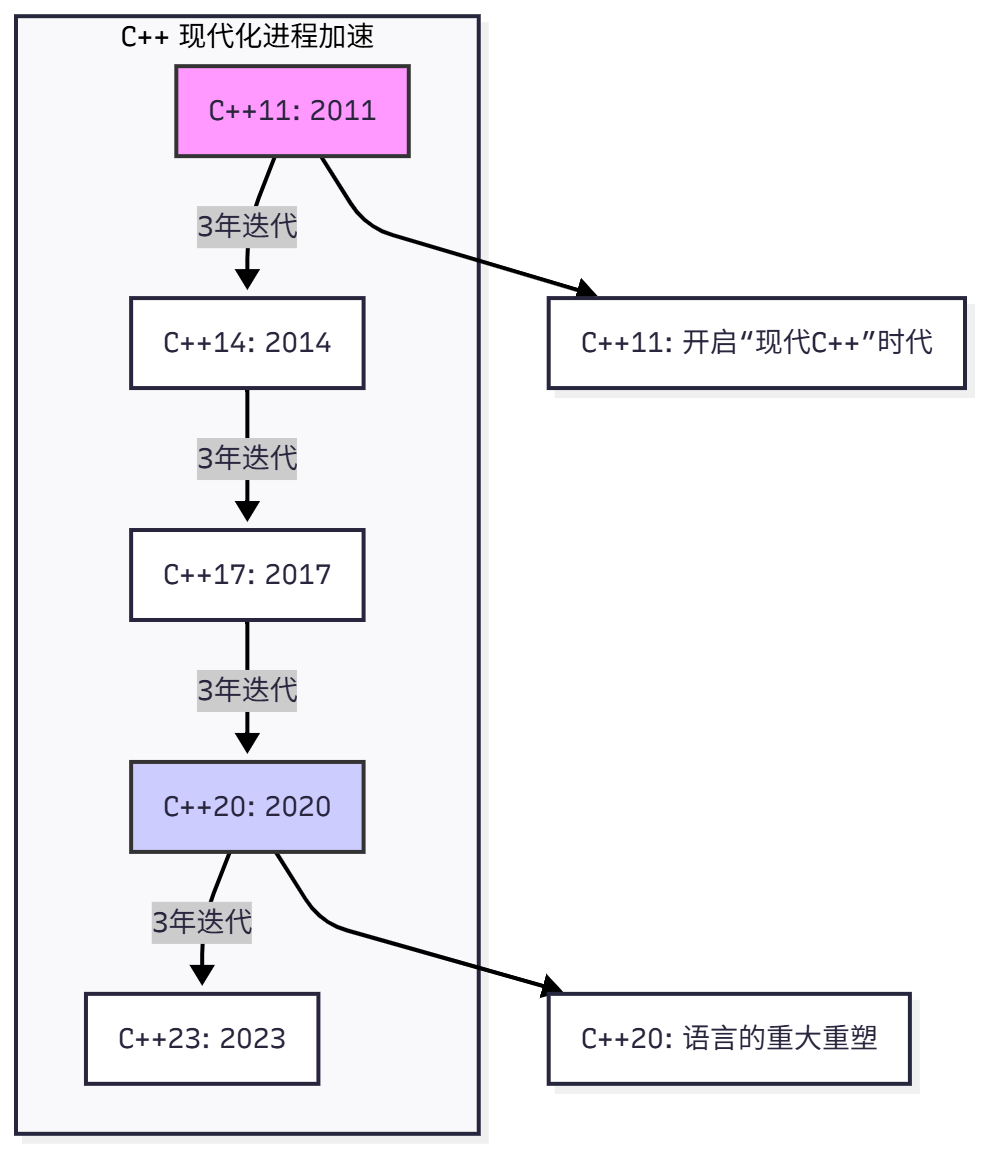
- Acceleration of the Standardization Process: From C++11, C++14, C++17 to C++20, the iterative process every three years rapidly elevated the language to the highest level of modern programming.
- Improvement of Safety: The introduction of smart pointers, lambda expressions, and range-based for loops lowered the threshold and risk of C++ programming.
- Support for Concurrency: Defining a language-level memory model and providing standard concurrency tools allowed C++ to fully utilize multi-core processors.
2. The Crisis Facing C++ in 2006
Around 2006, the C++ language was at a low point in its development. It faced not only fierce competition from external programming languages but also had to adapt to fundamental changes in hardware architecture. This dual pressure forced C++ to address its survival crisis.
Java and C# represented managed languages that dominated enterprise application development. By providing automatic garbage collection (GC), built-in exception handling, and extensive framework support, they addressed common issues in C++ such as memory leaks and dangling pointers. Many commercial applications prioritized development speed and reliability over extreme runtime performance, leading to C++ rapidly losing ground in this area.
Python and JavaScript dynamic scripting languages quickly became the preferred choice for data processing, scientific computing, and web front-end/back-end due to their simple syntax and rapid iteration capabilities. The ease of use and rich third-party libraries of these languages attracted a large number of non-professional programmers and rapid prototyping needs, pushing C++ to a lower level.
Although not fully formed in 2006, the focus on C++’s inherent flaws gave rise to later competitors. The Go language improved compilation speed and ease of concurrent programming, while Rust directly aimed to solve C++’s memory safety issues. The market had a strong demand for system languages that could achieve both “high performance” and “high safety,” which C++ at the time clearly could not fully meet.
If language competition was external pressure, then the dramatic changes in hardware architecture represented an internal crisis that C++ had to face. C++ is highly dependent on hardware efficiency, and when the hardware model changes, C++ must adjust accordingly.
Around 2005, the driving force of Moore’s Law shifted from increasing single-core clock frequency to increasing the number of processor cores. Single-threaded C++ programs could no longer automatically gain performance improvements by waiting for the next generation of processors. Software development was forced to shift towards concurrent programming and parallel computing to fully utilize multi-core resources. The then-current C++ standard (C++03) provided almost no support for this, and developers had to rely on non-standard, non-portable operating system APIs to manage threads and synchronization.
Graphics processing units (GPUs) and other specialized accelerators began to be used for general-purpose computing (GPGPU). This heterogeneous computing environment required programming languages to efficiently manage data transfer and task scheduling between different memory spaces and computing units. C++ lacked a unified, standardized heterogeneous programming model, making it exceptionally complex to use these new hardware.
The standardization process of C++ itself entered a long stagnation after the release of C++03 in 2003, further exacerbating the crisis.
Compared to languages like Java and Python, C++ lacked many convenient features required for modern programming, such as:
- No native concurrency support: Writing multi-threaded programs was both difficult and error-prone.
- Redundant and complex syntax: Lacked mechanisms like the
<span>auto</span>keyword and lambda expressions to simplify code. - Manual resource management: Must rely on raw pointers and manual calls to
<span>delete</span><span>, which is a major source of memory unsafety.</span>
C++’s generic programming (templates) is powerful but has a poor user experience. Template error messages are obscure and difficult to understand, and the lack of constraints on template parameters has made template metaprogramming a domain for a few experts. This high barrier has made it difficult for C++ to effectively utilize generics to improve code abstraction and safety.
In 2006, C++ stood at a crossroads: if it continued to remain stagnant, it would soon be eliminated by the times; only through thorough self-renewal could it find its position again. This crisis ultimately led to the most radical modernization process in C++ history.
3. Modernization and “Zero-Cost Abstraction”
Faced with external competitive pressure and internal hardware changes, the revival of the C++ language was not about imitating competitors by introducing garbage collection (GC), but rather achieving it through two strategic routes:
- One is to completely change the standardization model to achieve rapid, iterative modernization;
- The other is to steadfastly adhere to the principle of “zero-cost abstraction.”
The C++ Standards Committee (ISO C++ Committee) deeply recognized the dangers of the long stagnation after C++03. To quickly respond to industry needs and keep pace with technological developments, the committee adopted a revolutionary standardization strategy:
(1) The committee abandoned the long and uncertain standardization cycles of the past and adopted a fixed, predictable release cycle, which is to release a new standard every three years (C++11, C++14, C++17, C++20, C++23). The advantages of this model are:
- Rapid iteration: Ensures that new, industry-validated features can enter the standard in a timely manner, preventing language features from falling behind the times again.
- Risk reduction: If a feature fails to make it into the current standard, it will enter the next standard cycle instead of being indefinitely shelved, ensuring continuous progress in standardization.
(2) The new standardization strategy places greater emphasis on incorporating widely used features that can solve practical problems into the standard library and the language itself.
The revival of the C++ language will not sacrifice its commitment to performance. Unlike languages like Java that achieve abstraction through runtime overhead, C++ is characterized by “zero-cost abstraction.”
Definition: Zero-cost abstraction means that any high-level abstraction mechanism provided by the language should not introduce additional performance loss at runtime. In other words, code written with high-level abstractions must be as efficient as or close to manually optimized, low-level C-style code.
Significance: This principle is fundamental to C++’s irreplaceable position in system programming and high-performance computing. It allows developers to enjoy the convenience of modern language abstractions without worrying about performance loss.
C++ achieves zero-cost abstraction primarily through powerful compile-time capabilities:
- Template metaprogramming: Complex logic and type checks are completed at compile time, leaving only efficient machine code at runtime.
- Inlining and link-time optimization: The compiler completely eliminates the overhead of function calls and abstraction layers.
<span>constexpr</span>mechanism expansion: More computations are done at compile time, completely eliminating runtime overhead.
A <span>std::unique_ptr</span><span> has almost no overhead at runtime because it is merely a lightweight object that wraps a raw pointer, with its ownership transfer and destruction logic optimized very efficiently at compile time.</span>
By adopting rapid iterative standardization and adhering to the zero-cost abstraction principle, C++ has reshaped itself:
- Improvements in safety no longer come at the cost of performance. Tools like smart pointers provide the convenience of GC without the runtime pause overhead of GC.
- Enhancements in expressiveness no longer come at the cost of low-level control. Improvements in lambda expressions and generic programming make C++ code more concise while allowing fine control at the memory and hardware levels.
4. Technical Revival
The revival of C++ began with the release of the C++11 standard in 2011, marking the most profound transformation in C++ history. The subsequent C++14 and C++17 standards continued to optimize based on this foundation, collectively forming the first phase of C++ modernization:Addressing historical pain points and enhancing code safety, simplicity, and readability.
One of the biggest pain points in C++ history is the high risk associated with manual memory management. C++11 strengthened the RAII (Resource Acquisition Is Initialization) mechanism, achieving safe memory management without garbage collection.
This is also one of the most important safety features of C++11, automating resource management and reducing the risk of memory leaks and dangling pointers while maintaining the principle of zero-cost:
<span>std::unique_ptr</span>: Implements exclusive ownership semantics. When a<span>unique_ptr</span><span> goes out of scope, the resource it points to is automatically released. Since ownership is exclusive, there is almost no overhead at runtime.</span><span>std::shared_ptr</span>: Implements shared ownership semantics, managing the resource’s lifecycle with reference counting.<span>std::weak_ptr</span>: Used in conjunction with<span>shared_ptr</span><span> to solve the problem of circular references.</span>
By promoting the use of smart pointers, developers can write code that has C++ performance while achieving safety close to that of managed languages.
The introduction of rvalue references and move semantics in C++11 fundamentally changed how C++ handles temporary objects.
- Problem Solved: Traditional C++ had expensive deep copy operations when passing or returning large objects.
- Implementation Mechanism: Move semantics allows resources to be “stolen” from one object to another without incurring expensive copies, improving the efficiency of container operations and returning large objects from functions.
To lower the learning curve and complexity of writing C++, C++11 introduced a large number of syntactic sugars and type deduction mechanisms, making the code more concise and modern.
<span>auto</span>keyword (C++11): The compiler automatically deduces the variable type based on the initialization expression.Advantage: Avoids lengthy and complex type declarations (especially when using templates and iterators), improving code readability while ensuring type safety.- Range-based for loops (C++11): A more concise and safer way to iterate over containers or arrays, avoiding common “out-of-bounds” or “iterator invalidation” errors in traditional iterator loops.
- Uniform initialization (C++11): Using curly braces
<span>{}</span>for initialization, unifying the initialization syntax for variables, arrays, structures, and classes, avoiding ambiguities caused by C++’s complex initialization rules.
C++11 also introduced powerful functional programming features, making algorithm expression more flexible and efficient.
- Lambda expressions (C++11): Directly define anonymous function objects, greatly enhancing the flexibility of standard library algorithms.Advantage: Code becomes more localized, reducing the overhead of defining one-time-use function objects, making it an indispensable tool in modern C++ programming.
<span>std::function</span>and<span>std::bind</span>(C++11): Store, pass, and call any callable object (function pointers, function objects, lambda expressions) in a unified way, enhancing C++’s capabilities in callbacks and strategy patterns.
Expansion of compile-time computation capabilities (C++11/14/17):
<span>constexpr</span>keyword enhancement. C++11 allows simple functions and constructors to execute at compile time.C++14 began to relax the restrictions on<span>constexpr</span><span>, allowing loops, conditional statements, and local variables in </span><code><span>constexpr</span><span> functions, enabling more complex logic to be completed at compile time.</span>- Structured bindings (C++17): Directly unpack members of composite types into independent variables. Simplifies code for returning multiple values from functions or iterating over
<span>std::map</span><span>.</span>
By the end of 2017, C++ had completely shed its “outdated” image, becoming a modern language that provides both extreme performance and high levels of abstraction and safety.
5. Technical Revival: Concurrency and Generic Programming
If the features of C++11/14/17 mainly improved code expressiveness and safety, then another significant achievement of C++ from 2011 to 2020 was the incorporation of concurrent programming into the standard, fundamentally revolutionizing the user experience of generic programming (templates).
5.1. Concurrency Programming in C++11/17
Before C++11, concurrent programming relied entirely on platform-specific libraries, making code non-portable and prone to errors. C++11 provided a standardized concurrency library to support programming in the multi-core era.
The language-level memory model is the cornerstone of C++11 concurrent programming. Before C++11, compilers and hardware could reorder instructions arbitrarily, leading to unpredictable behavior in multi-threaded environments.
C++11 defined the memory model at the language standard level for the first time, clarifying how threads observe the order of memory operations. This allows for writing concurrent code that behaves consistently and predictably across different hardware architectures.
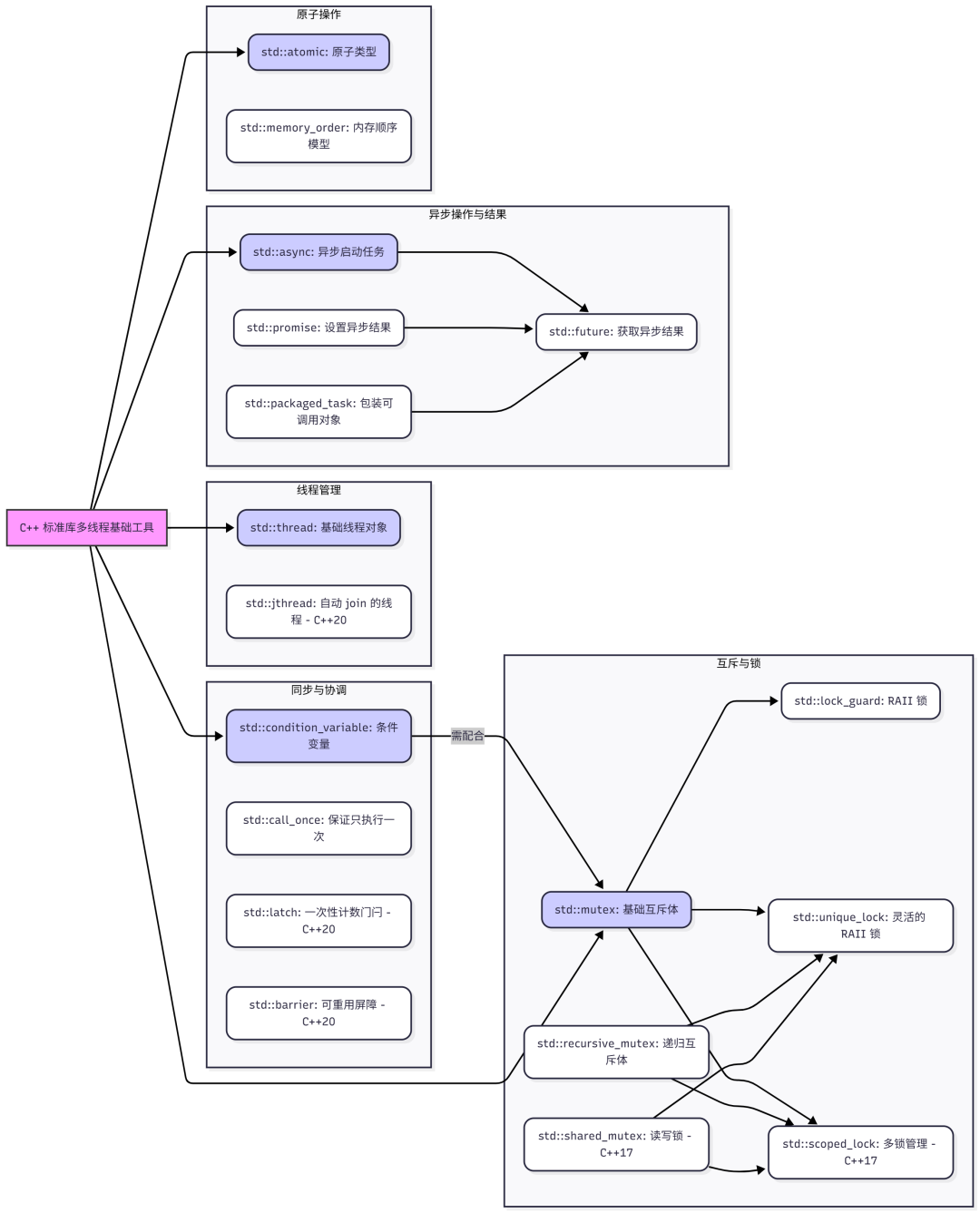
The standard library also provides the basic tools needed to write multi-threaded programs, abstracting thread management from operating system APIs:
- Thread Management:
<span>std::thread</span><span> creates and manages threads, </span><code><span>std::mutex</span><span> serves as a mutex, and </span><code><span>std::lock_guard</span>and<span>std::unique_lock</span>safely manage the lifecycle of locks (following the RAII principle). - Atomic Operations:
<span>std::atomic</span><span> provides lock-free atomic operations, suitable for high-performance, fine-grained concurrent control, avoiding performance bottlenecks associated with traditional locking mechanisms.</span>
C++11 introduced higher-level abstractions to handle asynchronous tasks, avoiding direct management of low-level threads:
<span>std::future</span>and<span>std::promise</span>: Start a task in one thread and wait for the result in another thread, achieving efficient asynchronous communication.<span>std::async</span>: Simplifies the process of starting asynchronous tasks, automatically choosing whether to execute synchronously or in a separate thread.
With the increase in the number of hardware cores, C++17 further introduced parallelization into the standard library, making it easy to perform data-parallel computations on multi-core processors.
C++17 applies execution policies to standard library algorithms. By specifying <span>std::execution::par</span><span> (parallel) or </span><code><span>std::execution::par_unseq</span><span> (parallel and unordered), the compiler and runtime library are instructed to automatically decompose algorithms and execute them across multiple cores.</span><strong><span>Advantage:</span></strong><span> Achieve large-scale data parallel processing with very low cost and minimal code modifications, without manually writing thread management code.</span>
5.2. Generic Programming in C++20
C++ templates (generic programming) are the core implementation mechanism of zero-cost abstraction, but their complexity has always been one of C++’s biggest pain points. C++20 introduced Concepts, which completely resolves this issue.
Before C++20, the constraints of templates were implicit. If template parameters did not meet the requirements, the compiler would produce lengthy and obscure error messages (known as “template error waterfalls”).
Concepts allow for explicitly defining the semantic and syntactic requirements that template parameters must meet.
- Now, constraints can be specified using the
<span>requires</span>keyword or directly in the template signature, making the intent of the template code clear at a glance. - If the provided type does not meet the requirements of the Concept, the compiler will give clear and concise error messages before instantiating the template, rather than producing difficult-to-understand errors deep in the implementation.
- Explicit constraints help the compiler perform type checking and overload resolution more quickly.
The introduction of Concepts has made C++ generic programming safer and easier to use, significantly lowering the barrier to using C++ templates, making it one of the most revolutionary features of C++20.
Through breakthroughs in concurrency and generic programming, C++ proves that it can not only provide extreme performance but also meet the computing challenges of the 21st century in a modern and safe manner.
6. C++’s Unique Ecological Niche
The revival of C++ from 2006 to 2020 has freed it from the fate of marginalization. C++ did not seek to compete with Python or Java in all areas but instead consolidated and strengthened its unique ecological niche where extreme performance, low-level control, and zero-cost abstraction are required.
In performance-centric fields: C++ remains the first choice. Microsecond-level latency or slight improvements in memory efficiency can bring significant commercial or technical value. In these areas, C++ maintains absolute dominance due to its direct control over hardware and zero-cost abstraction.
- In high-frequency trading (HFT) systems, latency is a key factor in profitability. C++ precisely controls memory allocation and network I/O, avoiding unpredictable pauses caused by garbage collection (GC), ensuring the lowest trading latency.
- Almost all mainstream AAA game engines are built with C++. Games need to manage a large amount of memory and resources in real-time. C++ allows for fine memory layout and custom memory allocators, optimizing cache hit rates and loading speeds. Rendering loops, physics engines, and AI logic must be completed within milliseconds, and C++’s zero-cost abstraction is the only way to achieve this.
- In scientific computing and high-performance computing (HPC), C++ remains the primary programming language on high-performance computing clusters due to its good interoperability with languages like Fortran and strong support for parallel computing. C++17’s parallel algorithms further simplify development in these fields.
C++ also plays an irreplaceable role as the underlying support of the modern software ecosystem, acting as the “glue” that connects high-level languages and low-level hardware.
(1) C++ remains the implementation language for operating system kernels, device drivers, and all mainstream compilers and virtual machines (VMs).
- LLVM and GCC: Modern compiler infrastructures are themselves written in C++, driving the development of the C++ language itself.
- Virtual Machines: Core runtime components like Google’s V8 engine (JavaScript) and the Java Virtual Machine (JVM) rely heavily on C++ to implement their high-performance underlying logic.
(2) Many popular high-level language libraries outsource their compute-intensive parts to C++ to solve their performance bottlenecks.
- Artificial Intelligence and Data Science: Renowned machine learning frameworks, such as Google’s TensorFlow and Facebook’s PyTorch, have their core computation graphs and tensor operations written in C++.
- Python Scientific Computing: Libraries like NumPy and Pandas provide high-performance array operations through C++ or C extensions, enabling Python to handle large-scale data.
Higher-level languages enjoy development efficiency while delegating the most performance-critical tasks to C++, achieving a “win-win” in the ecosystem.
Globally, trillions of lines of high-quality C++ code constitute a massive existing investment. The C++ Standards Committee has been committed to maintaining backward compatibility, ensuring that these codebases can smoothly transition to new standards while gradually adopting modern features. This compatibility is a significant reason many enterprises choose to continue using C++ rather than switching to entirely new languages.
C++ boasts the most mature and powerful toolchain on the market, including:
- Compilers: GCC, Clang, and MSVC have highly optimized performance.
- Debuggers and Analysis Tools: GDB, Valgrind, Sanitizers, etc., provide unparalleled low-level debugging and performance analysis capabilities.
The revival of C++ is not coincidental; it is a process of maintaining absolute performance advantages in key areas while addressing usability issues through modernization efforts. It occupies an irreplaceable “performance cornerstone” position in the software stack, ensuring that it remains a core language in critical infrastructure fields for decades to come.
7. Conclusion
The journey of C++ from 2006 to 2020 is one of self-renewal and adherence to core values. It refutes those who predict the decline of C++, proving that a language with a solid foundation can achieve sustained prosperity through active modernization in a crowded and ever-changing world.
The ability of C++ to achieve revival and consolidate its position is primarily attributed to three factors:
- Zero-cost abstraction prioritizes performance above all else. C++ ensures that all modern features introduced do not come at the expense of runtime efficiency.
- Backward compatibility. The C++ Standards Committee has explicitly stated its commitment to maintaining backward compatibility. Trillions of lines of existing C++ code can coexist smoothly with new standards.
- Rapid iteration every three years ensures that the language can timely absorb excellent features validated by industry and academia.
Through a series of transformations from C++11 to C++20, C++ has completed its transition from a “traditional” language to a modern, high-performance system programming language.
By integrating modern programming paradigms into its core while retaining direct control over low-level hardware, C++ is no longer a language filled with pitfalls that can only be used by experts.
The evolution of C++ will not stop. After C++20, the Standards Committee continues to address deeper challenges to ensure C++ remains competitive in future computing environments:
- Modularization (Modules): The module system introduced in C++20 aims to ultimately solve the long-standing issues of C++’s reliance on header files, which lead to long compilation times and macro pollution.
- Coroutines: The coroutines introduced in C++20 provide more robust language-level support for asynchronous programming, simplifying the development of high-concurrency network services and I/O-intensive applications.
- Support for Networking and File Systems: The standard library continues to expand, providing more comprehensive tools for network programming and file system operations, reducing reliance on third-party libraries.
Looking back at past tutorials
Recommended 6 C++ open-source projects suitable for practice, so you won’t just be talking about theory!
C++
STL Algorithms: Master these, and your code efficiency will improve tenfold!
Building
Using Google Test for C++ Unit Testing
Applications
Thoroughly understand asynchronous and multithreading: concepts, principles, and application scenario comparisons
 Lion RyanWelcome to follow my public account for learning technology or submissions