
In the era of artificial intelligence, open source has become an important development direction.Author|Bai ShiEditor|Jing Yu
In the era of artificial intelligence, open source has become an important development direction.
Meta’s Llama has opened the curtain on open-source models challenging closed-source models, forcing companies like OpenAI and Anthropic to continuously release updated and improved AI models.
China’s Qwen and DeepSeek have taken up the baton, allowing open-source models to flourish, with their AI models achieving download numbers in the tens of millions within the open-source community.
For users and developers, open-source models and tools alleviate concerns over the expensive token costs of closed-source models, enabling rapid development and iteration of their projects.
For the open-source community, developers within the ecosystem can help refine projects and continuously drive innovation, fostering the growth of derivative ecosystems based on these projects.
As AI gradually enters the real world, new AI-native hardware devices present new demands for operating systems that connect underlying hardware with top-level applications.
Recently, a domestic company has opened its self-developed operating system kernel aimed at the AI era to the world.

The company taking this crucial step is Vivo. This open-source initiative is the result of an eight-year technological marathon.
In 2018, with the surge of AI, Vivo officially initiated the development of its self-developed operating system—Blue River Operating System (BlueOS); in 2023, Vivo officially released the Blue River Operating System, which is based on a framework written in Rust and was first deployed in smart watch products; in 2024, it further evolved into a full-stack operating system written entirely in Rust from the kernel to the system framework.
In this fully self-developed operating system, the most core and fundamental part is its kernel, which is also the key to determining the entire system’s security, performance, and stability.
The Blue River Operating System kernel was officially released in 2024 and will be open-sourced to the industry in July 2025; it will be donated to the OpenAtom Open Source Foundation in November 2025, officially named “BlueKernel” as an open-source incubation project, adopting a new open-source operation and governance model for the industry.
It is evident that Vivo has always been at the forefront of the industry in terms of Rust language technology research, product implementation, and open-source practices, making it a pioneer in Rust. So, what value does Vivo’s open-sourced operating system kernel bring? What boosts will the open-sourcing of the system kernel provide to the industry?
01
Why Do We Need a Rust Kernel?
The distance an operating system can travel is closely related to the language it uses.
AI-native hardware devices like AI glasses and robots differ from ordinary smart devices primarily in their built-in AI capabilities, which are typically driven by large models and AI agents. Running AI models and AI agents on edge devices imposes stricter demands on the operating system’s security, lightweight nature, and versatility.
The Blue River Operating System is Vivo’s self-developed operating system designed for the AGI era, written entirely in Rust from the kernel to the system framework. Its excellent features in security, AI capabilities, and smooth operation can effectively meet the requirements of AI-native hardware devices for operating systems.
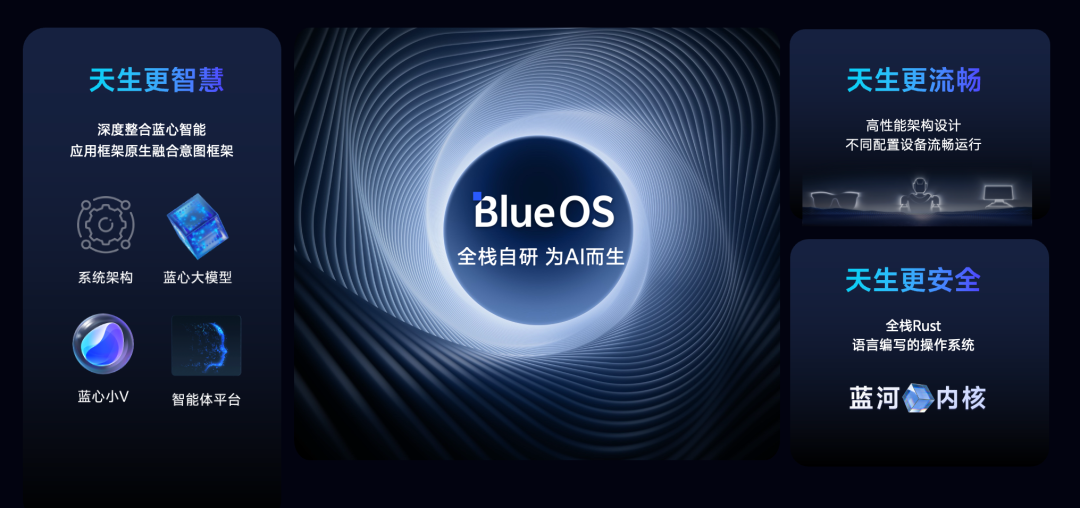
In terms of security, the Blue River Operating System uses Rust throughout, ensuring memory safety from the ground up. In terms of AI capabilities, the system architecture of the Blue River Operating System deeply integrates the Blue Heart large model, and the agent framework possesses capabilities such as cross-scenario perception and autonomous decision-making. Regarding smooth operation, the Blue River Operating System has built a series of high-performance technologies that efficiently utilize software and hardware resources.
The core features of the Blue River Operating System are underpinned by a powerful “heart”—the kernel. BlueKernel is Vivo’s self-developed operating system kernel written in Rust, characterized by security, lightweight nature, and versatility.
In terms of security, approximately 70% of serious security vulnerabilities in operating systems primarily based on C/C++ are related to memory safety issues. In recent years, numerous incidents related to memory safety have emerged in the industry. For instance, in September 2025, the Ministry of Industry and Information Technology’s Network Security Threat and Vulnerability Information Sharing Platform (NVDB) reported high-risk vulnerabilities in Apple’s operating systems (including Mac OS and iOS) related to memory safety.
Especially for AI applications, particularly edge AI, which need to process and analyze vast amounts of extremely sensitive personal data, such as user conversation recordings, facial images, and health metrics, the deficiencies in memory safety of traditional operating systems can lead to catastrophic privacy breaches.
Compared to C/C++, Rust represents a qualitative leap in memory safety. Its core idea is to strictly check common memory risks at compile time, preventing many errors that could lead to hidden dangers from passing compilation. Errors that developers must consciously avoid in C/C++ are mostly caught directly by the compiler in Rust during code writing.
Its superior security performance has been validated by mainstream operating system projects. For example, after adopting Rust at the lower levels of the Android system, memory safety vulnerabilities dropped below 20% of total vulnerabilities for the first time compared to the C/C++ era.
In terms of lightweight nature, AI-native hardware devices are often subject to strict resource constraints, including limited memory, flash storage, and battery capacity. Therefore, their operating systems must be extremely lightweight, with the kernel and core services occupying as little system resources as possible to allow AI models and algorithms to run more efficiently.
Moreover, the forms of AI-native hardware devices are currently quite diverse, and they may use AI chips with different chip architectures, which imposes high demands on the versatility of the operating system. The BlueKernel, written in Rust, is continuously enhancing its compatibility with CPU architectures and drivers, significantly reducing the hardware resource requirements compared to traditional operating system kernels, enabling it to meet the needs of various terminal products at a lower cost.
Essentially, Rust provides a robust universal foundation for long-term iteration across multiple hardware platforms, bridging the gap from low-level systems to upper-level services.
With a better language, we can have a better operating system kernel.
02
BlueKernel: The Cornerstone of AIOS
The Blue River Operating System itself is a smart operating system designed for AI-native hardware devices like smart glasses and robots, so its kernel—BlueKernel—has been natively designed to address the pain points of AI hardware devices, such as “high security, low resources, and multiple forms,” embodying the three core characteristics of security, lightweight nature, and versatility, transforming the potential of the language into system-level core competitiveness.
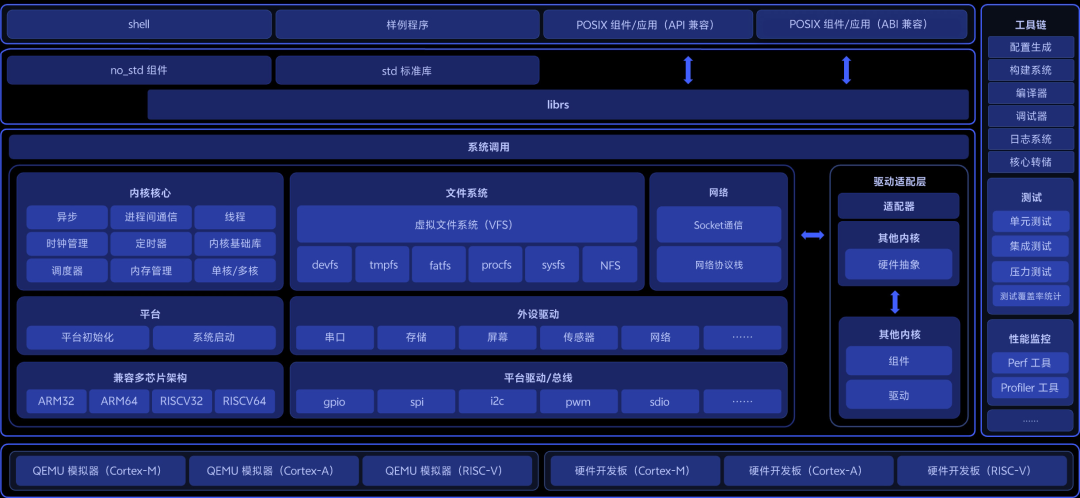
BlueKernel Technical Architecture Diagram
As an open-source Rust kernel suitable for AI-native hardware devices, BlueKernel’s competitiveness is first reflected in the unity of security and efficiency.
In terms of memory safety, BlueKernel employs a compile-time ownership system, evolving memory safety from passive defense to active control, allowing developers to spend less development resources on memory safety issues, thereby accelerating the consumer-level adoption of AI-native hardware devices and promoting the prosperity of the entire industry.
Additionally, thanks to its design of high-performance, low-overhead basic data structures, BlueKernel has low hardware resource requirements, with a minimum kernel memory footprint of only 13KB, freeing up valuable computational resources for “resource-hungry” entities like AI models and algorithms, enabling extremely lightweight AI-native hardware devices, such as smart glasses (typically weighing only a few dozen grams) and smart bands, to provide sufficient AI capabilities using limited computing power.
In terms of versatility and hardware compatibility, BlueKernel is compatible with various chip architectures, including RISC-V and ARM, and supports standard libraries compatible with POSIX interfaces. For developers, this means that the programs they write can be more easily ported across various types of hardware device platforms.
To ensure system scalability, BlueKernel enhances its compatibility with CPU architectures and drivers through a series of methods, including hardware abstraction, supporting Rust language development drivers, and also supporting existing C language kernel peripheral drivers. Therefore, developers and vendors within the ecosystem can continue to use existing C language drivers or write new drivers for new hardware using Rust, lowering the entry barriers for the entire industry.
From memory safety protection and ultra-low resource consumption to flexible adaptation to multiple chip architectures and device forms, BlueKernel addresses the demands for high security and low resources of AI-native hardware devices at the system kernel level by leveraging the excellent features of the Rust language. This balance of efficiency and versatility makes it a new cornerstone for operating systems in the AI era.
As a pioneer in Rust, Vivo also takes on the responsibility of open-sourcing BlueKernel, collaboratively building an increasingly prosperous AI ecosystem with the industry.
03
Opportunities and Future of the BlueKernel Ecosystem
In overseas markets, open-source operating systems have already gained significant influence; for example, Linux is not only the underlying operating system for most servers but also the cornerstone of the global internet; the Android operating system, which led the mobile internet era, is also based on the Linux kernel.
In the Chinese market, with increasing investments and innovations from more enterprises, universities, research institutions, and developers in recent years, open source has also shown a prosperous development trend. Therefore, Vivo’s decision to open-source its Rust language self-developed operating system kernel, BlueKernel, and donate it to the OpenAtom Open Source Foundation is both sincere and far-reaching in significance.
Vivo is open-sourcing the operating system kernel, which is the “heart” of the operating system, allowing underlying hardware manufacturers, professional system developers, and the open-source community to innovate based on BlueKernel, not just Vivo alone.
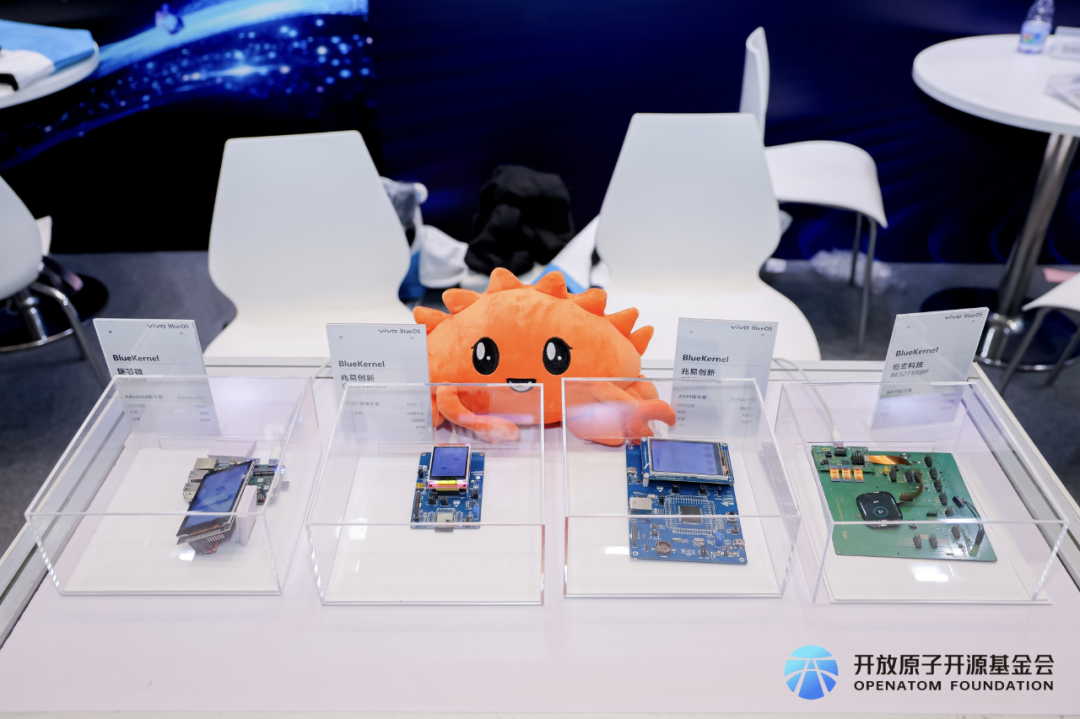
Vivo adopts a pragmatic attitude in building the ecosystem. Currently, Microsoft and Linux remain the mainstream operating systems, leaving behind a vast amount of C language driver code (nearly 20 million lines). Therefore, BlueKernel adopts a flexible “gradual” migration strategy: it supports developers in writing native drivers using the advanced Rust language while also being compatible with existing C language drivers, significantly lowering the adaptation threshold for hardware manufacturers and the learning costs for developers.
Based on its security, versatility, and lightweight characteristics, along with a pragmatic ecological strategy, BlueKernel provides immense imaginative space for the burgeoning market of AI-native hardware devices.
Vivo’s contributions extend beyond just the open-source operating system kernel; it is also collaborating with the OpenAtom Open Source Foundation to systematically promote the Rust language through initiatives like the “Blue River Operating System Innovation Competition.” Currently, the third “Blue River Operating System Innovation Competition” is underway, with a prize pool of 700,000 yuan, focusing on tackling industry challenges in the Rust ecosystem through the C2Rust project-level translation tool competition. Vivo will continue to develop the Blue River Innovation Competition into the most valuable and influential Rust competition in the industry.
From open-sourcing and donating the operating system kernel to hosting the “Innovation Competition,” Vivo continuously contributes to the industry, driving the prosperity and development of the entire sector. The open-sourced operating system kernel BlueKernel provides a powerful, secure, and versatile “heart” for AI glasses, robots, and other AI-native hardware.
*Header image source: VivoThis article is an original piece by Geek Park; for reprints, please contact Geek Jun via WeChat geekparkGOGeek QuestionWhat do you think about Vivo’s decision to open-source and donate its self-developed operating system kernel? 


Hot Videos
Fu Sheng: Innovation in new industries is an opportunity for small companiesLike and FollowGeek Park Video Account,to watch more exciting videos