

How Arm’s Chip Technology is Revolutionizing AI Experience in Mobile Phones with a 5x Performance SurgeAuthor | YunpengEditor | Mo YingToday, AI is having a tremendous impact and transformation on the entire mobile phone industry, reconstructing everything from the underlying chips to the operating systems and the upper application ecosystem.Increasingly complex models and more powerful AI agents are posing new challenges in terms of computing efficiency, latency, power consumption, and memory bandwidth.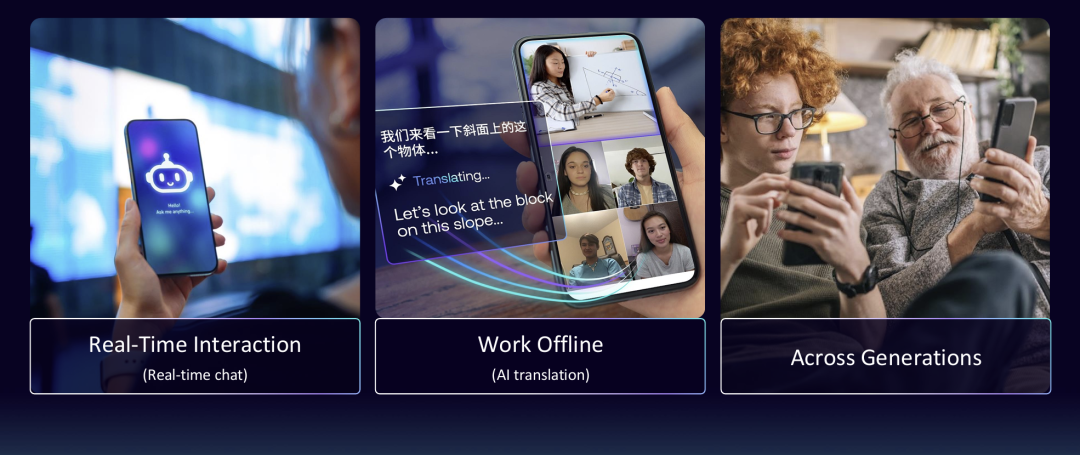 From Apple to Samsung, MediaTek, and Xiaomi,mobile chip players are accelerating the integration of AI capabilities at the chip level,with Apple recently launching the A19 chip, which directly incorporates a neural network accelerator into each core of the GPU.Innovations in chip technology are the core support for accelerating edge AI deployment and enhancing AI mobile experiences.In this industry trend, Arm, a core player in the chip technology field, has once again thrown a heavyweight AI bombshell into the industry.Recently, Arm officially unveiled its flagshipArm Lumex Computing Subsystem (CSS) platform,marking an important renaming and upgrade of the Arm CSS platform.
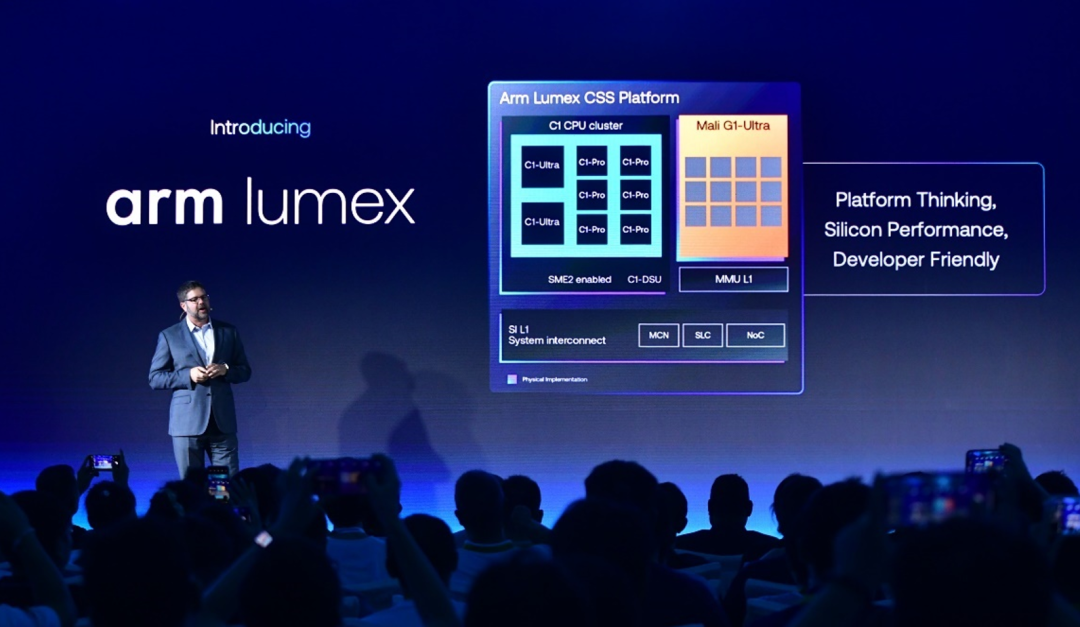 Arm Lumex includes new CPU, GPU, DSU, and other modules, significantly improving performance and energy efficiency while groundbreakingly introducing the second-generation Scalable Matrix Extension (SME2) technology into the CPU, which is the first time this technology has been implemented in Android mobile chips. According to my understanding, the CPU used in Apple’s chips still employs the first-generation SME technology.Arm emphasizes thatthis is a complete “AI-first” platform.Today, AI is becoming the core direction for the entire industry, and in this new era, Arm’s computing platform is becoming an indispensable foundation for the development of AI and personal computing. What key thoughts lie behind this significant technological upgrade from Arm, and what value and significance does it hold for the industry and consumers? We will explore this together.01.Equipping CPUs with “AI Accelerators”Collaborating with Alipay, vivo, and other companiesto enhance edge AI from “usable” to “user-friendly”After nearly two years of iteration, the AI mobile phone has reached a consensus in the industry regarding its development direction and types of AI functions.Today, the focus for all companies is undoubtedly on optimizing the edge AI experience.Under the hybrid AI model that combines edge and cloud, how to efficiently deploy models on mobile phones and achieve a better AI application experience has become a challenge that the industry must solve together.Throughout Arm’s entire press conference,AI was the core theme around which Arm’s technological iteration revolved,as Chris Bergey, Arm’s Senior Vice President and General Manager of the Client Line of Business, stated, the new Arm Lumex is an “AI-first” platform.To achieve AI-first, Arm’s most critical improvement this time isthe introduction of SME2 technology into the CPU.Behind the impressive figures of a 5x performance increase and a 3x energy efficiency improvement, Arm is essentially equippingthe CPU, the most core and versatile module in mobile phones, with a new matrix accelerator, making various complex calculations in the AI era faster and more energy-efficient,thus allowing us to achieve a better AI experience on smartphones.
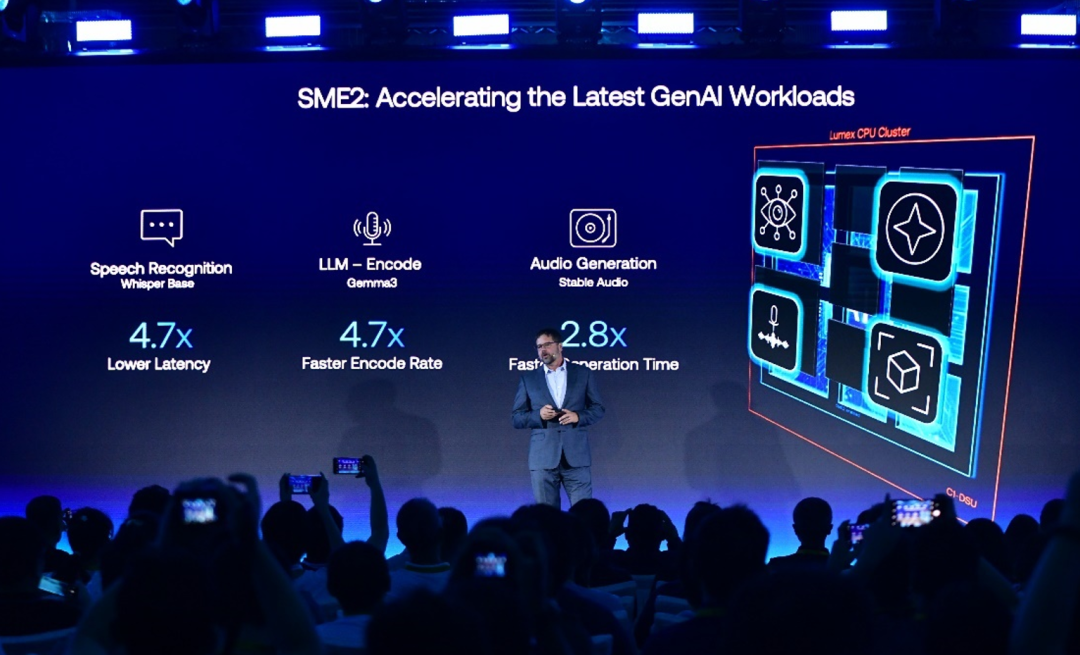 Currently, the SME2 technology has already been supported and adopted by leading companies in the tech field such as Alibaba, Alipay, Samsung System LSI, Tencent, and vivo. Based on SME2 technology, Arm has collaborated deeply with these partners to achieve intuitive upgrades in many AI applications.Overall, the most prominent feature of this AI experience upgrade is that it has made AI functionsprogress from “usable” to “user-friendly and easy to use”significantly.How do we define “user-friendly and easy to use”? It means making devices “understand you better” and able to “respond seamlessly”.The innovation and competition in the mobile phone industry is one of the fields closest to user application scenarios. In the past, features like camera enhancements and fast charging optimized specific pain points; now, in the AI era, generative AI applications and the integration of AI with computational photography, communication, performance, and other fields have become the focus,essentially reconstructing the value of various scenarios with AI, transforming from “passive response” to “proactive service”.
 We witnessed a demonstration of an“Intelligent Yoga Coach” at the event, where the AI coach could quickly and smoothly convert text to speech output, reportedly achieving a generation speed improvement of2.4 times, allowing users to receive posture feedback and guidance in real-time during their workouts without worrying about battery life.
▲ Intelligent Yoga Coach
In fact, we are not unfamiliar with AI fitness coach functionalities, but enabling AI to communicate and interact with us as quickly, accurately, and efficiently as a real person remains a goal that the industry continues to strive for, and Arm has undoubtedly brought this vision closer to reality.In the deep collaboration between Arm, Alipay, and vivo, the upgrade of AI mobile phone experiences has brought me more surprises.The Alipay edge AI engine xNN integrates SME2 technology,completing the verification of large language model inference based on Arm SME2 technology on vivo’s flagship smartphone, achieving performance improvements of over40% and 25% in the pre-filling and decoding stages, respectively, with the interaction response time of the large language model shortened by40%. It is said that with the support of SME2, vivo phones have achieved an additional20% performance boost.From the application effect perspective, vivo phones have significantly accelerated performance in various AI computing tasks such as visual, voice, and text, for instance, in real-world scenarios likeglobal offline translation, where the AI response time has noticeably sped up, making the entire translation process smoother and more natural.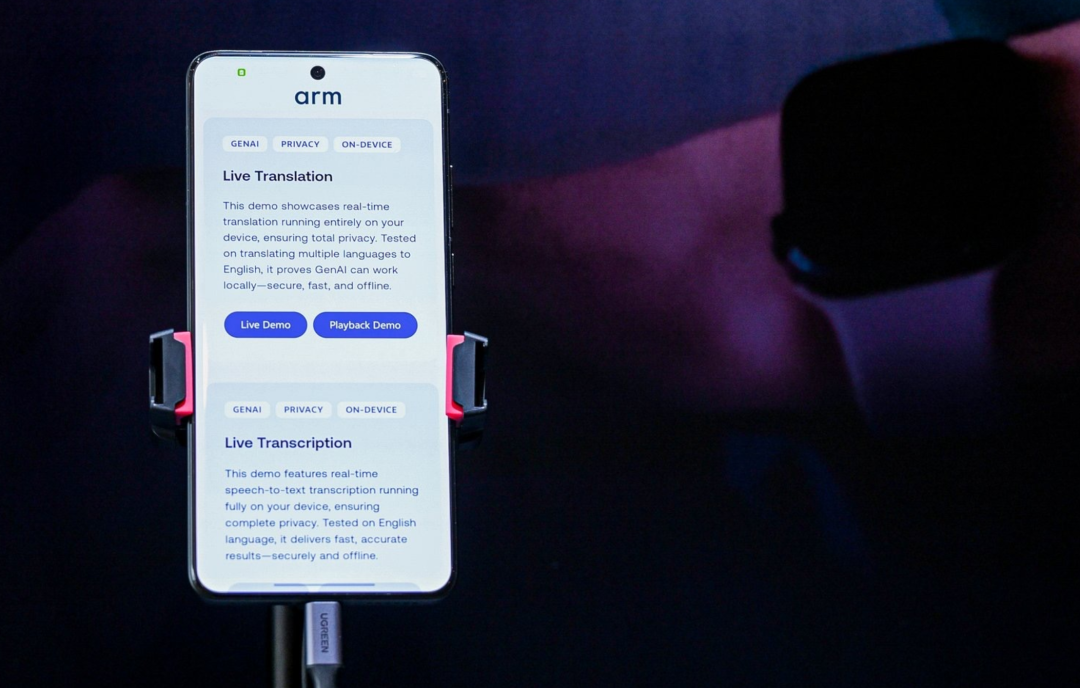
▲ Local Offline Real-time Translation
These exponential improvements signifya major breakthrough in CPU backend capabilities, proving that SME2 can bring faster real-time generative AI experiences to end devices,and various local functions of edge AI have been significantly enhanced.Now, let’s look at computational photography, which users highly value. The SME2 single-core operation of the neural camera noise reduction function can achieve an ultra-high frame rate of 120 frames per second at 1080P resolution, and even at 4K high resolution, it can maintain a frame rate of 30 frames per second. This means that when we use our phones to take pictures, even in dimly lit scenes, we can capture clearer and sharper photos.Overall, the series of upgrades from CPU, GPU to software libraries in the products and technologies released this time show us the value that Arm Lumex brings to manufacturers, developers, and consumers in the AI era.For developers, the comprehensive support from software tools to ecosystem improvements enables them to quicklyintegrate these new technologies with their products and bring AI innovations to market faster.According to Arm’s predictions, by2030, SME and SME2 technologies will add over 10 billion TOPS of computing power to more than 3 billion devices worldwide,with edge AI performance showing exponential growth.02.Decades of Deep Computing, Achieving Double-Digit IPC Improvements AnnuallyLeading the Industry with Technology and EcosystemToday, we see that Arm has achieved a significant enhancement in edge AI performance for mobile devices through foundational technology innovations. This achievement stems from Arm’s strong technical capabilities and its continuous leadership in mobile technology and ecosystem over the decades,always staying ahead at critical junctures of technological and industrial development.From a technological evolution perspective, Arm’s layout for AI has actually been ongoing for over a decade: during the Armv8 architecture era, optimizing the NEON module to enhance AI efficiency; the Armv9 architecture introduced SVE2 and SME to adapt to more AI scenarios; and now in the Armv9.3-A architecture era, integrating SME2 technology to optimize throughput, latency, and accuracy for modern AI workloads.Arm is improving SoC design at the architectural level to prepare for the explosion of AI applications.Today, the massive explosion of smart devices has made computing ubiquitous, from smartphones, PCs, and cars to various AIoT devices, the trend of interconnected intelligence is becoming increasingly evident. At the same time, the industry’s extreme pursuit of energy efficiency, relentless focus on power consumption, optimization for large models, and demand for AI computing power have become challenges that the industry faces together—Arm has finally caught the wind of AI.Returning to the mobile phone industry, if it were only an architectural innovation, it would not be enough to keep pace with the applications of edge AI. The Arm Lumex Computing Subsystem (CSS) platformprovides a new solution,integrating the highest performance Arm CPU, GPU, and system IP equipped with SME2 technology from a systemic perspective, accelerating the deployment and popularization of edge AI.In terms of software tools and ecosystem, KleidiAI has been integrated into all mainstream mobile operating systems and AI frameworks. Developers can achieve the best AI performance on various Arm devices without any additional operations.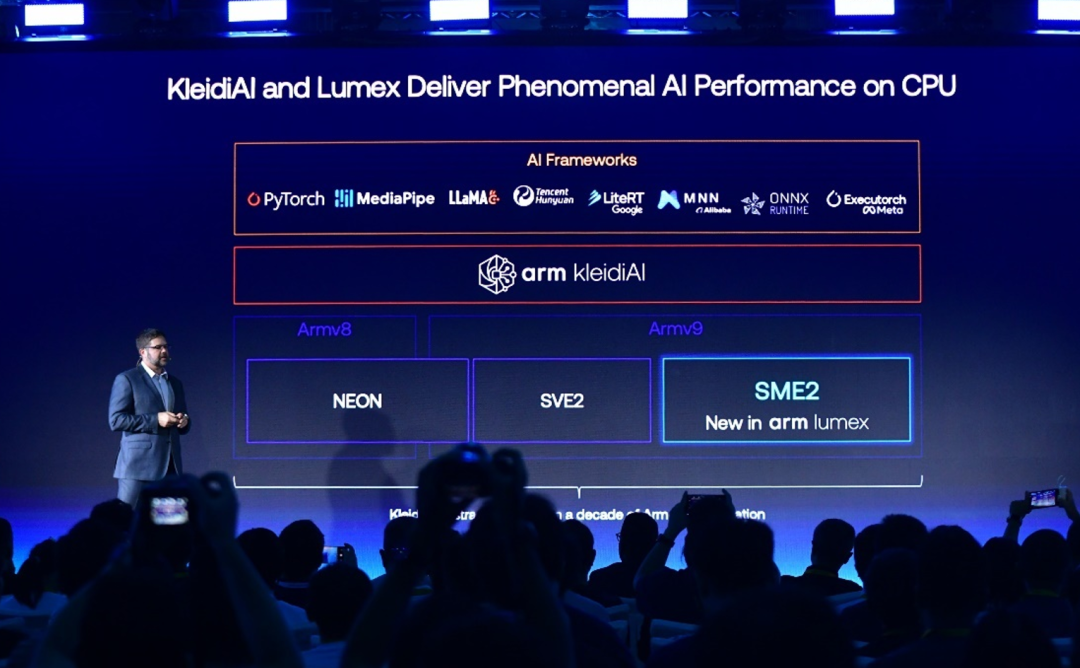 Throughout the development of the mobile phone industry, Arm has always been at the forefront of technological waves. Each version update injects new vitality into the industry,providing industry players with the most solid foundational technology “resource pool”.Arm and its ecosystem’s efforts in establishing a computing foundation enable the industry to seize emerging opportunities at all times.03.From Mobile Phones and PCs to the Entire Ecosystem, the Computing Industry is Undergoing Dramatic ChangesTransforming Models to Build the “Core Foundation”Today, a new wave of AI is rapidly sweeping across the entire technology industry.Major terminal manufacturers are going “All in AI”, upgrading products and services around AI; the iteration of large models has shifted from updates every six months, to monthly, and now to weekly, with competition entering a heated phase; at the foundational chip level, various chip manufacturers are intensively integrating new AI features into their products.From mobile phones, PCs, cars, and the Internet of Things to data centers, from billion-level, hundred billion-level to trillion-level and tens of trillion-level models,AI is rapidly reshaping various industries and fields, while also bringing new challenges and opportunities to the computing industry.
 Arm is clearly one of the companies actively responding to this AI wave. As the technological foundation driving AI applications, whether it is to quickly bring performance value to market or to deeply design configurations, from high-end smartphones and PCs to emerging AI smart devices, Arm always helps manufacturers find the flexible balance “sweet spot” between peak performance, sustained energy efficiency, and chip area.Under the AI wave, foundational technology companies that have long been behind the scenes are gradually stepping into the spotlight, reshaping the industry landscape with core technologies.Arm, fully sprinting towards AI, is prepared in every aspect from technology to ecosystem, from products to services.04.Conclusion: Strengthening the Computational Foundation Technology in the AI EraAccelerating Edge AIToday, from Android to Apple ecosystems, the rapid development of edge AI requires more foundational technology innovations to support it, and there is still significant room for improvement in AI application experiences. The release of Arm Lumex provides the industry with a solid computational platform foundation, equipping manufacturers and developers with more ample ammunition to face the hard battle of AI.In the future, the competition for AI mobile phones will become increasingly fierce, and innovation at the chip level will continue to be a focal area of industry competition. From manufacturers to developers,facing the opportunities and challenges of the AI era, the Arm ecosystem has already become fertile ground for AI innovation.
 (This article is original content from NetEase News • NetEase’s special content incentive program signed account [Smart Things], unauthorized reproduction is prohibited.)