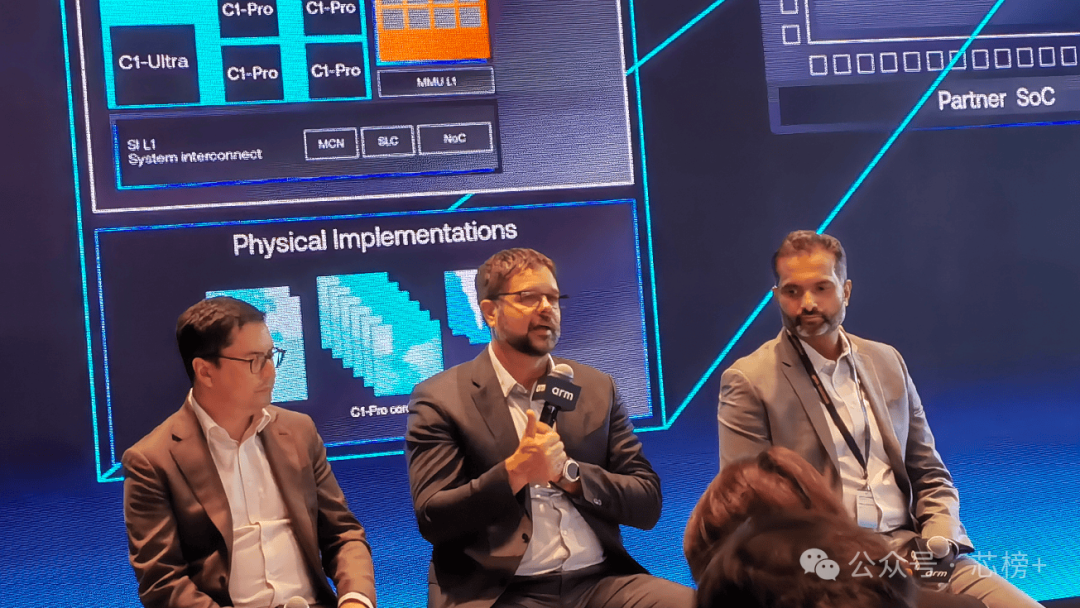

On September 10, at the Arm Unlocked event held in Shanghai, Chris Bergey, Senior Vice President and General Manager of Arm’s Client Line of Business, stated that AI is redefining computing, and the biggest challenge facing AI development is computation.
To address this, Arm has launched the new Arm Lumex computing platform, transitioning from an IP provider to a computing platform.
Chris believes that AI presents a huge opportunity for the smartphone market. Although the current sales growth in the smartphone industry is sluggish, consumer interest and spending on high-end devices are increasing.
Regarding the self-developed chips by manufacturers such as Apple, Samsung, Huawei, and Xiaomi, he stated that this is a major trend in the industry due to the significant value of chips.
However, manufacturers do not need to assemble large engineering teams to integrate Arm technology; with the help of the CSS platform, they can achieve specialization and differentiation at a lower cost.
In a media interview after the event, Arm executives indirectly responded to the controversy surrounding Xiaomi’s launch of the Arm architecture self-developed chip, the Xuanjie O1, this year.
On May 22 of this year, after the official release of Xiaomi’s first 3nm flagship SoC, the Xuanjie O1, Arm’s official website published a press release titled “XRING O1 Custom Silicon from Xiaomi is Powered by the Arm Compute Platform.” Many netizens interpreted this literally, believing that the Xiaomi Xuanjie O1 is a custom chip developed by Arm based on its CSS for Client (Arm Compute Subsystem for Client) for Xiaomi. Although at that time, Chip Intelligence interviewed Xiaomi’s chip head Zhu Dan to refute this, Arm also deleted that press release and reissued a corrected version, but it still did not quell various external doubts.
Although Arm did not directly respond to previous external doubts about whether “Xiaomi’s Xuanjie O1 is Arm-customized” or “Xiaomi’s Xuanjie O1 is based on Arm CSS customization,” James McNiven, Vice President of Product Management for Arm’s Client Line of Business, clearly pointed out during the interview that currently, Arm’s CSS platform only focuses on its strengths in CPU, GPU IP, and cluster solutions, providing customers with reference designs and physical implementations. This does not mean that Arm utilizes the Lumex CSS platform to customize complete SoC solutions for customers. Customers also cannot directly use the Lumex CSS platform to have foundries produce their own chips, as SoCs cannot operate solely with CPU/GPU; this does not constitute a complete SoC solution. Customers still need to add a series of their own IP or third-party IP to create a complete SoC solution based on the Lumex CSS platform, such as interface IP, ISP, NPU, baseband IP, etc.
Disclaimer:This article is copyrighted by the original author and source, provided for reference only and does not constitute investment or application advice. Some articles on this platform are reprinted and not for commercial purposes. If there are any infringement issues, please contact us promptly, and we will handle it as soon as possible. This platform has the final interpretation right for this disclaimer.


Xin Yuan Co., Ltd. today resumed trading, rising over 14%, with each share priced at 106.66 yuan for purchasing Xin Lai Technology.

Breaking! TSMC makes significant adjustments, exiting!

Apple releases four major chips including the 3nm A19! Performance comparable to MacBook.