The Internet of Things (IoT) is transforming how businesses monitor products, control inventory, and optimize processes in supply chain management. By connecting physical assets with sensors, devices, and software, a new era of smarter supply chain strategies is emerging. The IoT is reshaping every link in the supply chain—from real-time data collection to predictive analytics—significantly enhancing the transparency and agility of supply networks.
In today’s rapidly changing logistics environment, businesses must leverage data-driven tools to identify inefficiencies, reduce delays, and meet the growing demands of customers to remain competitive. By implementing IoT supply chain solutions, companies are continuously improving operational visibility, achieving process automation, and effectively lowering operational costs.
IoT in the Supply Chain
In simple terms, it refers to an integrated management system that utilizes smart connected devices to collect, transmit, and analyze data at every stage from raw materials to final delivery.
GPS trackers, RFID tags, temperature sensors, wearable devices, drones, and Automated Guided Vehicles (AGVs) are all components of IoT systems. When these devices work in conjunction with platforms such as Enterprise Resource Planning (ERP) or Warehouse Management Systems (WMS), they provide unprecedented insights and control over logistics operations.
Applications of IoT in Supply Chain
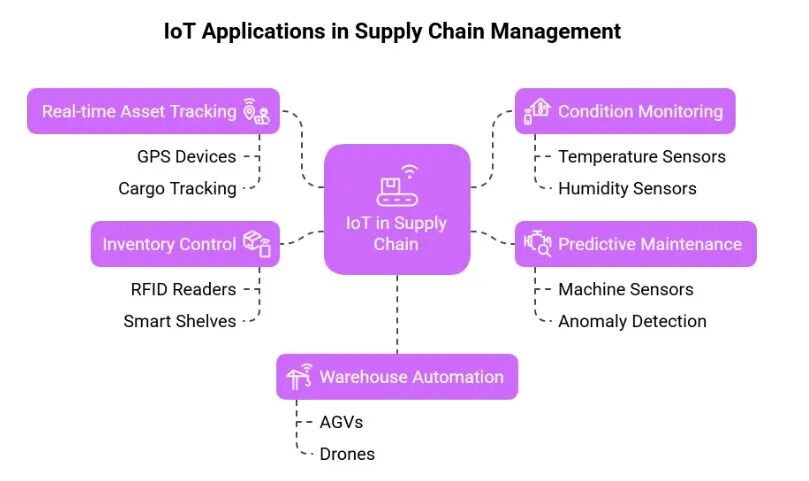
The application of IoT in the supply chain is profoundly impacting various industries, with its core value reflected in several typical scenarios:
1️⃣ Real-time asset tracking: Using GPS devices to accurately locate vehicles and goods in transit, keeping track of logistics dynamics at all times.
2️⃣ Condition monitoring: Continuously monitoring key parameters such as temperature, vibration, and humidity of sensitive items through sensors.
3️⃣ Predictive maintenance: Analyzing equipment operational data to timely identify anomalies and effectively prevent failures.
4️⃣ Smart inventory management: Achieving automatic inventory counting and tracking through RFID readers and smart shelves.
5️⃣ Warehouse automation: Utilizing AGVs and drones to significantly enhance the efficiency of restocking, packing, and picking processes.
These applications not only enhance customer satisfaction and reduce human errors but also comprehensively optimize operational processes.
IoT Supply Chain Example: Cold Chain Monitoring
Taking cold chain monitoring in the food and pharmaceutical industries as an example, IoT technology plays a crucial role. Perishable goods and vaccines require continuous temperature-controlled environments, and IoT sensors can monitor temperature changes in real-time during storage and transportation, issuing alerts immediately if deviations from safe ranges are detected.
This system not only prevents product spoilage and ensures compliance with safety regulations but also enhances consumer trust. Currently, industry leaders such as Nestlé and Pfizer have widely adopted IoT cold chain technology, maximizing product quality while minimizing loss risks.
Cross-Industry IoT Supply Chain Applications
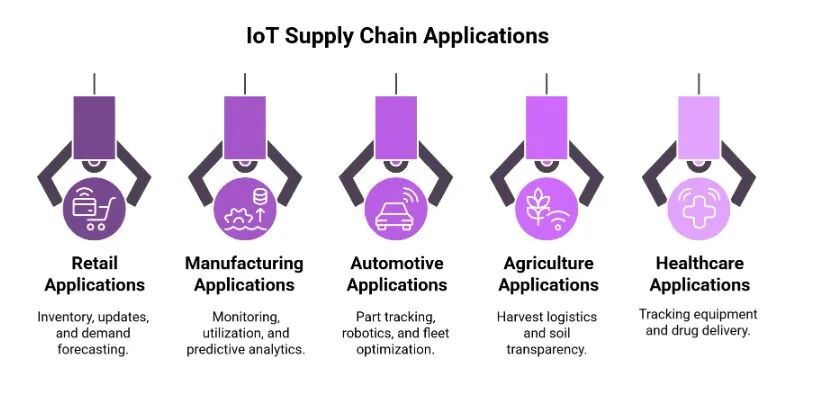
The application of IoT in supply chain management is rapidly expanding across various industries:
1️⃣ Retail: Smart shelves, real-time inventory updates, and customer demand forecasting systems.
2️⃣ Manufacturing: Full-process monitoring, asset performance management, and predictive analytics.
3️⃣ Automotive: Parts traceability management, warehouse robots, and intelligent fleet scheduling.
4️⃣ Agriculture: Sensor-based harvest logistics optimization and full-chain visibility from production to sales.
5️⃣ Healthcare: Intelligent tracking of medical devices and full-process monitoring of drug distribution.
According to a McKinsey study, it is predicted that by 2025, the economic value created annually by IoT in logistics and supply chains could reach $1.9 trillion.
In the context of supply chains, “IoT” specifically refers to a network of interconnected smart devices in the real world. Leading logistics companies such as FedEx and DHL have achieved automated warehouse operations, package delivery time predictions, and intelligent global fleet management through IoT technology.
Specific cases include: Maersk deploying IoT sensors in containers for real-time tracking and status updates, significantly reducing port dwell times and optimizing resource allocation; Walmart effectively reducing food waste rates in its fresh food department while greatly improving inventory accuracy using IoT technology.
It is noteworthy that with the deep integration of artificial intelligence technology, IoT devices are upgrading from condition monitoring to intelligent decision-making and automated management, continuously driving innovation in supply chain operational models.
Global Perspective of IoT in Logistics and Supply Chain
IoT is bringing profound changes to the logistics and supply chain sectors. In this globalized era, strategic agility and operational efficiency are equally important—facing uncertainties such as pandemics and geopolitical factors that may disrupt supply chains, IoT technology is empowering businesses with indispensable resilience and foresight.
When IoT solutions are combined with artificial intelligence and machine learning, they can achieve real-time disruption predictions, freight route adjustments, and dynamic inventory allocation based on demand changes.
Case Study of IoT in Supply Chain: Amazon
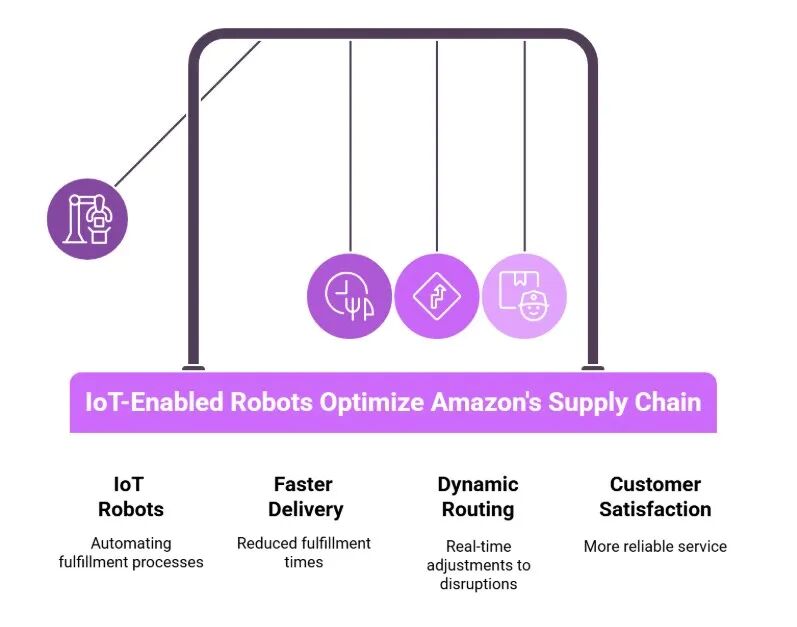
To achieve faster and more accurate goods scheduling, Amazon has deployed a large-scale network of IoT robots in its global retail distribution centers. By deeply integrating sensor data with artificial intelligence technology, the company has not only significantly shortened order fulfillment cycles but also successfully reallocated human resources to higher-value decision-making and execution tasks.
With the IoT system, Amazon has achieved dynamic route planning and real-time delivery status updates. This system can instantly respond to order changes, traffic congestion, and unexpected weather disruptions. Even during high logistics load periods such as holidays, it maintains efficient and stable delivery times.
Through continuous interaction between IoT devices and a central data platform, Amazon’s logistics team can proactively optimize delivery routes, effectively reducing vehicle idle time and significantly lowering delivery failure rates. This practice demonstrates that strategic investment in smart infrastructure can not only comprehensively enhance supply chain operational efficiency but also significantly improve customer satisfaction through reliable and transparent service experiences, setting an industry benchmark for excellence in supply chain operations in the digital age.
Future Development Directions of IoT in Supply Chain
IoT will play an increasingly important role in future supply chain systems. With the rapid proliferation of 5G networks and the widespread application of edge computing, the next generation of IoT technology will provide businesses with faster data insight capabilities and more decentralized decision-making mechanisms.
Looking ahead, we may see the following scenarios become a reality:
1️⃣ Hyper-automated warehousing systems: Widespread adoption of autonomous vehicles and drones to achieve fully autonomous operations in warehousing.
2️⃣ Seamless human-machine collaboration: Human employees and intelligent devices efficiently and safely collaborate in the same space in real-time.
3️⃣ Integration of blockchain and IoT: Building an immutable supply chain data exchange network to ensure information transparency and trustworthiness.
4️⃣ AI-driven predictive systems: Large-scale application of AI-based demand sensing and predictive analytics technologies.
5️⃣ Sustainable precision management: Real-time tracking of carbon footprints through IoT technology to provide data support for emission reduction decisions.
It is foreseeable that the future IoT supply chain will exhibit three core characteristics: autonomous decision-making, intelligent operations, and sustainable development, thereby constructing a next-generation supply chain ecosystem that is more resilient and adaptable to complex environments.
Market Size and Growth Trends of IoT in Supply Chain
The global IoT supply chain market is in a rapid growth cycle. According to data released by Fortune Business Insights, the global market size in this field reached $34 billion in 2022 and is expected to exceed $114 billion by 2030.
This significant growth is primarily attributed to the in-depth application of IoT technology across diverse fields such as manufacturing, retail, energy, and agriculture. As digital transformation becomes a core strategy for businesses, IoT technology has evolved from a tool for enhancing efficiency to a necessary infrastructure for building modern supply chain competitiveness.
Source: LitsLink
Original Title:IoT in Supply Chain: A New Era of Smarter Supply Chain Management