Overview:
The OSINT work in Africa is challenging due to linguistic diversity, infrastructure limitations, and legal gray areas, but key intelligence can be extracted through SOCMINT strategies.
Africa is one of the most diverse continents on Earth, and its open-source intelligence (OSINT) landscape is equally unique. The African cyberspace is fragmented across more than 50 sovereign nations, using over 1000 languages. It is not difficult to see that conducting OSINT work in Africa faces significant challenges. However, do not be misled by this complex terrain; for seasoned OSINT investigators and analysts, the African internet is a fertile ground full of opportunities. Therefore, whether conducting due diligence in Lagos, investigating armed groups in the Sahel, verifying identities in Nairobi, or tracking misinformation in Kinshasa, this article will showcase the best strategies for conducting OSINT in Africa. You will learn where to investigate, what to focus on, and how to gain key insights while ensuring operational security and legal compliance.
SOCMINT and OSINT in the African Context
Most cybersecurity professionals, journalists, law enforcement, or investigators can understand the definition of OSINT: the collection and analysis of publicly available open-source data. However, before data is analyzed into OSINT intelligence, it is classified as open-source intelligence (OSINF). OSINF comes from any source that is freely accessible and unrestricted: including news websites, government databases, public records, and the most prominent social media platforms. Intelligence from social media is often referred to as social media intelligence (SOCMINT).
Today, many users rely on mobile phones as their only digital device. In Africa, mobile platforms and social applications like Facebook, WhatsApp, and TikTok are not just for entertainment; they carry much of Africa’s economic and political networks. Therefore, almost all OSINT in Africa falls under SOCMINT. Searching for public domain research data, NGO aid coordination, or armed conflict on social media may seem strange, but for Africa’s OSINT, this is precisely where to look.
Specific Challenges Facing OSINT in Africa
In this digital jungle of Africa, there exists a dense structure, intricate investigative leads, and ambiguous gray areas that make this field challenging. Below are some specific issues that many investigators face in African OSINT and how to overcome them.
1. Linguistic and Dialect Diversity
The EU recognizes about 24 official languages across Europe. In contrast, India, known for its linguistic diversity, has hundreds of native languages. Meanwhile, Africa has approximately 3000 spoken languages; from Arabic in North Africa to Bantu languages in the Niger-Congo family, to Madagascar’s unique Austronesian languages.
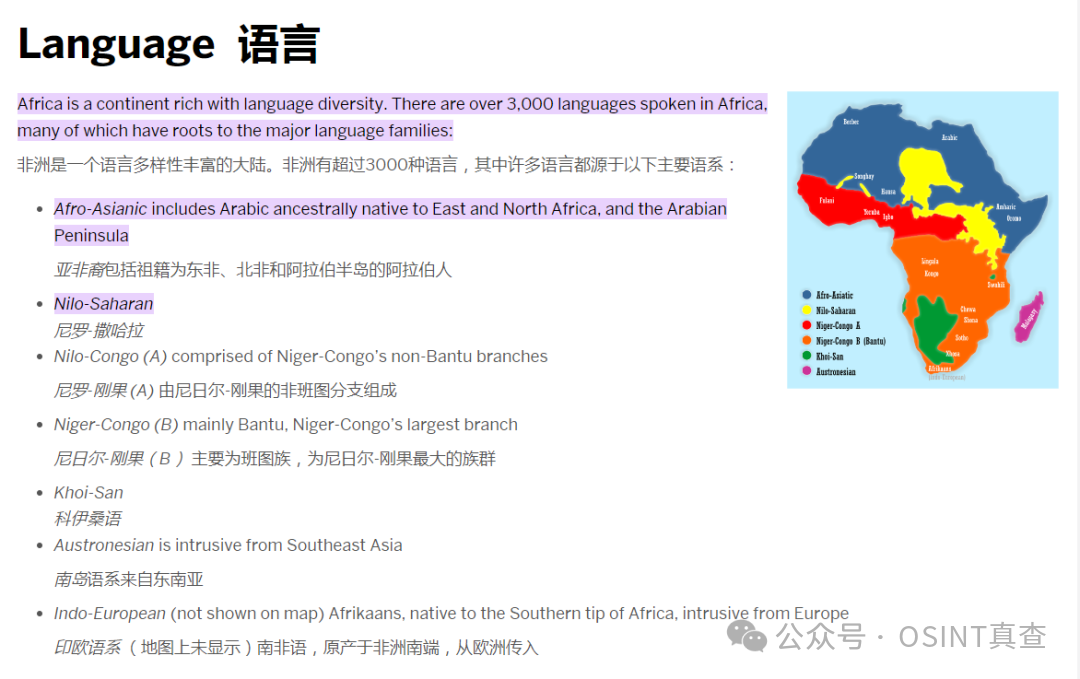
These languages often overlap. Even within a country/region, multiple languages and dialects may be used interchangeably online, with most people speaking at least two languages. For example, Nigerians may speak English, Hausa, Yoruba, Igbo, or Pidgin. Besides structural differences, the reference frameworks of these languages are entirely different; these frameworks are closely related to religion, history, and culture, making them incompatible with most translation tools.
To conduct in-depth OSINT investigations in Africa, it is necessary to collaborate with local experts or linguists for support to gain the best insights. Otherwise, it is easy to miss the implied meanings in the information or even completely misunderstand the data content. Basic translation software like Google Translate is often inadequate.
2. Limited Infrastructure and Data Persistence
As mentioned earlier, much of Africa’s OSINT will come from social media activity. However, the reliability of mobile internet is sometimes notoriously low; this makes mobile-first Africa’s internet one of the most unstable in the world. Evolving infrastructure, ongoing political turmoil, and the actions of criminals exacerbate this instability.
Therefore, while social media is often the only source of real-time information, data can quickly disappear. Meanwhile, internet outages, post deletions, and mobile-only access make archiving difficult—even impossible.
Africa also faces severe digital inequality: for example, in Malawi, 1GB of mobile data costs only $0.38, while in Zimbabwe, it costs $43.75.
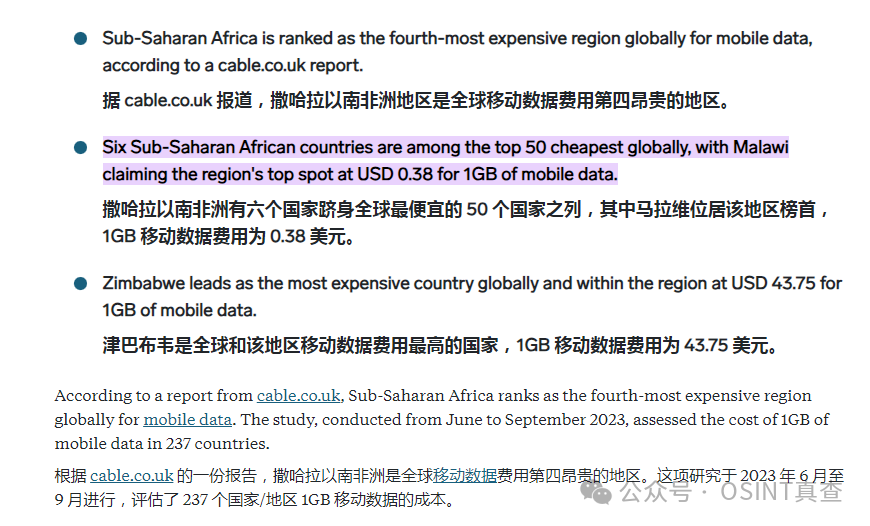
Due to the lack of stable and affordable internet access, African internet users often cannot leave clear digital footprints. When conducting OSINT investigations in Africa, be prepared to make every piece of data work harder. You need to extract more value from less data.
3. Legal Gray Areas
Gray areas still exist in Africa. Many African countries lack clear digital privacy legislation, making it difficult to distinguish between OSINT in Africa and protected private information.
Typically, a subtle and complex set of rules must be followed, with significant differences even between neighboring countries. For example, in the Congo region: the Republic of the Congo has had data protection legislation since 2019, but has yet to establish a dedicated data protection authority. Meanwhile, the Democratic Republic of the Congo has no data protection laws or authorities at all.
OSINT investigators in Africa should proceed with caution and adhere to ethical standards, especially when scraping or archiving data. It is essential to check the data privacy and protection rules of the target country/region, including draft bills, upcoming legal changes, and any decisions or discussions currently under consideration by the legislature. Alternatively, stick to tools with built-in compliance.
The Five Most Popular Platforms in Africa and Their Characteristics
While global platforms dominate, regional applications and local forums are also filled with a wealth of interesting social media intelligence:
1. Meta Products
-
Facebook: remains the dominant platform in Africa. It is used for a variety of activities from political organization to market transactions. Business pages often contain phone numbers and email addresses.
-
WhatsApp: an omnipresent communication tool. Group links are often posted on Facebook, Twitter, and Telegram.
-
Instagram: popular among influencers, businesses, and activists.
2. TikTok
TikTok short videos are very popular in Africa, especially among young people. Viral trends often reflect or precede real-world events and provide compelling political commentary—often expressed through memes or satire. It helps monitor protests, misinformation campaigns, and unfiltered public sentiment.
3. Twitter/X
Due to the lack of globally interconnected alternatives, Musk’s “universal app” remains relevant in Africa, especially in countries more closely connected to the Global North (e.g., Nigeria, Kenya, South Africa). Twitter posts are a goldmine for OSINT investigators, who can track events or individuals through these posts, especially when these activities relate to Western countries outside Africa.
4. YouTube
In countries with better bandwidth or cheaper mobile data (e.g., Ivory Coast, Ghana, Algeria, and Malawi),YouTube is a primary platform for investigative journalism, local documentaries, and whistleblowing.
5. Regional Platforms
-
Nairaland (Nigeria): a large comprehensive discussion forum with sections on politics, crime, business, and interpersonal relationships.
-
Jamii Forums (Tanzania): Tanzania’s most popular social media platform. A Reddit-like forum, dubbed the “East African version of WikiLeaks,” and also a “venting platform where even disgruntled politicians upload sensitive documents.”
-
Wazua (Kenya): a forum focused on investments, aiding in financial due diligence when investigating target entities.
-
AfroCharts and Boomplay: both are popular streaming platforms, with AfroCharts focusing on African music (e.g., Afrobeats and Afropop), while Boomplay originated in Nigeria but offers all types of music.
African Emails and Phone Numbers
If you want to collect African phone numbers and emails through OSINT, you need to be familiar with the formats of this data. For example, the standards for emails and phone numbers across Africa.
1. African Phone Numbers
Most African numbers also start with a “+” followed by the country/region code. These codes are very suitable for geolocation identification. All African country/region codes start with the number 2, usually three digits long, except for Egypt (+20) and South Africa (+27). For example:
-
+234-Nigeria
-
+256-Uganda
-
+251-Ethiopia
-
+263-Zimbabwe
-
+225-Ivory Coast
Disposable Phones
Disposable phones are very popular in Africa, making OSINT investigations more challenging. In a mobile-first environment, disposable phones are the best way to keep online activities anonymous; these anonymous, affordable, and easily accessible devices are the perfect solution. Additionally, due to limited use of formal identification or banking systems in many areas, these numbers are very helpful for rural populations. Here’s how to determine if a phone is disposable:
-
Unregistered: In many African countries, using an ID to register a SIM card is mandatory, but enforcement is weak. If a number lacks verifiable registration data, it may be disposable.
-
Frequent Switching: If a number is used for a short time and then disappears, it is likely a “disposable” number.
-
Prepaid SIM Cards: Most disposable phones use prepaid SIM cards. If a number is tied to a prepaid plan and not associated with a contract or bank account, it is likely a disposable number.
-
Lack of Digital Footprint: Disposable numbers are often not associated with social media, instant messaging apps, or online activities. Especially in Africa, almost all online activities can be linked to a mobile phone.
2. African Email Addresses
Many African users default to using Gmail addresses; the accompanying applications and global influence make it an easily accessible choice. They are particularly popular among internet users in Africa who want to hide their location for criminal or political reasons. Besides Gmail addresses, proprietary business addresses are also popular. Pay attention to the following regional domain names:
-
.za (South Africa)
-
.ke (Kenya)
-
.ng (Nigeria)
-
.ci (Ivory Coast)
-
.sd (Sudan)
-
.cg (Republic of the Congo)
African Platform-Based SOCMINT Strategies
In Africa, obtaining emails, phone numbers, and other personal data requires specialized SOCMINT strategies. Segmenting by platform, shows where to find what.
-
Business Pages: often contain phone numbers, email addresses, and WhatsApp links. Additionally, comments can precisely locate user locations and activities.
-
Location Tags: used to geolocate users and images.
-
Groups: check local buy/sell groups, job groups, etc., for leads.
Twitter/X
-
Tags:Dorking: look for localized tags (e.g., #EndSARS, #NairobiFloods, #DRCVotes). Simple and often effective.
-
List Mining: identify subjects that influential people follow and interact with.
-
Advanced Search: use “near:” or “lang:” operators to search for posts in specific areas.
-
Group Links: search for group invitation links in public posts or in more private groups like Discord or Telegram.
-
Screenshots: many sensitive discussions are displayed through shared screenshots on other platforms. They may not appear in text searches but can contain very valuable information.
Telegram
-
Channels: used for protests, misinformation, cryptocurrency scams, and even armed group communications. Many of the most dangerous communications occur here under the cover of encryption.
-
Bots: some channels use custom bots to spread misinformation or mobilize protesters. Be aware of automated activities.
Instagram and TikTok
-
Contact Information in Profiles: many influencers and small businesses include emails, phone numbers, or WhatsApp links in their profiles. So this is the best place to obtain this information.
-
Audio and Tag Trends: help track sentiment and discover narrative information. Some African cultural factors may be needed to interpret.
Reverse Username, Phone, and Email Queries
OSINT tools are designed to search for the required data; among them, tools like OSINT Industries integrate African platforms. They provide over 1000 query modules covering the platforms mentioned in this article. Usernames, phone numbers, or email addresses drive investigations. Reverse searches (e.g., reverse email queries and reverse phone queries) are excellent for account lookup tasks. Using these tools, you can cross-reference information and reveal any account or personal information.
Additionally, tools like Maltego or OSINT Industries Palette can automate searches, visualize associations, and automatically comply with strict ethical and legal standards to avoid unnecessary trouble.
Note: From a security perspective, when using these offshore tool platforms, consider the confidentiality of the investigative task and personal privacy.
Legal and Ethical Considerations
Finally, when conducting OSINT investigations in Africa, be mindful of the following points. Always adhere to the legal guidelines of the region you are in:
-
Data Protection Laws: as discussed, they vary widely. Nigeria has NDPR; South Africa has POPIA. But as always, enforcement is inconsistent. Even if you believe you are working in a region with weak regulation, proceed with caution.
-
Surveillance and Monitoring: do not assume that low enforcement means no monitoring. In countries like Rwanda or Egypt, authorities closely monitor the digital space, and it is necessary to ensure that OSINT investigative activities do not attract negative attention.
-
Scam Operations and Honey Traps: be cautious when directly engaging with suspicious actors, as these are very prevalent in Africa. Conducting OSINT investigations requires strong operational security, so it is advisable to use temporary accounts, virtual machines, and VPNs.
The above content comprehensively outlines the current state, challenges, and strategies for OSINT work in Africa, providing a practical guide for OSINT investigators in Africa.