
With the advent of the era of the Internet of Things, the methods of connection between objects are constantly evolving and updating.If sensors are the tactile sense of the Internet of Things, then wireless transmission is the nervous system of the Internet of Things, connecting the sensors spread throughout the network.Before the emergence of the Internet of Things, the demand for network access was mainly reflected in the need for PCs and mobile terminals to connect to the Internet. Today, with the development of IoT technology, wireless access is not only reflected in the connection needs of PCs and mobile terminals to the network but also in the connection needs between objects in industrial production environments.
Short-range wireless transmission technologies, including Wi-Fi, Bluetooth, UWB, MTC, ZigBee, and NFC, generally have a signal coverage range of several centimeters to several hundred meters. Short-range wireless transmission technologies are mainly applied in local area networks, such as home networks, factory workshop networking, and enterprise office networking.
01 Wi-Fi
Wi-Fi is widely used in many IoT application cases, most commonly as a link from the gateway to the router connecting to the Internet. However, it is alsoused for primary wireless links that require high speed and medium range.
Wi-Fi technology is not designed to replace Bluetooth or other short-range radio technologies; the application fields of the two are completely different, although there may be overlaps in certain areas.Wi-Fi devices are generally designed to cover a range of several hundred meters, and if antennas are enhanced or hotspots are added, the coverage area can be even larger, potentially covering an entire office building..
Wi-Fi wireless technology is primarily designed for mobile devices to access LAN (Local Area Network), WAN (Wide Area Network), and the Internet.
Basically, in the Wi-Fi standard, mobile devices act as clients, while the server is the network center device; this is a significant difference from the peer-to-peer structure of NFC and Bluetooth technology where two mobile devices interconnect.
Supported Topology:Star topology
Usage Distance:Short to medium distance (hundreds of meters)
Application Scenarios:Mobile devices, etc.
02Bluetooth
Bluetooth is a universal short-range radio technology, Bluetooth 5.0 can theoretically connect devices up to about 100 meters apart, butin practical use, it is about 10 meters..
Its main feature is that it allows easily portable mobile communication devices and computers to connect and transmit data and messages without the need for cables. It is currently widely used in the connection of smartphones and smart wearable devices, as well as in smart homes and automotive IoT applications.
Supported Topology:Point-to-point structure
Usage Distance:Short distance (≤100 m)
Application Scenarios:Mobile devices, smart wearable devices, etc.
03UWB
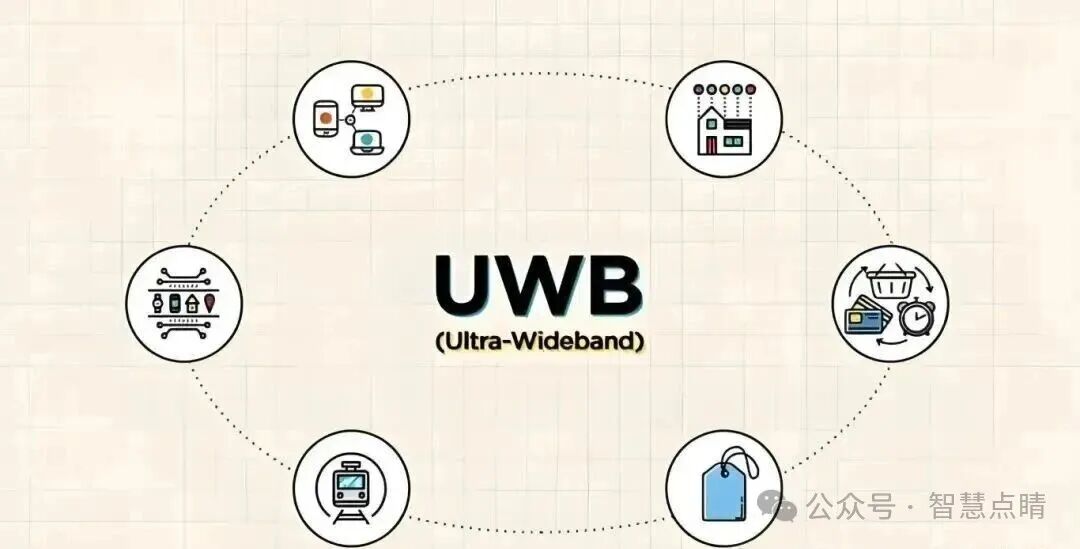
Ultra-Wideband (UWB) is a carrier-free communication technology that uses non-sinusoidal narrow pulses in the nanosecond to microsecond range to transmit data,with a transmission distance typically within 10 meters, using bandwidth above 1 GHz, and communication speeds can reach several hundred megabits per second. The UWB operating frequency range is from 3.1 GHz to 10.6 GHz, with a minimum operating bandwidth of 500 MHz.
Its main characteristics are:
① High transmission rate;
② Low transmission power and low power consumption;
③ Strong confidentiality;
④ UWB communication uses time-hopping sequences, which can resist multipath fading;
⑤ UWB requires very few RF and microwave components, which can reduce system complexity.
Due to the high bandwidth occupied by UWB systems, they may interfere with existing other wireless communication systems.UWB is mainly used in high-resolution radar and imaging systems that can penetrate walls and other obstacles in a “small range”.
This device can be used to inspect defects in concrete and asphalt structures in buildings, bridges, and roads, as well as to locate faults in underground cables and other pipelines. It can also be used for disease diagnosis. Additionally, it has significant applications in rescue, security prevention, firefighting, and medical imaging processing.
04ZigBee
ZigBee, also known as the purple bee, is a low-speed short-range wireless network protocol that uses the IEEE 802.15.4 standard for its media access layer and physical layer.
Its main features include low speed, low power consumption, low cost, support for a large number of online nodes, support for various online topologies, low complexity, fast, reliable, and secure.
Transmission range is generally between 10 to 100 meters, and can be increased to 1 to 3 kilometers with increased transmission power. This refers to the distance between adjacent nodes. If routing and node-to-node communication relays are used, the transmission distance can be even further.
Supported Topology:Star, tree, and mesh structures
Usage Distance:Short to medium distance (10m – several km)
Application Scenarios:Mobile devices, etc.
05NFC
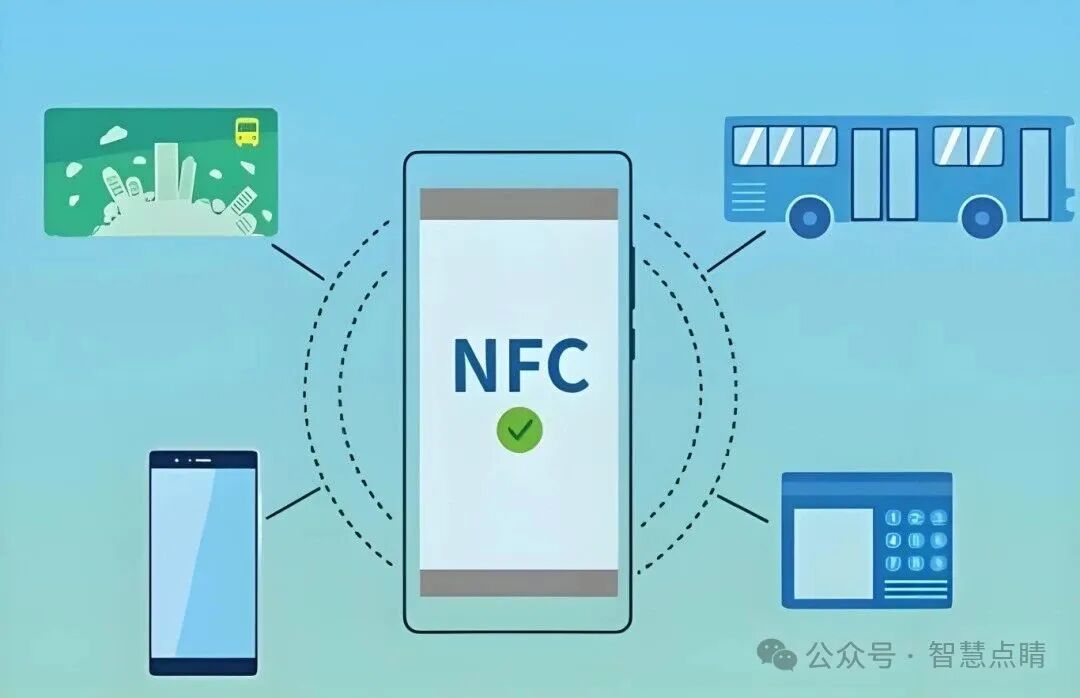
NFC is essentially a “contactless radio frequency identification” (RFID) and interconnection technology that has evolved from wireless devices. It is a contactless automatic identification technology that automatically identifies target objects and obtains relevant data through radio frequency signals, without the need for manual intervention.
Supported Topology:Point-to-point structure
Usage Distance:Short distance
Application Scenarios:Scanning, card swiping, etc.
Long-range wireless transmission technologies include GPRS, NB-IoT, Sigfox, and LoRa,with a signal coverage range generally from several kilometers to tens of kilometers.Long-range wireless transmission technologies are mainly applied in remote data transmission, such as smart meters, smart logistics, and remote device data collection.
06GPRS
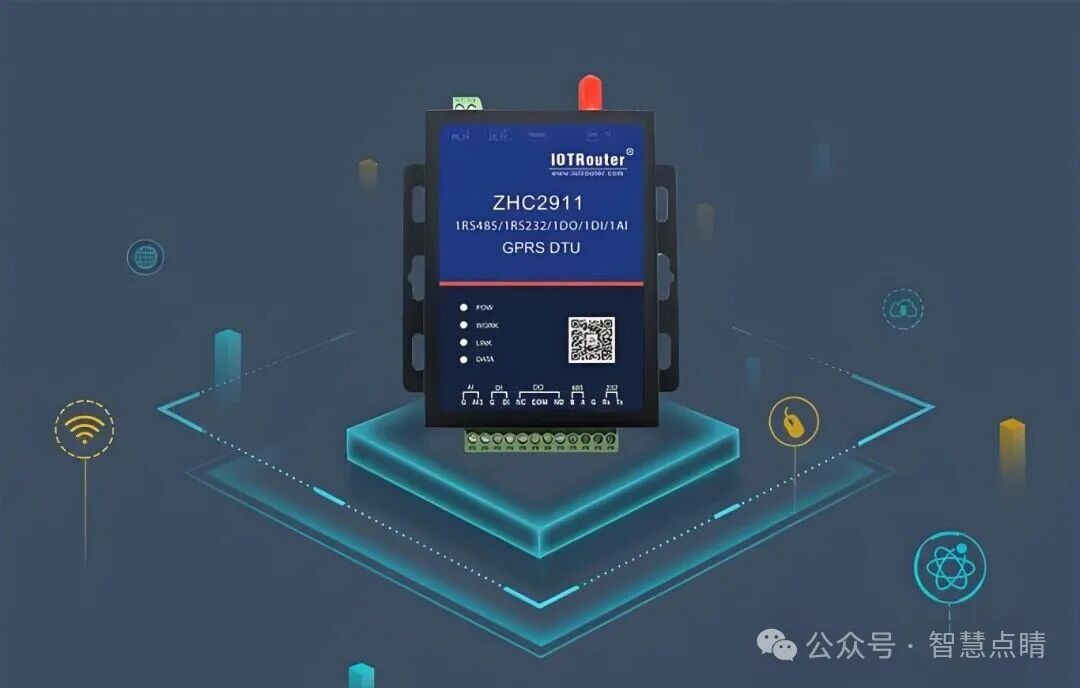
Primarily aimed at industrial applications, it is a wireless modem embedded with a GSM/GPRS core unit, using the GSM/GPRS network as a transmission medium. It is an industrial-grade communication terminal based on the mobile GSM short message platform and GPRS data services. It builds an ultra-long-distance data transmission platform for users using the short message and GPRS services of the GSM mobile communication network.
Please open in the WeChat client
Compared to short message services, GPRS is in a real-time online state and can handle multiple or receive data from multiple detection points simultaneously without stopping the current working state. It is verywell-suited for systems that need to collect data from multiple target points simultaneously; GPRS not only has a long working distance but also allows for bidirectional operations of the system,making it very suitable for remote device operations and remote device upgrades. Since the GPRS network covers most areas, there are basically no blind spots, so there is no need to establish a separate communication network; just install the device and insert the SIM card to enable network communication.
It is mainly applied in meteorology, hydrology, geology, and other industries.GPRS real-time data transmission is used in banking, securities, insurance, taxation, public security, traffic police, traffic inspection, traffic monitoring, industrial control, remote sensing, telemetry, and mobile office.
07NB-IoT
Narrowband Internet of Things (NB-IoT) has become an important branch of the Internet of Everything.
NB-IoT is built on cellular networks, consuming about 180 kHz of bandwidth, and can be directly deployed on GSM, UMTS, or LTE networks to reduce deployment costs and achieve smooth upgrades.
NB-IoT features low frequency, low power consumption, low cost, high coverage, and high network capacity, and is also known as the “narrowband Internet of Things”.
A single base station can provide 50-100 times more access terminals than traditional 2G, Bluetooth, or Wi-Fi, and a single battery-powered device can operate for ten years.
Supported Topology:Star topology
Usage Distance:Long distance (over 10 km)
Application Scenarios:Smart cities, shared bicycles, etc.
08LoRa
LoRa stands for Long Range Radio, and its main feature is that it can transmit over longer distances under the same power consumption conditions compared to other wireless methods, achieving a balance between low power consumption and long range. It can extend the transmission distance by 3-5 times compared to traditional wireless RF communication under the same power consumption.
Supported Topology:Star topology
Usage Distance:Long distance (typically 2 km – 5 km, up to 15 km)
Application Scenarios:Logistics tracking, etc.
In many scenarios, we need to consider multiple factors, such as customer data volume, data transmission distance, cost, and so on. Therefore, making choices based on the scenario is the wisest decision.
-
In the field of the Internet of Things, most sensors are embedded in chips, and the energy consumption of network transmission modules is low, with small power, mainly relying on short-range wireless connections. Especially within factories, countless production devices, materials, and smart terminals need to utilize Wi-Fi, Bluetooth, and ZigBee for interconnection.
-
However, in some businesses, short-range wireless transmission cannot meet the needs. For example, enterprises need to monitor the usage status of customer products and transmit data in real-time.
-
In heavy industry, monitoring the usage status of remote devices is very important. Therefore, long-range wireless transmission technologies are needed to achieve data return. At this time, enterprises can choose cellular communication technologies such as 3G and 4G, or low-power wide-area network transmission technologies such as LoRa, Sigfox, and NB-IoT.
 Wireless Transmission Needs for Different Levels of IoT Applications 01
High power, high-speed wide area network transmission technologies. Such as 2G, 3G, and 4G cellular communication technologies, these transmission technologies are suitable for applications requiring high real-time performance and large data transmission, such as GPS navigation and video surveillance.
02
Low power, low-speed wide area network transmission technologies. Such as LoRa, Sigfox, and NB-IoT, these transmission technologies are suitable for data transmission of remote device operating status, industrial smart devices, and terminal data transmission.
03
High power, high-speed short-range transmission technologies. Such as Wi-Fi and Bluetooth, these transmission technologies are suitable for smart homes, wearable devices, and M2M connections and data transmission.
03
Low power, low-speed short-range transmission technologies. Such as ZigBee. These transmission technologies are suitable for flexible networking applications of local area network devices, such as hotspot sharing.
Currently, the development trend of wireless transmission technology in the Internet of Things is primarily focused on low-power wide-area networks. It is expected that in the coming years, low-power wide-area network transmission technologies represented by LoRa, Sigfox, and NB-IoT will gradually become the mainstream connection technology for IoT transmission layers.
Friends! The WeChat push mechanism has changed, so to prevent losing contact, please be sure to follow the steps below to star the public account, so you won’t miss any content~ This way, the articles pushed daily can be displayed to you first!
Follow the public account below, download!


Statement
This free resource is for personal learning and communication use only. For commercial use, please purchase through the official website.
If the download link for the materials is invalid, please contact us in the background or check the official website.
All our materials come from the internet and are provided by netizens.
This public account does not own all rights; all rights belong to the copyright holder.
Please delete the downloaded materials within 24 hours and do not use the downloaded materials or tutorials for commercial purposes. Any responsibilities arising from this are unrelated to this public account.
If we inadvertently infringe on your rights, please contact us promptly, and we will delete it immediately..
Learning and communication, please do not disturb! WeChat:china397260291

Must-read for middle school students and parents: General high school classes, vocational education college entrance examination classes, three-two linked classes, and industry-education integration classes, as long as you work hard, any score can reverse to enter a university! Follow this public account video number for detailed introduction (same number on Douyin and Kuaishou china397260291)
Thank you for taking the time
 ·
·
 to read this article

Clickto read the original text to get the download link and follow the public account or reply “password” to get the decompression password