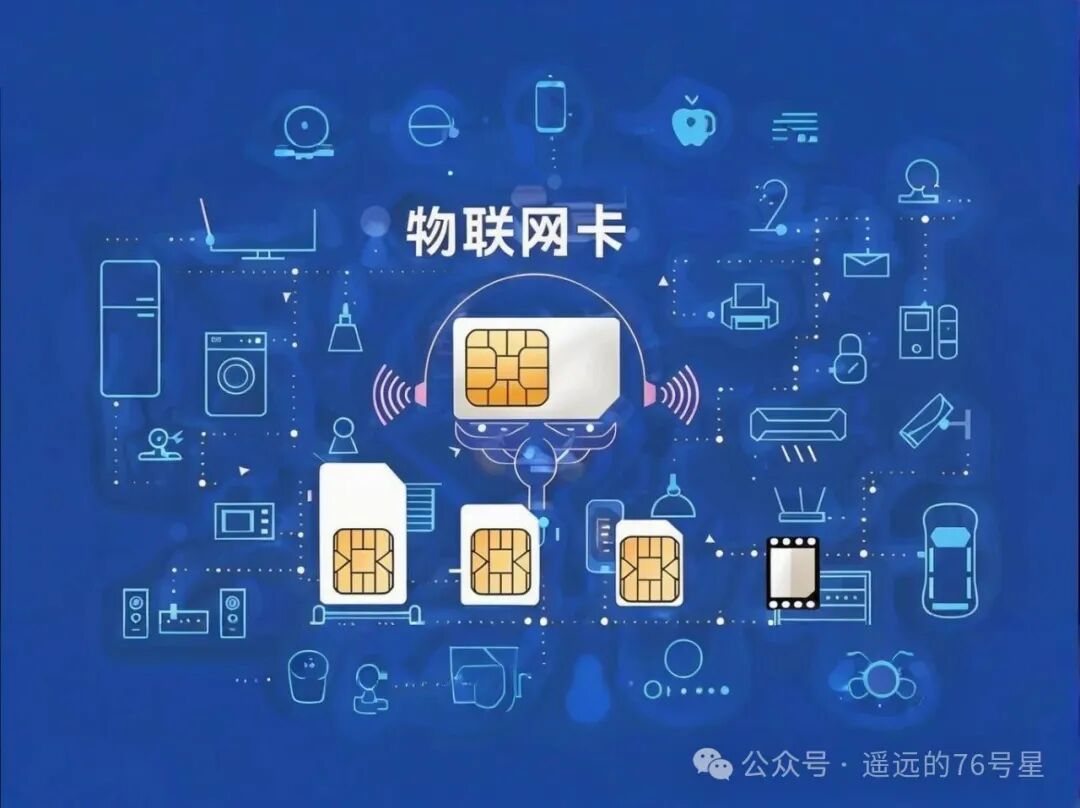
The IoT card, officially known as the IoT communication card, is a mobile communication access service provided by operators specifically for smart terminal devices. Unlike the mobile SIM cards we use daily, IoT cards use exclusive number ranges and are primarily sold in bulk to enterprise users, providing data transmission, remote control, and management services for smart devices through dedicated IoT networks. As a core carrier of IoT technology, IoT cards are quietly changing our lives and work, turning the concept of connectivity into reality.
Basic Concepts and Forms of IoT Cards
IoT cards are provided by the three major operators (China Mobile, China Unicom, China Telecom) and are communication cards designed specifically for smart devices. In appearance, IoT cards are similar to regular mobile SIM cards, but they are actually divided into two main forms: plug-in MP cards and chip MS cards. The MP card is the same size as a regular SIM card but is made of more durable materials; the MS card is smaller (typically 5mm×6mm) and is soldered inside the device, offering stronger shock resistance, high-temperature resistance, and anti-static capabilities, making it suitable for use in harsh environments.
In terms of number ranges, IoT cards mainly use 13-digit numbers, such as China Mobile’s 144, 10647, 10648 number ranges, China Unicom’s 146 number range, and China Telecom’s 1441 number range, etc. These exclusive number ranges allow IoT cards to be treated specially in the network, typically not supporting voice calls and point-to-point SMS functions, focusing on data transmission services. With the popularization of 5G technology, IoT cards are gradually upgrading to support 5G networks, providing possibilities for more high-speed, low-latency IoT applications.
Differences Between IoT Cards and Regular SIM Cards
IoT cards have significant differences from regular mobile SIM cards in several aspects. First, functional positioning: Regular SIM cards are mainly used for personal communication, supporting voice calls, SMS, and general data services; while IoT cards are designed specifically for device networking, primarily providing data transmission services, and usually do not support calling and SMS functions.
Secondly, usage scenarios: Regular SIM cards are aimed at individual users and can be purchased and used at any time; IoT cards are designed specifically for enterprise users and must go through enterprise qualification review to apply, and are not open to individual users. This restriction is mainly to prevent IoT cards from being used for illegal purposes, such as harassment calls, fraud, etc.
Thirdly, management methods: Regular SIM cards are usually managed by individuals, who can recharge and check at any time; IoT cards require unified management through an enterprise-level management platform, including functions such as traffic monitoring, device status checking, and remote control. Platforms like China Mobile’s OneLink and China Unicom’s WoLink provide enterprises with full lifecycle management services for devices.
Finally, billing models: Regular SIM cards are charged a fixed monthly fee; IoT cards are mainly billed based on data usage, supporting both monthly packages and cumulative packages, and the prices are much lower than regular SIM cards. The monthly fee for a regular mobile card may range from 50 to 100 yuan, while the monthly fee for an IoT card may be as low as 10 to 20 yuan, with data reaching tens of GB or even hundreds of GB.
Core Application Scenarios of IoT Cards
IoT cards have penetrated all aspects of our lives, becoming an important support for the construction of smart cities. In the smart home field, IoT cards enable smart locks, cameras, air conditioners, and other devices to connect remotely, allowing us to check the situation at home and control appliances remotely through mobile apps. According to statistics, China Mobile’s IoT cards have provided communication services for over 50 million children’s watches, allowing parents to keep track of their children’s safety at all times.
In the smart transportation field, IoT cards provide precise positioning services for vehicle GPS devices, with positioning errors controlled within 5 meters, greatly improving traffic safety and management efficiency. The new regulations for electric two-wheelers implemented in 2025 clearly state that operating electric two-wheelers must be equipped with Beidou positioning modules and use 4G or 5G IoT cards to achieve real-time data upload, ensuring vehicle anti-theft and status monitoring.
In the industrial automation sector, IoT cards enable efficient network management of devices. The device networking rate of China Mobile’s IoT cards in the industrial automation field is as high as 98.7%, with fault response times reduced to 15 minutes, significantly improving production efficiency. Haier’s Qingdao Industrial Park uses 6G IoT cards to achieve predictive maintenance of equipment, reducing production line downtime by 70%, becoming a model application of industrial IoT.
In the smart medical field, IoT cards connect medical devices, enabling real-time collection and transmission of medical information. Remote surgical equipment connects to hospital servers via IoT cards, ensuring millisecond-level latency and 99.999% reliability, providing strong support for healthcare.
Additionally, IoT cards play an important role in smart agriculture, environmental monitoring, energy management, and other fields. By collecting crop growth information through sensors, IoT cards transmit data to management platforms, providing a basis for scientific planting. In smart cities, IoT cards connect transportation, energy, medical, and other public facilities, creating a seamless network that allows us to enjoy the convenience of smart cities anytime, anywhere.
Potential Risks and Preventive Measures of IoT Cards
Despite the widespread application of IoT cards, they also face some potential risks. Security risks are the primary challenge. If IoT cards are illegally obtained and misused, they may become tools for online fraud and harassment calls. Statistics show that in many cases of investment fraud, online loans, and part-time job scams, criminal groups have extensively used IoT cards, with the amount involved exceeding 10 billion yuan.
Compliance risks cannot be ignored either. The new regulations in 2025 require IoT cards to implement real-name systems and scenario filing; if enterprises do not comply, it may lead to device deactivation. A smart wearable device manufacturer once had 100,000 IoT cards deactivated due to failure to file usage scenarios, directly affecting the launch of new products.
Technical vulnerability risks also exist. IoT devices may suffer attacks due to IP hijacking, traffic theft, etc., threatening data security and system stability. To prevent these risks, operators use various technical means, such as IPTABLES software firewalls, TCP WRAPPERS, and application-layer IP access whitelists, to identify and defend against illegal attacks at low cost and high security.
User usage risks should not be overlooked either. IoT cards do not support mobile phone use, and if mistakenly used in mobile phones, it may lead to communication service anomalies. At the same time, the package rules for IoT cards are relatively complex; for example, the 2025 new regulations adjusted the small data package limit (from 100M per month to 300M) and the directional IP whitelist limit (from 10 to unlimited), so users need to fully understand these rules to avoid service interruptions due to package expiration.
The Digital Bridge Connecting Everything
As a digital bridge connecting everything, IoT cards are profoundly changing our lives and work. From smart homes to smart factories, from remote healthcare to smart transportation, the application scenarios of IoT cards are increasingly rich, bringing tremendous value to society. IoT cards are not just cards; they are the link between the digital world and the physical world. Through this small card, we see the enormous potential of technology to change lives and look forward to IoT technology creating more surprises and conveniences in the future.