
Since its approval in 2021, the National Integrated Circuit Industry-Education Integration Innovation Platform at Huazhong University of Science and Technology has built an innovative practice base covering the entire process capabilities of integrated circuit design, technology, packaging, and testing over nearly four years. It has established an enterprise-level integrated circuit engineer technology center and a collaborative education base for integrated circuit industry-university-research in Hubei Province, becoming an important support for cultivating top innovative talents and excellent engineers in the integrated circuit field in Central China.
Since the launch of the Open Sharing Fund Project for School Instruments and Equipment, the National Integrated Circuit Industry-Education Integration Innovation Platform has focused on “teaching and research driven by dual wheels, and industry-education integration for collaborative empowerment”. It has continuously made breakthroughs in three major areas: optimizing shared management, constructing teaching and research systems, and innovating industry-university-research models. This not only revitalizes and utilizes 36 sets of large instrument equipment but also becomes a strong support for cultivating top innovative talents in integrated circuits and tackling “bottleneck” technologies. The platform continues to deepen industry-education integration, innovating the practical teaching system, ensuring high-quality completion of on-campus teaching while actively radiating talent cultivation in the Central China region, providing customized, order-based internship training services for brother universities and enterprises, and continuously improving operational efficiency through teaching, research, and social services.
01
Teaching Empowerment: From “Classroom Infiltration” to “Practical Training”, Creating a Full-Chain Talent Cultivation Scenario
“From theoretical blueprints to hands-on production of physical devices, every piece of equipment in the ultra-clean laboratory is our ‘refining core’ classroom,” said Li, a student majoring in Microelectronics Science and Engineering, after completing the “Microelectronics Process Innovation Practice” course. As a beneficiary of the National Integrated Circuit Industry-Education Integration Innovation Platform’s “Research on Open Sharing Models of Large Instruments and Equipment” project, he and his classmates have fully experienced the key processes of chip manufacturing through the platform’s open equipment for cleaning, thin film deposition, photolithography, etching, and device characterization testing.
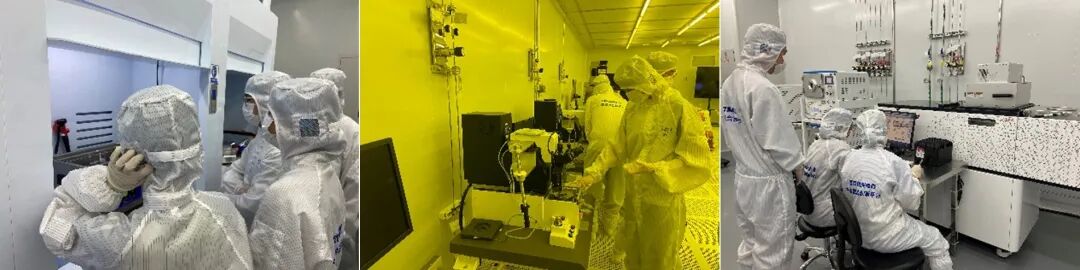
During the project implementation, the platform broke through the limitations of traditional experimental teaching and constructed a four-stage progressive training model of “classroom theory – virtual simulation – platform practice – technology application”. In the spring semester of 2025, the “Microelectronics Process Innovation Practice” course will be upgraded again, with 226 undergraduates participating in the entire chip manufacturing process training in a 1700 square meter ultra-clean laboratory, achieving a course satisfaction rate of over 95% for two consecutive years, and being selected as the university’s “Most Favorite Experimental Practice Teaching Project”.
To radiate high-quality resources more widely, the platform has created a “customized + modular” shared training system. Since 2023, the platform has trained over 2000 students, promoting the collaborative development of four departments: Integrated Circuits, Mechanical Engineering, Materials, and Future Technologies. It has opened high-quality teaching resources related to microelectronics and integrated circuits for universities in Central China, such as Wuhan University of Technology, South-Central University for Nationalities, and Wuhan Business University, providing “order-based” practical training course services and building a community for integrated circuit industry-education integration.
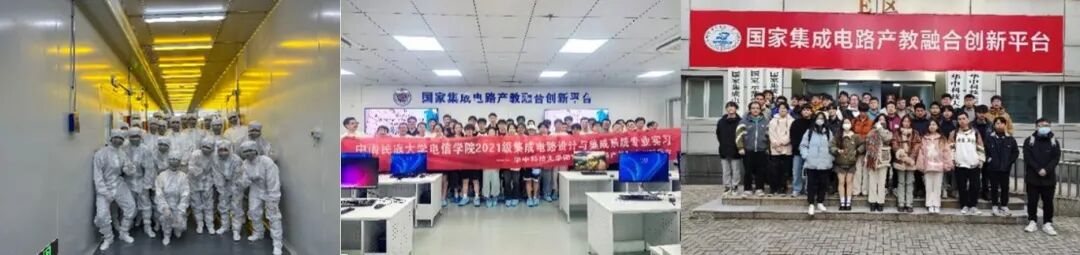
In the summer of 2025, special modules such as “The Art of Nano Coating”, “Photolithography as Embroidery”, and “Silicon Wafer Carving Art” will be offered for Wuhan University of Technology, with core process module training conducted through group assembly line operations; for 34 students majoring in integrated circuits at South-Central University for Nationalities, a systematic training on “From Sand to Chip” will be conducted, achieving a deep integration of theory and process practice. “Previously, learning photolithography only stayed in textbook illustrations, but now I can operate the UV lithography machine, adjust exposure parameters, and observe the pattern transfer effects. This sense of achievement is irreplaceable in the classroom,” said Wang, a student majoring in Applied Physics at Wuhan University of Technology after participating in the platform’s practical training.
02
Research Breakthroughs: Using “Large Instrument Sharing” as a Link to Overcome Key Technical Bottlenecks
The platform focuses on the “bottleneck” technologies in integrated circuits, supporting high-level research breakthroughs through equipment sharing. In the field of advanced storage, Professor Miao Xiangshui’s team relies on core process equipment such as cleaning, photolithography, thin film deposition, etching, and testing to conduct research on “Memory-Level High-Speed Phase Change Random Access Memory Chips”, which has been approved as a national key research and development project; in the field of brain-like computing, Professor Li Yi’s team utilizes the platform’s magnetron sputtering, atomic layer deposition, laser direct writing lithography machine, and wafer testing probe station to prepare and test memristors, constructing a heterogeneous matrix equation solving system, with multiple results continuously published in Science Advances. Professor Zeng Shuangshuang’s team, relying on various thin film deposition equipment of the platform, proposed the “Molecular Beam Holographic Lithography Technology”, which can achieve complex three-dimensional surface nanostructuring without photoresist, with related results published in Nature Communications. As of August 2025, the platform has supported over 20 national-level research projects, including national key research and development plans and key projects of the National Natural Science Foundation, producing a number of high-level academic achievements and achieving a series of innovations in experimental teaching methods.
The improvement of management efficiency is a solid guarantee for equipment sharing. The platform continues to promote the construction of a one-stop information-based reservation portal, aiming to achieve “one network for equipment reservation, machine time statistics, and fee management”, and has connected six large instruments, including Raman spectrometers, X-ray photoelectron spectrometers, and scanning electron microscopes, to automatic machine time collection terminals, synchronizing in real-time to the school’s shared platform. To enhance equipment service efficiency, the platform has established a “responsible person for equipment” system, breaking down the annual open target of 20,000 hours to each instrument and each administrator, and forming a technical support team composed of university teachers and corporate engineers. As of August 2025, the total machine time for open shared research services is 9914.5 hours, and the total machine time for teaching services exceeds 3500 hours, more than doubling compared to the same period last year.
03
Industry-University-Research Collaboration: Innovating Sharing Models to Bridge the “Last Mile of Achievement Transformation”
The platform innovates the cooperation model of “University-Enterprise Joint Laboratory + Customized Training” with large instruments and equipment as the link, and has successively cooperated with more than 10 leading enterprises, including Huawei, Jiufengshan Laboratory, Yangtze Memory Technologies, Loongson Technology, Puyuan Precision Electronics, and Anlu Technology. By co-building joint teaching laboratories and teaching cases and training modules, the real process needs of enterprises are integrated into teaching cases, allowing students to be job-ready upon employment.
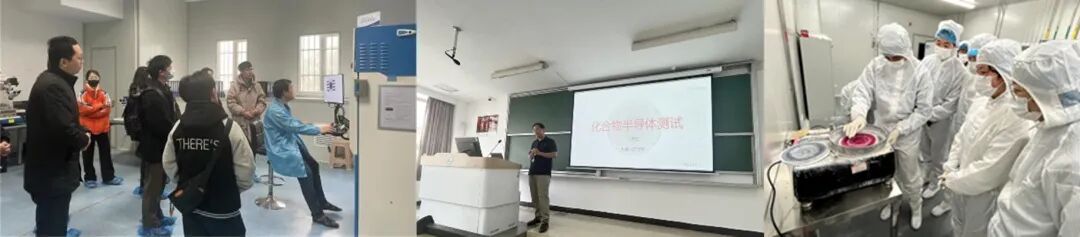
In terms of course co-construction, relying on high-quality teaching resources and industrial practice resources accumulated through university-enterprise cooperation, the platform deeply integrates cutting-edge industry standards and real research practices into the curriculum and teaching content, truly achieving seamless connection between “teaching supply” and “industry demand”. The platform has jointly launched the “Integrated Circuit Materials and Device Characterization Testing Experiment” course with Wuhan Xinxin, Jiufengshan Laboratory, based on real scenarios of integrated circuit manufacturing, organically integrating rich process engineering practices and engineering management experiences from the industry, building an engineering case library to provide more practical, innovative, and practical learning content for cultivating excellent engineers. Jointly with Huawei, courses such as “High-Performance Embedded Software Design” and “Advanced Information Storage Materials and Devices” have been launched, and jointly with the 709 Institute of Integrated Circuit Industry Metrology Center, the course “Integrated Circuit Testing Technology and Practice” has been offered, transforming real enterprise projects and process standards into teaching content, with a total of 9 university-enterprise joint courses throughout the year.
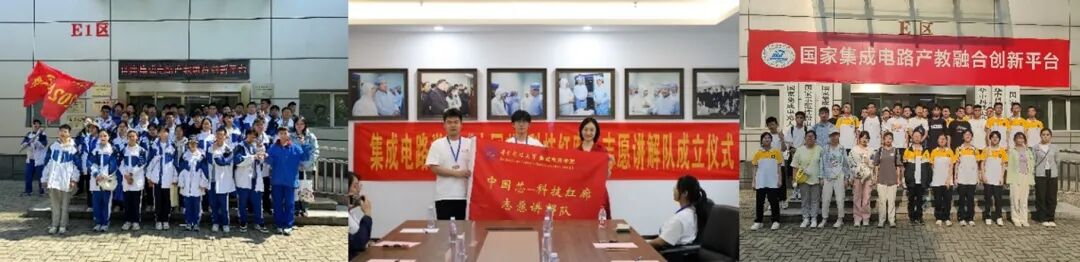
In addition, in the process of deepening industry-university-research collaboration, the platform simultaneously practices social responsibility: applying for the Hubei Provincial Science Popularization Education Base, forming the “China Chip – Technology Red Corridor” volunteer explanation team, and conducting more than 20 chip science popularization activities to educate the public about the industry and research knowledge in the integrated circuit field, building a bridge for research achievements to reach the public and connect with social needs. Relying on the dual paths of “research services + social training”, research services focus on the precise connection between “research” and “production”, while social training achieves seamless connection between “teaching” and “production”, accelerating the landing of research achievements and realizing the linkage of industry-education, university-enterprise, and social science popularization, further constructing a virtuous ecosystem of “industry-education integration, university-enterprise collaboration”.
In the future, the platform will continue to improve the information management system and operational management system, achieving full coverage of automatic collection of machine time for large instruments and equipment, expanding cooperation with universities, research institutes, and enterprises in the integrated circuit field, allowing the “Central China Chip” sharing model to radiate nationwide. As the project progresses, the National Integrated Circuit Industry-Education Integration Innovation Platform is leveraging large instrument open sharing as a fulcrum to achieve a “double harvest” of improved teaching quality and breakthroughs in research innovation, delivering more “design-savvy, craftsmanship-oriented, and innovative” outstanding talents for China’s integrated circuit industry to achieve high-level technological self-reliance and strength.
– END –
Author Unit: School of Integrated Circuits
Written by:Tan Bo
Reviewed by:Li Yi
Edited by: Yue Siyang
Revised by: Jiang Qi


Huazhong University of Science and Technology Experimental Teaching