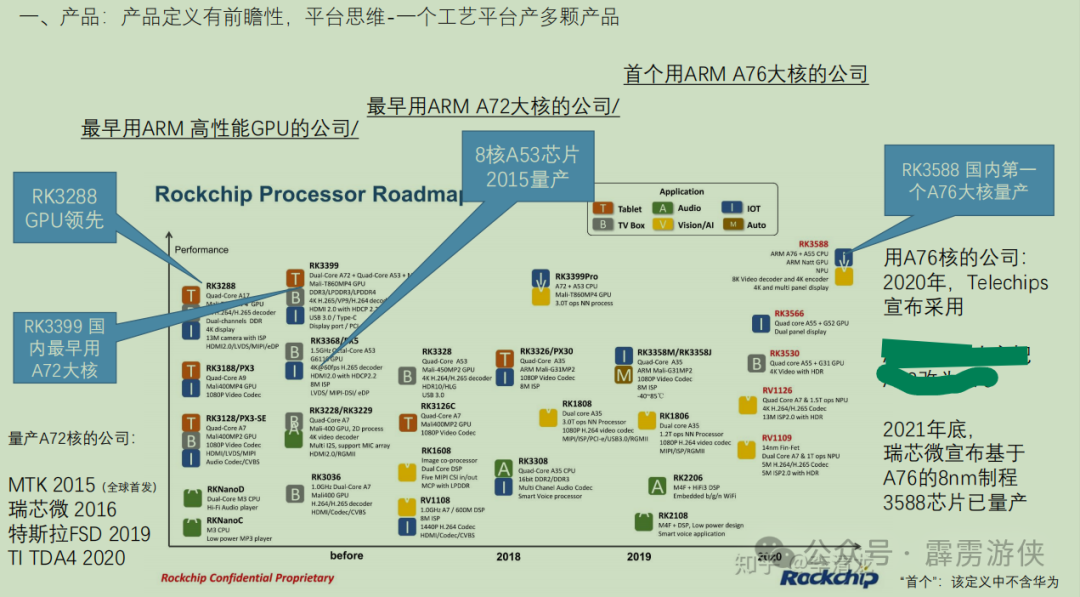
To start off, here’s an analysis I did in April 2022: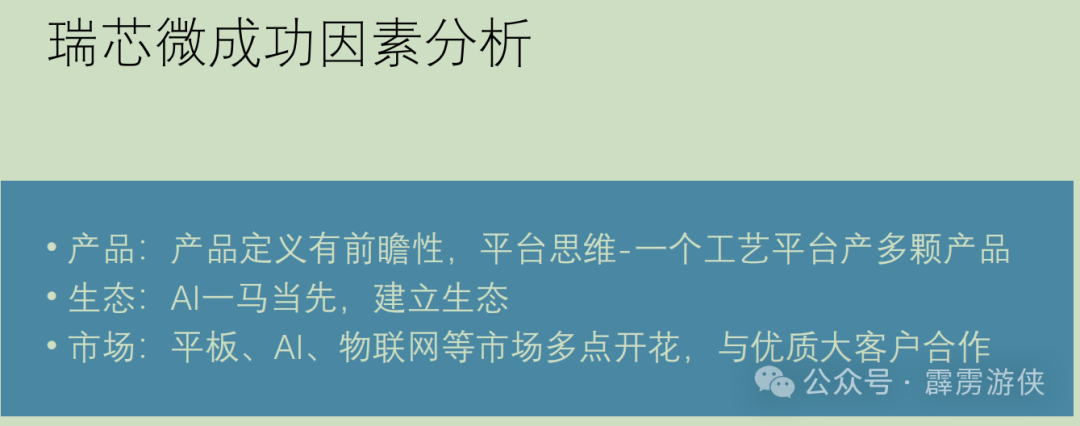 Keeping pace with ARM’s new cores, with forward-looking product definitions: The company is always among the first to adopt ARM’s new big core products (A72, A76, GPU), being the first in China, apart from Company H, to use the A72 big core and the A76 big core. The RK3588, released at the end of 2021, has become a hot product, used in cockpit systems, robotic applications, and many other scenarios, with millions of units shipped each year and an average selling price of about 400 RMB.
 The 3588 chose Samsung’s 8nm process; don’t be intimidated by this 8nm, as Samsung’s 8nm is on par with SMIC’s 14nm and TSMC’s 12nm, falling between the two. The key is that it is cost-effective.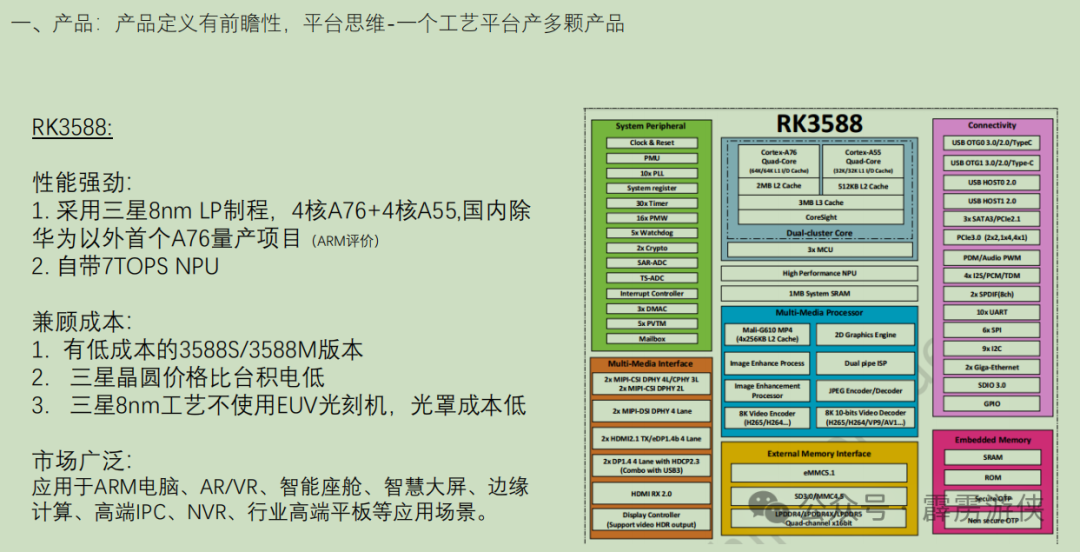
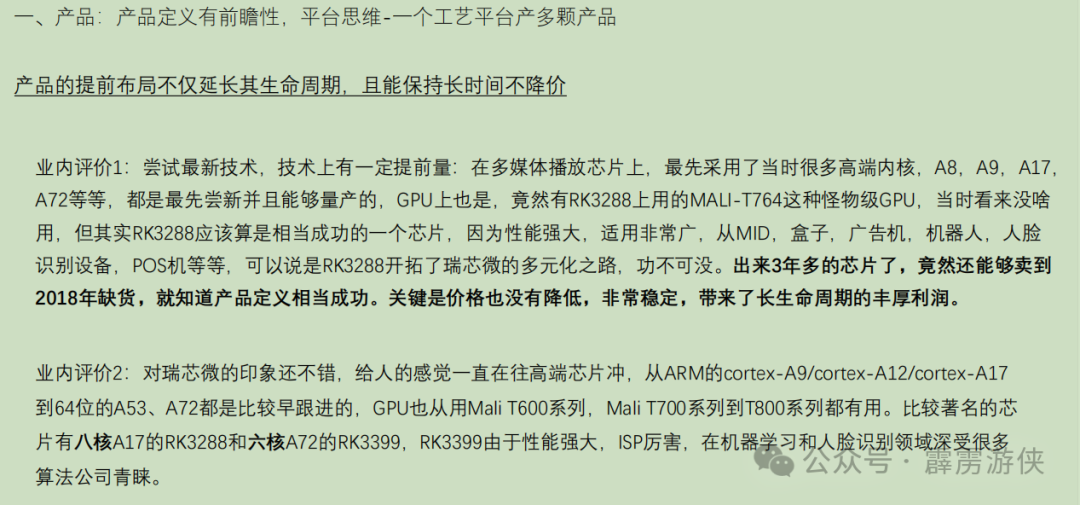
The early layout of products not only extends their lifecycle but also maintains stable pricing over time.
Industry Evaluation 1: Attempting the latest technologies, with a certain lead in technology: In multimedia playback chips, they were the first to adopt many high-end cores at the time, such as A8, A9, A17, A72, etc., being the first to innovate and achieve mass production. The GPU also saw the use of the MALI-T764, a monster-level GPU used in the RK3288. At the time, it seemed useless, but the RK3288 can be considered a very successful chip due to its powerful performance and wide applicability, from MID, set-top boxes, advertising machines, robots, face recognition devices, to POS machines. It can be said that the RK3288 opened up Rockchip’s path to diversification, which is invaluable.Even after more than three years, the chip can still be sold at a premium in 2018, indicating that the product definition is quite successful. The key is that the price has remained stable, bringing substantial profits over a long lifecycle.
Industry Evaluation 2: The impression of Rockchip is quite good; it has always been perceived as moving towards high-end chips, from ARM’s Cortex-A9/Cortex-A12/Cortex-A17 to the 64-bit A53 and A72, which were followed relatively early. The GPUs have also evolved from using the Mali T600 series, Mali T700 series to the T800 series. Notable chips include the octa-core A17 RK3288 and the hexa-core A72 RK3399. The RK3399, due to its powerful performance and excellent ISP, is favored by many algorithm companies in the fields of machine learning and face recognition.
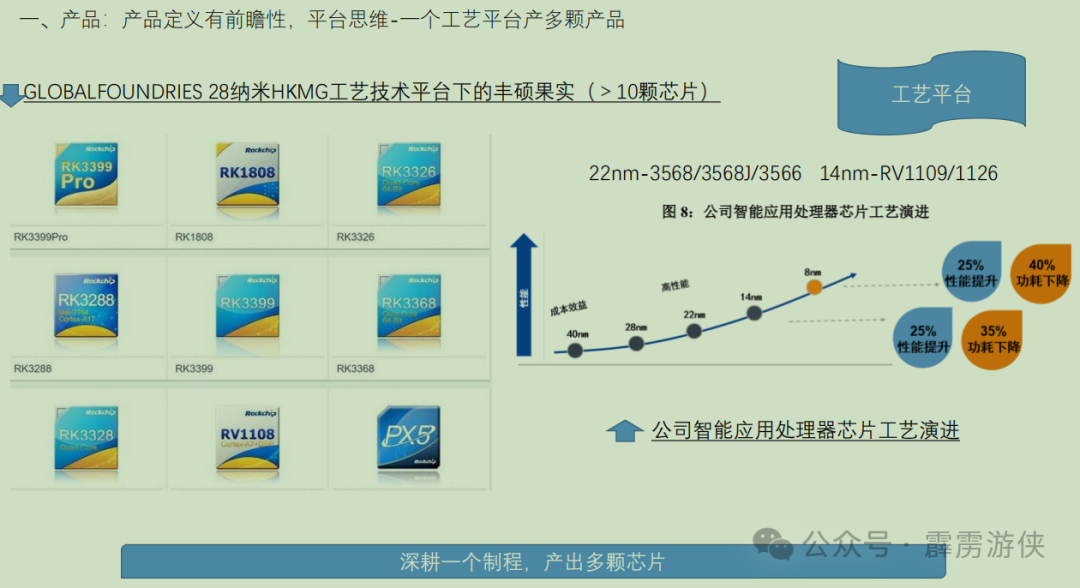 Diving deep into a process technology, producing multiple products.The ecosystem is a strong moat for the company. Looking at it now, this is even more evident. College students are using RK chips for their graduation projects. This aspect reflects the influence of NVIDIA’s CUDA.
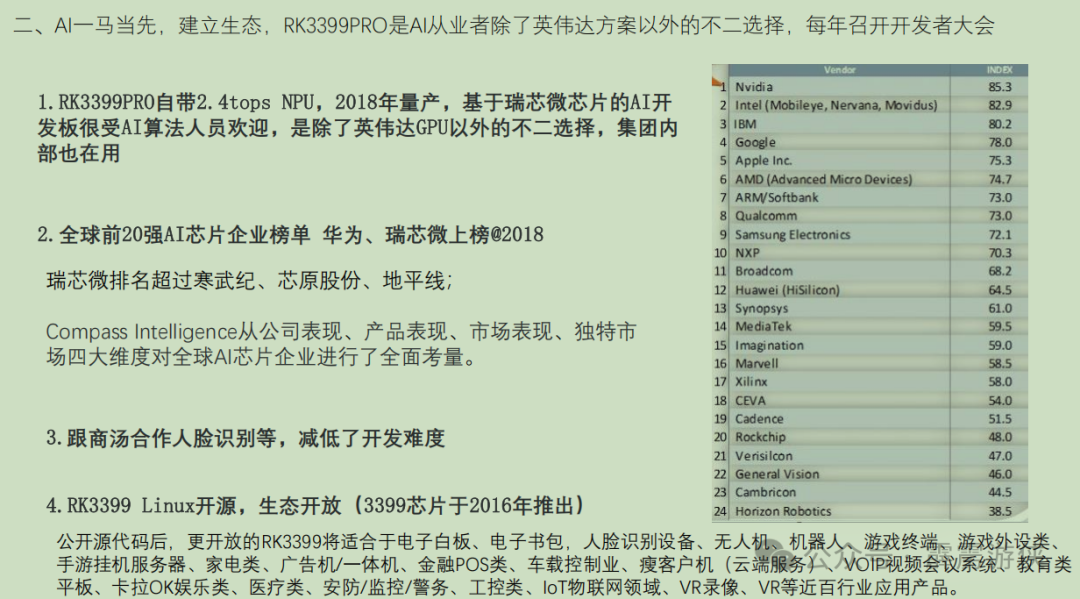 Collaborating with leading customers. Now, several leading customers can be added: the robotic dog from Yushu, and Tuozhu (the largest 3D printer manufacturer in China, with an annual shipment of 5 million units). In fact, the success of Oracle is also attributed to collaborating with leading customers. For more details, see the article “Who is China’s ‘Oracle’?”
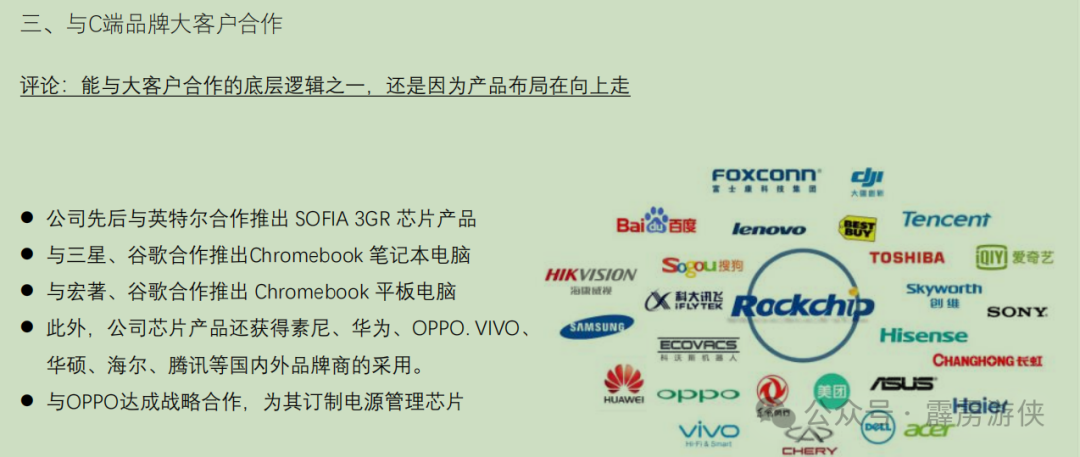 Not rushing to adopt advanced process technologies. On one hand, the company did not choose TSMC’s 7nm or below processes early on, but opted for Samsung’s 8nm, which has cost advantages; on the other hand, at this year’s developer conference, they released a 22nm ASIC stacked DRAM chip, RK182X, which can run large models using mature processes, showing better performance than advanced chips. For more information on stacking technology, please refer to this article: “3D DRAM Stacking Technology is About to Explode, Which Companies Will Benefit Most?”
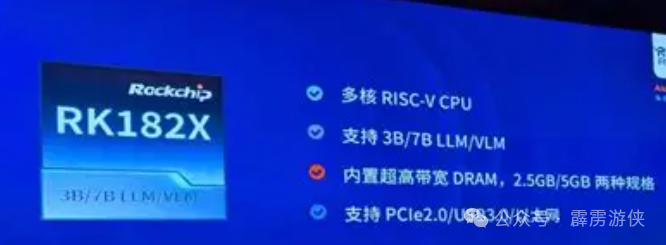 Product details are as follows:1. Core performance indicators: Real-time performance and computing power far exceed competitors. The RK182X is designed for edge-side large models (such as LLM/VLM), and its performance has been validated through actual model running data, significantly outperforming existing mainstream solutions (such as NVIDIA Orin NX):Token output speed: In the Qwen2.5-3B model, the RK182X’s edge-side model processing speed reaches 87.7 Tokens/s, while NVIDIA Orin NX is only 25.2 Tokens/s; in the DeepSeek-R1-Distill-7B model, RK182X further improves to 56 Tokens/s, while Orin NX is 14.5 Tokens/s.End-to-end response latency: The complete response latency of RK182X is as low as 0.1-0.15 seconds (for example, the first token delay of the Qwen2.5-3B model is 85.8ms, while Orin NX is 201.77ms), far exceeding market requirements for “real-time performance”.Computing power and bandwidth: RK182X is equipped with 2.5GB/5GB high-bandwidth DRAM (custom 3D stacking from Changxin Technology), with bandwidth exceeding 1TB/s (far surpassing the processing speed of a single HBM3/3E), and computing power of about 20 TOPS, supporting multi-modal data processing (text, voice, images, video) and mainstream AI frameworks (Pytorch, ONNX, Rockchip RKNN).2. Technical advantages: Addressing core pain points of edge-side AI. The leading edge of RK182X comes from its targeted technical design, effectively breaking through two major bottlenecks of edge-side AI:High-bandwidth storage: Utilizing 3D stacked DRAM packaging technology (custom from Changxin Technology), it stacks storage and computing units vertically, achieving a 10-fold increase in memory bandwidth (compared to traditional solutions) and a 90% reduction in power consumption, solving the “memory wall” problem of edge devices (where storage speed cannot keep up with computing power demands).Multi-modal support and large model adaptation: The built-in multi-core NPU (supporting INT8, W4A16, and other low-precision computations) optimizes the localization deployment capability of large models (such as 3B/7B parameters), supporting a context length of 16K, covering complex AI tasks such as natural language processing, image recognition, and video analysis.3. Market positioning and application scenarios: Focusing on the essential needs of edge-side AI. The RK182X is positioned as an edge-side computing co-processor, requiring collaboration with a main processor (such as RK3588 SoC), primarily targeting edge AI scenarios with high real-time and privacy requirements:Typical applications: Security (real-time video analysis), automotive (smart cockpit interaction), industrial (robot control), education (offline voice recognition), office meetings (real-time translation), etc.Market demand alignment: With the launch of the edge-side AI replacement cycle (such as sweeping robots, AI glasses, etc., with rising hardware volume and price), the RK182X’s characteristics of “high computing power, low latency, and low power consumption” precisely meet the demand for “localized AI processing” in terminal devices.4. Industry status: A benchmark product for edge-side AI co-processors. The release of RK182X marks a technological breakthrough for Rockchip in the field of edge-side AI chips, with its performance already recognized by the market:Comparison with competitors: Compared to mainstream edge-side chips like NVIDIA Orin NX and Qualcomm QCS series, RK182X leads in core indicators such as token output speed, response latency, and energy efficiency ratio.Industry evaluation: Institutions like CITIC Electronics and Zhongtai Electronics believe that RK182X’s “3D stacked storage + multi-core NPU” solution provides a “breakthrough solution” for deploying large models on edge-side, and is expected to become an “important support” for the development of edge-side AI.Conclusion: The performance superiority of RK182X. As an edge-side computing co-processor launched by Rockchip, RK182X, with its high-bandwidth storage, multi-core NPU, and low-latency response, significantly outperforms existing competitors in core indicators such as token output speed, end-to-end latency, and computing power efficiency ratio, placing it in a leading position in the field of edge-side AI co-processors. Its precise positioning focuses on essential edge-side AI scenarios, making it a preferred solution for “localized large model processing” in edge AI devices.It should be noted that RK182X is a co-processor and needs to be used in conjunction with a main processor. The next generation product, RK1860 (60-80 TOPS computing power, 1TB+ bandwidth), will further consolidate Rockchip’s leading position in the edge-side AI field.That’s all for now. This article does not constitute investment advice. For more meeting minutes and analysis discussions, please visit Knowledge Planet, where all mentioned are good companies.
 Fudan Microelectronics accepts research for the first time after entering the entity listSMIC’s market value surpasses 1 trillion for the first time, with 8 reasons for the surgeWho is the “Ningde Times” of China’s semiconductor listed companies?Fudan Microelectronics in-depth analysis: Entering the entity list is not difficult, half of the net assets are inventory, advanced processes, and 2.5D advanced packaging are all in progressAojie Technology communication minutes 202509103D DRAM stacking technology is about to explode, which companies will benefit the most?