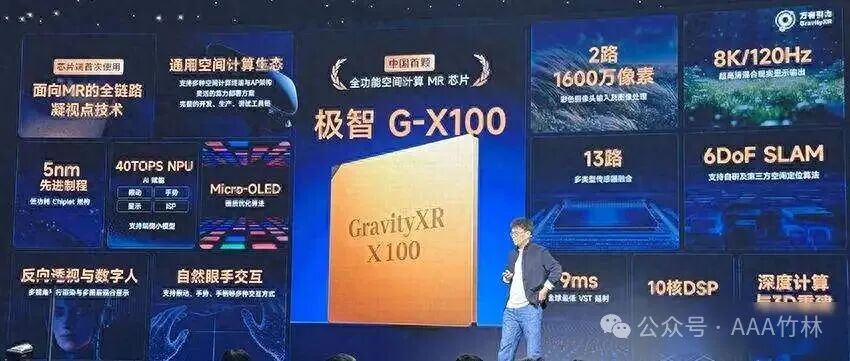
Yesterday, a company in Ningbo called Wan You Yin Li announced that it has developed China’s first chip specifically designed for MR glasses, named “Extreme Intelligence G-X100.” The purpose of this chip is to make MR devices lighter and faster. This company was founded only four years ago, and its founder, Wang Chaohao, graduated from Stanford and previously worked on XR-related projects at Apple. Now, he has started his own business and led his team to achieve this milestone.
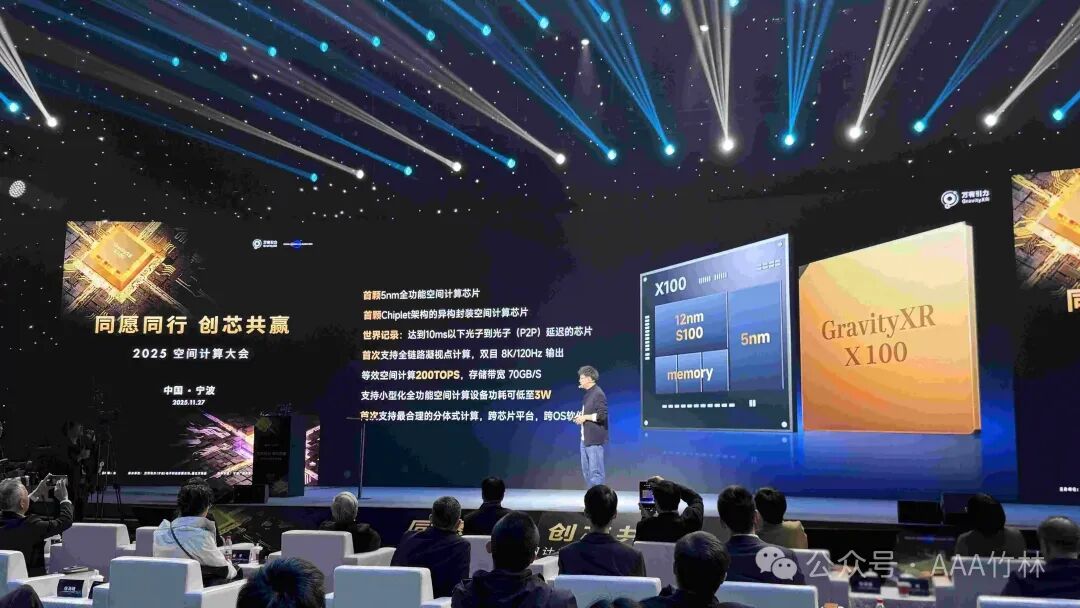
This chip uses a 5-nanometer process and combines Chiplet stitching technology, achieving a computing power of 200 TOPS with latency controlled within 10 milliseconds. The MR glasses equipped with this chip weigh less than 90 grams and consume only 3 watts. In contrast, Apple’s Vision Pro weighs 600 grams and requires an external box. This new device is directly integrated into the glasses frame and can support 8K resolution at a 120Hz refresh rate, while connecting to eight cameras and thirteen sensors. These specifications are indeed compelling.
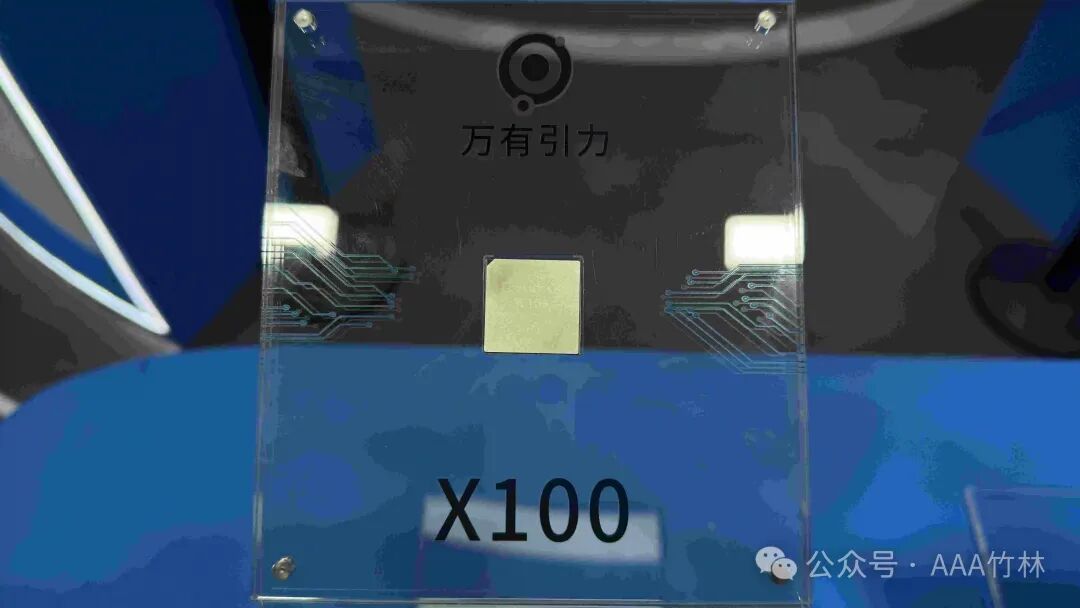
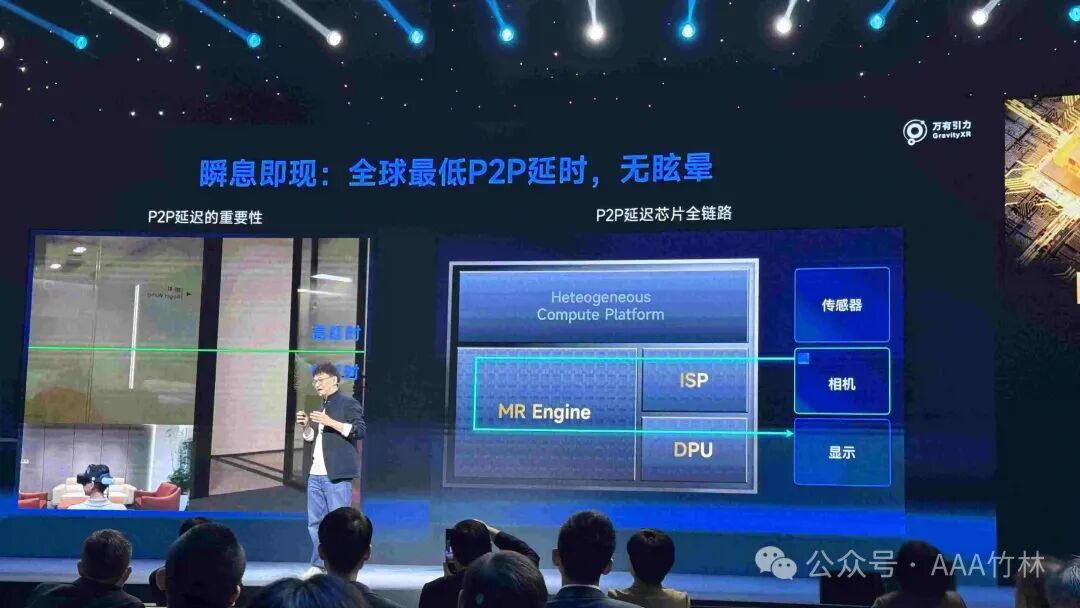
Some have compared this product to Apple’s, claiming it is a dimensional reduction attack. Apple’s devices are heavy, have high latency, and require external computing units, while this product is fully self-developed, from camera input to image processing to display output, all designed in-house. It also employs a clever method of area rendering based on human visual characteristics, keeping important areas clear while blurring less important ones, thus saving power without compromising user experience. This approach avoids the old path of relying solely on computing power for a good experience.
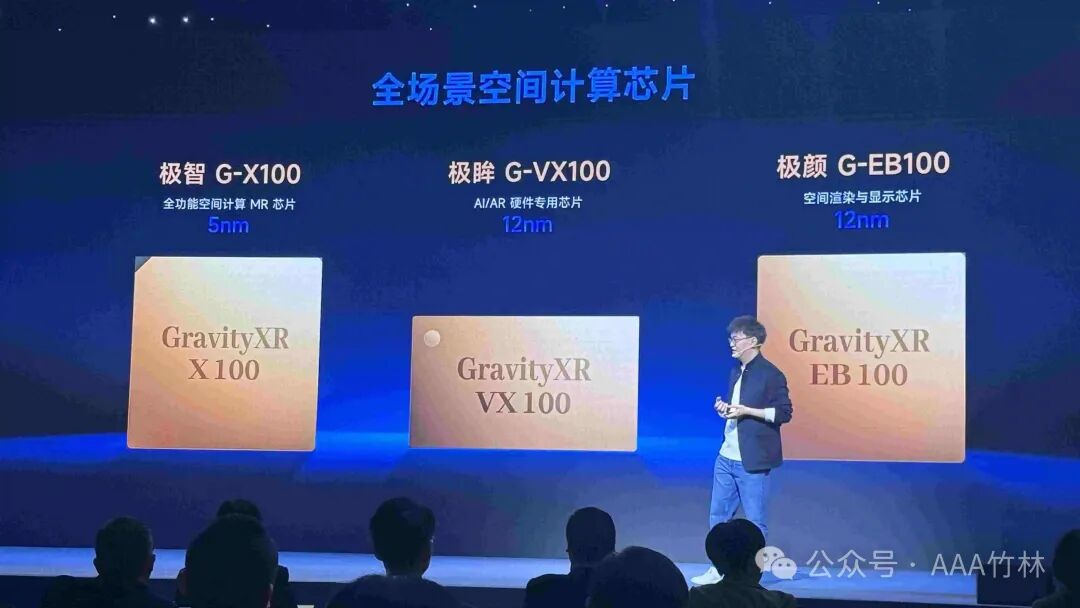
This company has not only developed this chip but also created a spatial computing three-engine system. In addition to the main control chip G-X100, there is an ISP chip called Extreme Eye G-VX100, specifically designed for AR glasses. It is small enough to fit into the arms of regular glasses, supports night photography and 4K video recording, with a power consumption of only 260 milliwatts and a battery life of up to 16 hours. Additionally, there is a display chip called Extreme Display G-EB100, which was released last year, mainly for robots and interactive devices, supporting real-time 3D rendering and layer mixing. These three chips each handle different tasks, combining to form a complete spatial computing solution.
They not only sell chips but also offer complete machine reference designs and robot development platforms, covering everything from hardware to algorithms to systems, no longer relying on the Android or Apple ecosystems, thus achieving a closed loop independently. Their financing has also been robust, with five rounds of funding totaling nearly 2 billion yuan over four years, with well-known institutions like Sequoia, IDG, and Goer participating in the investment. Capital values actual underlying control rather than empty concepts.
The global spatial computing market is expected to reach over $600 billion by 2032, but current mainstream devices are still constrained by powerful yet overly heavy performance. Wan You Yin Li has carved out a unique path, not relying on ecological monopolies or platform subsidies, but redesigning the entire system from the chip level. By adopting Chiplet architecture, optimizing algorithms, and integrating sensors, they have successfully reduced device weight by half while maintaining performance, bringing significant breakthroughs to fields such as sports training, industrial applications, and everyday consumer use.
Their approach differs from that of Europe and the United States, which tend to develop AI platforms and emphasize software ecosystems. Instead, they adopt a hardware-as-a-service model, solving computing power, display, and perception issues themselves. This is reminiscent of how Huawei approached 5G, completing everything from chips to protocols to modules independently. If mass production goes smoothly, we may see a batch of small MR devices designed in China and manufactured globally within the next two years, priced affordably yet functionally practical.
I have several friends involved in AR startups who previously complained about the high prices, large sizes, and high power consumption of foreign chips. Now that they see domestic solutions emerging, they are busy reaching out to potential partners. To be honest, this advancement in foundational technology is far more important than marketing gimmicks and product launches. It signifies not just an upgrade in products but a transformation in the entire industry’s playbook. Whoever controls the core chip will have the final say, and this is something we should pay close attention to.