Major companies often prioritize educational background when hiring fresh graduates, especially the first degree; however, during lateral hiring, they relax educational requirements to some extent but place higher demands on experience and skills.For fresh graduates with an ordinary first degree or for those who lack professional experience and wish to change careers, starting with small and medium-sized enterprises (SMEs) to accumulate2-3 years of experience before attempting to transition to major companies has become a necessary path.
So, what is the demand pattern for embedded development talent in SMEs? We interviewed several entrepreneurs.
01
—
First, we interviewed Mr. Chen, an entrepreneur in the smart home industry, regarding talent needs.
Zhang Cheng:Mr. Chen, we need embedded talent for our smart home products, right?
Mr. Chen:Yes, we do.
Zhang Cheng:What methods do we usually use to recruit R&D talent?
Mr. Chen:We need embedded development talent, but we do not consider hiring because we have to think about the development space for the talent, and in many cases, during recruitment, everyonetalksvery well,but in actual workit turns out to be unsuitable, and there is a high turnover rate. Therefore, we prefer to train internally with mentors or rely onrecommendations from industry insiders.
Zhang Cheng:Have you considered customized talent training, where third-party organizations recommend talent to companies?
Mr. Chen:Not at the moment, but perhaps in the future, as we scale up, we will.
The editor says:Mr. Chen’s company is a small-scale enterprise. Due to past hiring experiences, their current talent needs lean more towards internal training or recommendations from known industry contacts, and they are not very welcoming to new hires from outside. However, as they grow rapidly, they may consider talent training or recommendations from third-party organizations in the future.This also tells us one thing: the necessity of accumulating experience, building industry connections, and leveraging third-party resources.
02
—
Next, we interviewed the head of a company headquartered in Shanghai.
Zhang Cheng:I see that we belong to the semiconductor industry, specifically a chip design company, with core products being analog chips (such as power management and signal chains), which are used in smart devices running the Android system (like tablets, in-car control systems, commercial display devices, etc.). Is your demand for embedded talent focused on the Android tech stack?
Mr. Lin:Yes. As a chip manufacturer, we mainly needAndroid talent, not Linux. For example, customizing the Android Framework, developing BSP, and optimizing drivers to ensure system performance on our chips. Ensuring compatibility between the chip and the Android system.
Zhang Cheng:So the core need is forAndroid vertical domain talent, including Framework, BSP, driver engineers, and engineers who customize apps for hardware development?
Mr. Lin:Correct.
The editor says:Mr. Lin’s company is already of considerable scale and is not classified as a small or medium-sized enterprise. Here we can see the specific talent demand characteristics of some chip manufacturers, which can help us strengthen relevant skills accordingly.
03
—
Next, we interviewed Mr. Zhong, an entrepreneur specializing in LCD power supplies for tablets.
Zhang Cheng:Mr. Zhong, I see that we are making LCD power supplies for tablets. What kind of R&D talent do we need in this area?
Mr. Zhong:(pointing to the development board) We need them! However, we are more in need of talent who can develop circuit boards, such as this power control board (showing the PCB). Can you find someone who understands this?
Zhang Cheng:When you say “develop circuit boards,” do you mean hardware design (drawing PCBs, selecting components) or embedded software (writing control programs)?
Mr. Zhong:Both! On the hardware side, they need to be able to design power circuits, and on the software side, they need to be able to write programs inC language to control voltage output and signal feedback. For example, this board uses STM32, and they need to write firmware to interact with the LCD driver.
Zhang Cheng:I understand, this is actually a position that combines embedded hardware and software. For students, they need to learn the basics of electronics (analog/digital), PCB design, and also master embedded development (STM32, RTOS), right?
Mr. Zhong:Exactly! Additionally, if they understand LCD timing control or power management algorithms, we will prioritize them.
Zhang Cheng:So these positions can be referred to as “embedded hardware development engineers” or “MCU firmware engineers,” which belong to a subfield of embedded systems, different from pure Linux/Android system development, but still require programming and hardware skills.
Mr. Zhong:Yes, our type of company needs “hands-on” embedded talent who can directly solve circuit and code issues.
The editor says:
1. The talent needed for “developing circuit boards” in Mr. Zhong’s company belongs to the hardware collaboration direction in embedded development, requiring both:
Hardware skills: circuit design, PCB layout, component selection.
Software skills:C/C++ embedded programming (STM32/51 microcontrollers), RTOS (FreeRTOS, etc.), communication protocols (I2C/SPI).
2. Differences from pure software embedded roles:
Unlike Linux driver/Framework development, these positions are closer to the hardware level, suitable for students who enjoy circuit debugging and have strong hands-on abilities.
3. Learning suggestions:
Basic stage: LearnC language, STM32 microcontrollers, analog/digital electronics.
Advanced stage: MasterAltium Designer, RTOS, power management ICs (like TI’s BQ series).
Practical projects: Try designing a power board with an MCU to achieve voltage monitoring + LCD display.
4. Industry expandability:
Similar positions are common in power module, industrial control, and smart home hardware companies, with career paths leading to embedded systems engineers or hardware architects.
Through this dialogue, we can understand: the diversity of embedded positions (hardware/software/system level). The demand for “developing circuit boards” is not purely hardware but a typical position that combines embedded software and hardware. By clarifying the skill tree, students can learn targeted skills and avoid blindly pursuing a single technology stack (like only learning Linux).
04
—
In addition to traditional hardware manufacturers, the emerging smart wearable field also has unique demands for embedded talent.… Next, we will look at another entrepreneur’s interview.
Zhang Cheng:Hello, Mr. Fang! I see that we are a high-tech enterprise focused on precision injection molding technology and AI algorithm development, mainly providing cutting-edge PCB and chip processing solutions for smart wearable devices. What is the current demand for embedded development talent?
Mr. Fang:We need it, but currently, it is all outsourced.
Zhang Cheng:Mr. Fang, when you mention “outsourcing,” do you mean outsourcing embedded development work to third-party teams, or collaborating with partners for joint development?
Mr. Fang:It is mainly outsourced to professional embedded development teams because they have mature project experience and can quickly respond to our needs.
Zhang Cheng:Does your company have plans to build its own embedded team in the future?
Mr. Fang:We are indeed considering it. However, at this stage, our focus is still on precision injection molding technology and AI algorithm optimization. If our business scales up in the future, or if certain key technologies need to be controlled independently, we may recruit specialized embedded talent.
Zhang Cheng:Understood. If we recruit embedded engineers in the future, what skills would you prioritize? For example, RTOS, sensor driver development, or low-power optimization?
Mr. Fang:Low-power optimization will be a core requirement because wearable devices have extremely high endurance requirements. Of course, basic hardware debugging skills, such as using oscilloscopes to analyze signal integrity, are also essential.
Zhang Cheng:So these positions can be referred to as “embedded low-power development engineers,” who need to understand hardware tuning and be able to write efficient firmware code, right?
Mr. Fang:Yes, exactly, we need this type of talent.
The editor says:Mr. Fang’s company currently relies on outsourcing for embedded development due to business focus, but may build its own team in the future. If targeting the wearable/IoT field, it is essential to focus on learning:
low-power design (such as STM32L series, Zephyr RTOS), wireless communication protocols (BLE, LoRa), sensor data fusion (such as IMU, heart rate sensors), and supplement hardware skills (such as PCB debugging, signal analysis).
Industry trends: According to IDC data, global shipments of wearable devices will reach 550 million units in 2023, with a year-on-year growth of 12%, driving a surge in demand for low-power embedded talent. The wearable device market is growing rapidly, and the demand for “soft and hard integration + low power” positions continues to increase, suitable for long-term planning.
The current embedded recruitment in SMEs shows a ‘dumbbell-shaped’ characteristic: one end requires full-stack talent for rapid output, while the other end requires experts in specific technologies (such as BLE Mesh). Although outsourcing can reduce costs, it poses risks of core technology leakage, which is also why Mr. Fang is considering building a team. Furthermore, Mr. Fang’s company reveals a new trend in the embedded field—cross-disciplinary capabilities in “AI + embedded” will become a core competitive advantage.
05
—
Finally, let’s look at an interview with another company.
Zhang Cheng:Hello, Mr. Li! What is the current scale of your company? What kind of talent do you need? Do you need embedded-related talent?
Mr. Li:Hello!Our company has over eighty people, but since we do not develop many products each year, and both shareholders come from major companies and understand embedded systems themselves, we do not need too many embedded talents. What we need more are software talents, regardless of educational background and qualifications, as long as they can get the job done.
The editor says:Although Mr. Li’s company is also a small and medium-sized enterprise, it is considerable in the software industry. They do not have much demand for embedded talent but require a large number of software talents. With a pragmatic attitude, they do not limit their requirements for talent based on educational background and qualifications, as long as they can get the job done.
06
—
Conclusion:
For students aspiring to engage in embedded development, if it is currently difficult to enter major companies, small and medium-sized enterprises are also a worthwhile starting point.Through this interview, we found that the different fields of companies mentioned above have different needs:
Some SMEs prefer internal training or recommendations from acquaintances, emphasizing experience and network accumulation; some chip manufacturers need vertical domain Android embedded talent (such as BSP/Framework development); hardware device manufacturers focus on “soft and hard integration” capabilities (such as circuit design + MCU programming).
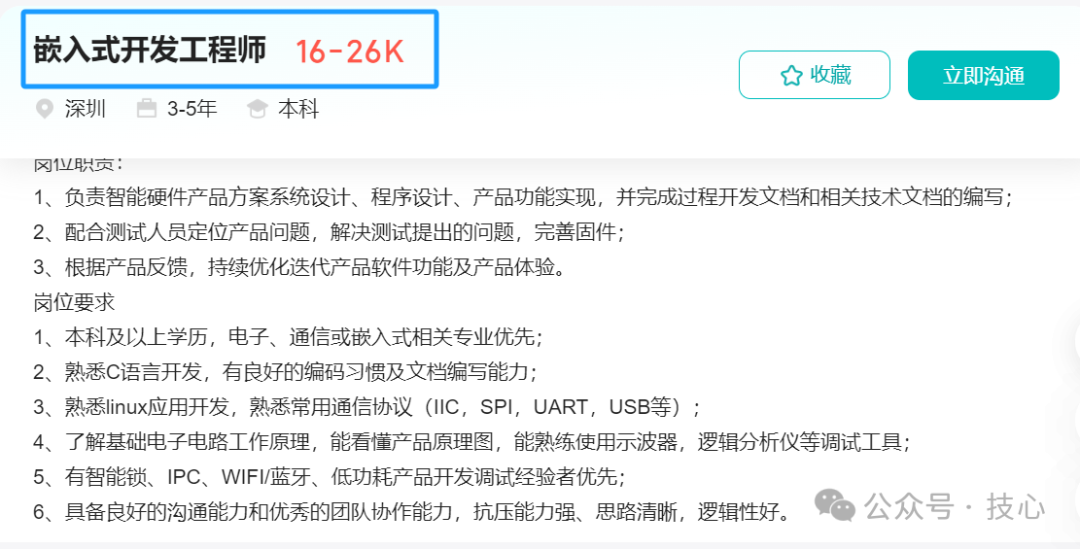
Embedded Development Technology Stack Demand Heat Map (2024)
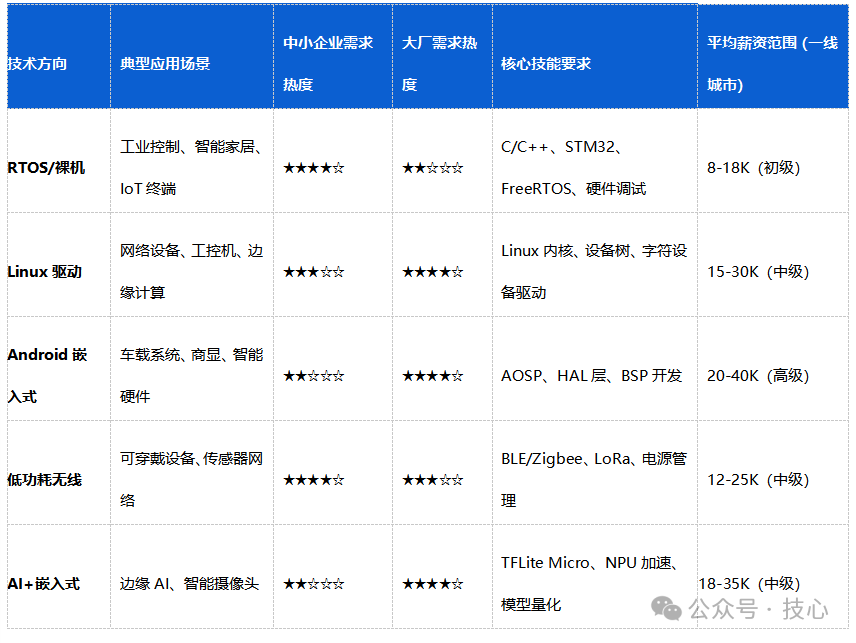
Suggestions:
lIf your educational background is ordinary: prioritize RTOS + low-power combinations (high demand in SMEs, relatively low threshold)
lIf your target is major companies: you need to delve into Linux drivers or Android Framework (high technical barriers, less competition)
lFor long-term development: supplement Python + AI capabilities (trend in edge computing)
Although the positions in SMEs are segmented in different directions, they all require hands-on abilities and practical experience. Students can choose specific career direction fields based on their interests and strengthen their learning and practical skills accordingly, accumulating skills through projects to lay the foundation for future career transitions.
Which embedded direction do you most want to conquer?