
Click the above PC Enthusiasts to follow us
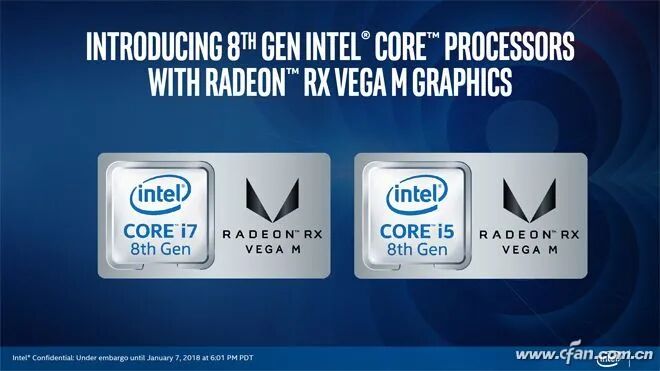
For PCs, the processor is the most critical hardware that determines performance. So, what are the differences between laptop and desktop processors, and why do desktop processors always lead in performance? Additionally, what are the most common processors in the laptop field today? How do they compare in terms of strength and weakness?Defined by TDPProcessors from the same brand during the same period will use the same manufacturing process and microarchitecture.For example, each generation of Intel Core processors will have both desktop (desktop) and mobile (laptop) versions.The most significant parameter difference between these two types of processors is TDP (Thermal Design Power), which indicates the amount of heat a CPU can dissipate under typical power consumption, serving as a reference for thermal system design.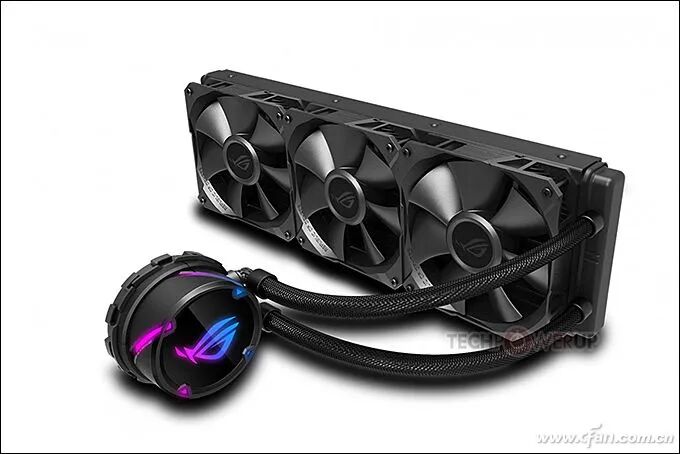 No matter how luxurious the cooling module of a laptop is, it is limitedThe TDP of mobile processors dedicated to laptops is a maximum of 45W, while the TDP of desktop Core processors starts at 65W.High-end desktop processors require water cooling to suppress high temperaturesOf course, there are exceptions. In April 2018, Intel collaborated with AMD to launch the Kaby Lake-G platform (part of the eighth generation Core), where the CPU remained on the seventh generation Core Kaby Lake core, while the GPU borrowed from rival AMD’s Radeon RX Vega M GH/GL integrated graphics. The platform includes several members: i7-8809G, i7-8709G, i7-8706G, i7-8705G, and i5-8305G, with TDPs of 100W and 65W.
 We can understand processors with the same process and architecture as Coca-Cola; they have the same taste, while TDP is the size of the packaging.
 Desktop processors have a higher TDP, so they choose larger bottles, containing more energy that can be distributed to more people (multitasking), allowing one person to enjoy more (higher performance).Mobile processors, on the other hand, are like small bottles or cans of cola; their advantage is being smaller and more portable (power-saving and conducive to thin designs), but constrained by the maximum packaging volume, they can quench your thirst (quick consumption) but are hard to keep running at full power for long periods.Other Performance Influencing ParametersBased on the same process and microarchitecture, the strength of processor performance also depends on the number of cores, base/turbo boost frequency, and cache size.Generally speaking, the higher the TDP, the easier it is for the processor to accommodate more physical cores (with a corresponding increase in cache) and to set higher base and boost frequencies.In other words, other performance-influencing parameters are still constrained by TDP. Therefore, by looking at TDP, we can roughly understand the tier standard of a processor.
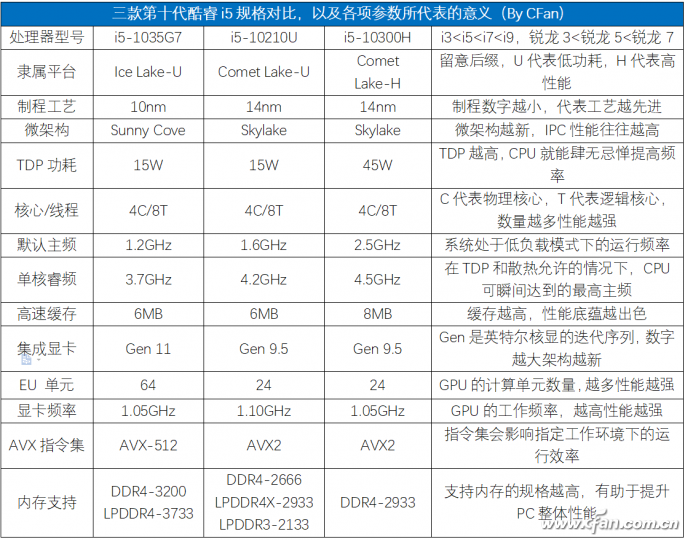 Different brands (such as Intel and AMD) and different product lines under the same brand (such as Core or Pentium) have more or less differences in process, architecture, frequency, cache, and other functional modules. Therefore, even if the TDP is the same, there may still be significant performance differences between them. However, these will not be discussed in this article; interested readers can follow up on CFan’s subsequent reports.Next, let’s briefly understand the classification of laptop processors.Intel SectionH Series (45W)Representatives: Core i5-10300H, i7-10750HThe H series Core processor platform has a TDP of 45W, with performance reaching about 80%~90% of the same-level desktop processor (e.g., mobile i5-10300H vs. desktop i5-10400, depending on the laptop’s power wall settings), specifically tailored for gaming laptops. To unleash stronger performance, H series cores require relatively luxurious cooling modules, making it difficult for ordinary thin laptops to handle them stably. If you enjoy gaming or engage in video editing, complex programming, and other multitasking work environments, look for products equipped with this series of processors.
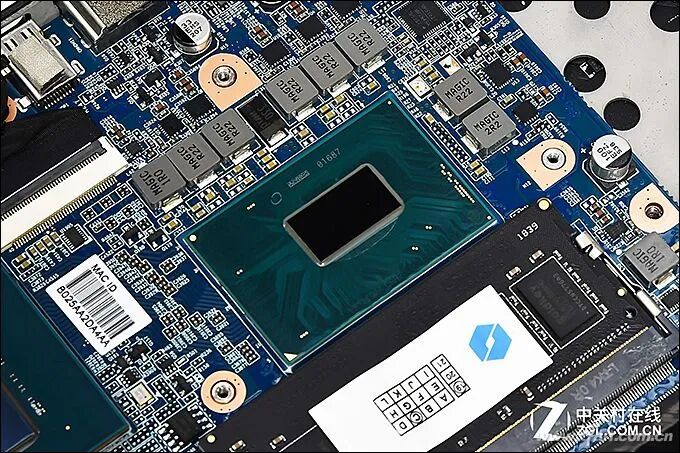 Most H series Core processors are single-chip designsU Series (15W~28W)Representatives: i5-10210U, i5-1035G7The U series Core processor platform primarily has a TDP of 15W, with a few top models having a TDP of 28W. The performance of these processors is about 20%~30% lower than that of the same-level H series Core, but they come with relatively lower heat generation and power consumption, allowing them to fit into lighter and thinner laptops, significantly improving battery life. If you want a balance between thinness and performance, laptops equipped with this platform will not disappoint you.
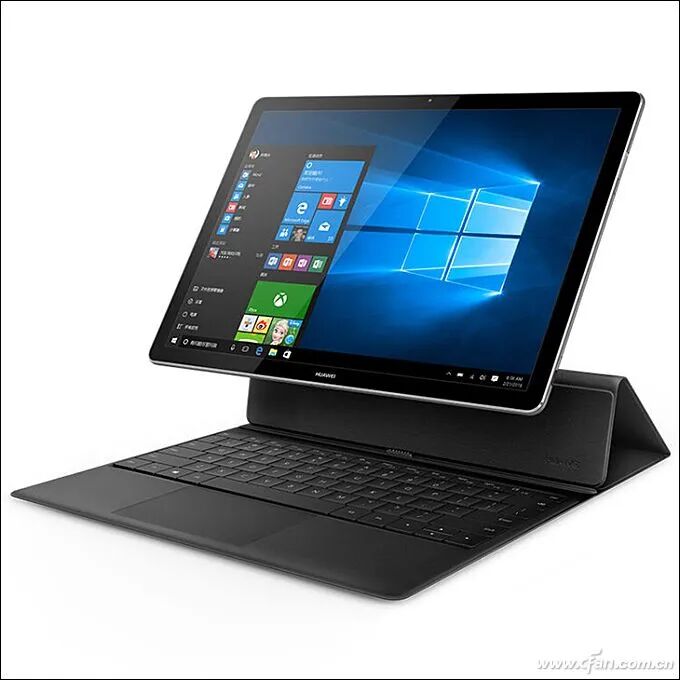
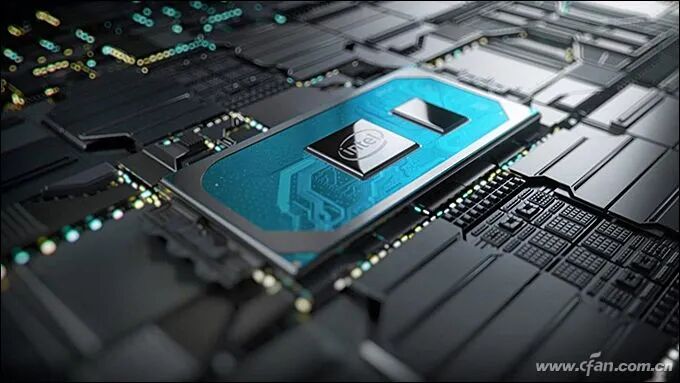 U series Core processors are often integrated into a basic dual-chip design, consisting of a CPU and a southbridge chipY Series (4.5W~12W)Representatives: i5-10310Y, i5-1030G7The early Y series Core processor platform had a TDP of only 4.5W, which has increased to 9W~12W starting from the tenth generation Core. In terms of performance, the Y series is lower than the U series at the same level, but it offers even lower heat generation, allowing for stable operation with passive cooling (no fan). Therefore, this platform is most suitable for 2-in-1 PC tablet devices, meeting the needs of business travelers for mobile office and entertainment.
 Pentium and Celeron Series (6W~15W)Representatives: Pentium J5040, Celeron J4125The mobile Pentium and Celeron are positioned below the Y series Core in terms of performance, commonly found in entry-level laptops and mini PCs priced below 3000 yuan. Their performance can only be considered barely sufficient, suitable for users with light office needs who do not play games.Lakefield Big.LITTLE Series (7W)Lakefield is Intel’s latest ultra-low power platform, which does not perform as well as the Y series but has comparable energy efficiency to ARM architecture processors. In simple terms, it uses the most advanced 3D packaging technology to fit 1 big core (Sunny Cove architecture) and 4 small cores (Tremont architecture) into a chip the size of a fingernail, along with an LPDDR4 memory controller, L2 and L3 caches, and a Gen11 GPU unit, becoming a SoC (System on Chip) similar to mobile processors. The entire chip’s packaging area is only 12mm×12mm, significantly reducing the size of mobile devices.Lakefield can reduce the entire PC motherboard to the size of a large USB drive, with the processor, memory, wireless network card, M.2 slot, SIM card slot, and more already embedded.AMD SectionH Series (45W)Representatives: Ryzen 5-4600H, Ryzen 7-4800HAMD currently focuses on “Mobile Ryzen” in the laptop field, which, like Core, is subdivided into performance-level H series and low-power U series. Among them, the H series Mobile Ryzen has a TDP of 45W (the previous generation Ryzen 3000H series was 35W), allowing it to run stably at higher frequencies, thus outperforming the U series Mobile Ryzen.
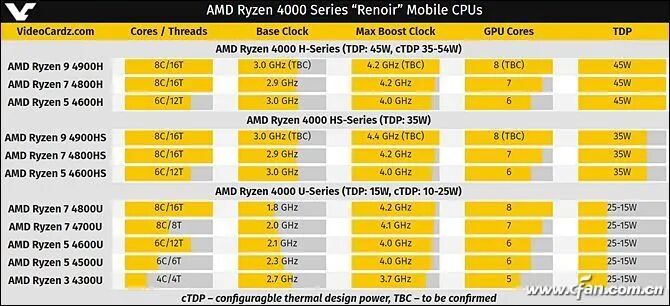 In fact, the Ryzen 5-4600H and Ryzen 5-4600U, which have the same core count and support simultaneous multithreading, are essentially the same chip. If the TDP of the Ryzen 5-4600U is increased to 45W, it becomes the Ryzen 5-4600H; conversely, if the TDP of the Ryzen 5-4600H is reduced to 15W, it becomes the Ryzen 5-4600U.U Series (15W)Representatives: Ryzen 5-4600U, Ryzen 7-4800UThe U series Mobile Ryzen processors also have a TDP of 15W, with single-core CPU performance comparable to the same-level Core (U series), but multi-core performance can outperform the same-level Core (due to more cores), and GPU performance is stronger. In the low-priced lightweight laptop market below 4000 yuan, laptops on the Ryzen platform often offer better performance-to-price ratios.Athlon/A Series (6W)Representatives: Athlon 300U, A6-9220CThe Athlon/A series is positioned similarly to Intel’s Pentium and Celeron, with performance also being barely sufficient; we will just briefly understand it, as it is not worth regular selection.
After reading this article, you might also click:

Click “Read the original text” for more exciting content