As an official partner of Unisoc, ALINX recently released the Kosmo-2 series new PG2K100 core board K100.
With a compact size of 35mm×42mm, it integrates a dual-core A53 processor + 85K FPGA logic units, 1GB DDR3 to ensure real-time data processing capabilities, and a 120-pin industrial connector for direct insertion into various device backplanes, providing a high-cost performance 100% domestically produced option for embedded devices with space constraints and high dimensional requirements.
ALINX has released multiple core modules based on Unisoc FPGA SoM, with its Kosmo-2, Titan-2, and Logos-2/Logos series FPGA SoM core boards offering a wide range of choices from entry-level to flagship performance.
Below, we will systematically outline the selection logic for these three main series of core boards (SoM) from Unisoc, helping engineers and product managers quickly identify the core board products that best meet their project needs, thereby optimizing design decisions and accelerating the product launch process.
Multi-core Heterogeneous Kosmo-2 Series
The Kosmo-2 series is Unisoc’s SoPC (System-on-Programmable-Chip) solution, characterized by the integration of high-performance ARM processors and FPGA programmable logic. This design simplifies hardware design solutions, increases integration, and enhances the collaborative processing capabilities of FPGA and ARM processors, such as running operating systems and network protocol stacks, as well as tasks requiring hardware parallel acceleration, like image processing and signal processing. The Kosmo-2 series core boards are highly attractive for embedded system applications that require compact, integrated, and powerful solutions, such as industrial control, medical, machine vision, and automotive, with numerous vertical industry application scenarios.
ALINX’s main product models based on the Kosmo-2 series are K100 (PG2K100) and K400 (PG2K400), corresponding to development platforms AXK100 and AXK400.
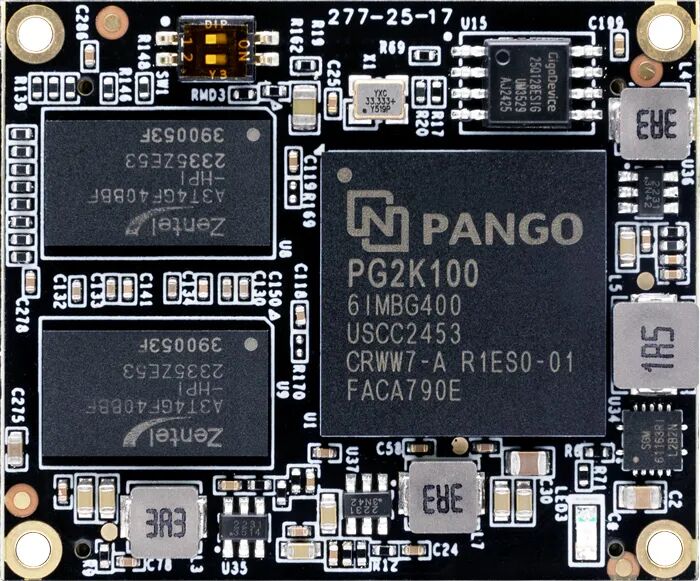
(ALINX Kosmo-2 series core board K100)
K100 integrates a dual-core ARM Cortex-A53, FPGA, DSP, high-speed interconnect bus USB2.0 (OTG), GEb, SD/SDIO/eMMC, and can be applied in security monitoring, automotive electronics, machine vision, intelligent manufacturing, video and audio acquisition and processing, medical devices, instruments, smart grids, data centers, and other industries.
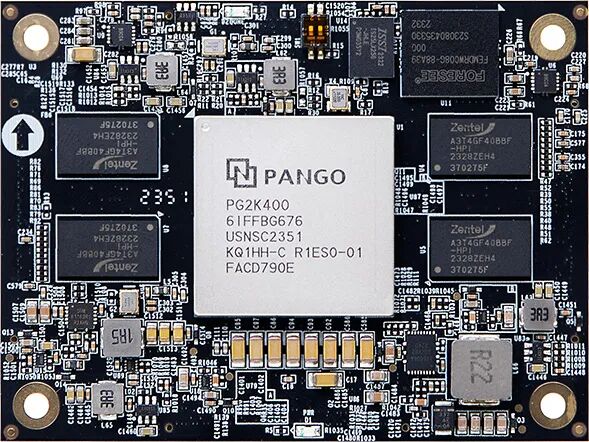
(ALINX Kosmo-2 series core board K400)
If higher logic resources are needed, K400 increases the logic units to 350K, with PCIe Gen3×8 and 8GB eMMC to build a high-speed data pipeline, applicable in surgical robots, radar, communications, semiconductor equipment, and high-end medical devices for real-time multi-stream application scenarios.
The table below compares the key parameters of K100 and K400:
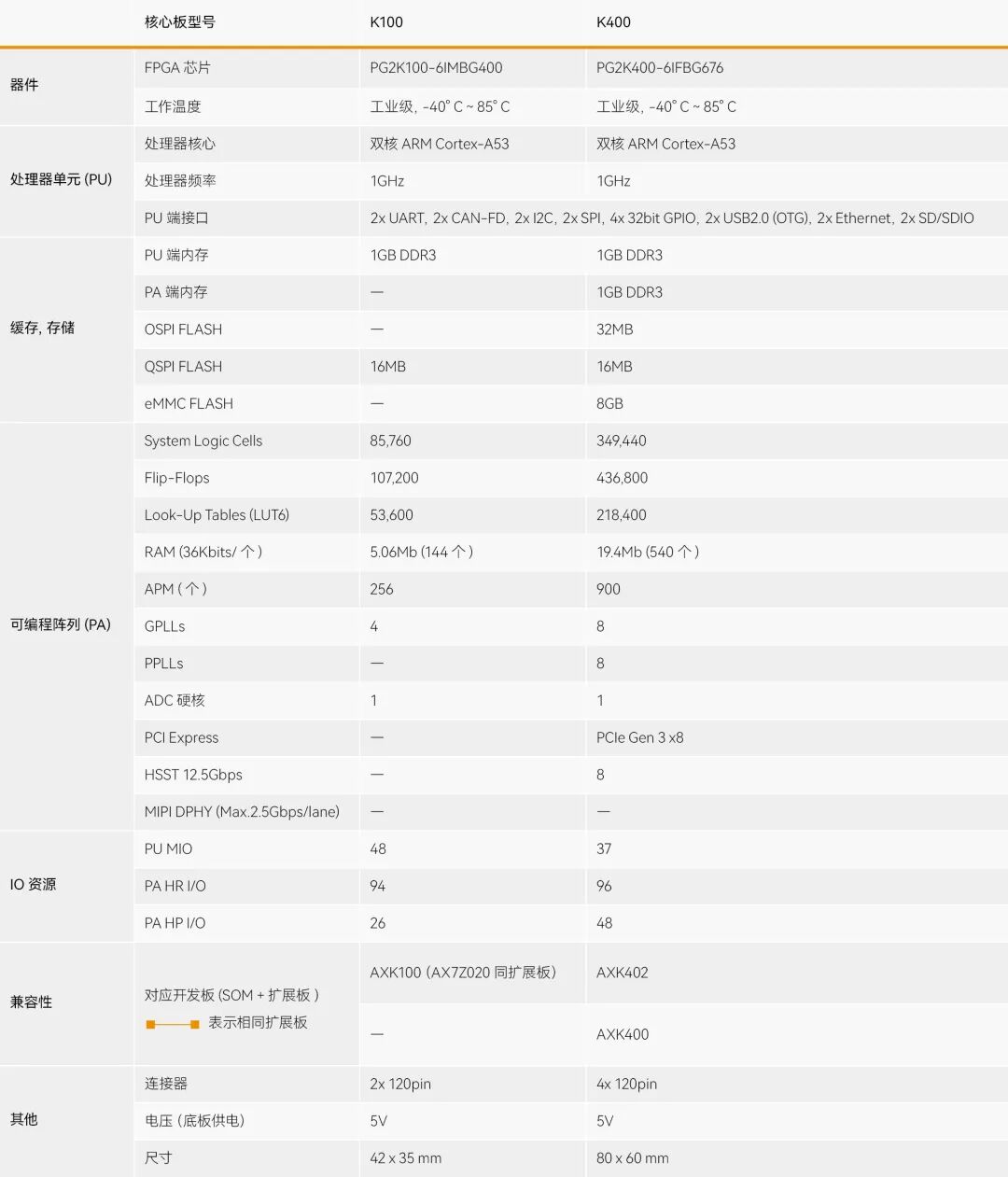
(ALINX Kosmo-2 series core board selection table)
Summary:
K400 has advantages in processor performance, FPGA logic resources, memory capacity, and high-speed interfaces, suitable for more complex, data-intensive and real-time demanding SoPC applications.
K100, with its compact size and balanced performance, becomes an economical choice for general embedded and medium complexity SoPC projects.
Titan-2 Series
The Titan-2 series represents Unisoc’s high-performance level in the pure FPGA product line. It focuses on providing massive logic resources, powerful DSP processing capabilities, ultra-high-speed serial transceivers, and high-bandwidth memory interfaces to meet the extreme requirements for data throughput and processing speed.
ALINX’s core board model based on the Titan-2 series is P390.
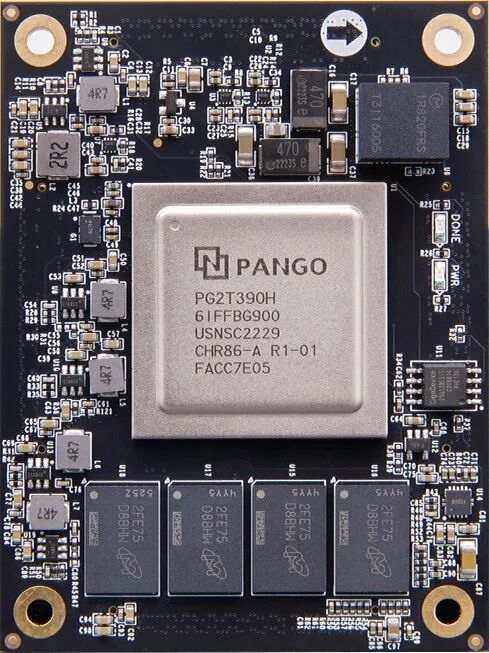
(ALINX Titan-2 series core board P390)
If you need pure FPGA parallel architecture, pursuing ultra-high-speed data throughput, such as in data center acceleration, high-frequency trading platforms, advanced radar/LiDAR systems, 5G base stations, satellite communication systems, then P390 is recommended.
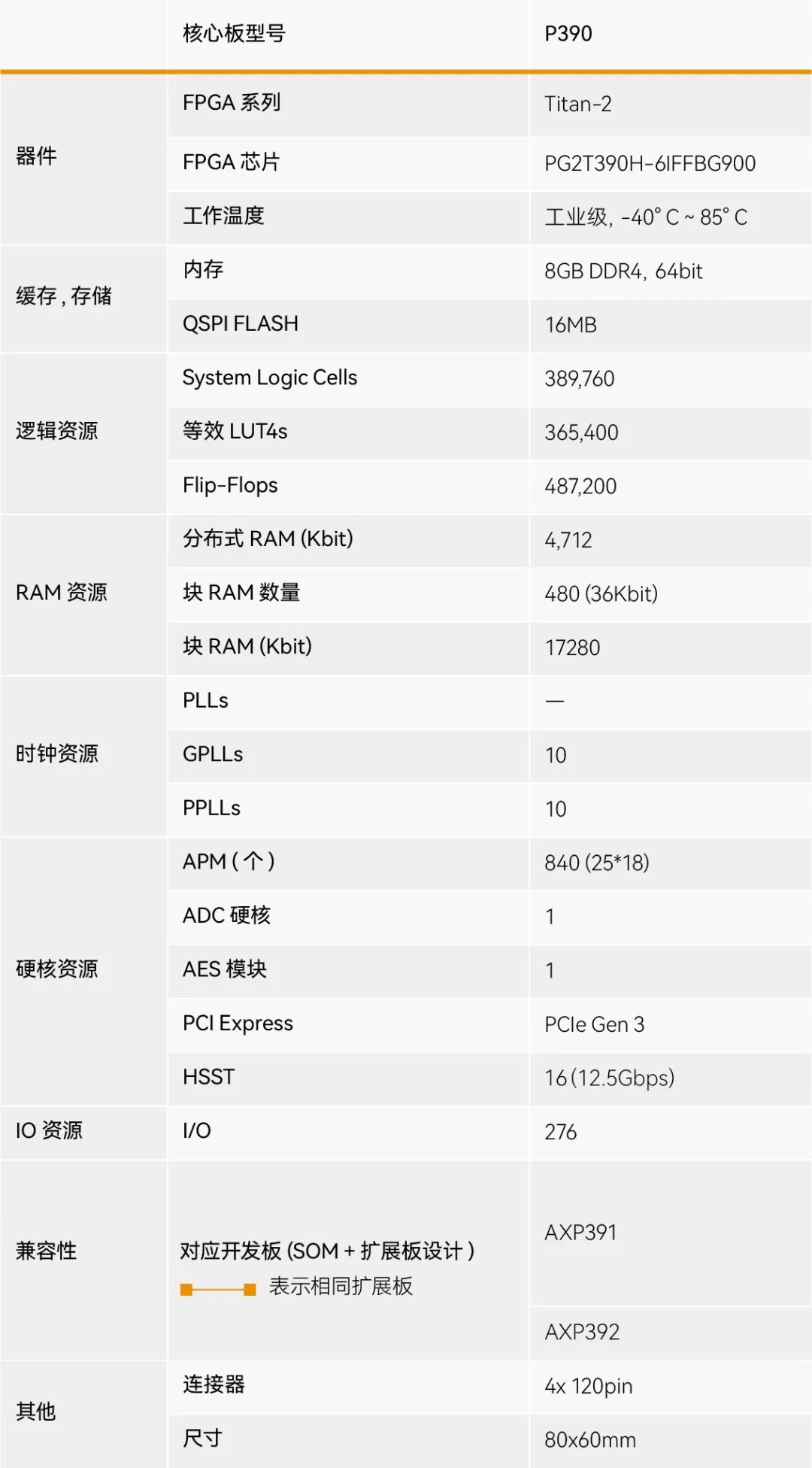
(ALINX Titan-2 series core board P390 selection table)
P390 stands out with its 16 HSSTHP transceivers, reaching speeds of up to 12.5Gb/s, and supports PCIe Gen3x8, equipped with 4 pieces of 2GB DDR4 memory, with a maximum operating data rate of 1866Mbps, and has 840 APM units, providing massive logic and DSP processing capabilities, especially suitable for digital signal processing-intensive tasks, applicable in data center acceleration, high-frequency trading platforms, advanced radar/LiDAR systems, 5G base stations, satellite communication systems, and other demanding applications.
Logos/Logos-2 Series: Cost-Effective Choice
For cost-sensitive applications with extreme environmental requirements, consider the Logos/Logos-2 series.
Logos-2 series is Unisoc’s product in the mid-to-high-end pure FPGA market, aiming to provide a good balance of performance, resources, and interfaces. It has sufficient logic resources and DSP capabilities while supporting PCIe Gen2 and multiple mid-to-high-speed serial transceivers, suitable for various complex applications.
ALINX’s main product models based on the Logos-2 series include P200 (PG2L200H) and P100 (PG2L100H).
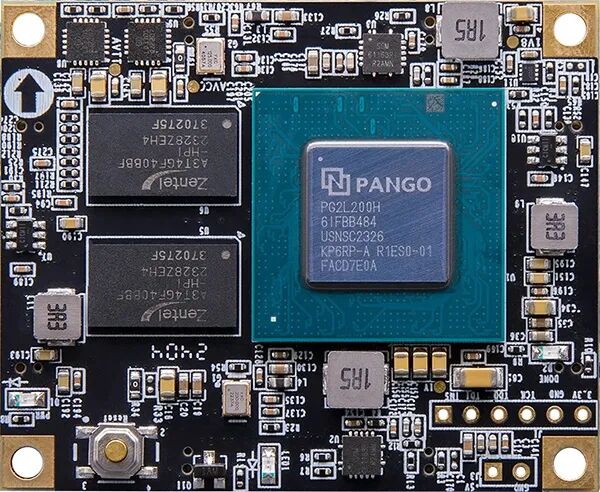
(ALINX Logos-2 series core board P200)
Logos series is Unisoc’s entry-level to mid-low-end pure FPGA product line, popular among customers for its high cost-performance ratio and wide applicability. This series offers different scales of logic resources, memory, and interface configurations, covering various application needs from simple control to medium complexity.
ALINX’s main product models based on the Logos series include P50G (PGL50G), P50 (PGL50H), P25G (PGL25G), P22G (PGL22G), and P12G (PGL12G).
Customers can choose core boards that almost perfectly match their project requirements, avoiding over-configuration and unnecessary costs.
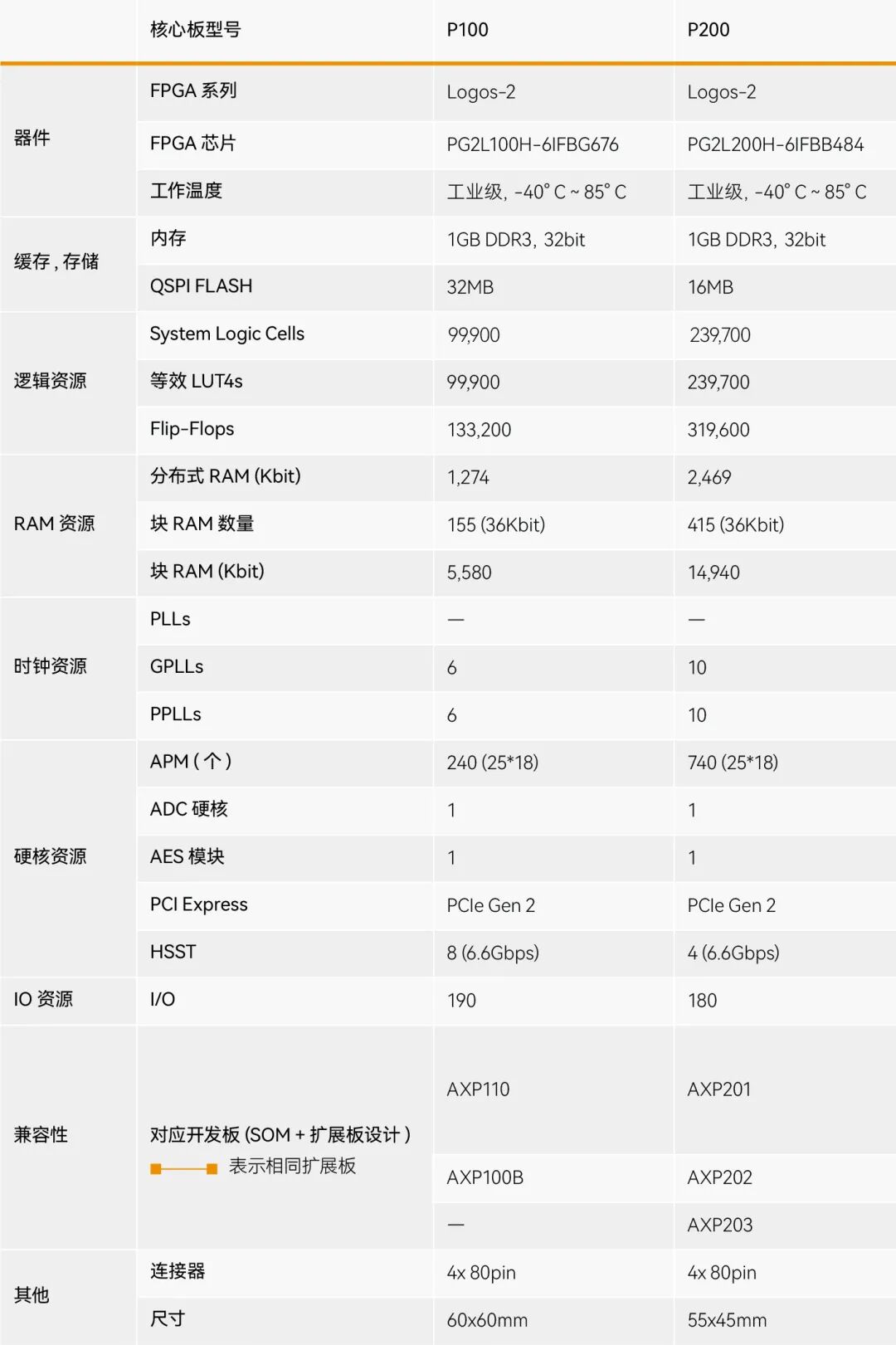
(ALINX Logos-2 series core board selection table)
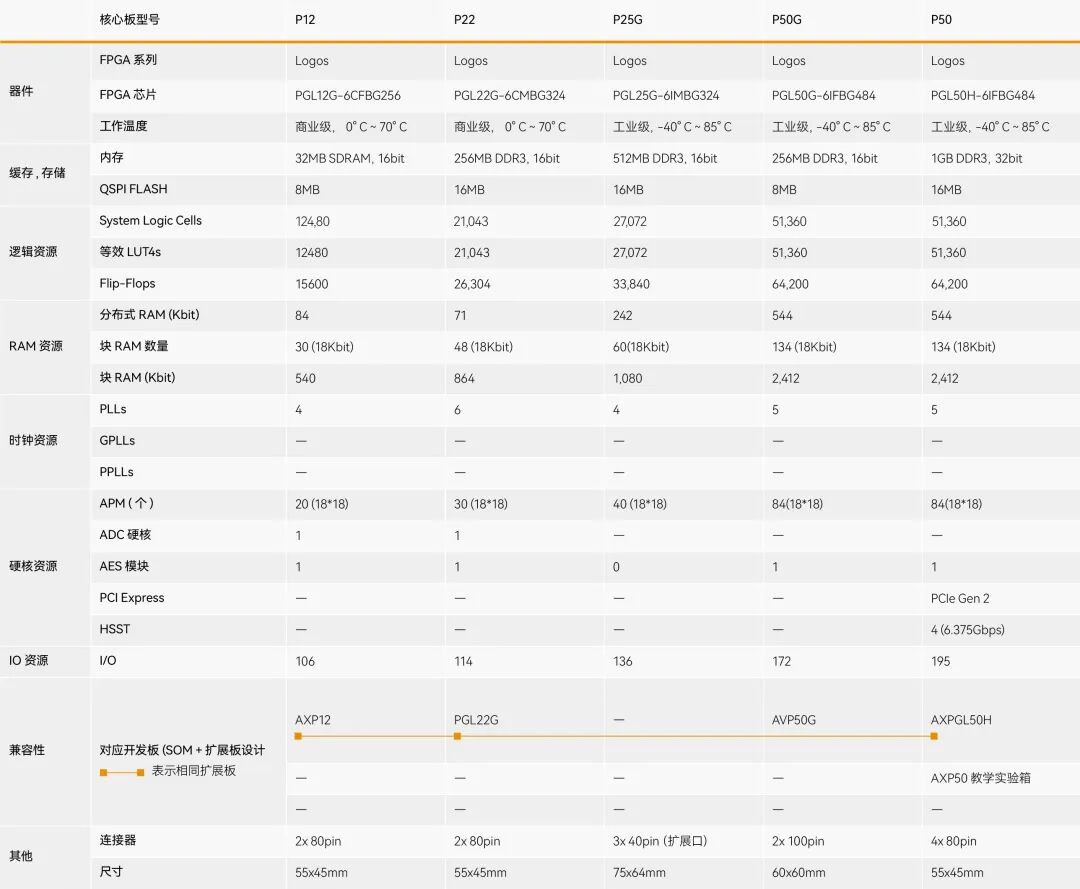
(ALINX Logos series core board selection table)
Ultimate Selection Advice
Let’s get practical! Follow the steps below to select the most suitable core board~

1. Clarify the application scenario and core requirements
Need heterogeneous computing with integrated processors and FPGAs? Prioritize the Kosmo-2 series.
K400 provides a powerful dual-core A53 processor, massive FPGA logic resources, high-speed DDR3, and PCIe Gen3x8, making it an ideal choice for ADAS, high-end video processing, complex industrial IoT applications that demand extreme computing and interface performance.
K100 offers compact size and balanced performance, suitable for security monitoring, machine vision, intelligent manufacturing, and other medium complexity general SoPC applications.
Pursuing extreme pure FPGA performance and ultra-high-speed interconnect? Select Titan-2 P390.
Its ultra-high logic resources, massive DDR4 memory bandwidth, up to 16 12.5Gb/s HSSTHP transceivers, and PCIe Gen3x8 make it a flagship solution for data centers, 5G communications, high-performance computing, and other data-intensive and bandwidth-intensive applications.
Seeking a balance of pure FPGA performance, rich interfaces, and cost? Consider the Logos-2 series.
P200 provides ample logic resources, DDR3, PCIe Gen2x8, and 4 6.6Gbps HSST channels, suitable for industrial vision, medical imaging, and other mid-to-high-end FPGA applications.
P100 offers more HSSTLP channels and larger QSPI Flash with slightly lower logic resources, suitable for applications requiring multiple mid-to-high-speed serial communications and more configuration storage.
Focusing on cost-effectiveness, suitable for general embedded or medium-low complexity applications? Pay attention to the Logos series.
P50 provides 1GB DDR3, PCIe Gen2x4, and 4 6.375Gbps HSST, making it the preferred choice for medium-performance industrial applications.
P50G has less memory but is still suitable for specific video image processing scenarios.
P25G is an entry-level option with strong performance for industrial applications, suitable for projects with environmental requirements but low performance demands.
P22G and P12G are commercial-grade entry models, with P12G using SDRAM, the lowest cost, suitable for very basic control, sensor interfaces, or educational projects.
2. Carefully consider key technical parameters
Logic resources (LUTs, FFs, BRAM, APM): Choose based on algorithm complexity, parallel processing needs, and DSP computation volume. The number of APM units is particularly critical for signal processing.
Processor and memory (DDR type, capacity, bit width, Flash capacity): Determines data throughput, processable data scale, and system software complexity. The processor performance and storage configuration of SoPC solutions (Kosmo-2) are core considerations.
High-speed interfaces (PCIe version, channel count, Serdes speed, channel count): Directly affects data exchange capabilities with external high-speed devices (such as high-speed ADC/DAC, optical modules, CPU).
I/O and peripherals (number of GPIOs, voltage adjustability, ADC/AES, etc.): Ensure compatibility with external sensors, actuators, and specific functional requirements.
Environmental adaptability (operating temperature): Industrial or commercial grade is determined by the severity of the product’s final deployment environment, which is the cornerstone of product reliability.
This selection guide aims to help you conveniently find the products that best meet your technical and cost requirements among ALINX’s rich FPGA SoM core board product line based on Unisoc, accelerating product development and seizing market opportunities.
You can also visit 【ALINX Official Website—Support—Download Center】 to download the complete SoM selection table.
Direct link: https://www.alinx.com/cate/95.html
Unisoc FPGA core boards: https://www.alinx.com/cate/147.html
If you would like more detailed consultation, please fill out the customer demand form, and ALINX will contact you as soon as possible.

| Contact Information
Official Website:www.alinx.com | www.aumo.cnService Hotline:021-67676997Technical Support: [email protected]Company Address: 3rd Floor, Building 1, No. 1 Caosong Road, Xinqiao Town, Songjiang District, Shanghai
| Scan to Learn More

ALINX WeChat Official Account

AUMO WeChat Official Account