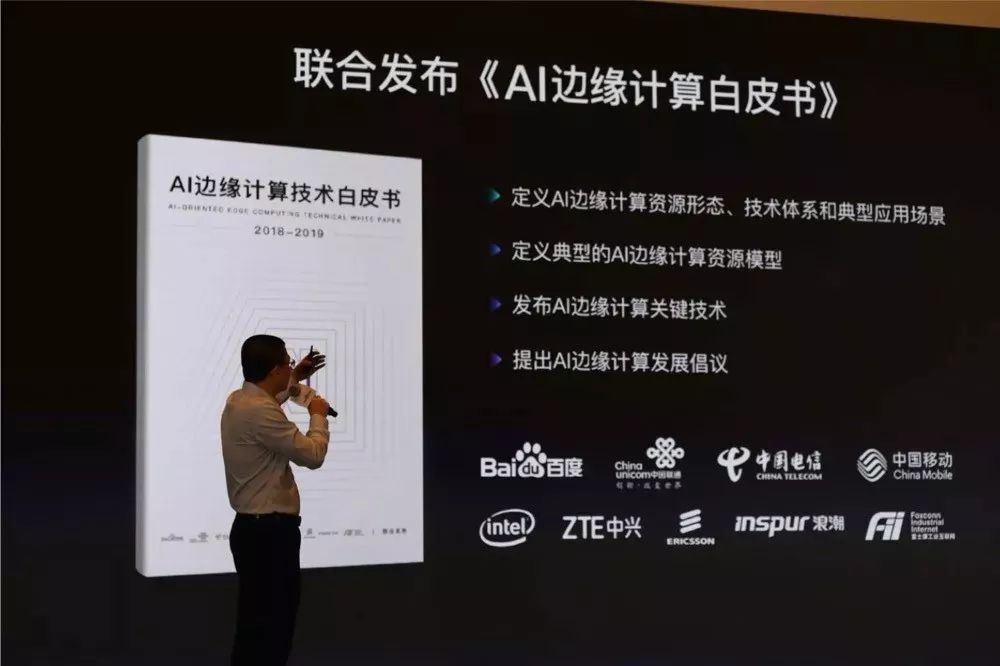
On July 4th, at the 2019 Baidu AI Developer Conference, Baidu, in collaboration with three major telecom operators, Inspur, Intel, and others, jointly released the Baidu AI Edge Computing Action Plan and the “AI Edge Computing Technology White Paper”. The white paper systematically elaborates on the broad application scenarios of the combination of edge computing and AI in the 5G era, as well as technical strategies.
01 Development Trends and Demands
The deep development of the internet service market has brought about significant changes in information flow and computing demands. According to multiple institutions’ forecasts, 5G will further stimulate the growth of video-rich media traffic, with mobile video traffic increasing by 45% annually, accounting for 73% of overall mobile data traffic by 2023. Global internet data is increasing year by year, expected to reach 40ZB in 2020, with 40% of the traffic generated by the Internet of Things, leading to a huge demand for data analysis and processing.
Edge computing can provide network, computing, and storage services close to users or data sources, not only enabling localized processing of traffic to reduce the impact on transmission networks and remote data centers, but also providing low-latency and highly stable application operating environments, facilitating the extension of computing frameworks between terminals and data centers, and helping achieve optimal matching of scenario demands, computing power distribution, and deployment costs. Edge computing will meet the following demands from consumers and the industrial internet market.
1. Edge computing is an important guarantee for upgrading consumer internet experiences.
• Video consumption upgrade: On one hand, consumers expect higher picture quality and zero tolerance for buffering during viewing experiences. From 1080P to 4K/8K, from 30 frames to 60/120 frames, higher picture quality and smoothness continuously refresh consumer viewing habits, with each level of picture quality improvement bringing a 3-4 times increase in traffic bandwidth. On the other hand, video is evolving towards immersive and highly interactive service modes. 360-degree panoramic views and video socialization are pushing video towards multi-channel and real-time directions. Edge computing can effectively avoid the resource occupation of long-distance networks by large traffic, ensuring low latency, high bandwidth, and high reliability from video sources to consumers.
• Popularization of scenario-based AI capabilities: AI capabilities have become the default configuration for most terminals. From simple image processing to AR rendering, and to complex media editing, AI capabilities enrich application interaction methods while broadening consumers’ imagination regarding information editing and creation. Providing sufficient AI computing power continuously without restrictions of time, space, and terminal types is a trend in the development of intelligent applications. Edge computing can overcome the limitations of terminals in terms of power consumption and storage capacity, combining the powerful computing power of the cloud with the ultra-low latency of the local end, thus laying a more solid foundation for the accelerated promotion of AI applications.
• Multi-modal interaction for consumers: The Internet of Things and 5G technology have promoted the interconnection of all things, with more devices that combine computing and storage functions connecting to the network, such as smart wearables, connected in-car entertainment, AR/VR glasses, and drones, among others. The interaction time between smartphones and consumers will be shared among various terminals, leading to the development of multi-modal consumption. Multi-modal interaction not only brings diversification in information supply, but also places extreme demands on performance parameters for specific terminal interaction methods, such as the requirement for VR applications to have a latency of less than 20ms. Edge computing can meet the performance requirements of diverse applications while achieving the lightweight design of terminals by distributing computing and storage capabilities, thus reducing terminal costs and optimizing terminal experiences.
2. Edge computing is a necessary infrastructure for the development of the industrial internet.
• Digitalization and networking of traditional industries: The 2019 government work report proposed the transformation of new and old kinetic energy, including the upgrading of traditional industries, the construction of the industrial internet, and the establishment of industrial-level digital ecosystems. Firstly, the networking of traditional industries accelerates data surges, for example, smart traffic systems deploy high-precision radars and multiple cameras along roads to link with autonomous vehicles to improve the accuracy of traffic information capture and establish high-precision models, thus generating TB-level data. The proximity deployment of algorithms and computing power is one of the basic requirements for the large-scale deployment of such products. Secondly, the digitalization and transmission of industrial data pose higher challenges for information security. The privatization of data requires edge computing facilities as protection to meet basic deployment requirements.
• Infrastructure sharing and industrial platforms: In order to maximize the empowerment of traditional industries by internet technology and improve efficiency, information technology needs to be deeply integrated with industry demands. Through the embedding of digital functions and the softwareization of products, intelligent development can be achieved. Edge computing is an important resource relied upon by the industrial internet, and the efficiency improvements brought by edge computing platforms will also radiate to the production processes of the industrial internet, driving the development of digitalization, process standardization, and platform services. Currently, the continuous warming of open-source software for edge computing platforms can significantly promote the future enhancement of industrial platform efficiency.
• Penetration and integration of digital products into traditional industries: The development of traditional industries towards the internet requires maintaining the intrinsic connection between digital products and production environment demands. Digital products such as smart cities, smart transportation, smart agriculture, and AI security need to be reasonably deployed to serve traditional industries. Edge computing not only meets the various requirements of traditional industries for deployment security but also efficiently satisfies the deployment environment required by digital products through platform-based technologies. Therefore, edge computing will facilitate the interaction and integration of the digital world with the physical world, realizing mutual promotion between technology and market.
02 Definitions and Technical System
Based on the requirements for computing power, latency, and stability in comprehensive applications, edge computing can be classified into three types based on the execution location of computing and product attributes:
• Device Edge: The data source itself possesses computing capabilities, such as smartphones, computing cards, smart cameras, etc. Due to processing computing requests locally at the data source, although the response latency is low and stability is optimal, it is generally limited to completing simple computing tasks due to factors like power consumption and physical resources.
• Mobile Edge: Emerging edge computing resources generated alongside the development of 5G networks, capable of optimal edge placement in conjunction with 5G terminals and wireless base stations, and combined with enhanced features such as defined wireless bandwidth, network slicing, and terminal positioning.
• Cloud Edge: Utilizing existing CDN node resources within cloud services, additional computing server resources are added to conduct function computing, AI intelligent services, and other functionalities on top of the original traffic acceleration services.
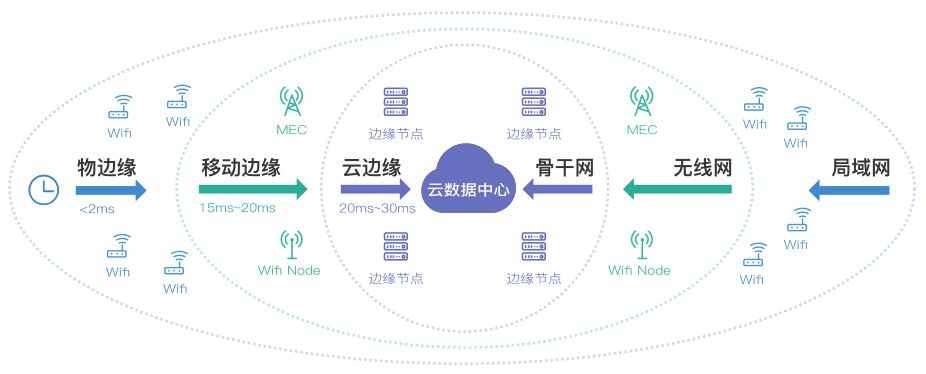
Figure 1: Edge Computing Resource Types
The above three types of edge computing resources vary in scenario design, computing tasks, product attributes, and resource readiness levels. In handling complex AI computing tasks, it is necessary to concentrate their respective resource advantages to achieve optimal overall results through matching computing tasks with corresponding resources.
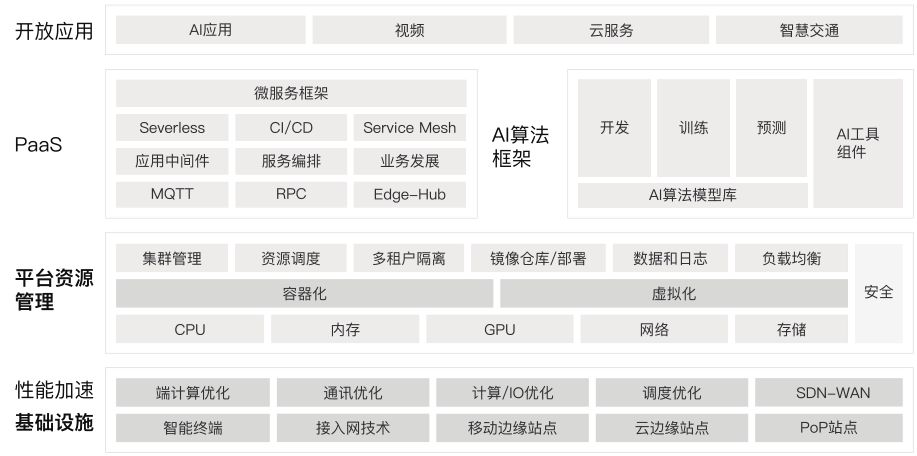
Figure 2: Edge Computing Technology Stack
To achieve such effects, the edge computing technical system needs to optimize physical resource properties, platform logical resource management, and efficient computing task frameworks, realizing the best integration of hardware and software layers. As shown in Figure 2, the technical system is divided into five parts: physical resources and acceleration, IaaS platform resource management, PaaS services, AI algorithm frameworks, and application services.
• Edge Computing Physical Resources: Physical resources are divided into smart terminals, mobile edge computing sites, and cloud edge sites, with computing tasks allocated based on different resource levels. The three types of resources connect node resources through access-side or wide-area network technologies. Access-side networks include 4G/5G, fixed access, IoT, or LAN technologies, connecting end computing to other edge site resources. The wide-area side connects data center cloud to mobile edge/cloud edge sites through PoP points, ensuring network quality between edge and cloud.
• Physical Resource Acceleration: This completes local computing, storage, I/O optimization, and node connection acceleration optimization for the above edge nodes. End nodes provide a good performance environment for AI inference computing through hardware acceleration technologies like FPGA. Mobile edge and cloud edge sites achieve acceleration and effect enhancement under power consumption requirements through AI chips, storage optimization, and high-speed I/O frameworks. Additionally, acceleration of connections between edge nodes can be achieved through 5G slicing, QoS tuning, or SDN-WAN.
• Platform Resource Management: Resource management realizes virtualization, containerization, and pooling functions for CPU/GPU, storage, and networks, meeting requirements for elastic scheduling and cluster management of resources. At the same time, the platform will provide services at the resource layer, such as tenant isolation, security assurance, image repositories, and log storage.
• PaaS Services: PaaS services provide three functional stages: Firstly, microservices during the application design and development phase, completing the dependency mapping between microservice modules and service orchestration to edge computing resources through a microservices framework. Secondly, providing the runtime environment and communication framework for services, such as business discovery, MQTT, RPC, etc., to support the functional framework for service operation. Thirdly, management services supporting service CI/CD and operational status monitoring.
• AI Algorithm Framework: This framework focuses on AI inference acceleration and the coordination of AI training algorithms across multiple nodes, completing lightweight, low-latency, and efficient AI computing frameworks from aspects of latency, memory usage, and energy efficiency. Edge devices need to execute an increasing number of intelligent tasks, such as street target detection for autonomous driving and natural language understanding for voice assistants. For real-time information inputs, AI algorithms must perform prediction processing and timely responses to inputs. Furthermore, to meet requirements for information security and data privacy, edge nodes need to complete data security preprocessing, and edge-cloud data center collaboration is essential for comprehensive AI model training. These operations, combined with AI algorithm model libraries such as CV, NLP, and tools like reinforcement learning and transfer learning, form a complete AI algorithm framework.
• AI Applications: Applications at edge nodes have a strong dependence on computing and traffic bandwidth processing. In terms of computing, applications require AI algorithm frameworks to perform human-computer interaction, encoding/decoding, and other algorithm frameworks for information preprocessing, as well as modeling algorithms for specific fields such as traffic/medical. Meanwhile, PaaS provides a friendly environment of “write once, run everywhere”. In terms of traffic, edge nodes require a physical resource environment with low convergence ratios and low latency responses to meet data transmission and interaction demands.
03 Technical Characteristics of Edge Computing
Summarizing the technical characteristics of edge computing from physical and logical perspectives.
Physically, edge nodes have characteristics of proximity to data sources, security affinity, flattened structure, and standardized infrastructure.
• Low Latency and Localized Traffic: The inherent advantages of edge computing nodes are low latency and high bandwidth due to their proximity to data sources, with multi-access characteristics enabling this technical advantage to benefit various types of data sources.
• Security Affinity: In applications across industries such as industrial, transportation, and healthcare, ensuring data security, network security, and information security is a necessary condition and service scenario for edge computing. The security deployment of edge node resources is the foundation for related scenarios.
• Flattened Computation: Edge computing further popularizes intelligence, enabling computing power to extend with edge node resources, achieving decentralization and boundary-less computation.
• Standardized Infrastructure: Different application scenarios have varying infrastructure requirements. To improve application deployment efficiency, standardized deployment specifications for infrastructure are necessary. Standardization can be defined from aspects such as deployment installation environments, I/O and acceleration component scalability, adaptability to high temperature/high humidity environments, fault management, and device maintainability. Standardized definitions help form a series of industry recommendations from equipment supply, installation deployment, operation maintenance, and fault recovery, promoting the maturity of the production chain.
Logically, edge nodes have characteristics of scenario-based, software-friendly, and service standardization.
• Scenario-based and Intelligent: Due to the directional nature of the populations and areas covered by edge computing, service scenarios also emerge, such as serving industries, parks, and transportation, which have distinct industry features. Intelligence can also be directed towards algorithm optimization and AI empowerment based on service scenarios.
• Software-friendly: Edge services extend cloud services and expand on-site services, forming an integral part of overall software services. Through the edge computing PaaS framework, the differences in underlying hardware and resource platforms are abstracted, enabling unified deployment of cloud-edge-end services.
• Service Standardization and Template Design: Rapid deployment and elastic operation of services are prerequisites for scaling edge computing services, which also require standardization and template design for typical edge computing scenarios, computing power, bandwidth, and other resources to achieve rapid replication and expansion.
04 Edge Computing Network Deployment Models
To adapt to the differentiated demands of various industries, edge computing will have various deployment forms in the industry, with each final edge network’s architecture corresponding to the business/network demands, management and operation models, and business models covered. Below are summarized three typical edge computing network deployment models.
• Enterprise Private Network: This model targets enterprises with strong demands for autonomous control over their networks, deploying the complete network data plane and control plane entirely within the enterprise’s private environment, managed by the enterprise itself. For example, providing end-to-end wireless networks and complete control plane deployment within the enterprise. The dedicated network is completely isolated from public networks, maximizing the isolation and independence of enterprise data and network environments, but also placing higher demands on the enterprise’s network management capabilities.
• Park Dedicated Network: This model satisfies the privatization deployment requirements on the data plane while reusing public deployment resources for the control plane. For example, during 5G deployment, the user plane gateway (SGW-U/UPF) can be deployed near the enterprise site, while the 5G control plane functions (AMF/SMF/PCF, etc.) still use network operator resources. Alternatively, cloud service providers can deploy on-site data plane processing functions for enterprises to meet security demands such as data not leaving the network, while offline control functions like AI model training still utilize cloud service provider resources. This model ensures the enterprise’s security demands while maximizing the reuse of public operators’ capabilities in resource management and orchestration, thus not imposing excessive maintenance requirements on enterprises, particularly for lightweight operations (e.g., a certain number of small and medium-sized enterprises organized by parks). Additionally, under this model, public service operators can simultaneously accommodate specific edge computing demands while ensuring that public network services are unaffected, making this model likely to become a typical deployment model for edge computing networks in park-type markets.
• Sliced Networking: Both the data plane and control plane utilize public service operator resources, achieving dedicated resource supply through the division of proprietary networks or resource isolation. For example, 5G uses network slicing technology to provide logically isolated networks. Differentiated slicing services are provided based on business demands combined with edge computing, constructing logically dedicated networks, while physical resources are fully integrated into the unified scheduling of public operators. For service scenarios that span large geographical areas and require specific SLA guarantees, sliced networking is an ideal solution. Of course, this model requires public service operators to have high requirements for market judgment and corresponding edge computing network resource deployment planning.
This also requires all parties in the industry, including service providers, device suppliers, and others, to explore together to derive best practices.
The above is the first part of the “AI Edge Computing Technology White Paper”. The white paper also includes topics such as AI edge computing application scenarios, key performance models, and the expansion needs of the edge computing industry. Interested readers can reply “Baidu” in the background to obtain the complete white paper.
Share this article,
Let’s promote knowledge dissemination in the field of edge computing ~