Smart Access Control Solution Based on AI MCU M55M1
Application Background
Traditional smart access control systems primarily achieve security protection through technologies such as biometric recognition, alarm linkage, and real-time monitoring. They are widely used in factories, financial institutions, medical facilities, public safety areas, commercial venues, and residential areas. However, these solutions have the following core pain points:
-
Dependence on manual screening of item carrying permissions, resulting in high labor costs and poor flexibility, without integrating artificial intelligence technology for automated judgment.
-
Data transmission requires internet connectivity, posing risks of hacking attacks, leading to lower security, and there is a certain delay in the data transmission and processing process.
-
Some solutions use biometric recognition technologies such as fingerprints and facial recognition, which have security risks related to the leakage of biometric information.
To address the above pain points, Nuvoton Technology has launched a smart access control solution based on the edge AI MCU M55M1, achieving safer and more efficient access control through local AI computing power, a non-networked design, and image recognition technology.
Solution Introduction
1. Core Functional Logic
The solution uses a camera module to capture scene images in real-time, with the M55M1 main control MCU running AI models for item recognition. Based on the recognition results, it controls the access status, with specific rules as follows:
Scene 1: A person holding a transparent wafer box in front of the camera → recognized as “unauthorized carrying item” → access remains closed;
Scene 2: A person empty-handed in front of the camera → recognized as “no carrying item” → access automatically opens;
Scene 3: A person holding a black wafer box in front of the camera → recognized as “authorized carrying item” → access automatically opens.
2. Hardware Architecture of the Solution
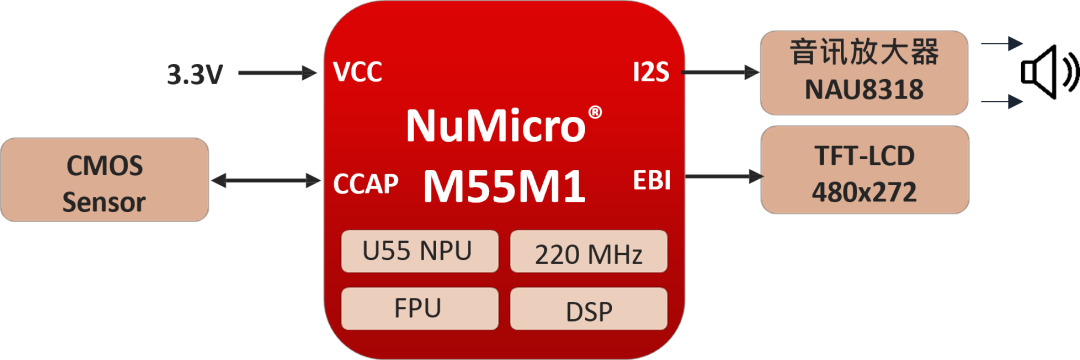
The core hardware of the solution consists of “M55M1 main control + peripheral module”. The block diagram logic and key component descriptions are as follows:
-
Main Control Unit: M55M1 AI MCU (integrated Arm Ethos-U55 NPU), responsible for image reception, AI inference, and access control signal output;
-
Image Acquisition: CMOS camera module, transmitting image data in real-time through M55M1’s 8-bit parallel camera interface (CCAP);
-
Audio Prompt: NAU8318 audio amplifier, receiving audio data from M55M1 via I2S interface, playing “access opened/closed” voice prompts;
-
Display Interaction: An external bus interface (EBI) connects to a 480×272 resolution TFT-LCD display to show access status, recognition results, and frame rate information;
-
Power Module: Provides 3.3V DC voltage to power the M55M1, camera, audio amplifier, and display.
3. Demo Function Display
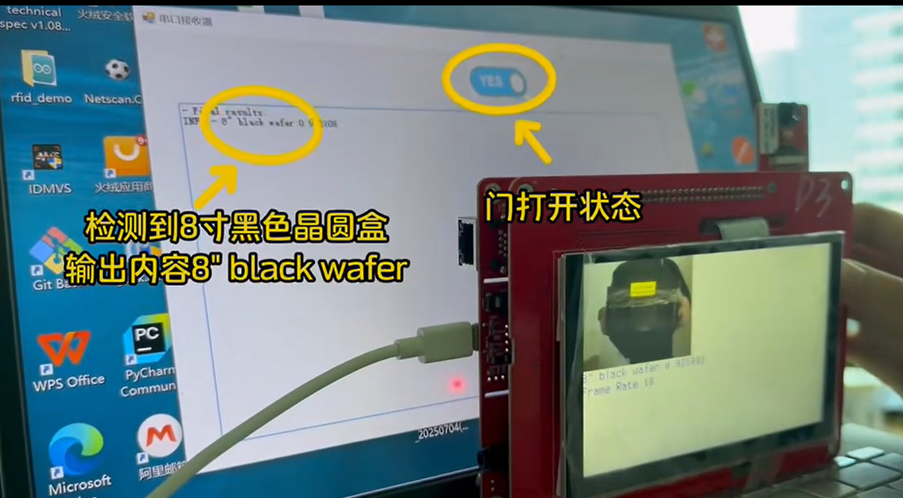
The demo achieves access control through real-time image acquisition and AI recognition, with key output information as follows:
– Recognition Result: When detecting an “8-inch black wafer box (8″ Black Wafer)” it outputs the corresponding text;
– Status Feedback: The TFT screen displays the access “open/closed” status, and NAU8318 synchronously plays voice prompts (e.g., “Access has been opened”).
Core Component: Detailed Explanation of M55M1 AI MCU
1. Core Performance Parameters
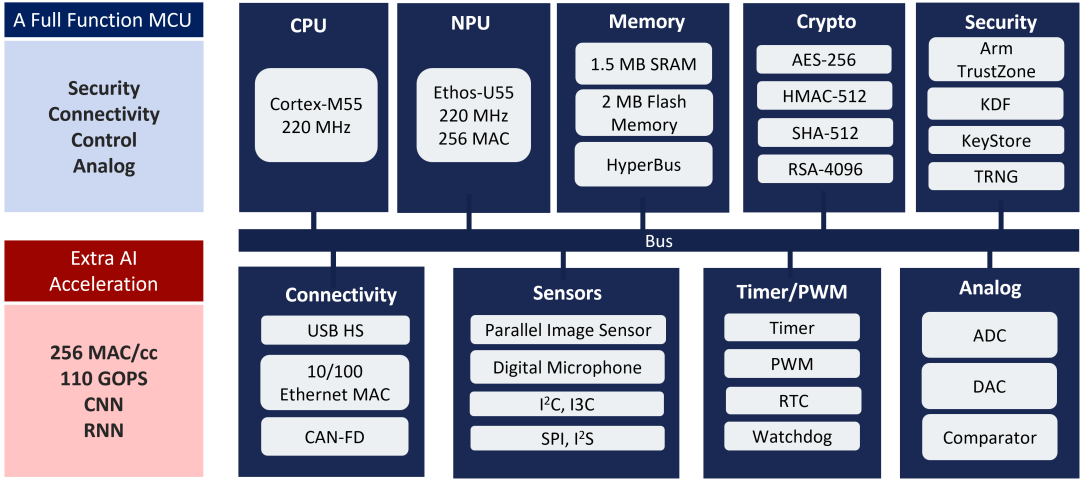
The M55M1 is a high-performance MCU designed for edge AI, with key parameters as follows:
-
Processor and Computing Power: Equipped with a 220 MHz Arm® Cortex®-M55 core, integrated with a 220 MHz Arm® Ethos™-U55 NPU (computing power 110 GOPS), supporting DSP extension, vector extension, and FPU (floating-point unit), capable of efficiently processing AI inference and other compute-intensive tasks;
-
Storage Resources: Built-in 1.5 MB SRAM, 2 MB flash, supporting OctoSPI and HyperBus interfaces, expandable external RAM/flash;
-
Power Supply and Environment: Operating voltage 1.71V~3.6V, operating temperature -40°C~+105°C, suitable for industrial and civilian scenarios;
-
Security: Supports secure boot, TrustZone hardware isolation, TRNG (True Random Number Generator), key storage, AES-256/SHA-512 encryption accelerator, and hardware-level tamper detection, compliant with PSA-Level 2 requirements;
-
Peripheral Interfaces:
-
Image Acquisition: 1 set of 8-bit parallel camera interface (CCAP);
-
Communication Interfaces: Up to 10 UARTs, 4 SPI/I2S, 4 I2C, 2 CAN-FD, 2 QSPI, 1 USB 2.0 high-speed OTG, 1 10/100 Ethernet MAC;
-
Analog Peripherals: 2 sets of 12-bit 5 MSPS SAR ADCs, 2 sets of 12-bit 1 MSPS buffered DACs, 4 analog comparators, 1 built-in temperature sensor;
-
Control Peripherals: 24 channels of 200 MHz PWM output, 4 sets of QEI (Quadrature Encoder Interface), 4 input capture units.
2. Core Advantages (for Smart Access Control Scenarios)
-
Local AI Computing Power: Ethos-U55 NPU supports INT8 quantized models, capable of running YOLO series object detection models locally without internet connectivity, with a judgment delay of ≤100ms;
-
High Security: Hardware-level encryption and isolation technology to avoid risks of data leakage and biometric information leakage;
-
Rich Peripherals: Directly compatible with camera, display, audio amplifier modules, without the need for additional expansion chips, simplifying hardware design;
-
Low Power Consumption: Local operation at the edge, resulting in lower power consumption compared to networked solutions, suitable for long standby requirements of access control systems.
M55M1 Development Process and Resources
1. Development Process

-
Model Design and Training: Developers design object detection models (e.g., YOLOv5s Tiny) based on TensorFlow, training for scenarios such as “wafer box/empty hands”;
-
Model Quantization Optimization: Use TFLite Converter for full integer quantization of the model, converting it to an INT8 TFLite model (reducing computing power requirements, suitable for M55M1 NPU);
-
One-Click Deployment: Through the NuML tool in the Nuvoton NuEdgeWise IDE, the INT8 TFLite model is automatically converted to C++ code, integrated into the M55M1 board support package (BSP), and compiled, downloaded, and executed;
-
Testing and Verification: Real-time images are captured by the camera to verify model recognition accuracy and access control logic, optimizing frame rate and delay.
2. Official Development Resources
Nuvoton provides a complete set of toolchains and documentation to lower the development threshold:
-
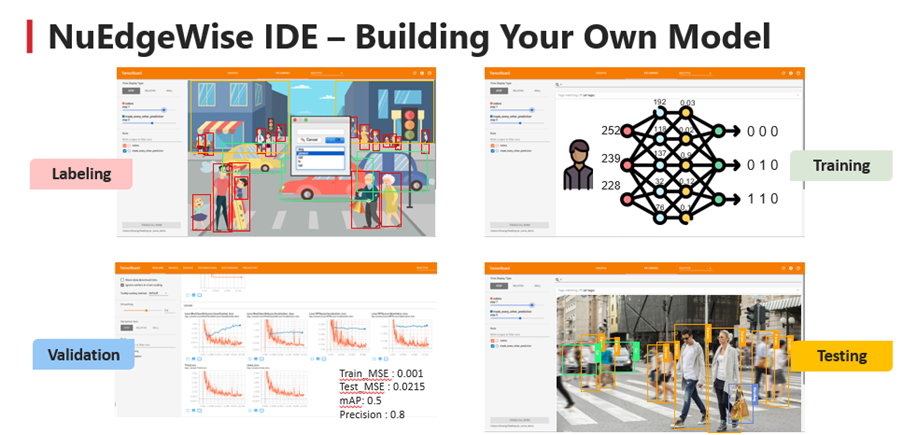
NuEdgeWise IDE: An integrated environment specifically for TinyML development, supporting the full process of “data labeling → model training → validation → testing”, providing a TensorFlow Lite model development interface based on Jupyter Notebook;
-
BSP and Drivers: Provides a complete board support package for M55M1, including driver code for peripherals such as cameras, displays, and audio amplifiers;
-
Example Projects: Provides source code for the smart access control demo (including YOLO model deployment examples and peripheral linkage logic);
-
Technical Support: Provides model optimization guidelines, hardware design references, and FAQs to assist developers in solving development issues.
Contact and Cooperation
If you are interested in the smart access control solution based on M55M1, you can obtain more information or connect for cooperation through the Nuvoton Technology AI information page https://www.nuvoton.com/ai/.
END