✅ Author Introduction: A research enthusiast and MATLAB simulation developer, skilled in data processing, modeling simulation, program design, complete code acquisition, paper reproduction, and scientific simulation.
🍎 Previous Reviews: Follow my personal homepage:MATLAB Research Studio
🍊 Personal Motto: Seek knowledge through investigation; complete MATLAB code and simulation consultation available via private message.
🔥 Content Introduction
1. Research Background and Significance
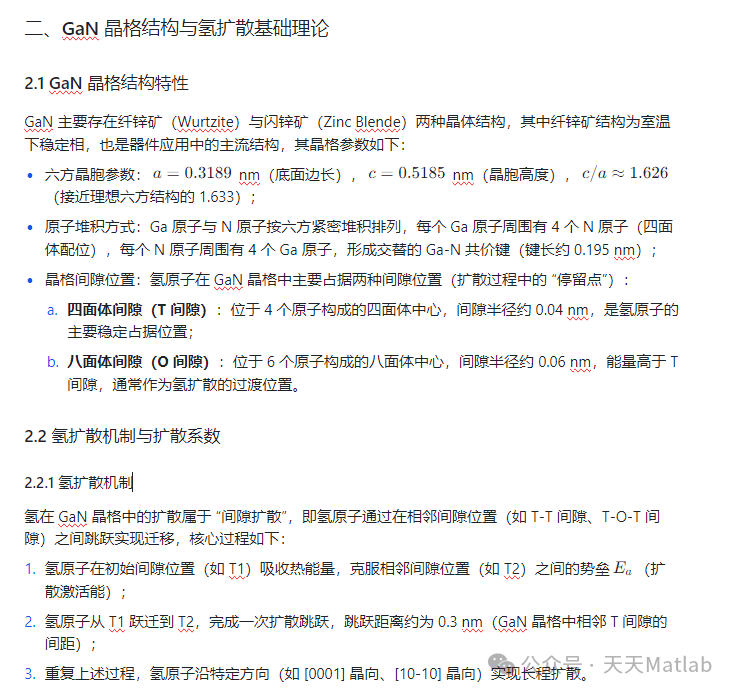
Gallium Nitride (GaN), as a third-generation wide bandgap semiconductor material, possesses excellent properties such as a large bandgap (3.4 eV), high electron mobility, high-temperature resistance, and radiation resistance, making it widely used in high-frequency power devices (such as 5G base station power amplifiers), ultraviolet detectors, and light-emitting diodes (LEDs). However, during the preparation and device processing of GaN materials, hydrogen can easily be introduced into the lattice through ion implantation, chemical vapor deposition (CVD), and other processes. The diffusion behavior of hydrogen atoms in the GaN lattice can significantly affect the performance of materials and devices: on one hand, hydrogen can passivate defects in GaN (such as vacancies and dislocations), reducing the density of defect states and improving the electrical performance of devices; on the other hand, rapid diffusion of hydrogen in high-temperature environments may lead to reactivation of defects, causing reliability issues such as threshold voltage drift and increased leakage current.
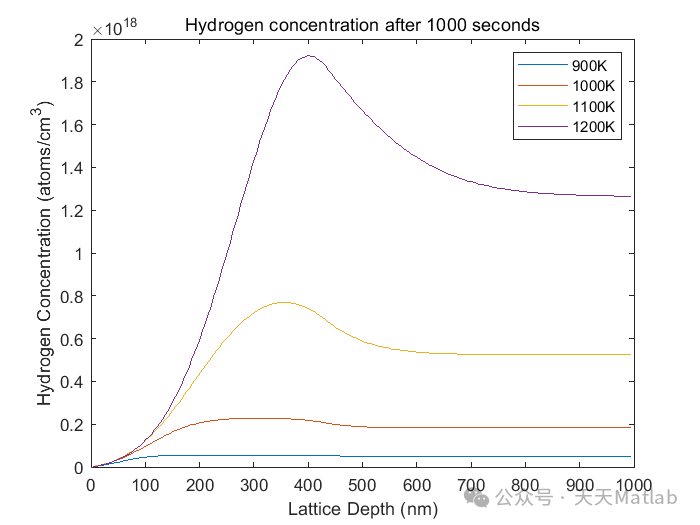
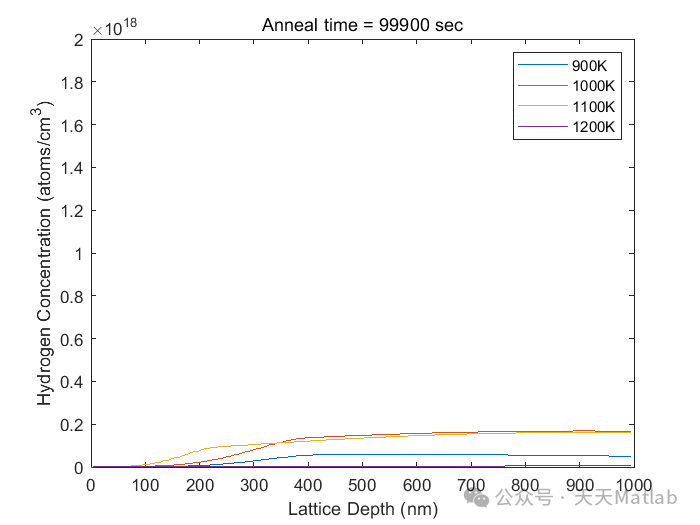
Temperature is a key factor affecting hydrogen diffusion in the lattice—an increase in temperature enhances the thermal motion energy of hydrogen atoms, increasing their probability of overcoming diffusion barriers, thereby altering the diffusion coefficient and diffusion path. Therefore, simulating the diffusion behavior of hydrogen in the GaN lattice at different temperatures reveals the influence of temperature on diffusion mechanisms and rates, which is of significant theoretical and engineering importance for optimizing GaN device fabrication processes (such as controlling hydrogen passivation temperature) and enhancing device high-temperature stability.
⛳️ Simulation Results
📣 Sample Code
hdif = (1/deltax)^2*(hconc(i-1)+hconc(i+1)-2*hconc(i));
fermi = 1/(deltax)^2*((hconc(i)+hconc(i+1))/2*(Ef(i+1)-Ef(i))/(k*T)…
– (hconc(i-1)+hconc(i))/2*(Ef(i)-Ef(i-1))/(k*T));
forces(i,2) = hdif;
forces(i,3) = fermi;
if i == floor(chargedepth/deltax)
fermi = 0;
end
deltaH = Dh*(hdif + fermi);
hconc(i) = hconc(i) + deltaH;
forces(i,1) = deltaH;
🔗 References
🎈 Some theoretical references are from online literature; please contact the author for removal if there is any infringement.
👇 Follow me to receive a wealth of MATLAB e-books and mathematical modeling materials.
🏆 Our team specializes in guiding customized MATLAB simulations in various research fields to support your research dreams:
🌟 Various intelligent optimization algorithm improvements and applications
Production scheduling, economic scheduling, assembly line scheduling, charging optimization, workshop scheduling, departure optimization, reservoir scheduling, 3D packing, logistics site selection, cargo location optimization, bus scheduling optimization, charging pile layout optimization, workshop layout optimization, container ship loading optimization, pump combination optimization, medical resource allocation optimization, facility layout optimization, visual domain base station and drone site selection optimization, knapsack problem, wind farm layout, time slot allocation optimization, optimal distributed generation unit allocation, multi-stage pipeline maintenance, factory-center-demand point three-level site selection problem, emergency supply distribution center site selection, base station site selection, road lamp post arrangement, hub node deployment, transmission line typhoon monitoring devices, container scheduling, unit optimization, investment portfolio optimization, cloud server combination optimization, antenna linear array distribution optimization, CVRP problem, VRPPD problem, multi-center VRP problem, multi-layer network VRP problem, multi-center multi-vehicle VRP problem, dynamic VRP problem, two-layer vehicle routing planning (2E-VRP), electric vehicle routing planning (EVRP), hybrid vehicle routing planning, mixed flow shop problem, order splitting scheduling problem, bus scheduling optimization problem, flight shuttle vehicle scheduling problem, site selection path planning problem, port scheduling, port bridge scheduling, parking space allocation, airport flight scheduling, leak source localization, cold chain, time windows, multi-vehicle fields, site selection optimization, port bridge scheduling optimization, traffic impedance, redistribution, parking space allocation, airport flight scheduling, communication upload and download allocation optimization.
🌟 Time series, regression, classification, clustering, and dimensionality reduction in machine learning and deep learning
2.1 BP time series, regression prediction, and classification
2.2 ENS voice neural network time series, regression prediction, and classification
2.3 SVM/CNN-SVM/LSSVM/RVM support vector machine series time series, regression prediction, and classification
2.4 CNN|TCN|GCN convolutional neural network series time series, regression prediction, and classification
2.5 ELM/KELM/RELM/DELM extreme learning machine series time series, regression prediction, and classification
2.6 GRU/Bi-GRU/CNN-GRU/CNN-BiGRU gated neural network time series, regression prediction, and classification
2.7 Elman recurrent neural network time series, regression prediction, and classification
2.8 LSTM/BiLSTM/CNN-LSTM/CNN-BiLSTM long short-term memory neural network series time series, regression prediction, and classification
2.9 RBF radial basis function neural network time series, regression prediction, and classification
2.10 DBN deep belief network time series, regression prediction, and classification
2.11 FNN fuzzy neural network time series, regression prediction
2.12 RF random forest time series, regression prediction, and classification
2.13 BLS broad learning system time series, regression prediction, and classification
2.14 PNN pulse neural network classification
2.15 fuzzy wavelet neural network prediction and classification
2.16 Time series, regression prediction, and classification
2.17 Time series, regression prediction, and classification
2.18 XGBOOST ensemble learning time series, regression prediction, and classification
2.19 Transform various combinations of time series, regression prediction, and classification
Covering directions include wind power prediction, photovoltaic prediction, battery life prediction, radiation source identification, traffic flow prediction, load prediction, stock price prediction, PM2.5 concentration prediction, battery health status prediction, electricity consumption prediction, water body optical parameter inversion, NLOS signal identification, subway stop precision prediction, transformer fault diagnosis.
🌟 In image processing
Image recognition, image segmentation, image detection, image hiding, image registration, image stitching, image fusion, image enhancement, image compressed sensing.
🌟 In path planning
Traveling salesman problem (TSP), vehicle routing problem (VRP, MVRP, CVRP, VRPTW, etc.), drone three-dimensional path planning, drone collaboration, drone formation, robot path planning, grid map path planning, multimodal transport problems, electric vehicle routing planning (EVRP), two-layer vehicle routing planning (2E-VRP), hybrid vehicle routing planning, ship trajectory planning, full path planning, warehouse patrol, bus time scheduling, reservoir scheduling optimization, multimodal optimization.
🌟 In drone applications
Drone path planning, drone control, drone formation, drone collaboration, drone task allocation, drone secure communication trajectory online optimization, vehicle collaborative drone path planning.
🌟 In communication
Sensor deployment optimization, communication protocol optimization, routing optimization, target localization optimization, Dv-Hop localization optimization, Leach protocol optimization, WSN coverage optimization, multicast optimization, RSSI localization optimization, underwater communication, communication upload and download allocation.
🌟 In signal processing
Signal recognition, signal encryption, signal denoising, signal enhancement, radar signal processing, signal watermark embedding and extraction, electromyography signals, electroencephalography signals, signal timing optimization, electrocardiogram signals, DOA estimation, encoding and decoding, variational mode decomposition, pipeline leakage, filters, digital signal processing + transmission + analysis + denoising, digital signal modulation, bit error rate, signal estimation, DTMF, signal detection.
🌟 In power systems
Microgrid optimization, reactive power optimization, distribution network reconstruction, energy storage configuration, orderly charging, MPPT optimization, household electricity, electric/cold/heat load forecasting, power equipment fault diagnosis, battery management system (BMS) SOC/SOH estimation (particle filter/Kalman filter), multi-objective optimization in power system scheduling applications, photovoltaic MPPT control algorithm improvement (perturb and observe method/incremental conductance method), electric vehicle charging and discharging optimization, microgrid day-ahead optimization, energy storage optimization, household electricity optimization, supply chain optimization.
🌟 In cellular automata
Traffic flow, crowd evacuation, virus spread, crystal growth, metal corrosion.
🌟 In radar
Kalman filter tracking, trajectory association, trajectory fusion, SOC estimation, array optimization, NLOS identification.
🌟 In workshop scheduling
Zero-wait flow shop scheduling problem (NWFSP), permutation flow shop scheduling problem (PFSP), hybrid flow shop scheduling problem (HFSP), zero idle flow shop scheduling problem (NIFSP), distributed permutation flow shop scheduling problem (DPFSP), blocking flow shop scheduling problem (BFSP).
👇