
HMI (Human-Machine Interface) refers to the hardware and software systems that facilitate information exchange between users and machines. Its core functions include user command input, system status feedback, and data visualization. In terms of form, HMI encompasses input and output components such as touch panels, display screens, and buttons. According to the “Touch-Based Human-Machine Interface (HMI) Industry Research Report” published by Beijieshi Consulting, the global market size for touch-based HMIs reached 35.782 billion yuan in 2023, and is expected to grow to 49.864 billion yuan by 2029, with a compound annual growth rate (CAGR) of 5.37% during the forecast period.
Throughout the history of HMI development, a core principle has been to achieve more natural information exchange with fewer physical constraints. As a result, traditional physical buttons are gradually being phased out, and capacitive touch technology, with its advantages of high noise resistance, low power consumption, and high precision, has become the core interaction method for modern HMI interfaces. For many years, Renesas Electronics has been deeply engaged in capacitive touch technology, and its third-generation capacitive touch technology (CTSU2) has been widely welcomed in the market since its launch in 2019.
The Core Parameters of Capacitive Touch Technology and the Advantages of CTSU2
From a technical principle perspective, capacitive touch technology is based on the capacitive coupling effect of the human electric field, detecting changes in electrode capacitance to locate touch positions. This technology is mainly divided into self-capacitance (absolute capacitance) technology and mutual capacitance (projected capacitance) technology: the former has each electrode independently forming capacitance, and when touched, the proximity of the human body changes the parasitic capacitance value of the electrode, allowing the controller to determine the touch position by detecting capacitance changes; the latter consists of a cross-capacitance network formed by an array of horizontal (X-axis) and vertical (Y-axis) electrodes, where each intersection forms a coupling capacitance. When touched, the human body couples part of the electric field, causing a decrease in capacitance value at the intersection, and the touch coordinates are determined by detecting the changes in capacitance at each point.
The entire capacitive touch system mainly includes the touch panel, touch controller (usually an MCU), and driver software. Among them, the touch controller serves as the hardware core of the system, mainly integrating capacitance detection circuits and signal processing chips, responsible for sampling, filtering, and coordinate calculation.
To evaluate whether a capacitive touch system is of high quality, several key parameters must be considered, including resolution, sampling rate, signal-to-noise ratio, and anti-interference capability. Resolution is primarily related to touch accuracy, indicating the minimum touch point spacing that can be recognized per unit area; the higher the precision, the more accurate the touch positioning. The sampling rate refers to the number of times touch signals are detected per second; a high sampling rate can enhance touch smoothness. The signal-to-noise ratio is the ratio of signal strength to noise strength; a high signal-to-noise ratio can reduce false touches and improve anti-interference capability. Anti-interference capability encompasses resistance to electromagnetic interference (EMI), electrostatic discharge (ESD), environmental light interference, as well as waterproof and anti-pollution performance. Of course, for some application scenarios, the system’s low power consumption level is also crucial.
Renesas Electronics has been deeply engaged in capacitive touch technology for many years and launched its second-generation technology IP—CTSU—early on, which was integrated into related MCU products. In 2019, Renesas Electronics introduced the third-generation capacitive touch technology (CTSU2) to the market. Compared to the previous generation CTSU technology, CTSU2 has achieved significant breakthroughs in anti-interference capability, power consumption control, waterproof performance, and functional integration.
CTSU2 has achieved revolutionary improvements in anti-interference performance through multi-frequency measurement and active shielding. Based on three-frequency measurement, CTSU2 can effectively suppress synchronous noise; even if one frequency is interfered with, the other two frequencies can still accurately capture capacitance changes, ensuring the stability of measurement results and significantly enhancing noise resistance at the measurement end.
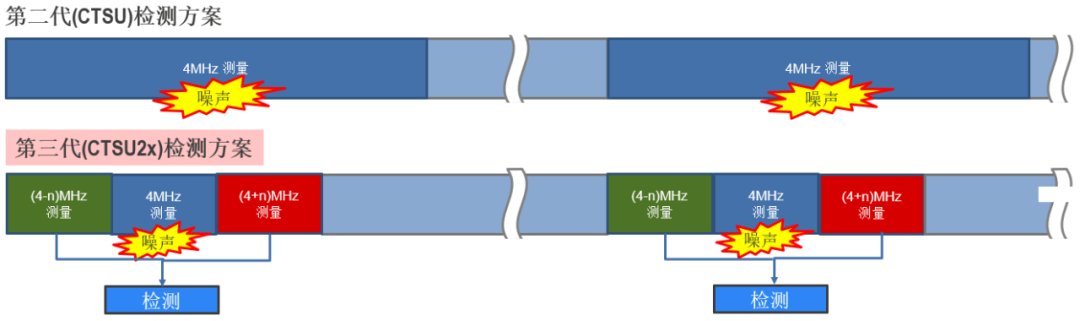
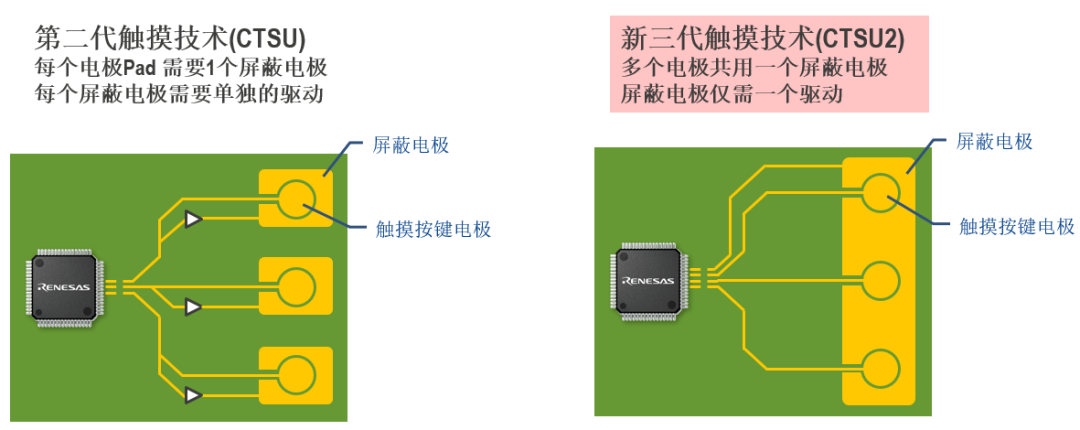
CTSU2 optimizes the design of shielding electrodes based on the second-generation technology, allowing multiple electrodes to share a single shielding electrode, significantly reducing the difficulty of hardware design. At the same time, by driving the touch electrodes and shielding electrodes to operate at the same potential and phase, CTSU2 can greatly reduce false touches caused by contaminants such as water droplets and oil stains.
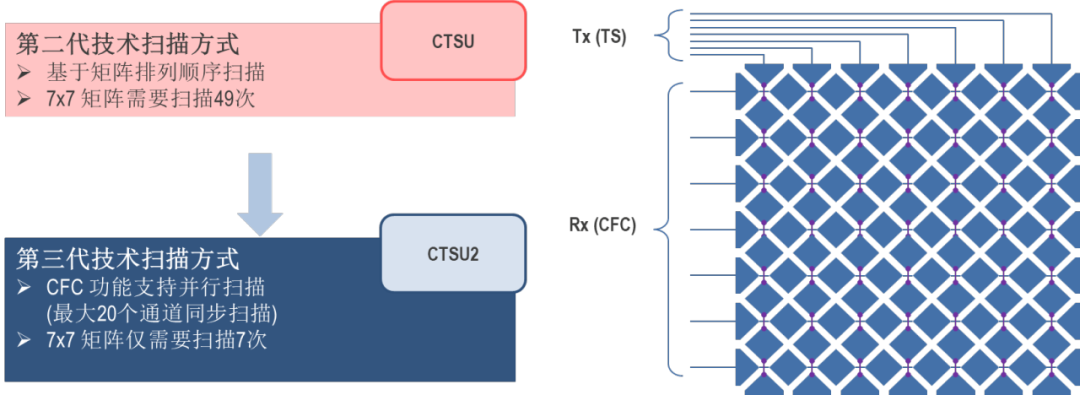
CTSU2 also focuses on optimizing accuracy and sensitivity. First, CTSU2 improves the temperature drift accuracy of the sensor (current counter), making it suitable for applications with significant temperature variations. Secondly, CTSU2 adds high-speed parallel scanning functionality (Capacitance Frequency Conversion) to the general touch IP technology, significantly reducing the number of scans and thus shortening the key response delay, making it very suitable for multi-key usage scenarios arranged in a matrix.
In addition, compared to the second-generation technology, CTSU2 performs better in terms of power consumption. Based on the general IP, CTSU2 adds multi-electrode connection and auto-judgment functions for low-power touch applications. The auto-judgment function can detect touch events without waking the CPU in the MCU’s standby state (such as sleep mode); once a touch is detected, the system automatically switches to normal operating mode. The multi-electrode connection function allows all electrodes to be connected together for a single scan, thereby reducing the time required for scanning each channel individually.
Renesas Electronics Touch MCU Product Matrix
In summary, CTSU2, as the culmination of Renesas Electronics’ efforts in capacitive touch technology, redefines the touch experience in complex environments through core innovations such as multi-frequency measurement, active shielding, low-power design, and high integration.
Currently, Renesas Electronics has launched various touch MCU products with different cores, including RL78 (16bit) and RX (32bit) as proprietary core MCUs, and RA (32bit) as ARM core products. Among them, the RL78/G23, G22 series, RX140 series, and RA2L1, RA2E1, RA4L1 series are all based on CTSU2 technology.
Taking the RA2L1 as an example, this MCU series is based on the Arm® Cortex®-M23 core, with a maximum CPU clock frequency of 48MHz, utilizing optimized processes and Renesas Electronics’ low-power technology, making it one of the industry’s leading ultra-low-power microcontrollers—compared to competitors, the RA2L1 has lower current consumption in both operating and standby modes. The RA2L1 product family is equipped with an enhanced capacitive touch sensing unit (CTSU2), serial communication interfaces, high-precision analog circuits, and timers, making it applicable in consumer applications, home appliances, industrial automation, building automation, and medical and healthcare fields.
Currently, Renesas Electronics offers a rich variety of capacitive touch MCU products, allowing users to quickly select based on packaging, flash memory size, and the number of touch channels. This includes products based on both CTSU2 and CTSU technologies, meeting users’ differentiated needs.
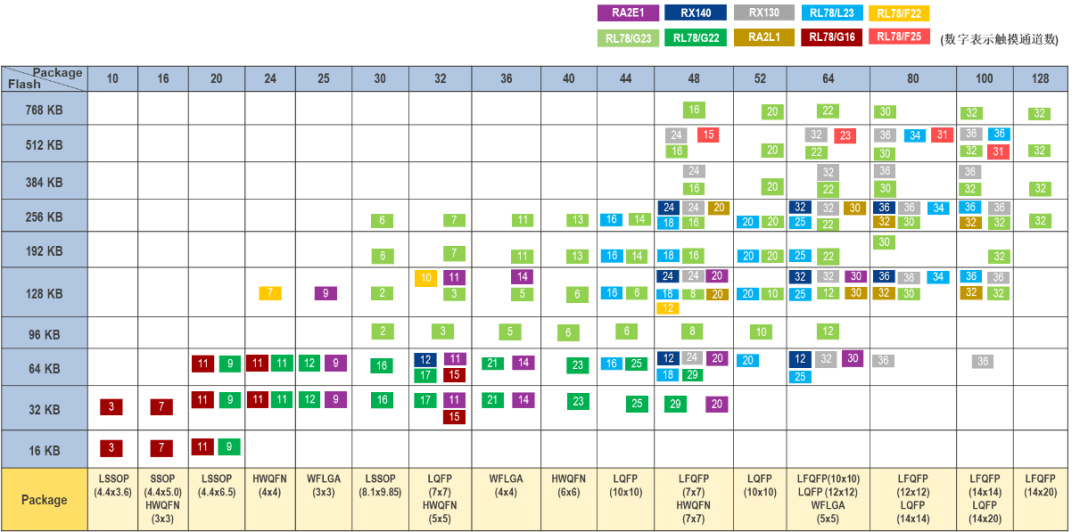
At the same time, the flexible product selection also indicates that Renesas Electronics’ technological advantages are not only reflected in the improvement of performance parameters but also through deep collaboration with MCUs, security modules, and development tools, providing a one-stop solution of “hardware + software + ecosystem” for markets such as automotive, industrial, and medical.
Conclusion
From the innovation of technical principles to the deep layout of the MCU product matrix, Renesas has elevated the capacitive touch experience to new heights through CTSU2 technology, meeting the stringent demands for touch accuracy and stability across various fields such as consumer electronics, industrial automation, and healthcare. Moreover, with a one-stop solution of “hardware + software + ecosystem,” Renesas constructs a complete closed loop from technological innovation to scene implementation. In the trend of HMI evolving towards intelligence and lightweight, Renesas Electronics, leveraging CTSU2 technology and the synergy of diverse MCU products, continues to create a more natural and reliable human-machine interaction ecosystem for global users, driving greater value for touch technology in the era of the Internet of Everything.
END
Renesas Electronics (TSE: 6723)
Technology makes life easier, dedicated to creating a safer, smarter, and sustainable future. As a global microcontroller supplier, Renesas Electronics integrates expertise in embedded processing, analog, power, and connectivity to provide complete semiconductor solutions. The successful product portfolio accelerates the market launch of automotive, industrial, infrastructure, and IoT applications, empowering billions of connected smart devices to improve people’s work and lifestyles. For more information, please visit renesas.com