
Click the blue text to follow “Textile Report”

The textile-based resistive strain sensor can collect physiological and motion signals, and has characteristics such as flexibility and breathability, playing an important role in medical and human motion monitoring fields. The existing integration methods for strain sensors are mostly adhesive or sewn, which is not conducive to long-term use. There is an urgent need to develop sensors with a wide sensing range, high sensitivity, and seamless integration.
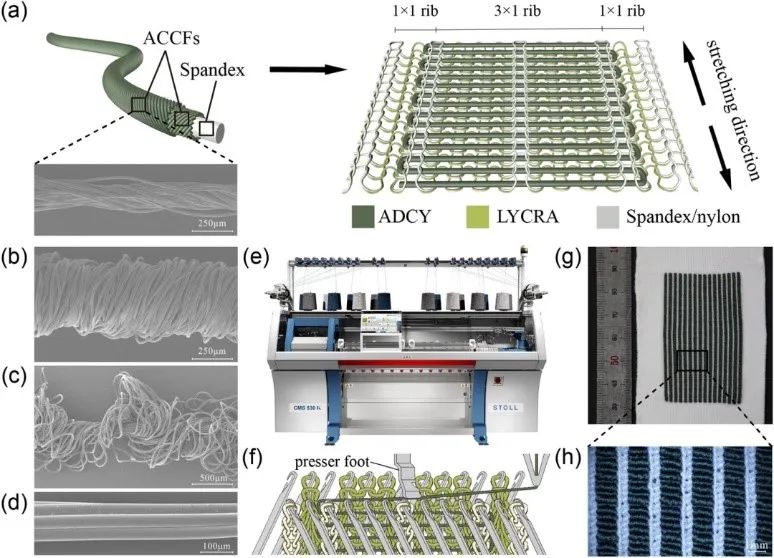
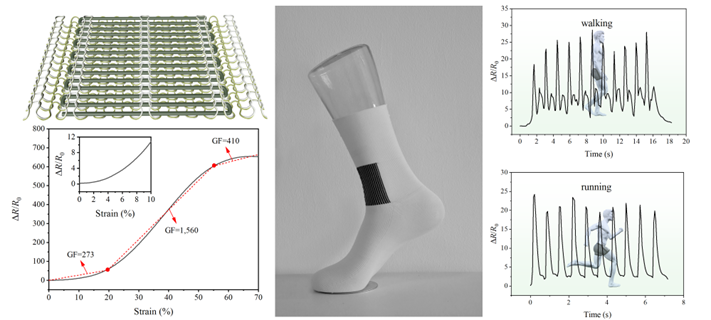 Recently, researchers from Donghua University used a knitting process to locally insert conductive acrylic double-covered yarn (ADCY) into an elastic fabric substrate, forming an “S”-shaped folded structure sensing network, and prepared a fiber-based resistive strain sensor (TRSS).The “S”-shaped folded structure endows TRSS with advantages such as a wide sensing range, high sensitivity, and low detection limit, and the use of copper-type conductive acrylic double-covered yarn (ACCF) enhances the TRSS’s oxidation resistance, stability, and durability; at the same time, TRSS can be woven and processed on industrial equipment, seamlessly integrating into various smart clothing products without additional bonding or sewing, effectively monitoring and distinguishing various human motion states, with broad application prospects in the field of human motion monitoring.The researchers used nylon/spandex covered yarn and spandex bare yarn to weave an elastic substrate, improving the substrate’s elongation, thereby achieving a wider strain sensing range; secondly, by using local weft insertion technology, ADCY was selectively and precisely embedded into the elastic substrate, thus obtaining an “S”-shaped folded stacking sensing network.
 Subsequently, the morphology changes and sensing mechanism of TRSS under 0~70% tensile strain were studied. The results show that in the initial state, adjacent ADCY units are tightly stacked, and the sensing network can be equivalently represented as a parallel circuit with low total resistance; during the subsequent tensile strain process, adjacent ADCY units separate, and the sensing network transforms into a series-parallel mixed circuit, resulting in increased total resistance; when the strain reaches 70%, the adjacent ADCY units completely separate, and the sensing network changes from a series-parallel mixed circuit to a series circuit, reaching peak total resistance. Through analyzing the sensing mechanism, it was found that the number of ADCY units and the initial strain state have a significant impact on the contact resistance and total resistance of TRSS. Therefore, by adjusting the weft insertion needle count and weft insertion rows, as well as the yarn tension of ADCY, the sensing performance can be improved.
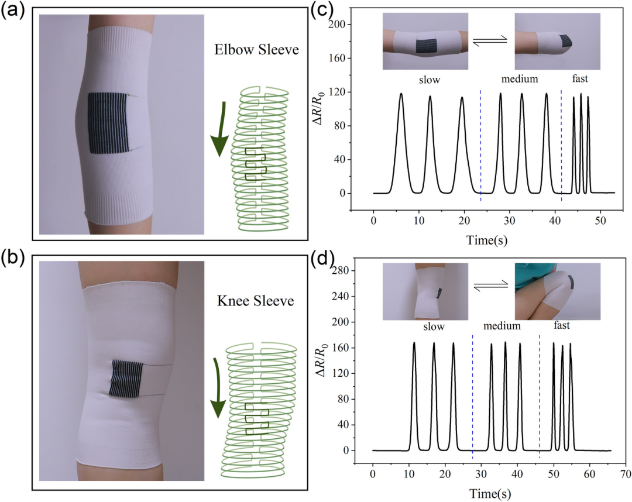
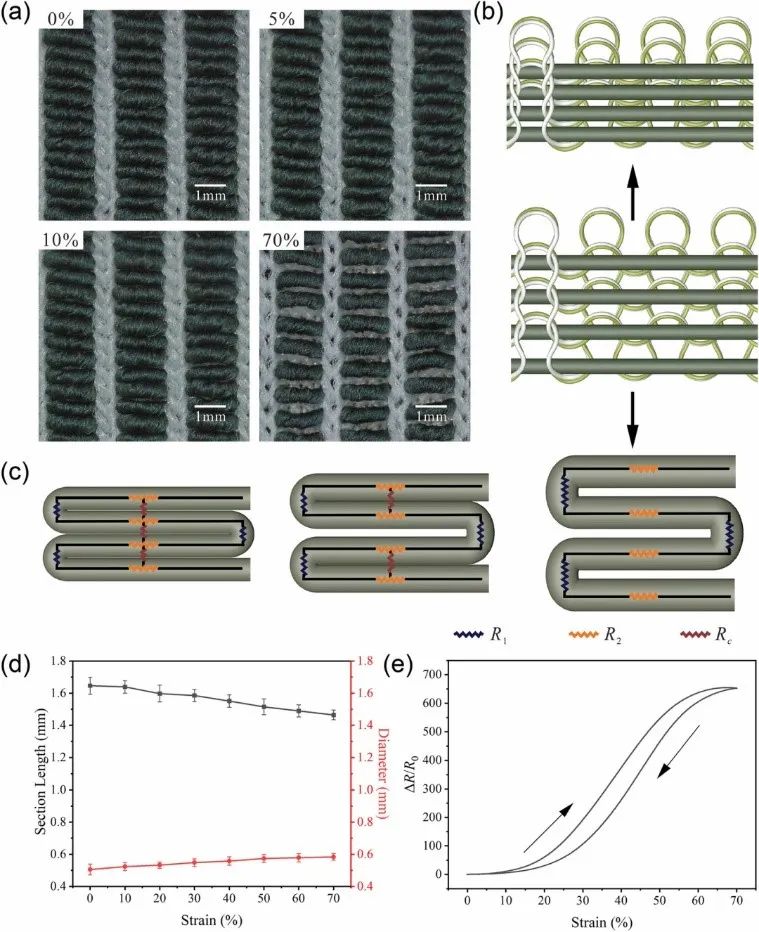 Further studies on the strain sensing performance of TRSS show that it possesses high sensitivity (GFmax=1560), a wide sensing range (0~70%), low detection limit (<0.5%), high stability, and rapid response (0.148 s), as well as advantages such as sweat resistance, wash resistance, and high repeatability (>4000 times).At the same time, to demonstrate the applicability of the stretchable strain sensor in wearable devices, the optimized TRSS was seamlessly integrated into elbow sleeves, knee sleeves, and socks, creating three types of smart clothing products, and its sensing performance was studied. The results show that after seamlessly embedding TRSS into elbow and knee protectors, there is a stable sensing response to elbow and knee bending at different frequencies.
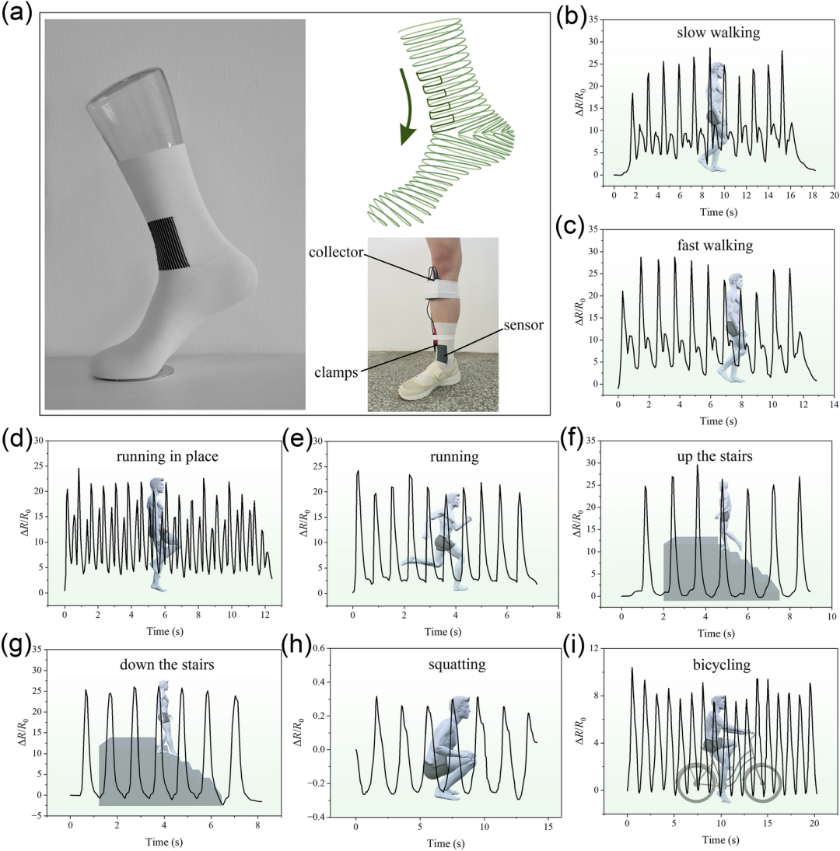
 To verify the feasibility of TRSS in monitoring multi-modal human movements, it was seamlessly embedded into elastic socks to create sensing socks. The results indicate that through the differences in resistance signals during human movements, various human activities such as walking, running, going up and down stairs, squatting, and cycling can be distinguished. Therefore, TRSS seamlessly integrated into wearable devices can monitor human joint movements in real-time.
 The related work titled “A Universal, Highly Sensitive and Seamlessly Integratable Textile Resistive Strain Sensor” was published in Advanced Fiber Materials.Source: Advanced Fiber Materials.




【Review】 Previous quality WeChat articles:

Welcome to reprint, please indicate the source, thank you!
“Textile Report”magazine is a guiding technology journal sponsored by the China Textile Information Center, aiming to provide in-depth reporting and analysis of textile technology development dynamics, and authoritative interpretation of technology policies and industry rules. It serves as a barometer of the trends in technology policies and ideas of government agencies and industry organizations, and is an important window for helping industry and enterprise decision-makers grasp the current state of textile technology and the context of the technology market.
Textile Report Official Website:www.texleader.com.cn
Distribution Hotline:010-84463638-8850
Advertising Inquiries:010-84463638-8830