👨🎓Personal Homepage
💥💥💞💞Welcome to this blog❤️❤️💥💥
🏆Author’s Advantages:🌞🌞🌞The blog content aims to be logically clear and coherent for the convenience of readers.
⛳️ Motto: A journey of a hundred miles begins with a single step.
💥1 Overview
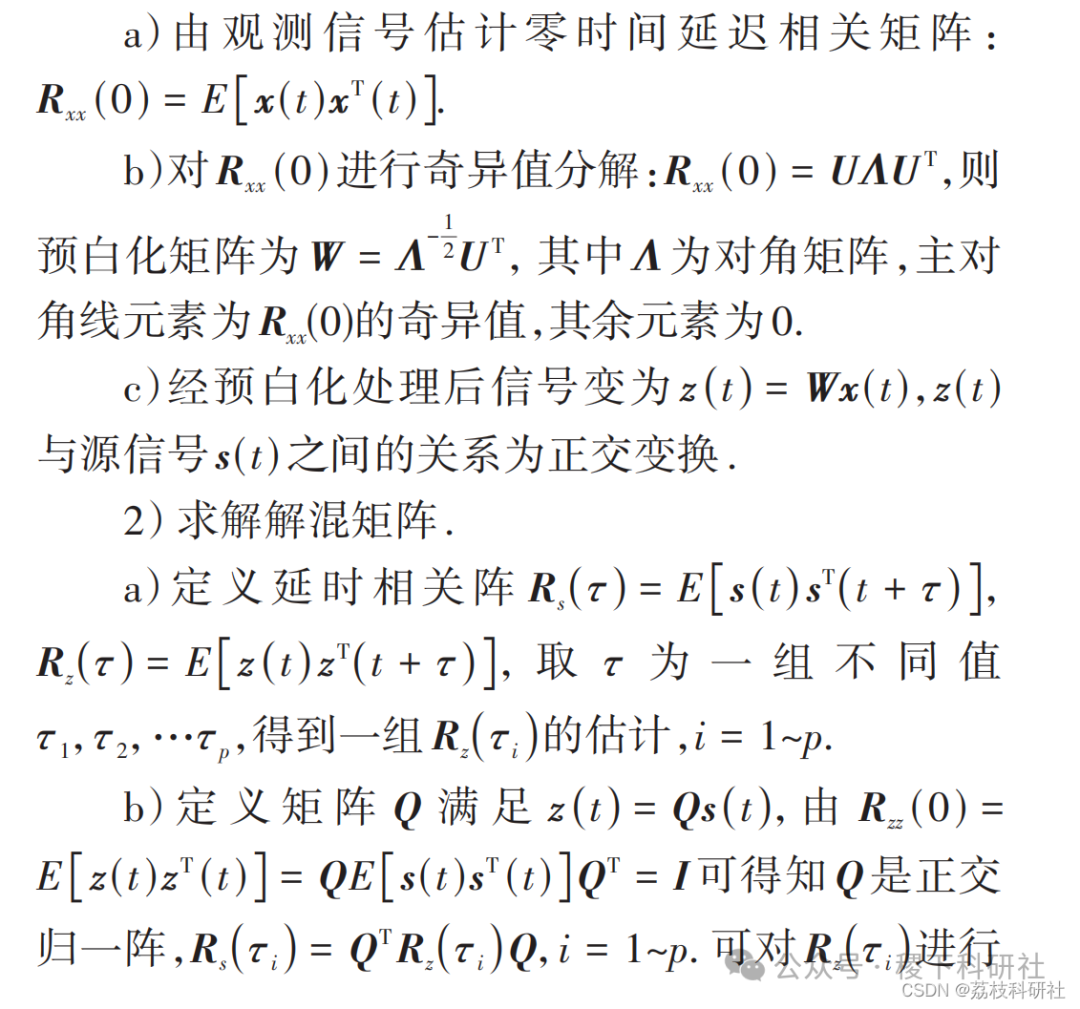
This article uses the analysis signal of measurement data, employing the two-step JAD algorithm (whitening and rotation). Essentially, it applies second-order blind identification (SOBI) to the analytical signal of vibration response data to estimate complex modes and modal responses.

Research on Modal Identification Based on Second-Order Blind Source Separation Method
Abstract
Modal identification is a key technology in structural dynamics, aimed at extracting parameters such as natural frequencies, damping ratios, and mode shapes of structures. Traditional methods rely on precise measurement of excitation signals or prior knowledge of system models, while the second-order blind source separation (SOBI) method effectively extracts modal parameters under unknown excitation scenarios by utilizing the second-order statistical characteristics of signals. This article systematically elaborates on the principles of the SOBI algorithm and its application process in modal identification, validating its accuracy through experiments, analyzing its advantages and limitations, and proposing directions for improvement.
Introduction
Background and Significance of Modal Identification
Structural modal parameters are the core basis for assessing dynamic characteristics, health status, and vibration control. Traditional methods such as frequency domain decomposition and stochastic subspace methods require the assumption that the excitation is white noise or a known system model. However, in the actual monitoring of large civil engineering structures (such as bridges and high-rise buildings) and mechanical systems, environmental excitations are complex and difficult to measure, limiting the applicability of traditional methods. Therefore, developing modal identification methods that do not require excitation information has significant theoretical value and engineering significance.
Introduction of Blind Source Separation Technology
Blind Source Separation (BSS) is a technique that separates independent source signals based solely on observed signals without prior knowledge. Second-Order Blind Source Separation (SOBI), as a typical BSS method, achieves source signal separation by analyzing the time-delay correlation matrix of signals, offering advantages such as computational efficiency and strong noise resistance, particularly suitable for the dense mode separation problem in modal identification.
Principles of the SOBI Algorithm
Core Idea of the Algorithm
SOBI is based on the following assumptions:
- Source signals are statistically independent stationary processes;
- Observed signals are linear mixtures of source signals, with an unknown mixing matrix;
- The second-order statistical characteristics of source signals (such as autocorrelation decay characteristics) can be distinguished.
The core objective is to find the demixing matrix W by jointly diagonalizing multiple time-delay correlation matrices, such that the time-delay correlation matrix of the separated signal s(t)=Wx(t) is diagonalized, where x(t) is the observed signal vector and s(t) is the source signal vector.
Algorithm Steps
- Preprocessing: Center the observed signals (remove the mean) and whiten them (eliminate variance differences) to obtain zero-mean, unit-variance signals.
- Time-Delay Correlation Matrix Calculation: Select a set of time delays τ1, τ2,…, τk, and calculate the covariance matrix Rx(τi) at different time delays.
- Joint Diagonalization: Use the Jacobi algorithm or iterative least squares method to find the orthogonal matrix U, such that all UTRx(τi)U are approximately diagonalized.
- Demixing Matrix Estimation: Estimate the demixing matrix W=VU using the whitening matrix V and the orthogonal matrix U.
- Source Signal Separation: Separate independent source signals through s(t)=Wx(t).
Application of SOBI in Modal Identification
Modal Identification Model Construction
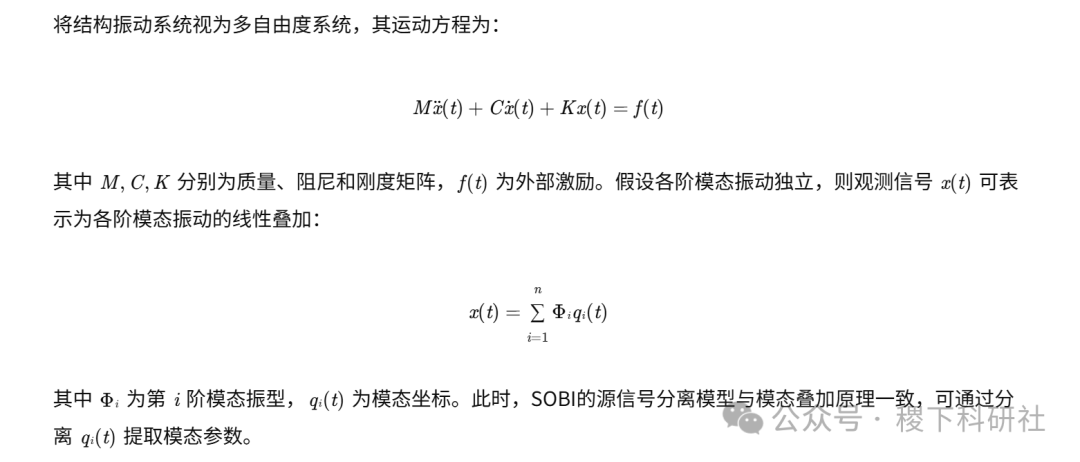
Application Process
- Data Collection: Arrange multiple sensors on the structure to collect vibration response signals under environmental excitation.
- Signal Preprocessing: Filter and denoise the collected signals (e.g., wavelet denoising, empirical mode decomposition) and center them.
- SOBI Separation: Apply the SOBI algorithm to separate independent modal response signals qi(t).
- Modal Parameter Extraction:
- Natural Frequency: Perform spectral analysis on the separated signals; the peak frequencies correspond to the natural frequencies.
- Damping Ratio: Calculate using the half-power bandwidth method or logarithmic decrement method.
- Mode Shape: Analyze the relative amplitude relationships of signals from each sensor to construct the modal shape vector.
Experimental Verification and Result Analysis
Simply Supported Beam Model Experiment
Taking a simply supported beam as the object, Gaussian white noise excitation is applied, and the response signals of four accelerometers are recorded using the NI-PXI1052 data acquisition system. The experimental parameters are as follows:
- Beam Size: 1200mm×40mm×5mm, material Q235 steel;
- Excitation Signal: Zero mean, standard deviation of 1, frequency range of 1-200Hz Gaussian white noise;
- Sensor Arrangement: Uniformly distributed on the beam.
Experimental Results
- Modal Parameter Identification:
- The SOBI algorithm successfully separated the first four modal responses of the simply supported beam, with spectral analysis showing peak frequencies of 23.5Hz, 72.1Hz, 146.8Hz, and 225.3Hz, with errors less than 2% compared to theoretical values.
- The identified damping ratios ranged from 0.5% to 1.2%, consistent with results from the stochastic subspace method (SSI).
- The modal shapes highly matched the finite element simulation results, validating the effectiveness of SOBI in mode shape extraction.
- Compared to Independent Component Analysis (ICA), SOBI performs better in dense mode separation, avoiding ICA’s dependence on higher-order statistics.
- At a noise level of -10dB, SOBI maintains over 90% identification accuracy, while traditional frequency domain methods exceed 20% error.
Advantages and Limitations of the SOBI Method
Advantages
- No Excitation Information Required: Suitable for scenarios with environmental excitation and unknown loads, breaking the dependency of traditional methods on excitation assumptions.
- Computational Efficiency: Based on second-order statistics, avoiding calculations of higher-order statistics, suitable for large-scale sensor arrays and real-time monitoring.
- Strong Noise Resistance: Second-order characteristics are insensitive to Gaussian noise, maintaining high accuracy even at moderate noise levels.
- Dense Mode Separation: Separates closely spaced modes through differences in time-delay correlation matrices, addressing the challenges of traditional frequency domain methods in distinguishing dense modes.
Limitations
- Modal Order Estimation: Requires prior knowledge of the number of source signals; unknown order in practical applications may lead to over-separation or under-separation.
- Strong Noise and Nonlinear Interference: When noise energy approaches that of the signal or when the structure exhibits nonlinear vibrations, separation effectiveness significantly decreases.
- Mode Shape Scaling Uncertainty: The separated mode shapes have amplitude scaling issues, requiring calibration with reference points or other methods.
Improvement Directions and Future Prospects
Improvement Directions
- Adaptive Order Estimation: Combine information-theoretic criteria (such as AIC, BIC) or machine learning methods to achieve automatic identification of modal order.
- Robust SOBI Algorithm: Introduce sparse constraints, regularization techniques, or time-frequency analysis to enhance separation robustness in strong noise and nonlinear scenarios.
- Optimized Multi-Sensor Arrangement: Study the impact of sensor arrangement on SOBI identification accuracy and propose optimal configuration strategies.
- Integration with Other Methods: Combine SOBI with stochastic subspace methods, wavelet transforms, etc., to leverage their respective advantages and enhance modal identification performance for complex structures.
Future Prospects
With algorithm optimization and expansion of application scenarios, SOBI is expected to become one of the core technologies in structural health monitoring and vibration control. For example:
- Monitoring of Large Bridges: Through long-term online monitoring, assess the location and severity of structural damage in real-time.
- Mechanical Fault Diagnosis: Identify changes in modal parameters of rotating machinery to provide early warnings for failures in components such as bearings and gears.
- Aerospace Structural Analysis: Separate aerodynamic elastic modes in wind tunnel tests or flight vibration data to optimize structural design.
Conclusion
The modal identification method based on second-order blind source separation effectively extracts structural modal parameters under unknown excitation scenarios by utilizing the second-order statistical characteristics of signals. Experimental validation shows that this method has high accuracy in identifying natural frequencies, damping ratios, and mode shapes, especially suitable for dense modes and structural analysis under complex environmental excitations. Despite limitations such as modal order estimation and sensitivity to strong noise, improvements through adaptive algorithms and multi-method integration are expected to provide more reliable technical support for the safe operation of engineering structures.
📚2 Running Results
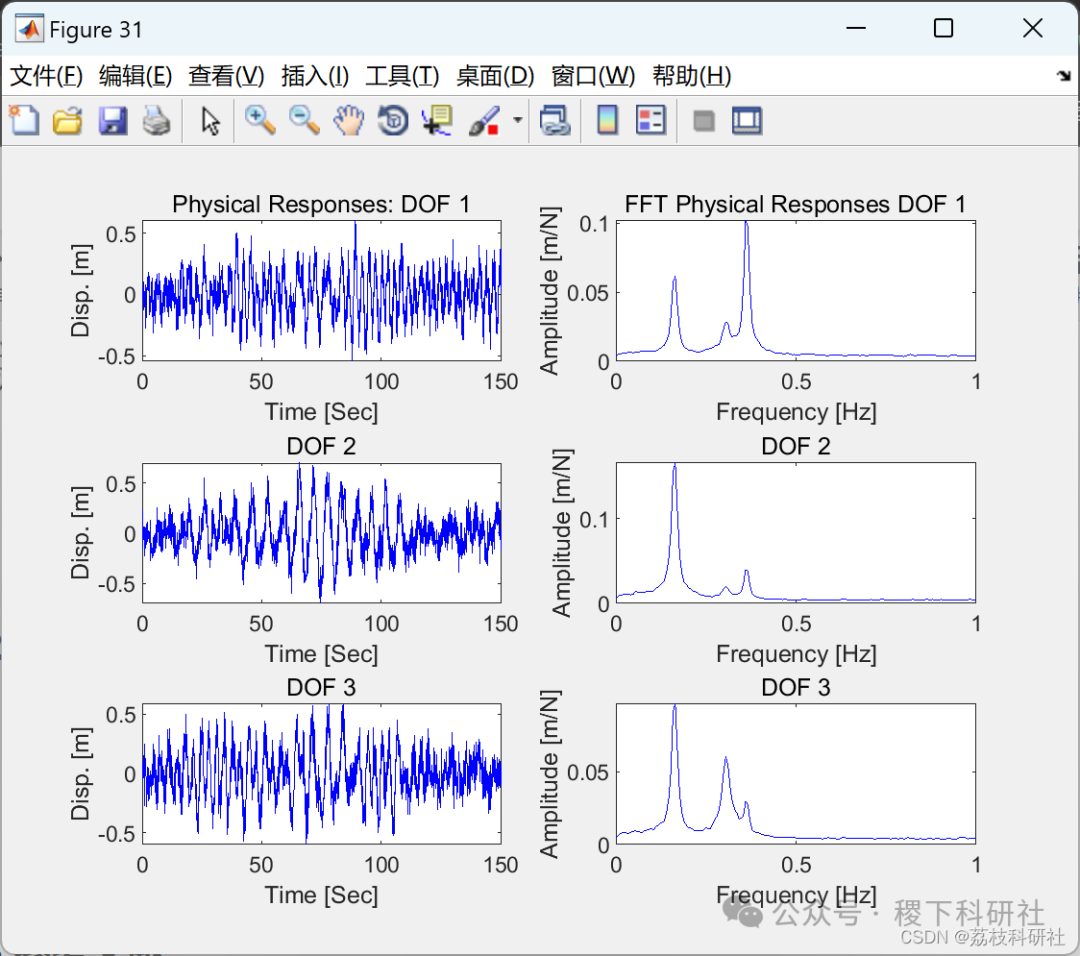
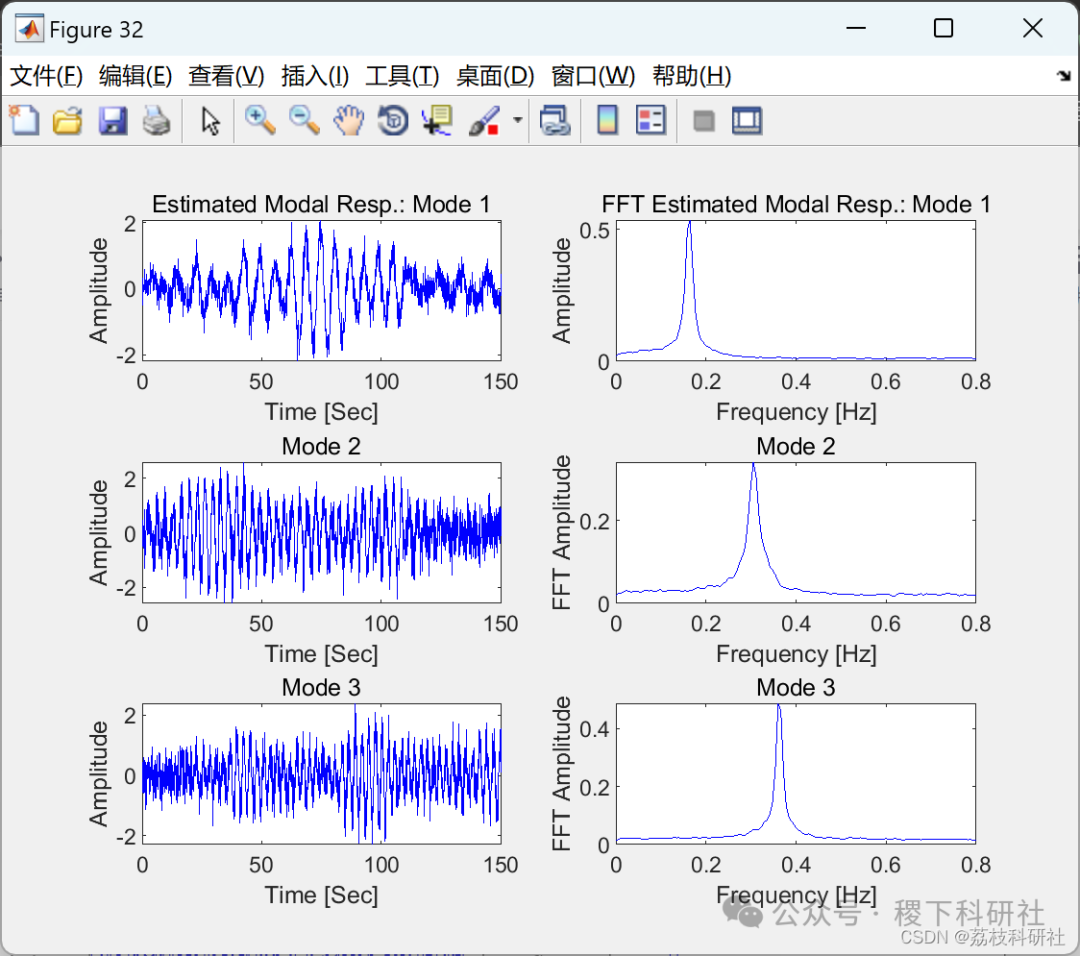
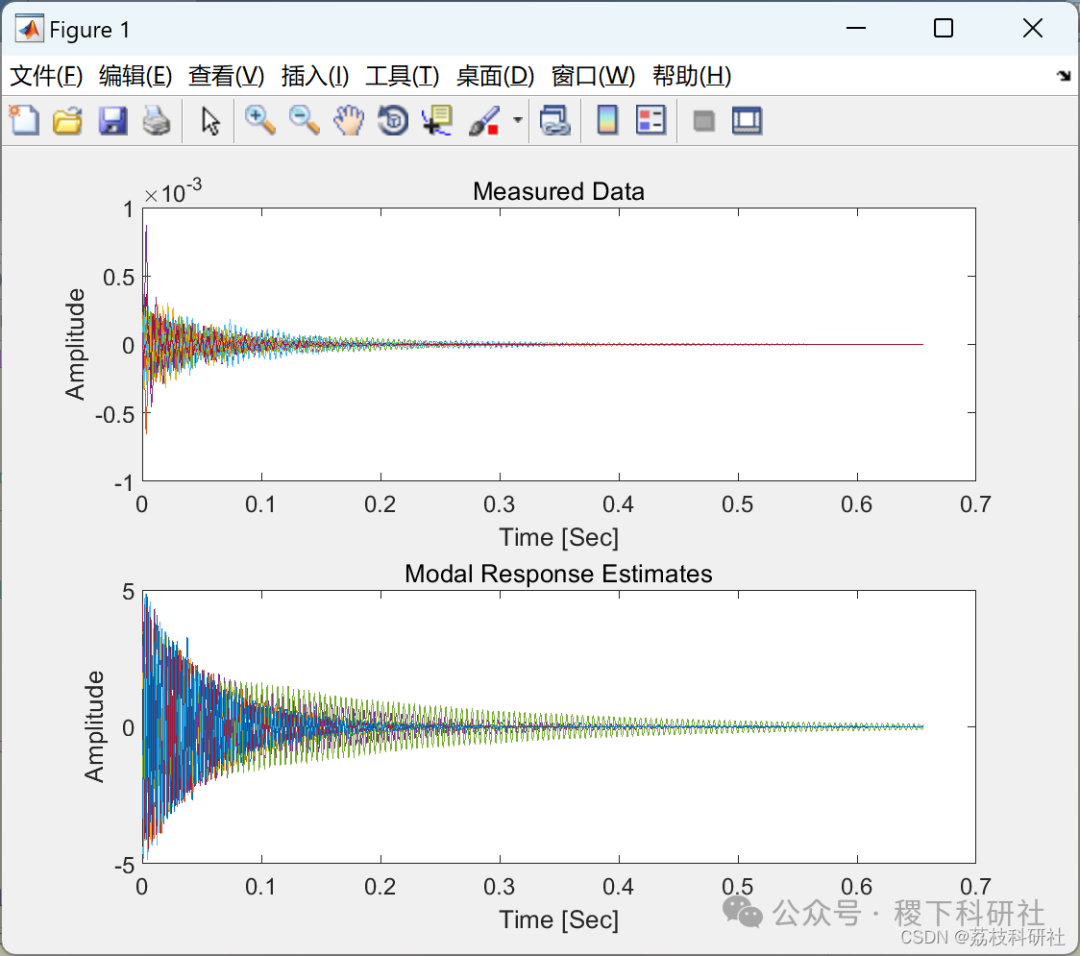
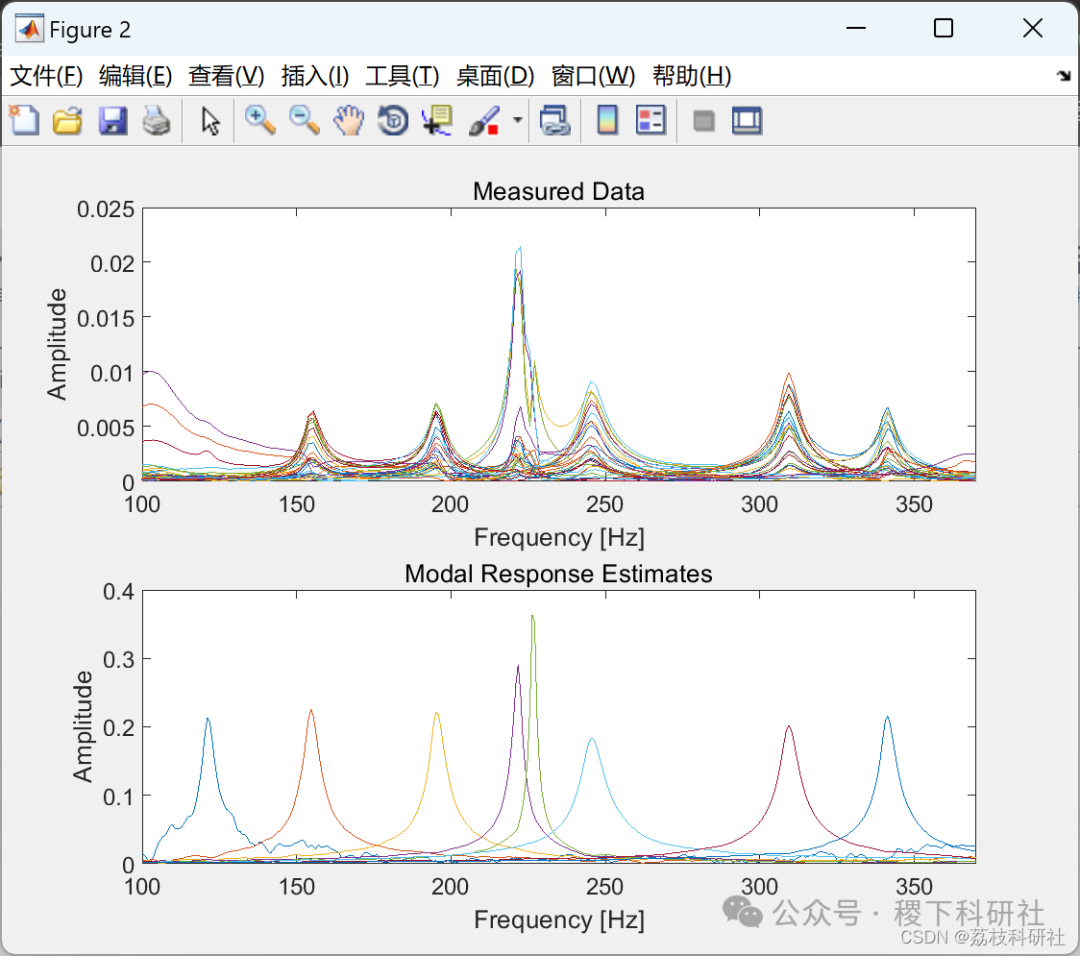
Some code:
[ld1,cd1]=size(dsine_m);t=[1:ld1]’./fs;%% Call blind modal id algorithm%[AaI,Aa,sac,n,svl] = bmidga(dsine_m,fs,2.7,[0,0],20,[30,1]);%sa=real(sac); % could also use imaginary part%% Modal params by sdof frequency domain method%[lsa,csa]=size(sa);np=7;nfft=2*lsa;[frqd,frqn,zetap,h,f,sa,i1] = mrsp2mpfd(sa,fs,np,nfft);Aa=Aa(:,i1);[Aar]=real_ms2(Aa); % real-valued modeshapes from complex%% Plot modal responses%ipl=[5,8,10,11,12,13,16,17];if 1 figure(1);subplot(2,1,1); plot(t,dsine_m); xlabel(‘Time [Sec]’); ylabel(‘Amplitude’); title(‘Measured Data’); % figure(2);subplot(2,1,1); plot(ff,abs(dsine_mf)); xlabel(‘Frequency [Hz]’); ylabel(‘Amplitude’); title(‘Measured Data’); set(gca,’xlim’,[100,370]); % figure(1);subplot(2,1,2); plot(t,sa(:,ipl)); xlabel(‘Time [Sec]’); ylabel(‘Amplitude’); title(‘Modal Response Estimates’); % figure(2);subplot(2,1,2); plot(f,abs(h(:,ipl))); xlabel(‘Frequency [Hz]’); ylabel(‘Amplitude’); title(‘Modal Response Estimates’); set(gca,’xlim’,[100,370]);end%% Save%Aa1=Aa(:,ipl);Aar1=Aar(:,ipl);frqd1=frqd(ipl);zetap1=zetap(ipl);sa1=sa(:,ipl);if exist(‘modes.mat’,’file’) ~= 2 save modes.mat Aa1 Aar1 frqd1 zetap1 sa1else save modes.mat Aa1 Aar1 frqd1 zetap1 sa1 -appendend
🎉3 References
Some theoretical sources are from the internet; please contact for removal if there is any infringement.
[1] Li Yan, Shi Xueqing, Liu Wen. Modal identification of bridges based on vehicle-bridge contact point response and blind source separation [J/OL]. Journal of Hunan University (Natural Science Edition): 1-10 [2023-02-28].
[2] Liu Tingting, Ren Xingmin, Guo Feng, Yang Yongfeng. Second-order blind separation method for convolution mixed mechanical non-stationary vibration signals [J]. Mechanical Strength, 2009, 31(06): 900-904.