Table of Contents | Issue 8, 2024 Special Topic: Integration of 6G and AI
Research on the Demand and Technology of Intelligent Computing Integration in Wireless Networks
6G Intelligent Endogenous Wireless Communication Networks: Current Status, Challenges, System Design, and Architecture
Integration of 6G and AI: External AI and Internal AI
AI Empowering 6G: The Future of Green Communication
Reflections on AI Empowerment Technologies for the Physical Layer of 6G
Overview of Federated Learning and Collaborative Deployment Technologies for AI Large Models in 6G Networks
07【Integration of 6G and AI】 Special Topic《Mobile Communications》 Issue 8, 2024
Research and Challenge Analysis on the Integration of AI and 6G Networks
Sun Wanfei1,2,3,4, Zuo Jun1,2,3, Xu Hui1,2,3, Suo Shiqiang1,2,3, Wang Ke1,2,3
(1. China Academy of Information and Communications Technology, Beijing 100083;
2. National Key Laboratory of Wireless Mobile Communications, China Academy of Telecommunications Technology, Beijing 100191;
3. Datang Mobile Communication Equipment Co., Ltd., Beijing 100083;
4. Beihang University, Beijing 100191)
【Abstract】This article briefly introduces the AI research projects involved in 3GPP and the methods and current status of the integration of AI and 6G networks in domestic and international research. As a potential important scenario for 6G AI, it analyzes the development history of large model applications, discusses the challenges faced by 6G networks in deploying large models at different locations and interacting with different terminals, and finally summarizes the advantages of deploying large models in 6G networks.
【Keywords】AI; 6G Networks; Integration; Large Models; 6G AI
doi:10.3969/j.issn.1006-1010.20240625-0001
Classification Number: TN919.5 Literature Code: A
Article Number: 1006-1010(2024)08-0041-05
Citation Format: Sun Wanfei, Zuo Jun, Xu Hui, et al. Research and Challenge Analysis on the Integration of AI and 6G Networks[J]. Mobile Communications, 2024,48(8): 41-45.
SUN Wanfei, ZUO Jun, XU Hui, et al. Research and Challenge Analysis on the Integration of AI and 6G Networks[J]. Mobile Communications, 2024,48(8): 41-45.

0 Introduction
The maturity and development of AI technology provide new technical means for the entire society and industry, including the use of AI technology to improve network performance and service quality in mobile communications[1-3]. The widespread application of AI technology in society has also created greater demands for data, computing power, and other resources. The 6G mobile communication network proposed intelligent endogenous and computing-network integration research ideas from the beginning[4-7], and the mobile communication network itself possesses massive data and computing resources. Furthermore, 6G networks will provide a complete distributed AI environment, including AI infrastructure, AI workflow logic, data and model services, etc., by encapsulating open AI services to provide AI services and accelerate the intelligent inclusiveness of the entire society and industry[8-9].
This article introduces the current status of AI research in 3GPP and 6G, focusing on the support of large model applications by 6G AI, mainly analyzing the potential impact of deploying large model applications (hereinafter referred to as application large models) on the network and the advantages of deploying large models based on 6G AI.
1 Standardization Progress of AI Research in Mobile Communications
The main standardization organization for mobile communication networks, 3GPP, has launched standard research on the application of AI technology in communication networks in both its SA and RAN working groups.
The SA working group introduced the Network Data Analytics Function (NWDAF) in the R15 phase and established the “Study of enablers for Network Automation for 5G (eNA)” project in the R16 phase to provide functional support for network intelligence. The R16 phase mainly researched and designed more use cases. The R17 phase further enhanced the NWDAF function, supporting a distributed network data analysis architecture for multi-NWDAF interaction and collaboration, dividing it into Model Training Logical Function (MTLF) and Analytics Logical Function (AnLF), and introducing Data Collection Coordination Function (DCCF) and Analytics Data Repository Function (ADRF) to improve data collection efficiency in the network. In the R18 phase, NWDAF capabilities and performance were further enhanced, adding new use cases such as federated learning and model sharing, and support for AI applications in the network. In the Rel-19 phase, NWDAF was further enhanced to support vertical federated learning, policy control, and network anomaly resolution, etc. In addition, in system management, Management Data Analytics (MDA) was introduced to support the intelligence and automation of network management[12-15].
The RAN working group launched the first AI/ML research project in the RAN3 phase of Rel-17, mainly studying the functional framework of RAN-side AI and solutions and potential standardization impacts for three use cases: network energy saving, load balancing, and mobility optimization[10]. In the Rel-18 phase, RAN3 enhanced data collection and signaling in the NG-RAN interface and architecture based on the conclusions of Rel-17’s research to support the aforementioned three use cases. At the same time, RAN1 led a project on AI-based air interface research, which studied the general framework for air interface AI and focused on three use cases: AI-based CSI feedback, beam management, and positioning, discussing simulation assumptions, evaluation metrics, and performance evaluations of each use case. Meanwhile, based on this framework, the potential standardization impacts of the AI lifecycle management processes for the aforementioned use cases were studied. In this project, RAN2 studied potential solutions for data collection and model transfer, and RAN4 studied the core requirements for AI lifecycle management processes and testing frameworks for AI functions or models[11]. In the Rel-19 phase, RAN1 led the standardization of AI-based beam management and positioning use cases from the R18 research and continued to study CSI compression, CSI prediction use cases, and some controversial lifecycle management processes. RAN2 led research on AI/ML-based mobility enhancement, including simulation verification and standardization impact studies for related use cases. In addition to improving existing use cases, RAN3 will also explore two new use cases: AI-based capacity coverage enhancement and AI-based slice resource allocation.
2 Methods and Current Research Status of AI and 6G Network Integration
2.1 Methods of AI and 6G Network Integration
At the beginning of the 6G network research, the industry proposed the goal of intelligent endogeneity, defined as: supporting AI through endogenous design patterns at the architectural level, rather than overlaying or external design patterns[16-17]. The internal architecture of the 6G network can provide a complete operational environment for the full lifecycle of AI workflows, including data collection, data preprocessing, model training, model inference, and model evaluation, deeply integrating the computing power, data, algorithms, connections, and network functions, protocols, and processes required for AI services[6].
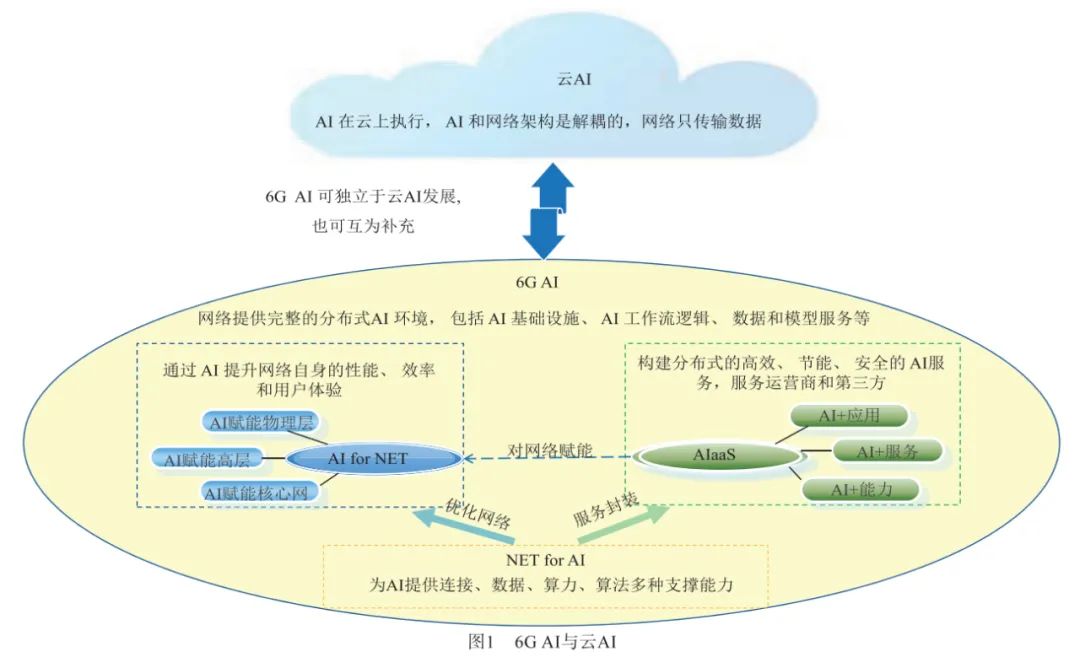
In the process of 6G AI research, the methods of integrating AI with 6G networks are divided into three categories: AI For Network, Network For AI, and AI as a Service. AI For Network enhances the performance, efficiency, and user experience of the network itself by using AI technology in the network, including two methods: AI-based use cases and the integration of large models with the network. Network For AI builds AI capabilities and functions in the network to provide various support capabilities such as connectivity, data, computing power, and algorithms for AI, including large models. AIaaS builds distributed, efficient, energy-saving, and secure AI services in the network to provide AI services for the network itself and third parties[6, 9].
Currently, in AI applications, AI is executed in the cloud, meaning that cloud AI is used, and the network is responsible for data transmission. In the future, 6G AI can develop independently of cloud AI or complement cloud AI to jointly support the intelligent inclusiveness development of the entire society and industry. The logical relationship between 6G AI and cloud AI is as shown in Figure 1. The technology of large models is currently the hottest, and with the rapid development of large model technology and applications, supporting the deployment of application large models will be one of the important scenarios that Network For AI will face in the future.
2.2 Current Research Status of AI and 6G Network Integration
Currently, both academia and industry are conducting research on the integration of AI and 6G networks. Domestic and foreign operators, equipment manufacturers, terminals, chips, and various 6G research organizations have published numerous white papers and research reports on the architecture and key technologies of AI and 6G network integration. There is a basic consensus among various units on providing computing power, data, algorithms, and other basic resources for the network, adding computing power, AI, and data functions in architecture, and providing AI services to the network and users. However, there are currently differences in the design of network architecture functions[6, 17-20].
Similarly, in academia, research in the field of AI and 6G network integration includes optimizing air interface parameters based on AI, replacing physical layer function modules with AI, and end-to-end system design enabled by AI[21]. In terms of research directions focused on AI use cases, algorithms, computing power, and data, academia has conducted research from aspects such as intelligent endogenous network architecture, management of AI elements in the network, intent-driven, data plane architecture, edge computing, and support for model training deployment (including large models), providing theoretical and technical support for the integration of AI and 6G networks.
In the current research hotspots regarding large models, in 6G AI research, one aspect is to empower the network by applying large models, and another focus is how 6G AI supports various applications of large models, including supporting data transmission between users and application large models, as well as deploying application large models based on the 6G network.
3 Analysis of Large Model Applications and 6G AI Development
Looking towards the 2030s, 6G AI needs to support the AI business demands of the entire society. Currently, the development of large model technology may significantly change future AI applications. In the future, according to the laws of technology and application development, how to analyze the development history of large model applications and the challenges and opportunities that future 6G AI will face in the development process of large model applications need further analysis.
3.1 Brief Analysis of the Development History of Large Model Applications
The development history of large model applications is worth learning from the development history of internet technology and industry. In terms of China’s internet, the 30-year development process is distinctly phased, developing rapidly and deeply. The development phases can be divided into academic traction period, exploratory growth period, rapid development period, mature prosperity period, and later the mobile internet period based on mobile communication networks[22]. According to the laws of technology and application development, the development history of large model applications is also expected to experience this process, although the exact timing of each phase cannot be precisely predicted. Based on our technical understanding, we have made the following analysis and judgment on the development history of large model applications.
Academic Traction Period (2000s): Breakthrough advances in deep learning in the field of machine learning, especially the successful application of Convolutional Neural Networks (CNN) in image recognition, provided new possibilities for the development of large models.
Exploratory Growth Period (2010s): In 2012, the AlexNet neural network model achieved image recognition and classification in the ImageNet competition, marking the starting point of a new round of AI development. Such systems can process large amounts of data and discover relationships and patterns that humans typically cannot find. In 2016, the AI robot AlphaGo defeated the Korean professional Go player Lee Sedol, which is a classic example of deep learning.
Rapid Development Period (2018-2026): In 2018, the release of the BERT model became a milestone in the field of natural language processing. OpenAI achieved iterations from GPT-1 to GPT-4, Sora large model generated video, rapid development of AI Agents, sparking a global wave of large models.
Mature Prosperity Period (2027-2035): According to development laws, the time required for large model applications to mature will be significantly less than that of previous technologies, including internet technologies. It is expected that by 2027, it will enter a mature prosperity period, and with the commercialization of 6G networks in 2030, 6G AI services will promote large model applications into a golden development stage. The potential deployment locations of large models and their interaction methods with terminals need to be highly focused on in 6G AI research.
3.2 Analysis of the Impact of Application Large Model Deployment on the Network
Currently, large models are developing towards generalization, and after intense competition in the future, whether the number of models and applications will be a single-digit scale, or tens or hundreds of large quantities, depends on whether future large model applications are “winner-takes-all” super apps or “blooming at multiple points” with many apps, which will also significantly impact the future traffic entry of the network.
Currently, in the telecommunications industry, terminal manufacturers are basically developing application large models independently, and application manufacturers are also developing application large models (Baidu, Alibaba, Tencent, etc.). Based on the deployment locations of application large models and the interaction methods between large models, there are two situations as follows.
(1) No deployment of application large models in the network
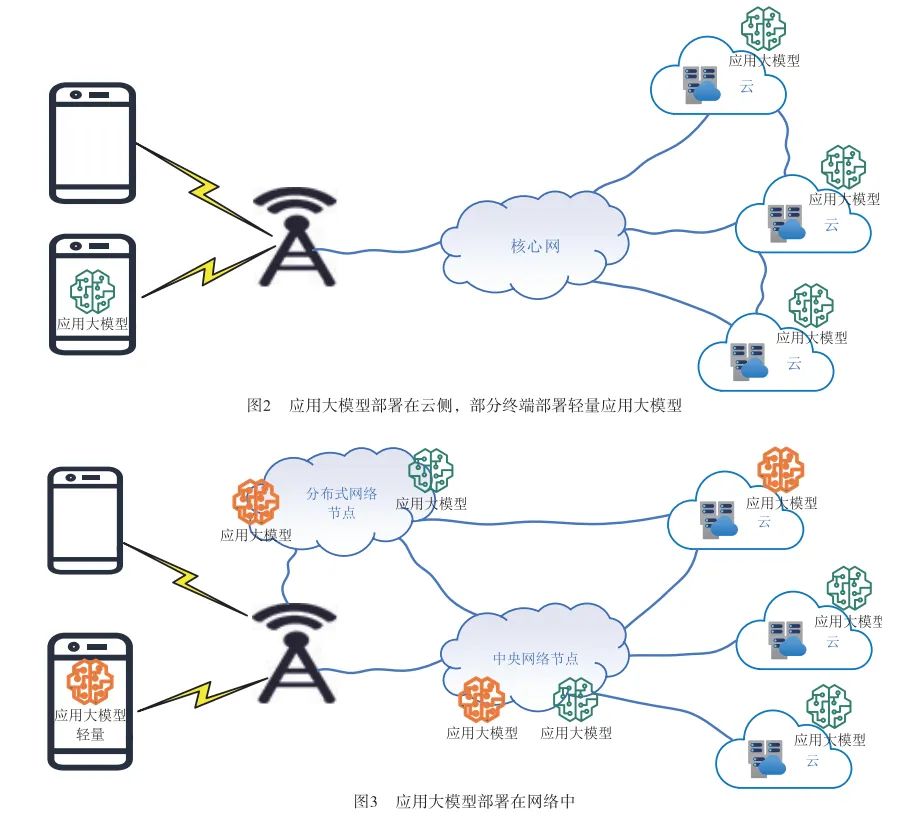
This situation represents the current usage method of large model applications. Application large models are mainly deployed on the cloud side, and only some powerful terminal types (referred to as Type A terminals) can deploy lightweight application large models, while most terminal types (referred to as Type B terminals) do not have the capability to deploy application large models. At this time, Type B terminals access cloud-side application large models through the network, and network functions are still limited to data transmission. Currently, there is no interaction between cloud-side application large models, but there may be interaction in the future, and this interaction is not through mobile communication networks. Some tasks of the application large models deployed on Type A terminals are processed locally, using lightweight application large models for processing, while other tasks are similar to Type B terminals accessing cloud-side application large models. Additionally, there is a possibility of interaction between the lightweight application large models on the terminal side and the corresponding application large models on the cloud side. As shown in Figure 2.
Challenge Analysis: 1) Based on the cloud-side deployment method, there are challenges in waiting time, reliability, etc., for multi-round cloud-to-cloud interactions; 2) Centralized deployment on the cloud and concentrated user access pose challenges for access congestion and model resources; 3) Considering the limitations of terminal chip performance, it is difficult for ordinary terminals to deploy application large models.
(2) Deployment of application large models in the network
The main difference between this situation and (1) is that application large models can be deployed within the 6G network, as shown in Figure 3, at this time, some terminal types can still deploy lightweight application large models, and the cloud side also has the capability to deploy application large models. Since different levels of application large models can be deployed at distributed network nodes and central network nodes in the 6G network, deploying lightweight application large models at distributed network nodes can significantly change the disadvantages of Type B terminals and become potential high-value scenarios for distributed nodes. Application large models deployed in the network can interact through mobile communication networks, ensuring data transmission with QoS guarantees and lower latency.
Challenge Analysis: 1) The deployment locations of distributed nodes need further research; 2) The quantity of resources at distributed network nodes and central network nodes needs to be evaluated; 3) The efficient interaction mechanism between application large models deployed in the network needs research.
Application large models are rapidly developing and are an important trend for the future. Based on 6G AI technology, the deployment methods of application large models at central and distributed network nodes in the 6G network will have the following advantages:
1) Significantly improved interaction efficiency between models, ensuring multi-model interaction transmission;
2) Potential significant improvements in model inference time and transmission time;
3) Deploying application large models in the network can reduce terminal costs.
Therefore, 6G AI can play an important supporting role in the future development of large model applications.
4 Conclusion
The integration of AI and 6G networks has become a common consensus in 6G research. The integration of AI and 6G networks not only enables 6G intelligence but further allows 6G networks to possess the capability for AI lifecycle operation. With the development of large model technology, application large models will become an important scenario for 6G networks. The development trends and deployment methods of large model applications will potentially propose new requirements for 6G networks and will significantly impact the commercialization of 6G AI in the 2030s, thus requiring high attention in 6G AI research.
References: (Scroll to browse)
[1] Chen S, Liang Y-C, Sun S, et al. Vision, requirements, and technology trend of 6g: How to tackle the challenges of system coverage, capacity, user data-rate and movement speed[J]. IEEE Wireless Communications, 2020,27: 218-228.
[2] Liu G Y, Huang Y H, Li N, et al. Vision, requirements and network architecture of 6g mobile network beyond 2030[R]. China Communications, 2020.
[3] You X, Wang C X, Huang J. et al. Towards 6G wireless communication networks: vision, enabling technologies, and new paradigm shifts[R]. Sci. China Inf. Sci. 64, 110301(2021).
[4] Sun W F, Ai M, Duan X Y, et al. 2022. Research on 6G Network Adaptability Index System[C]//2022 IEEE/CIC International Conference on Communications in China (ICCC Workshops). IEEE, 2022: 417-422
[5] Wang Z, Du Y, Wei K, et al. Vision, application scenarios, and key technology trends for 6G mobile communications[J]. Science China Information Sciences, 2022,65(5): 1-27.
[6] IMT-2030. Research Report on Intelligent Endogenous System Architecture for 6G Networks[R]. 2022.
[7] Duan X D, Wang X Y, Lu L, et al. 6G Architecture Design: from Overall, Logical and Networking Perspective[J]. IEEE Communications Magazine, 2023,61(7): 158-164.
[8] Sun W, Duan X, Shu M, et al. Research on 6G intelligent network architecture and key technologies for intelligent generation and autonomy[C]//2023 IEEE/CIC International Conference on Communications in China (ICCC Workshops). Dalian, China: IEEE, 2023: 1-6.
[9] 6GANA. Ten Questions about the Endogenous AI Network Architecture of 6G[R]. 6GANA, 2022.
[10] 3GPP. 3GPP TS 23.288: Architecture enhancements for 5G System (5GS) to support network data analytics services(Release 18)[S]. 2023.
[11] 3GPP. 3GPP TS 28.104: Management and orchestration; Management Data Analytics(Release 18)[S]. 2023.
[12] 3GPP TR23.700-80. Study on 5G System Support for AI/ML-based Services(Release 18)[S]. 2022.
[13] 3GPP TR 22.876. Study on AI/ML Model Transfer-Phase 2(Release 19)[R]. 2022.
[14] 3GPP TR 37.817. Study on enhancement for Data Collection for NR and EN-DC (Release 17)[R]. 2022.
[15] 3GPP TR 38.843. Study on Artificial Intelligence (AI)/Machine Learning (ML) for NR air interface (Release 18)[R]. 2023.
[16] 6GANA. White Paper on AI Native Concepts and Terminology for 6G[R]. 6GANA, 2022.
[17] Suo Shiqiang, Wang Yingmin. Discussion and Analysis on Future 6G Network Endogenous Intelligence[J]. Mobile Communications, 2020,44(6): 5.
[18] China Mobile. White Paper on 6G Wireless Endogenous AI Architecture and Technology[R]. 2022.
[19] China Telecom & ZTE. White Paper on 6G Network Architecture Outlook[R]. 2023.
[20] China Academy of Information and Communications Technology. White Paper on 6G Network System Architecture[R]. 2022.
[21] Ericsson. Defining AI native: A key enabler for advanced intelligent telecom networks[R]. 2023.
[22] IMT-2030. White Paper on Key Technologies for AI in the Physical Layer of 6G[R]. 2022.
[23] Fang Xingdong, Jin Haoqing, Zhong Xiangming. 30 Years of the Internet in China: A Global Historical Perspective—Based on Braudel’s “Middle Period” Perspective of “Social Time”[J]. Media Observation, 2022(11): 26-42. ★
Scan the QR code to read and download this paper on the Knowledge Network

★Originally published in《Mobile Communications》 Issue 8, 2024★
doi:10.3969/j.issn.1006-1010.20240625-0001
Classification Number: TN919.5 Literature Code: A
Article Number: 1006-1010(2024)08-0041-05
Citation Format: Sun Wanfei, Zuo Jun, Xu Hui, et al. Research and Challenge Analysis on the Integration of AI and 6G Networks[J]. Mobile Communications, 2024,48(8): 41-45.
SUN Wanfei, ZUO Jun, XU Hui, et al. Research and Challenge Analysis on the Integration of AI and 6G Networks[J]. Mobile Communications, 2024,48(8): 41-45.
 Author IntroductionSun Wanfei (orcid.org/0000-0002-7216-7390): Engineer, Master’s degree from Tianjin University of Technology, currently a PhD student at Beihang University, and a research engineer at China Academy of Information and Communications Technology, focusing on 6G network architecture, network artificial intelligence, and network adaptability.Zuo Jun: Engineer, PhD from Peking University, currently a senior research engineer at China Academy of Information and Communications Technology, mainly engaged in research on massive antennas, beam management, air interface AI, and 3GPP standardization.XU Hui: Senior Engineer, PhD from Xi’an Jiaotong University, currently the Technical Director at the Innovation Center of China Academy of Information and Communications Technology, focusing on 6G network architecture, network security, etc.Suo Shiqiang: Senior Engineer, Master’s degree from the Academy of Telecommunications Science, currently the Deputy General Manager of the Innovation Center of China Academy of Information and Communications Technology, responsible for research on 6G and future new technologies, mainly focusing on ultra-large-scale antennas, artificial intelligence, communication and perception integration, and space-ground integration.Wang Ke: Senior Engineer, Master’s degree from Tsinghua University, currently the General Manager of the Innovation Center of China Academy of Information and Communications Technology, mainly focusing on mobile communication technology planning, research on the integration of networks and AI, and standardization of new technologies and international and domestic standards for 5G/6G.
Submission method for《Mobile Communications》 is online submission
Please log in to the web submission system
Link: http://ydtx.cbpt.cnki.net
 Highlights【2024 Special Topic Call for Papers Issue 12】6G Millimeter Wave and Terahertz Communication【6G Endogenous Intelligent Theory and Key Technologies】 Call for Papers for Issue 1, 2025【Information Coding and Modulation Technology for Future Mobile Communications】Call for Papers for Issue 2, 2025Table of Contents | Issue 7, 2024 Special Topic: 6G Endogenous Intelligent TechnologyTable of Contents | Issue 8, 2024 Special Topic: Integration of 6G and AISummary of《Mobile Communications》2024 Table of Contents (Issues 1-6)
 #Scan to follow us#《Mobile Communications》Interpreting Communications with Papers《Mobile Communications》 magazine is supervised by China Electronics Technology Group Corporation and hosted by the Seventh Research Institute of China Electronics Technology Group Corporation. It is a “dual-effect journal” of the Chinese journal matrix, a high-quality electronic journal of the Ministry of Industry and Information Technology, a source journal of Chinese scientific and technological papers, a journal included in the high-quality scientific journal grading directory of the China Communications Society, a journal included in the high-quality scientific journal grading directory of the China Electronics Society, and a core journal in China, included in JST.