As we all know, Arm processors are widely used in terminal devices. So what thoughts and deployments does Arm have from the perspective of storage? At the CFMS2024 storage summit, Parag Beeraka, head of Arm’s global storage market, delivered a keynote speech titled “Storage Innovation ‘Wins’ the Future: Arm’s Next-Generation Computing Platform Solutions,” explaining how Arm empowers the storage market under the trend of AI and drives innovation.
Currently, data is being generated and stored at an exponential rate, and existing and new use cases continue to generate new data. For example, in the fields of industrial automation and intelligent driving, more sensors have been deployed to ensure that the feedback from machines is more precise, resulting in more data. In daily life, people take photos and videos every day, generating a significant amount of data. The currently hot topic of generative AI will also bring disruptive changes to data, and the aforementioned data derivation will continue to create new storage demands.
According to relevant information, it is estimated that by 2024, 150ZB of data will be generated globally. Arm, which has been deeply involved in the storage field for many years, provides high-performance, low-power, and secure reliable IP solutions for global storage controllers and devices. To date, the number of storage devices based on Arm architecture and platform has reached 19 billion, including enterprise SSDs, client SSDs, consumer SSDs, hard disk drives, and embedded flash devices. Currently, storage devices powered by Arm technology maintain a shipping volume of about three million units per day.
With leading technology and a rich ecosystem as the foundation, Arm provides a value-added soil for the storage industry chain.
Arm continuously focuses on three directions: product strength, ecosystem cooperation, and innovation, bringing new opportunities to the storage industry. Recently, ScaleFlux, a company focused on computable storage, announced that its upcoming enterprise SSD controller series will be equipped with the Arm Cortex-R82 processor. The Cortex-R82 is currently the highest performance Arm real-time processor and the first processor to adopt the 64-bit Armv8-R AArch64 architecture. Its high performance and energy-saving features set a new benchmark for performance and efficiency in the storage market.
As the wave of AI sinks into various application fields, the continuous increase in data volume brings new demands for storage solutions. For example, with the continuous upgrades of L3, L4, and L5 level autonomous driving in smart cars, the demand for automotive SSDs with more functional safety features is rising. In areas such as UFS, eMMC, and client SSDs, specific demands for high performance, high energy efficiency, and high security have been raised. Arm continuously refines its product strength, with technologies such as Cortex-A, Cortex-R, Cortex-M, and Neoverse meeting different computing and storage needs in various segments, providing high-performance, low-power, and secure reliable solutions for storage under the AI trend.
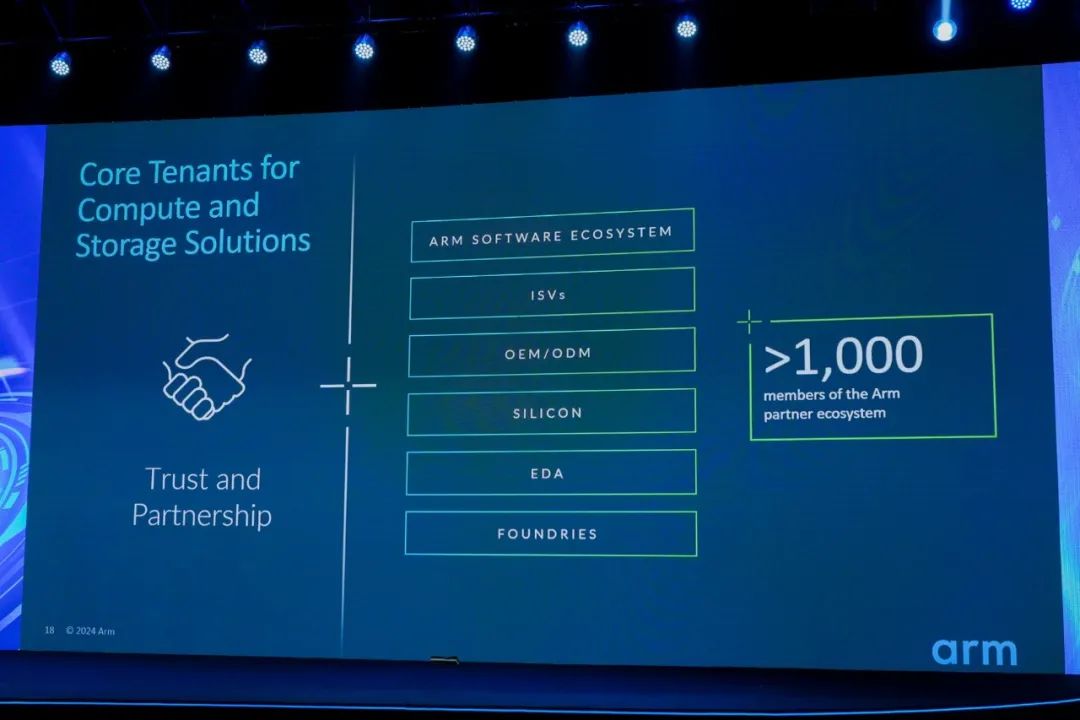
Parag Beeraka stated that in addition to continuously refining product strength, Arm has always attached great importance to the power of the ecosystem. In the storage field, Arm maintains close cooperation with chip suppliers, EDA partners, foundry partners, OEM manufacturers, software ecosystems, etc., to ensure that chips designed based on Arm technology can meet storage needs with smaller area, lower power consumption, and higher performance. Arm has one of the world’s most dynamic ecosystems, with over 1,000 partners involved, developing applications for different scenarios and fields on the Arm computing platform. With an active ecosystem and the integration of software and hardware, Arm provides value-added soil for the entire industry chain.
In the face of innovative changes across server architectures, Arm interconnect technology simplifies complexity.
Parag Beeraka mentioned that the data center and infrastructure fields have also undergone many transformations in recent years, from traditional servers to integrated systems and then to software-defined systems. Arm not only supplies cores for CPUs but also provides high-performance, low-latency coherent mesh network (CMN) interconnect technology for multi-core servers, supporting DDR, HBM memory, as well as protocols like PCIe 5.0, CXL, and CCIX, flexibly linking multi-protocol, multi-interface, and multi-core devices. He added that Arm is researching and supporting devices with CXL and UCIe connections, utilizing their functions in a more simplified manner.
Finally, Parag stated that with the explosion of data and the rapid development of AI, the industry has raised higher demands for storage. Arm will continue to provide high-performance, low-power, and secure reliable product combinations, create a vibrant ecosystem, support industry standards, and realize the future of storage innovation.
Latest Recommended Reading:
-
The storage spot market is diverging, with high-capacity embedded and industry SSD prices rising, and channel prices stabilizing at high levels.
-
AI sparks a computing power race; how does Yiheng Chuangyuan advance against the wind?
-
Silicon Motion: Reverse thinking to create new storage opportunities.
-
CFMS | MemoryS 2024 post-conference special is online! Exciting speech videos, photo collections, and news reports will be continuously updated…
-
Solidigm: The demand for high-capacity SSDs is surging; why is storage so important for AI?
-
SK Hynix: A full range of NAND solution providers for the multimodal AI era.
-
Micron Computing and Storage: Driving the AI revolution.