In smart water supply systems, RTU (Remote Terminal Unit) and DTU (Data Transfer Unit) are key devices that ensure the stable operation of the system. However, there are significant differences between the two in terms of functional positioning, technical characteristics, and application scenarios, which can be distinguished in the following dimensions:

1. Core Functions: “Transmission Specialist” vs. “Comprehensive Manager”

DTU: The “Professional Courier” Focused on Data Transmission
The core value of DTU lies in solving the problem of “how to transmit data”. It does not have data collection and device control capabilities, only undertaking the responsibility of “data transportation”, specifically manifested as:
Transmission Conversion Capability:
Supports bidirectional data conversion between serial ports (RS232/RS485) and IP networks, able to package serial data output from terminal devices such as water quality sensors and flow meters into IP data compliant with TCP/UDP protocols, and then stably transmit it to the backend monitoring center via wireless communication networks such as GPRS, 4G, and NB-IoT;
Basic Data Processing:
Only has simple data verification and formatting functions, with no complex computation logic, unable to analyze or judge the collected data such as water pressure and flow.
Communication Assurance Design: Some industrial-grade DTUs support reconnection, data caching, and multi-center communication to ensure the continuity of data transmission in smart water supply.
RTU: The “Comprehensive Manager” Balancing Collection, Processing, and Control
Based on Hengzhi, it means that in the Year of the Snake, no matter what challenges we face, we will adhere to our original intention.
RTU is a composite device that integrates “data collection – processing – control – transmission”, core solving the problem of “how to use data”, with specific functions including:
Multi-type Data Collection:
Directly interfaces with various sensors and actuators in smart water supply through analog input modules and digital input modules, without the need for additional collection devices.
Localized Data Processing:
With built-in microprocessor and storage unit, it can process data in real-time based on preset logic without relying on backend servers, reducing the impact of network latency on control — for example, the RTU at the pump station can autonomously determine the overload status of the pump and quickly trigger shutdown protection.
Remote Control and Adjustment:
Supports four major functions: “telemetry, remote control, remote signaling, and remote adjustment”, allowing the backend to directly issue control commands through the RTU for precise regulation of the water supply network.
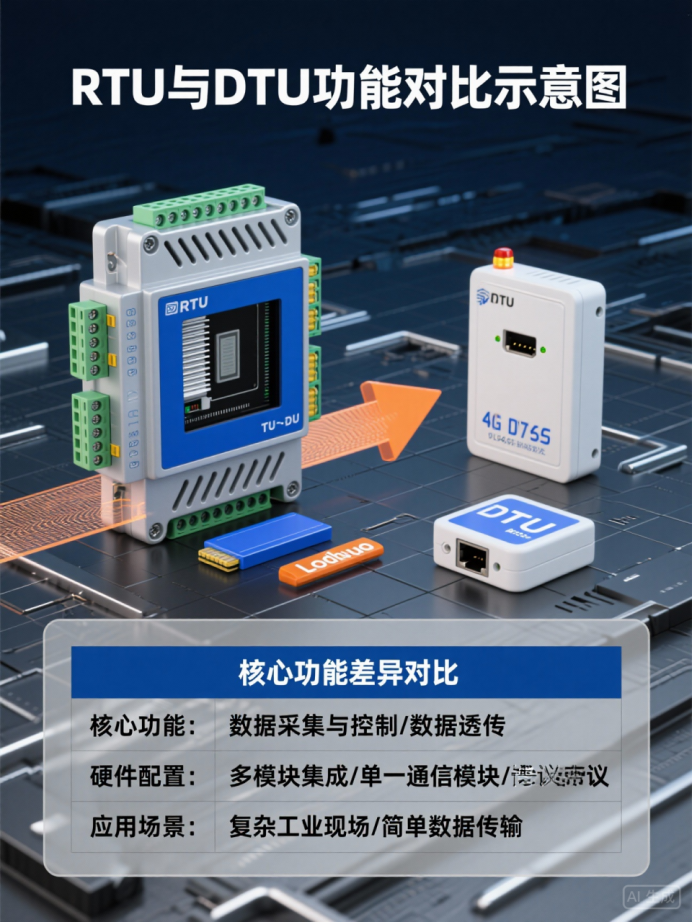
2. Hardware Configuration: “Streamlined and Practical” vs. “Comprehensive Redundancy”
01
DTU: Simple Hardware Structure, Focused on Communication Core
The hardware composition is centered on “ensuring communication”, with a streamlined configuration:
Core Module:
Wireless communication module (GPRS/4G/NB-IoT), serial conversion chip, power management module;
Auxiliary Components:
A few indicator lights, external antenna interfaces, and some industrial-grade DTUs will add protection circuits against lightning strikes and electromagnetic interference to adapt to the complex environment of smart water supply sites;
No Expansion Interfaces:
Usually only provides 1-2 serial ports, unable to connect external analog/digital modules, with weak functional expandability.
02
RTU: Complex Hardware Configuration, Balancing Stability and Expandability
The hardware design aims for “industrial-grade reliability”, with comprehensive configuration:
Core Components:
High-performance CPU, data memory, communication module;
Functional Modules:
Analog input/output modules, digital input/output modules, relays;
Redundancy Design:
Some high-end RTUs support dual power backup and communication link redundancy to meet the needs of smart water supply for “uninterrupted operation”.
3. Application Scenarios: “Simple Remote Transmission” vs. “Complex Monitoring”
01
DTU: Suitable for Simple Scenarios Where “Only Data Transmission is Required”
In smart water supply, when there is no need to control devices on-site and only data needs to be uploaded to the backend, DTU is the cost-effective choice:
Distributed Monitoring Points:
Such as pressure monitoring points in urban water supply networks and water quality monitoring points in secondary water supply in communities, which only need to transmit sensor data to the center without local control;
Low-Cost Renovation Projects:
Old equipment in water plants (such as old flow meters) only has serial output, and pairing with DTU can quickly achieve data transmission without replacing the entire set of equipment, reducing renovation costs.
02
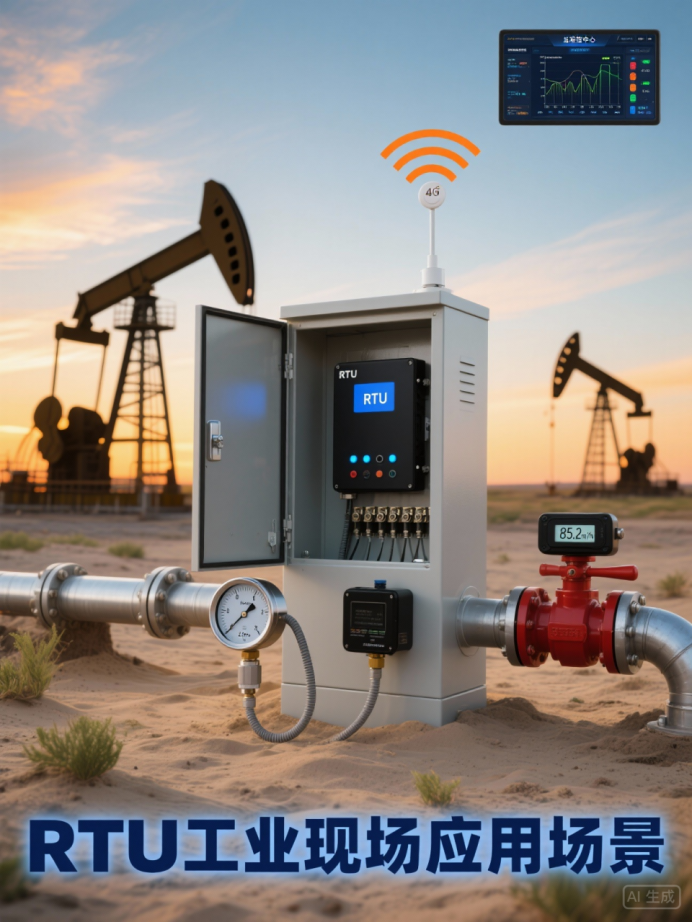
RTU: Suitable for Complex Scenarios Where “Monitoring + Control” is Required
When smart water supply scenarios require real-time monitoring, precise control, or localized decision-making, RTU must be relied upon:
Pump Station / Water Plant Monitoring:
For example, the intake pump station and pressurization pump station of a water plant need to monitor the pump status and pipeline pressure while remotely controlling the pump’s start/stop and speed, which RTU can achieve in one stop;
Key Pipeline Nodes:
Such as valve wells in the main pipeline of the water supply network, which need to monitor flow and pressure while remotely adjusting the valve opening to balance pipeline pressure, the “collection – processing – control” capability of RTU can ensure timely and accurate adjustments;
Emergency Handling Scenarios:
For example, when a pipeline bursts, RTU can quickly collect data on the sudden drop in pressure and autonomously trigger commands to close nearby valves, reducing water loss, which is faster than relying on backend commands.
4. Conclusion: Choose According to Needs, Maximize Collaborative Value
In simple terms, DTU is a “data transmission channel”, responsible only for “sending data out and bringing it in”; RTU is the “on-site control hub”, capable of “collecting data, processing data, and controlling devices”.

In the design of smart water supply systems, the two are not “either/or”: some scenarios will use them in combination — for example, in remote areas, small monitoring points use RTU to collect local data and control small valves, and then use DTU to transmit data to the center (when the RTU’s own communication module fails, DTU serves as a backup transmission channel). Selection should be made based on whether control functions are needed on-site, the complexity of data processing, budget costs, and other factors to maximize the stability and efficiency of smart water supply.

Address | High-tech Industrial Development Zone, Taocheng, Hengshui, Hebei Province
Phone | 0318-217 8620
National Unified Service Phone | 400-803-8087
Official Website | www.hebeidaocheng.com