Product Recommendation: YunJing TianHe 【TH-YJ Series】 Rainfall Sensor
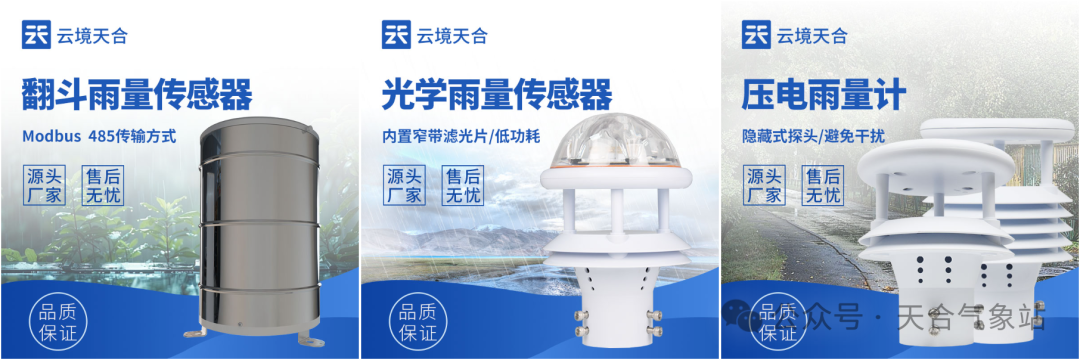
The rainfall sensor is an important device for monitoring precipitation, widely used in meteorology, water conservancy, agriculture, and other fields. Many people have questions about its use and principles. Below are common questions and answers.
1. What is a rainfall sensor? Where is it used?
The rainfall sensor can automatically collect and record rainfall, converting precipitation into measurable signals to output data. Application scenarios include: meteorological stations providing data for weather forecasts, water conservancy departments predicting flood risks, agriculture guiding irrigation, and urban drainage systems assisting in flood control scheduling.
2. How does a rainfall sensor measure rainfall?
The most common type is the tipping bucket rainfall sensor, which has a tipping bucket inside. Rainwater collects in the bucket, and when it reaches a fixed weight, the bucket tips over, discharging the water. Each time it tips, it generates an electrical signal. By recording the number of signals and combining it with the bucket’s capacity, the total rainfall can be calculated.
3. What types of rainfall sensors are there? What are their characteristics?
There are three common types: the tipping bucket type, which has a simple structure and is easy to maintain; the piezoelectric type, which has high measurement accuracy and is suitable for long-term monitoring; and the optical type, which has no mechanical parts, responds quickly, and is compact, making it suitable for space-constrained scenarios, although it is sensitive to debris and requires regular cleaning.
4. What should be noted when installing a rainfall sensor?
Choose a location with an unobstructed view, away from areas where water accumulates or where rainwater collects abnormally; ensure the installation height meets standards and remains level; outdoor installations should be waterproof and lightning-proof to avoid equipment damage.
5. How to maintain a rainfall sensor?
Regularly clean debris from the rain collection opening to prevent blockage; check the flexibility of the tipping bucket for the tipping bucket type, and check the smoothness of the siphon for the siphon type; regularly calibrate with a standard measuring cup, and if there is a large error, adjust promptly or contact for repair.
6. What points should be considered when purchasing a rainfall sensor?
Select accuracy based on the scenario; high accuracy is required for meteorological research, while agriculture can relax the standards; ensure the range covers the maximum rainfall intensity in the area; choose models suitable for the environment, such as those resistant to low temperatures in northern regions or corrosion-resistant for coastal areas; if remote data viewing is needed, opt for models with wireless communication capabilities; prioritize manufacturers with good reputations that provide after-sales calibration and repair services.
For more inquiries about meteorological monitoring equipment:
① Call the hotline:13276363313
② Visit the website:
https://www.thyqw.com or scan the QR code below
Author:Shandong Tianhe Environmental Technology Co., Ltd.

Follow me to get
more exciting content