I am Shen Gong, a programmer working in the Internet of Things (IoT) in Shenzhen.
No PowerPoint presentations, no grand visions, just practical solutions.
Last week, a client asked me to calculate costs: 50,000 devices, each with a WiFi module costing 10 yuan, totaling 500,000 yuan just for the modules.
With my solution: switch to a Bluetooth chip costing 2 yuan, paired with my 13 yuan small base station for unified connectivity,
the cost is cut in half, and the experience remains unchanged.
This is what technology should look like—unflashy but effective.
1. A Simple Choice Determines Your Profitability
First, let me ask you a question:
In the smart devices you create, how is the communication component responsible for connectivity designed?
Does each device come with a module capable of connecting to WiFi?
It seems straightforward, but this choice might be quietly eating into your profits.
The truth is:
Installing a WiFi module on each device costs five to six yuan more than using Bluetooth.
Specifically:
To enable devices to connect to the internet via WiFi, they need a chip with WiFi functionality, which generally costs around 10 yuan;
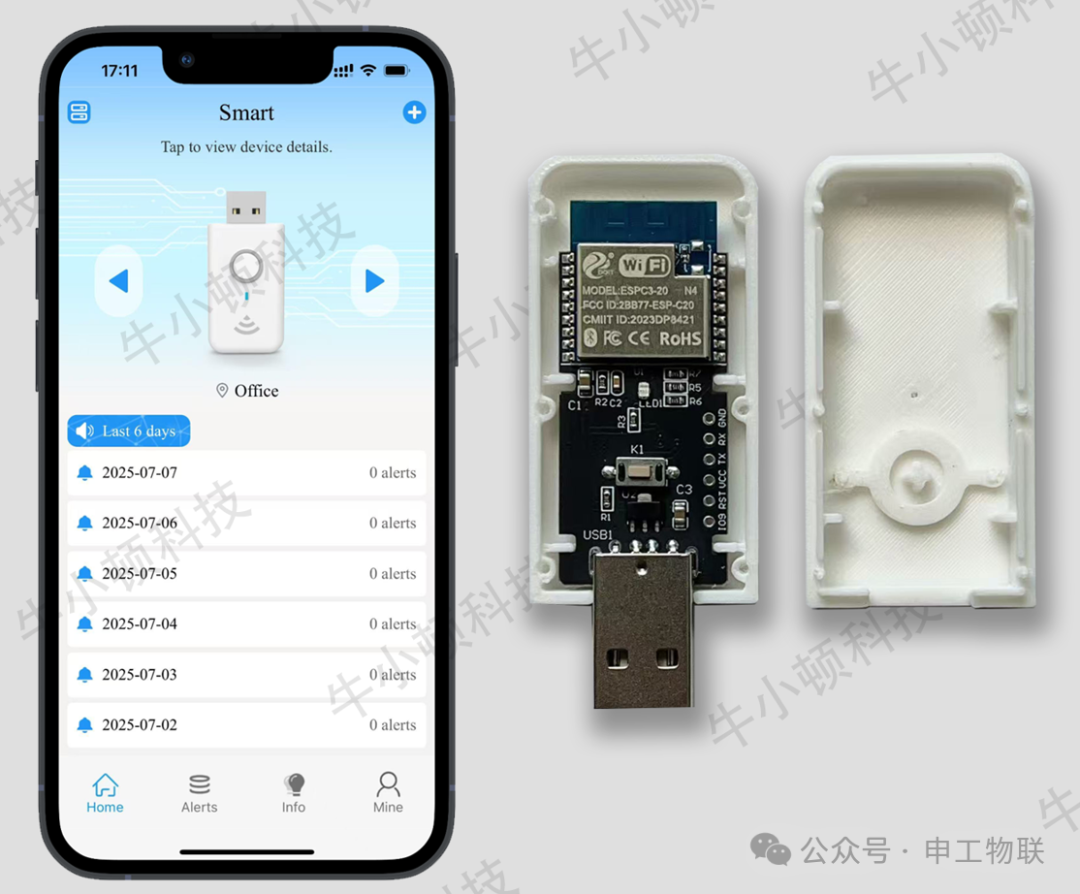
whereas using only a Bluetooth chip costs about 2 yuan, and by utilizing my 13 yuan Bluetooth base station (as shown below) for unified connectivity, data can be uploaded to a mobile app and remote commands can be received.
In other words:
* Small devices are lightweight, only needing to communicate with the 13 yuan gateway;
* The gateway is responsible for interfacing with the router, connecting to the cloud, and forwarding data;
The end result is—devices can still be remotely controlled, and data reporting and command issuing are fully supported, with no compromise on user experience.
But how much does it save in costs?
Each device saves 5 yuan, so for 10,000 devices, that’s a savings of 50,000 yuan, and for 100,000 devices, it’s 500,000 yuan.
Just this simple choice determines whether you barely break even or easily make a profit.
2. How Does the System Operate? This Diagram Explains It (See Below)
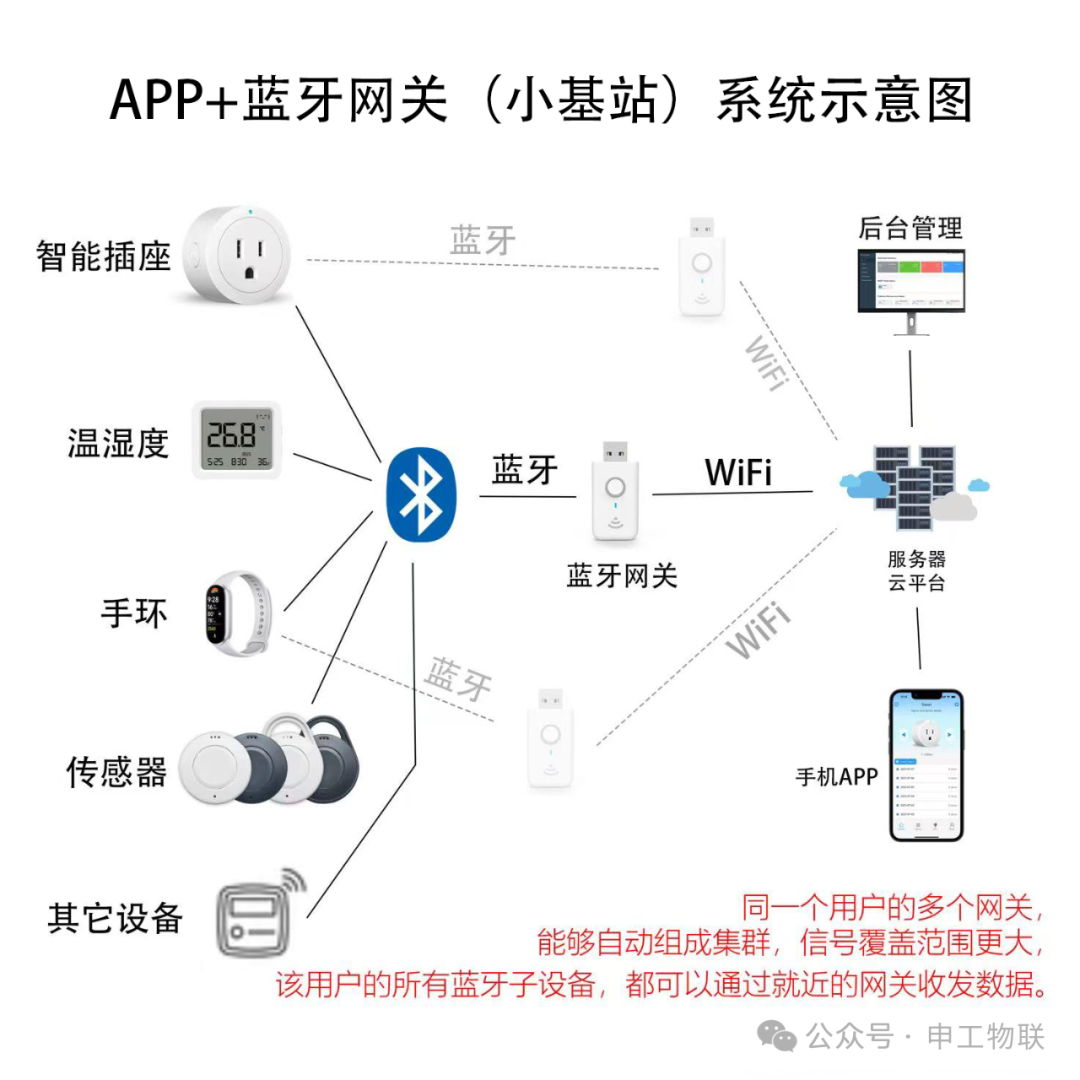
On the left are a bunch of small devices: temperature and humidity sensors, wristbands, smart plugs, door magnets…
They are equipped with a 2 yuan Bluetooth chip, and the battery lasts for a year.
In the middle is my 13 yuan Bluetooth base station, which just needs to be plugged in and connected to WiFi.
It acts as a “transit station,” specifically designed to receive data from surrounding small devices and then package it for upload to the cloud.
On the right are your mobile app and backend system, which can view data and issue remote control commands, just like WiFi devices.
The entire link is seamless, and users feel no difference.
But do you know? By not adding WiFi to each device, the costs are significantly reduced.
3. Some Ask: Isn’t Bluetooth Limited in Range and Poor at Penetrating Walls?
Indeed, Bluetooth signals are weak and can degrade when passing through walls.
However, my solution incorporates a clever design:
Place one gateway on the first floor, another on the second, and a third on the third floor, and they will automatically form a network.
Each device connects to the nearest gateway;
even if one gateway fails, others can still connect, ensuring no data loss.
So in practice, it is more stable than relying solely on WiFi.
4. What Can I Offer You?
I am not selling ideas; I am someone who can deliver tangible products:
1. Bluetooth base station hardware (bulk supply of PCBA, with a standard shell)
2. Mobile app (available for both iOS and Android, fully functional, customizable interface)
3. Private cloud platform deployment (supports long-term maintenance)
You can even modify the software of your existing Bluetooth products to connect to my 13 yuan gateway, and with just a product control panel added to the existing app, you can achieve remote control like WiFi products.
More importantly: this solution is already operational, with clients in mass production, so you won’t have to start from scratch; you can save costs and seize orders right away.
If interested, please add me on WeChat: napshen
I am Shen Gong, working in IoT and app development in Shenzhen,
helping you save real money with every device.