–【Previous Popular Selections】–
-
Japanese storage giant’s stock price surged by 68.6%! What happened to “Toshiba Storage”? Did you understand it?
-
Price increase twice in six months: SanDisk’s signal and the strategic shift in the NAND market
-
Nikkei Insight: Japanese automotive chips are shifting from “alternative” to “first choice”
–【Thank you for your attention and support】
The proliferation of artificial intelligence is following a clear path—from the cloud to the edge. Recently, Japanese semiconductor giant Renesas has mass-produced a new MPU product that marks a critical “intersection” on this path: the next generation of human-machine interface (HMI).
Renesas announced that its popular MPU “RZ family” has launched a new product, the “RZ/G3E”. The core highlight is that the RZ family has integrated Arm’s dedicated AI accelerator—the NPU (Neural Processing Unit) core “Ethos-U55” for the first time. This move clearly indicates that independent AI computing power is rapidly evolving from a “luxury” option to a “standard configuration” for mainstream application processors in industries such as industrial, medical, and automation equipment.

The core “trio” of RZ/G3E: A core + M core + NPU
To meet the demands of complex HMI systems, the RZ/G3E adopts a typical, efficient heterogeneous computing architecture, which can be regarded as the “standard template” for future intelligent edge devices:
-
Application Processing (A core): Equipped with up to 4 Arm Cortex-A55 cores (up to 1.8GHz), responsible for running graphical user interfaces (GUI), complex applications, and mainstream operating systems.
-
Real-time Control (M core): Equipped with 1 Arm Cortex-M33 core (up to 200MHz), specifically handling system control tasks that require high reliability and real-time response.
-
AI Inference (NPU): Equipped with 1 Arm Ethos-U55 NPU core. The presence of this NPU can free the CPU from heavy AI computations, allowing it to focus smoothly on tasks such as image classification, object recognition, speech recognition, and anomaly detection.
This combination of “A core running applications, M core doing control, and NPU specializing in AI” achieves a perfect division of computing power, ensuring that the system’s main application remains smooth and the stability of real-time control is not affected while running AI functions.
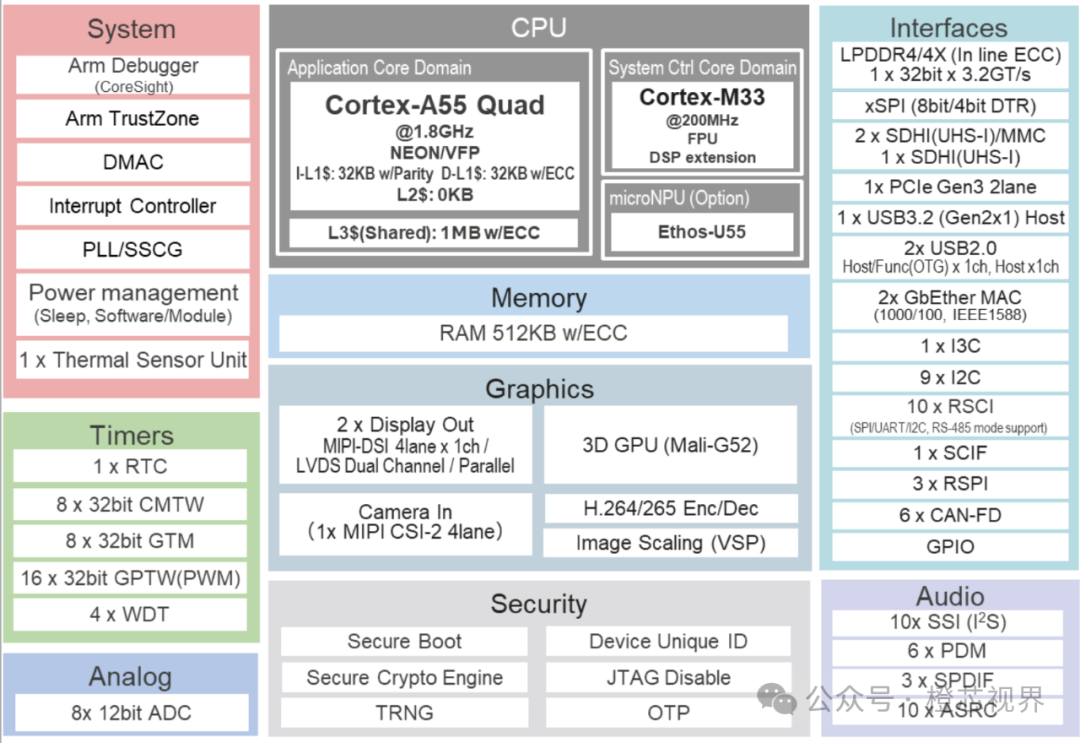
RZ/G3E
Why HMI? The next high-value scenario for AI implementation
Renesas has clearly targeted this MPU integrated with NPU towards manufacturing devices equipped with advanced HMI systems, medical monitors, and building automation equipment. This is backed by precise insights into market demand. The future HMI will no longer be just a simple information display or touch panel. It needs to possess stronger “perception” and “understanding” capabilities. For example, a factory control panel needs to implement gesture control or monitor anomalies through cameras; medical monitors need to analyze biological data in real-time and issue warnings; smart building terminals need to process voice commands.
The hardware capabilities provided by RZ/G3E are precisely to support these intelligent scenarios. It can drive two independent 60-frame full HD (Full HD) displays and is equipped with a MIPI-CSI camera interface for visual input, combined with the AI computing power of the NPU, providing a solid hardware foundation for the transition of HMI from “passive display” to “active intelligence”.
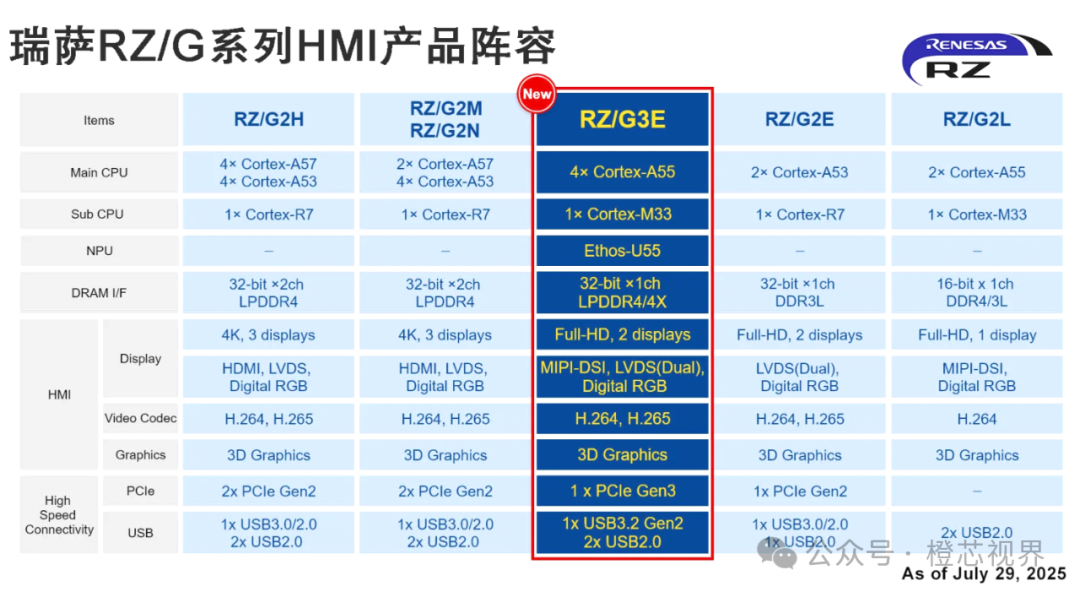
Image data sourced from Renesas official website
Integrated Software and Hardware: A “combination punch” to lower the AI development threshold
For embedded developers, powerful hardware is just the first step. To accelerate customers’ AI application implementation, Renesas has launched a “hardware-software integration” combination punch.
On the hardware side, Renesas provides an evaluation kit called “Evaluation Board Kit for RZ/G3E MPU” to help developers quickly start project prototypes. On the software side, three different levels of Linux software packages are prepared. For example, the version named “Linux BSP Plus” updates its kernel and Yocto framework every two years, providing stability assurance for industrial products that require long-term maintenance. By offering a complete solution from hardware evaluation boards to long-term maintenance Linux packages, Renesas aims to minimize the threshold for customers to deploy AI applications on complex heterogeneous processors.
“Orange Core” Perspective
The launch of Renesas RZ/G3E signals a strategy that is far greater than the product itself. It marks a shift in the focus of market competition in the industrial and IoT sectors.
In the past, the standard for evaluating an HMI processor was more about its GUI smoothness, multimedia processing capabilities, and richness of interfaces. Now, “Does it have built-in independent AI acceleration capability?” is rapidly becoming a new dividing line. Renesas’s move undoubtedly aims to establish industry standards in this new race.
For the entire industry, this signifies the dawn of a new era: the era of simple graphical interfaces is passing, and a new era of AI-driven, smarter, and more intuitive edge interaction is unfolding. Those who are still hesitating whether to integrate AI capabilities on the edge now face a more urgent question: How will their products compete when NPU becomes a standard feature of mainstream MPUs?
Renesas’s integration of Arm NPU into its mainstream HMI processors, do you think this marks the “tipping point” for the widespread adoption of edge AI, or will it remain a “choice” for specific high-end applications in the short term due to cost and computing power considerations?