After entering the 5G era, Samsung has successively released three 5G SoCs: Exynos 980, Exynos 990, and Exynos 880. Among them, the Exynos 990 is positioned as the flagship, targeting Qualcomm’s Snapdragon 865, and serves as the exclusive heart of the Galaxy S20 series flagship smartphones. The Exynos 980 and Exynos 880 are positioned for the mid-range market, primarily used in vivo’s smartphones.
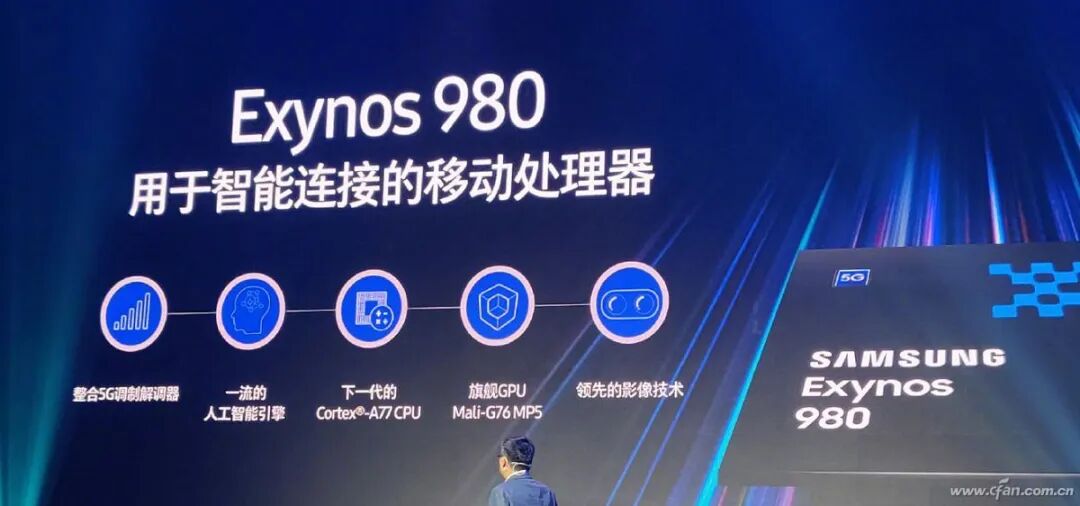
Samsung and vivo collaborated last year to customize the Exynos 980 mobile platform
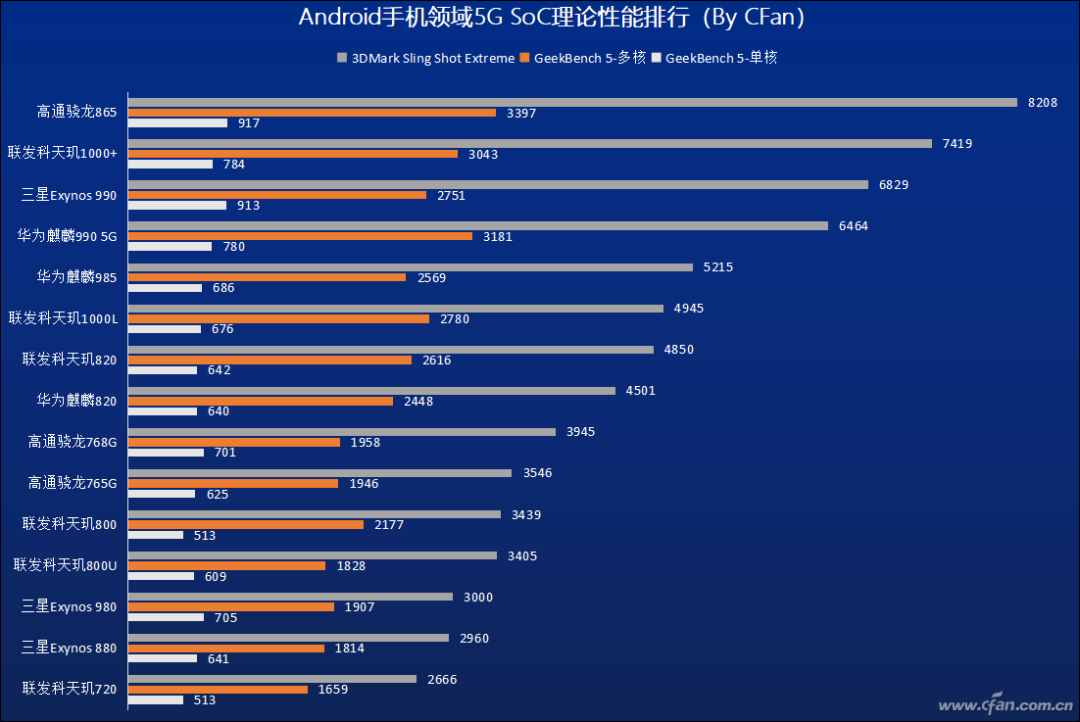
Unfortunately, in this round of competition among 5G SoCs, the performance of the Exynos series chips has not been impressive. The Exynos 990 falls short compared to the Dimensity 1000+ and Snapdragon 865, while the Exynos 980 and Exynos 880 can only slightly outperform the Dimensity 720, showing significantly weaker competitiveness.
To enhance Exynos’s influence in the mid-to-high-end 5G SoC market, Samsung once again collaborated with vivo to customize the new Exynos 1080 mobile platform.
We can understand the Exynos 1080 as an iterative upgrade of the Exynos 980 released at the same time last year, but its specifications have achieved a qualitative leap.

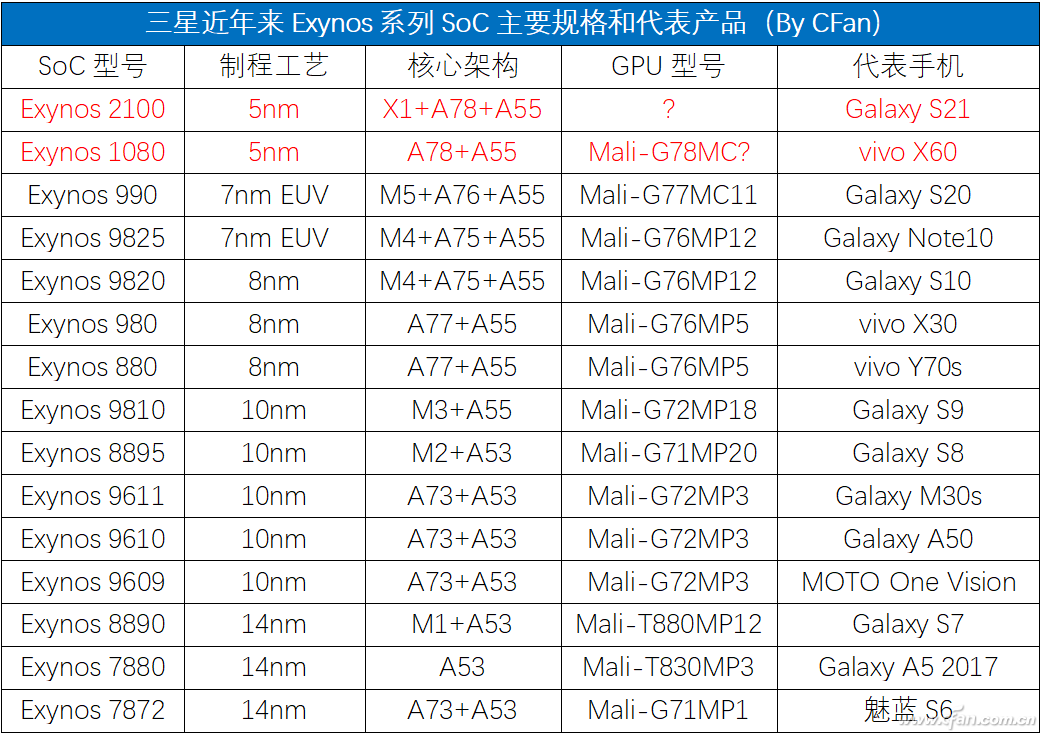
Specifically, the Exynos 1080 will adopt Samsung’s most advanced 5nm LPE process, a leap from the 8nm process used in the previous generation Exynos 980. At the same time, the Exynos 1080 will also utilize ARM’s latest Cortex-A78 and Cortex-A55 to form a dual-cluster CPU architecture, with the integrated GPU upgraded to ARM’s latest Mali-G78.
According to official data from ARM, the Cortex-A78 has improved IPC (Instructions Per Cycle) by 7% compared to the previous Cortex-A77, with a 4% reduction in power consumption, a 5% reduction in core size, and a 15% reduction in the area of the quad-core cluster.

Assuming the power consumption of a single “big core” in the SoC is about 1W at full load, the Cortex-A77 produced with a 7nm process can run at 2.6GHz, while the Cortex-A78 produced with a 5nm process can reach 3GHz, achieving a 20% performance improvement at the same power consumption. Conversely, assuming the same performance, the 2.1GHz Cortex-A78 produced with a 5nm process consumes 50% less power than the 2.3GHz Cortex-A77 produced with a 7nm process.
Of course, as a mid-to-high-end Exynos 1080, Samsung cannot set its big core at the extreme frequency of 3GHz; its main frequency will likely be between 2.2GHz and 2.6GHz.
Next, let’s look at the integrated Mali-G78 GPU of the Exynos 1080. It still uses the Valhall graphics architecture adopted by the Mali-G77, but it has optimized the global clock domain, changing it to a new two-level structure, achieving separation between the upper shared GPU module and the actual shader core frequency, which is an asynchronous clock domain. This allows the GPU core to operate at different frequencies from other parts, solving the imbalance between geometric output and computation, texture, and engine, while also allowing the GPU to run at different voltages, thereby reducing power consumption and improving energy efficiency, which is a common practice for desktop CPUs and GPUs.

During the Mali-G77 era, it could be paired with up to 16 compute units, i.e., Mali-G77 MC16, but due to cost, heat, and power consumption constraints, even the most aggressive Exynos 990 only used 11 compute units, i.e., Mali-G77 MC11, while the Dimensity 1000+ was equipped with Mali-G77 MC9.
This time, the Mali-G78 can arm up to 24 compute units, an increase of 50% over its predecessor. However, as mentioned above, even with the latest 5nm process, the actual commercial maximum scale is estimated to be around 16 units; any more would be difficult for smartphones to manage heat. Considering the positioning of the Exynos 1080, Samsung will likely prepare 5 to 8 compute cores for it, which corresponds to Mali-G78MC5 to Mali-G78MC8.
Due to the unspecified specifications of the Exynos 1080 (the number and frequency of CPU big and small cores, GPU scale and frequency), it is difficult to infer its actual performance. However, based on Samsung’s announced AnTuTu score for the Exynos 1080 (650,000), this figure has already surpassed the Exynos 990 and Snapdragon 865, indicating that the comprehensive performance of the Exynos 1080 has reached the ultra-flagship level of 2020.
The Samsung Exynos 1080 is likely to be launched first in the vivo X60 series, with a starting price expected to remain around 3,000 yuan. If it can indeed provide performance comparable to the Snapdragon 865, combined with the inherent power-saving advantages of the 5nm process, its competitiveness will far exceed that of its predecessor, the Exynos 980.

In addition to the Exynos 1080, Samsung is also preparing the next-generation flagship 5G SoC, the Exynos 2100, which also adopts a 5nm process but will upgrade to a CPU architecture consisting of Cortex-X1, Cortex-A78, and Cortex-A55. It is also expected to introduce a custom GPU unit from AMD and compete with the Kirin 9000, Snapdragon 875, and Dimensity 2000 series.