Click the blue text to follow us
Smart Sensor Network
This public account is a non-profit MEMS technology dynamic and industry reporting platform under the Guangdong Microtechnology Industrial Research Institute. We publish in-depth reports on MEMS, track industry dynamics, and provide technical popularization every week. This article is an in-depth report.
The power industry, as the core of the national energy infrastructure, is accelerating its transformation towards intelligence and digitization. From the single power supply function of traditional power grids to the full-process state monitoring and optimization control of smart grids, this transformation is closely related to advancements in sensor technology. Early power systems primarily relied on traditional mechanical sensors to achieve basic parameter monitoring, such as simple measurements of voltage and current, but faced limitations such as large size, high power consumption, and low accuracy, making it difficult to meet the real-time monitoring needs in complex grid environments.
With the maturity of Micro-Electro-Mechanical Systems (MEMS) technology, MEMS sensors have become the core support for the intelligent upgrade of the power industry due to their advantages of small size, high precision, low power consumption, controllable cost, and resistance to harsh environments. For example, by integrating micro pressure sensors and temperature sensors, smart meters can achieve high-precision energy consumption monitoring; using MEMS inertial sensors, inspection robots can accurately locate in complex grid environments. Currently, the demand for equipment state monitoring, fault warning, and energy efficiency optimization in the power industry is increasingly urgent, driving MEMS sensors to evolve from single parameter measurement to multi-modal fusion perception, showing broad application prospects in transmission, distribution, and consumption stages.
1
Current Industry Applications
MEMS SENSOR
1. MEMS Pressure Sensors
MEMS pressure sensors, based on the piezoresistive effect or capacitive effect, sense pressure changes through a micro diaphragm structure and convert them into electrical signals. Their miniaturized design can be directly integrated into power equipment, reducing wiring complexity, and can operate stably in wide temperature environments, meeting the stringent requirements for internal pressure monitoring of high-voltage equipment.
Typical Applications:
State Grid Zhixin Company has independently developed the “Lingxi” series of high-precision MEMS pressure sensor chips, achieving a full-range error of only 0.1% within a wide temperature range of -20℃ to 85℃ in SF6 digital density meters. Using ceramic substrates and encapsulation technology, it solves the problems of traditional mechanical meters lacking remote transmission capabilities and human reading errors, providing core monitoring components for the safe operation of gas-insulated equipment.
2. TMR (Tunnel Magnetoresistance) Sensors
TMR sensors, based on quantum tunneling effects, have extremely high sensitivity to magnetic field changes, enabling precise measurement of weak magnetic fields. Their core structure combines metal layers with non-magnetic tunnel junctions to convert magnetic field signals into resistance changes, featuring wide measurement ranges, low power consumption, and strong resistance to DC interference, making them suitable for current monitoring in complex electromagnetic environments.
Typical Applications:
Multi-Dimensional Technology has launched a series of high-performance TMR current sensor products based on years of research in TMR technology, providing precise and reliable current monitoring solutions for photovoltaic inverters.
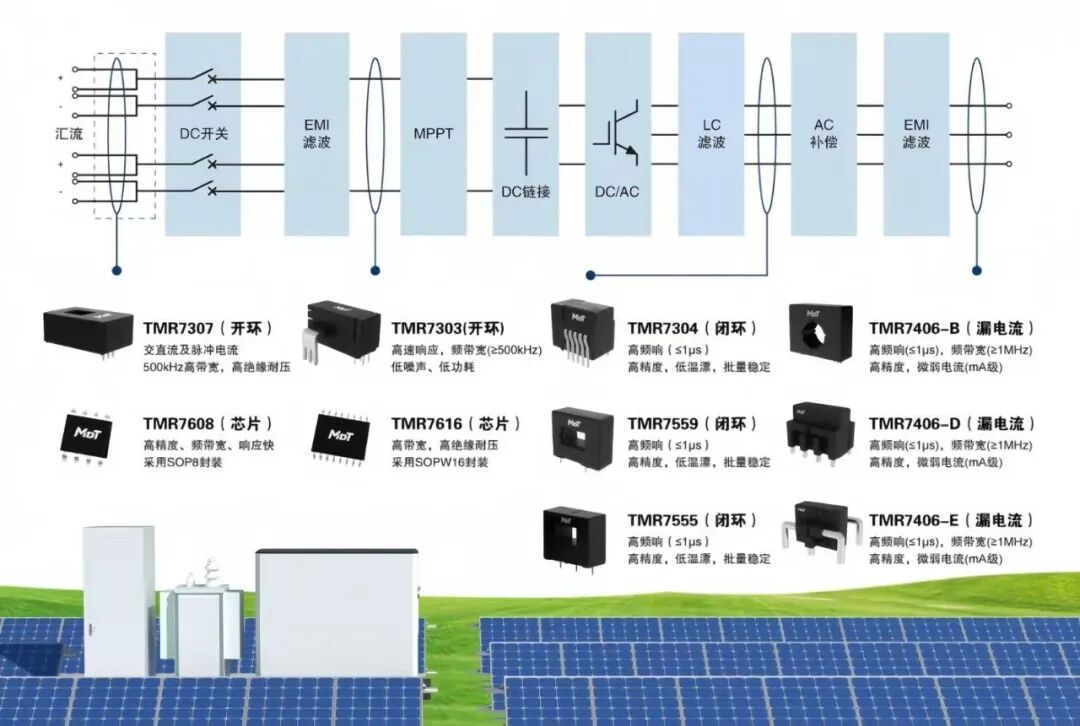
State Grid has piloted the application of “high-sensitivity MEMS magnetic sensitive components and sensor” project results in the Sichuan power grid, developing micro-amp to kilo-amp composite measurement series sensor modules and key components, providing data support for the panoramic perception of the new power system “grid – equipment – customer” state.
Allegro‘s XtremeSense™ TMR sensors can suppress external magnetic field interference in clean energy systems, achieving noise immunity performance and high-precision current measurement in high-voltage, power-dense scenarios, maximizing power conversion efficiency.
3. MEMS Gas Sensors
MEMS gas sensors, based on semiconductor metal oxides (such as SnO₂) or catalytic combustion principles, are sensitive to the concentrations of gases such as SF₆, O₂, and H₂. Their micro gas chamber design improves gas adsorption efficiency, allowing for rapid response in the confined spaces of power equipment, and their resistance to humidity and dust interference is significantly better than that of traditional sensors.
Typical Applications:
Zhongke Weiguan has launched MEMS-based hydrogen sensors and modules for lithium battery energy storage systems, adding a dimension of safety monitoring for the safe operation of lithium energy storage systems, especially suitable for monitoring changes in hydrogen content during the early stages of thermal runaway caused by aging in lithium batteries over long life cycles.
Guangxi Power Grid has launched patented MEMS gas sensor technology for monitoring lithium battery energy storage systems and power equipment, adding a dimension of gas concentration monitoring for the safe operation of lithium energy storage and substation equipment status monitoring, especially suitable for capturing characteristic gases (such as H₂, CO) during the early stages of thermal runaway caused by aging in lithium batteries, as well as abnormal gas component changes during the early stages of partial discharge in power equipment.
4. MEMS Infrared Sensors
MEMS infrared sensors utilize micro-electromechanical system technology to achieve non-contact detection of infrared radiation, capturing thermal radiation signals from object surfaces through infrared focal plane arrays or single-point detectors, and converting them into temperature distribution images through signal processing. They feature micron-level spatial resolution and millisecond-level response speed, and can operate stably in both low-light and bright environments.
Typical Applications:
State Grid Hubei Electric Power has independently developed a drone inspection micro-application infrared detection platform, using AI target detection and image segmentation technology to extract temperature matrices of easily heated components such as composite insulators and tension clamps, achieving a detection speed of 24,000 images per day, improving efficiency by more than five times compared to manual identification.
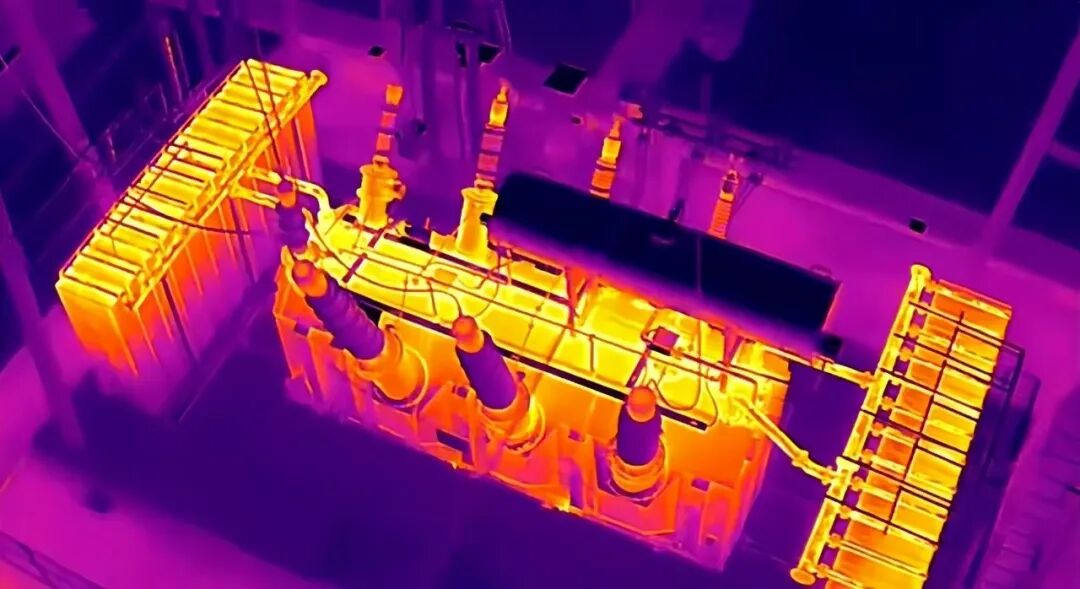
Gaode Zhiguan handheld thermal imaging thermometer covers all aspects of power inspection, including generation, transmission, transformation, and distribution, achieving non-contact diagnosis of faults such as oil depletion in bushings and leakage in GIS equipment through dual-spectrum fusion technology and regional temperature analysis.
DJI Zenmuse H30T integrates a zoom camera, wide-angle camera, thermal imaging camera, laser rangefinder, and near-infrared fill light in a gimbal camera, helping the Shaanxi Power Transmission and Transformation Company improve the efficiency and safety of operations and repairs.
5. MEMS Temperature Sensors
MEMS temperature sensors, based on thermistor or thermocouple principles, achieve high-precision temperature measurement through miniaturized structures. Their size is only 1/10 to 1/5 of traditional sensors, allowing for dense deployment within equipment, supporting wide temperature range measurements from -40℃ to 125℃, and their power consumption is below microwatt level, suitable for long-term online monitoring.
Typical Applications:
Guangdong Power Grid has developed cable temperature measurement technology that integrates RFID and low-power MEMS sensors, achieving long-distance wireless communication, low-power operation, and high-precision temperature measurement through efficient rectifiers, gated clocks, and nanowatt-level ADCs, adapting to harsh environments, solving traditional system wiring difficulties and low accuracy issues, enhancing cable monitoring reliability, and reducing operation and maintenance costs.
6. MEMS Inertial and Vibration Sensors
MEMS inertial sensors (including accelerometers and gyroscopes) sense motion states through vibrations or displacements of micro-mechanical structures, enabling high-precision attitude measurement and motion trajectory tracking; vibration sensors, based on piezoelectric or piezoresistive principles, capture micron-level vibration signals, with a frequency response range of 0.1Hz to 10kHz.
Typical Applications:
Southern Power Grid has deployed nine-axis inertial measurement units (IMUs) on mountainous transmission lines, integrating MEMS accelerometers, gyroscopes, and magnetometers to achieve monitoring with an inclination accuracy of 0.01°. When the tilt of a tower exceeds a safety threshold, the system automatically triggers laser ranging verification and coordinates with drones for detailed inspections. In the 2024 measurements of Southern Power Grid, this system successfully warned of 17 potential tower collapse risks, with a false alarm rate controlled below 0.3%, reducing by 85% compared to traditional solutions.
Jiangsu Yutuo Power‘s monitoring device deploys micro-sensor nodes every 200 meters along the line, integrating MEMS vibration sensors (0-500Hz bandwidth) and tilt sensors to monitor wire swaying and insulator loosening in real-time, warning of tower settlement. The warning time for hazards such as wildfires and icing has been reduced from hours to 10 minutes, decreasing manual inspection frequency by 75% and extending wire lifespan by 40%.
7. MEMS Fiber Optic Sensors
MEMS fiber optic sensing technology integrates miniaturized fiber Bragg gratings (FBG) with MEMS structures to achieve distributed monitoring of parameters such as strain, vibration, and temperature in wind turbine blades. It features ultra-high sensitivity, full-size coverage, and resistance to electromagnetic interference, providing stable data output even in thunderstorm weather, solving electromagnetic compatibility issues of traditional electronic sensors.
Typical Applications:
Fraunhofer IKTS Research Institute in Germany has developed a 3×3mm² nanophotonic chip that achieves single-fiber 16-channel multiplexing through machine learning, providing a 58-day early warning of adhesive failure at the trailing edge of blades in the North Sea wind farm, avoiding a loss of 2 million euros.
Goldwind Technology has deployed a fiber optic sensing + edge computing system in the Pingtan offshore wind farm, implanting 45 sensors in each blade, diagnosing early gearbox wear through vibration phase analysis, achieving a 28% reduction in operation and maintenance costs.
Three Gorges Energy Jiangsu Rudong Project has deployed a distributed fiber optic acoustic sensing (DAS) system, addressing sensor reliability issues in highly corrosive offshore environments, avoiding three ice impact damages in the first year of operation, with power generation exceeding design values by 8.3%.
2
Key Technologies and Research Progress
MEMS SENSOR
Professor Hu Zhiyu’s team at Shanghai Jiao Tong University has achieved a disruptive breakthrough in MEMS high-integration large array thermoelectric chips, with core technologies published in top journals such as the Journal of Power Sources, and evaluated by teams from MIT, Wuhan University of Technology, and others as “extremely challenging” and “very difficult” innovative results. This chip integrates over 46,000 sub-micron thick thermoelectric arrays on a 75mm silicon wafer through micro-nano processing technology, achieving continuous power generation at an ultra-low temperature difference of 0.0001℃ for the first time, breaking the technical bottleneck that has prevented heat engines from effectively working with small temperature differences since the Watt steam engine.
Wang Fei’s research group at Southern University of Science and Technology has developed a high-performance anti-interference piezoelectric energy harvesting system, designed with a three-piezoelectric cantilever structure based on magnetic field coupling principles, maintaining stable output under external vibration interference, with a maximum output power of 272.91μW, successfully powering temperature and humidity sensors in smart grid monitoring, achieving engineering applications of self-powered sensor systems.
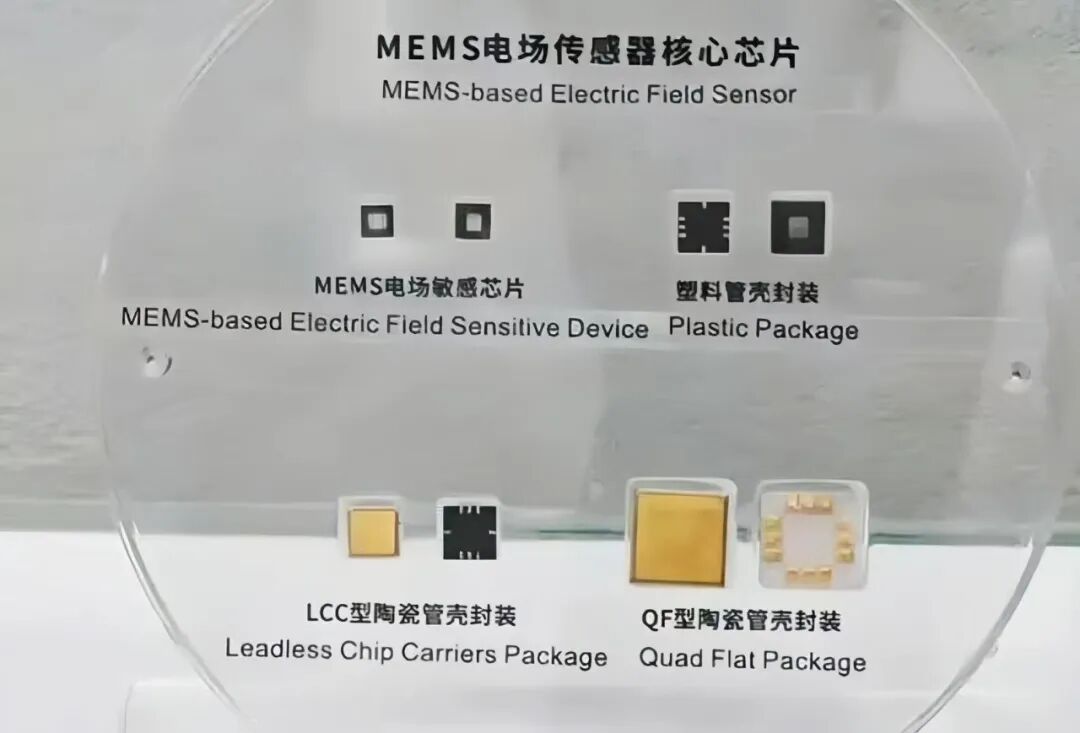
Zhongke Feilong has broken through multiple key technologies to develop high-performance MEMS electric field sensors, and based on this, has developed a series of products including MEMS atmospheric electric field instruments, MEMS high-altitude electric field sensors, MEMS electrostatic sensors, and MEMS oil surface potentiometers. They are currently working hard to develop “hard pressure plate state monitoring sensors” and supporting systems based on high-performance MEMS electric field sensitive chips, which are expected to achieve large-scale applications in power grid relay protection equipment in the future.
3
Development Trends and Challenges
MEMS SENSOR
1. Single Chip Integration and Multi-Functional Composite
Future MEMS sensors will develop towards “multi-parameter sensing on a single chip”, for example, composite sensors integrating pressure, temperature, vibration, and magnetic fields, capable of simultaneously monitoring mechanical stress, temperature rise, partial discharge, and magnetic field anomalies at cable joints.
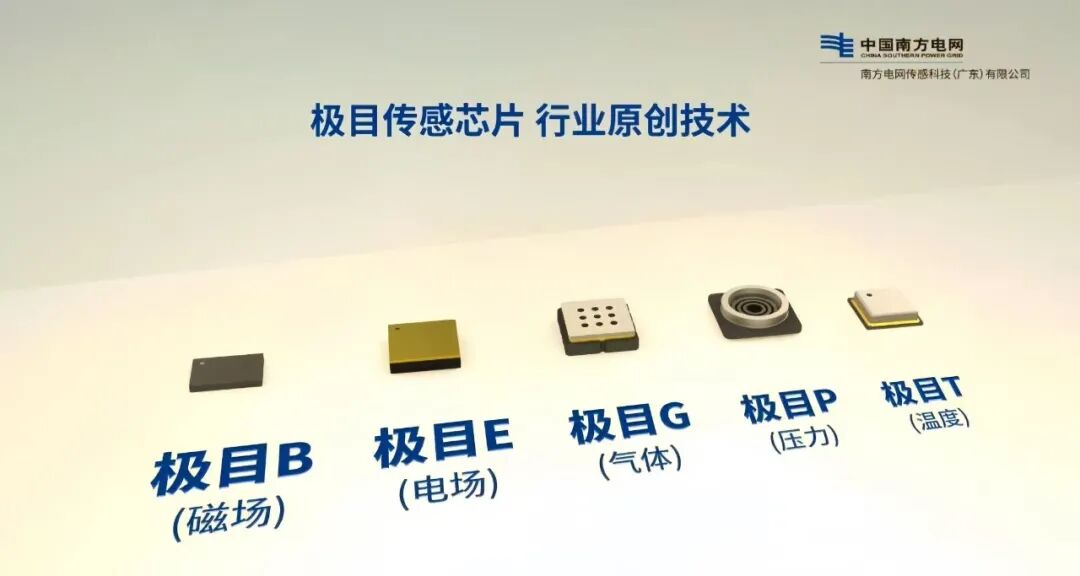
For instance, the Southern Power Grid “Nanfang Extreme Eye” series has achieved integrated measurement of electrical quantities (current, voltage, power) and non-electrical quantities (temperature, humidity, vibration), with the volume of its miniaturized electrical quantity integrated sensor being only centimeter-level, achieving current measurement accuracy of 0.5S level, supporting plug-and-play and over-the-air upgrades.
2. Quantum Sensing and AI-Driven Predictive Maintenance
As the demand for “zero downtime” maintenance in power systems increases, MEMS sensors will deeply integrate with cutting-edge technologies:
For example, the Shanghai Micro System Institute has developed a MEMS quantum current sensor based on diamond nitrogen vacancy color centers, achieving high-precision measurement of 0.06% over a range of 1mA to 10kA within a volume of 2.4 cubic centimeters, validated through ±800kV ultra-high voltage transmission line hanging network type verification, with comprehensive technical performance reaching international leading levels.
Jiejie Sensing has launched the VBL12 three-axis temperature and vibration sensor, capable of simultaneously monitoring acceleration, temperature, and tilt, with precision reaching micron-level vibration signals, while supporting real-time data upload via 4G gateways, and cloud-based AI models automatically analyzing spectral features, providing early warnings of looseness, short circuits, and other hazards seven days in advance, applicable to monitoring scenarios in power transmission and distribution systems, industrial plant substations, new energy wind power, and photovoltaic stations.
3. Adaptability to Extreme Environments and Safety Protection
The power industry has stringent requirements for the reliability and safety of sensors, especially in scenarios such as ultra-high voltage and submarine cables.
Resistance to Electromagnetic Interference and Weather Resistance: Sensors need to meet conditions such as resistance to electromagnetic interference, salt mist corrosion, and extreme temperatures. Currently, domestic MEMS sensors are continuously breaking through in wide temperature ranges and high protection indicators. Industry research shows that the demand for MEMS sensors with extreme environmental adaptability is rapidly growing, with related technology development focused on high-voltage insulation packaging and wide-temperature material modification.
Safety Protection Technologies: Intelligent power sensors and sensor networks face risks such as physical attacks and side-channel leakage. The industry is promoting lightweight encryption and identity authentication technologies, such as hardware fingerprint authentication based on physically unclonable functions (PUF), and lightweight encryption algorithms like ASCON suitable for small data volumes, to ensure data transmission and storage security.
4. Standardization and Acceleration of Domestic Substitution
Currently, high-end MEMS sensors (such as high-precision inertial sensors and infrared focal plane arrays) still rely on imports, but domestic companies are accelerating breakthroughs.
For example, the Southern Power Grid Company has developed the first domestic power-specific main control chip “Fuxi” based on domestic instruction architecture, which has completed verification applications in key scenarios such as grid control protection and automation, marking a shift in the core chips of China’s power industrial control field from “imported general-purpose” to “independent specialized”, providing foundational support for the domestic integration of MEMS sensors.
4
Conclusion
MEMS SENSOR
As the “nerve endings” of the intelligent power system, MEMS sensors are upgrading from single parameter monitoring to multi-dimensional perception, extending from equipment state detection to predictive maintenance. As the new power system’s requirements for reliability and flexibility continue to increase, the integration of MEMS technology with AI, 5G, quantum sensing, and other technologies will give rise to more innovative applications, such as digital twins of power grids based on MEMS sensors and intelligent control of distributed energy. In the future, the industry needs to continue overcoming key technologies such as adaptability to extreme environments and deep integration of multi-source data, promoting the intelligent transformation of power systems to a higher level.
END
Welcome to reprint this article,
please indicate it comes from the public account “Intelligent Sensor Network”!