Saturday, November 22, 2025 Sunny 21℃/7℃
Quantum Navigation
Source: NOV/DEC 2025 DISCOVER
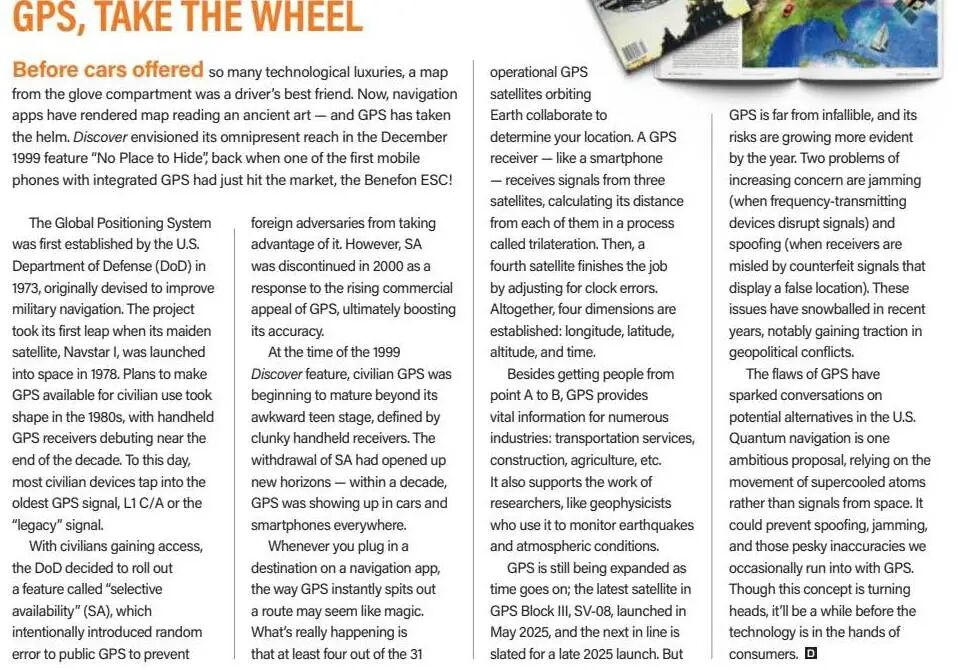
The flaws of GPS have sparked discussions in the United States about alternatives. Quantum navigation, as an ambitious proposal, relies on the motion of ultra-cold atoms for positioning instead of space signals, effectively preventing spoofing interference and addressing the occasional positioning errors of traditional GPS. Although this concept is intriguing, the widespread adoption of this technology at the consumer level will take time.
Quantum Bits
Source: The Economist NOV 22nd-28th 2025
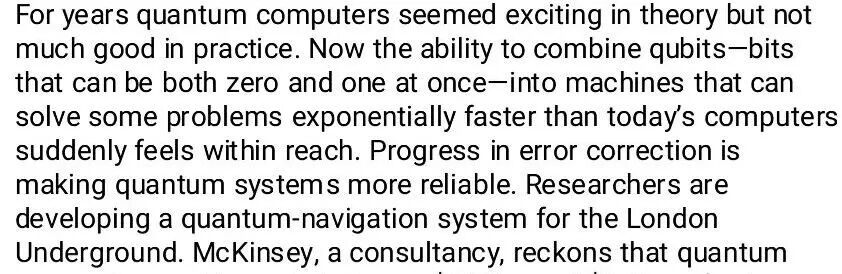
For years, quantum computers have been theoretically impressive but practically lacking. Now, integrating quantum bits that can exist in both 0 and 1 states into machines shows promise for exponentially solving existing computational problems. Advances in error correction technology are enhancing the reliability of quantum systems, and researchers are working on developing a quantum navigation system for the London Underground.

Source: Science·News 11/NOV 2025
The long road to building a fully functional quantum computer may be shortened by a new version of a device called “superconducting quantum bits”. This new type of quantum bit can maintain fragile quantum states for over 1 millisecond, three times longer than the previous best record for such devices. A study published last week in Nature indicates that the number of quantum bits required for a mature quantum computer may be far less than previously expected. Most importantly, this breakthrough was achieved not by redesigning the quantum bits but by improving their manufacturing materials.
Source: Science·News 11/NOV 2025
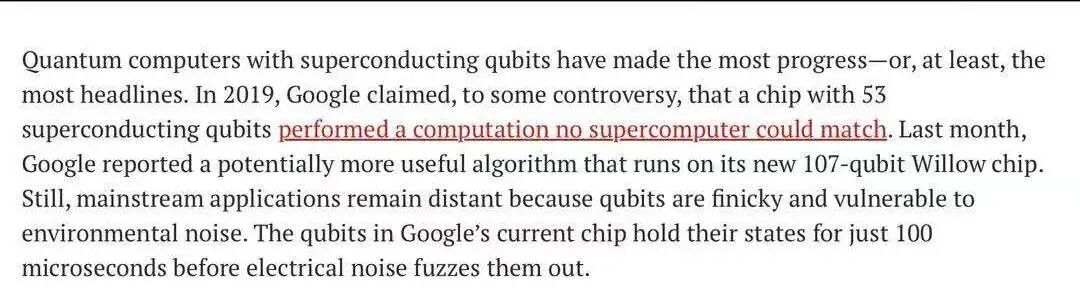
Quantum computers using superconducting quantum bits have made the most significant progress—at least in media coverage. In 2019, Google controversially claimed that its 53 superconducting quantum bit chip completed a computational task that traditional supercomputers could not achieve. Last month, Google announced that it ran a potentially more practical algorithm on its new 107-qubit “Willow” chip. However, due to the extreme instability of quantum bit states and their susceptibility to environmental noise, mainstream applications remain out of reach. Currently, the quantum bits in Google’s chip can only maintain their state for 100 microseconds before being disrupted by electrical noise.

Source: Science·News 11/NOV 2025
Now, Princeton University experimental physicist Natalie DeLeon and her team have successfully developed superconducting quantum bits that can maintain quantum states for 1 millisecond, ten times longer than Google’s chip. DeLeon stated that this is the latest breakthrough in systematically identifying, quantifying, and eliminating noise sources in superconducting quantum bits since 2019.
Quantum Communication

Source: November 15, 2025 | New Scientist
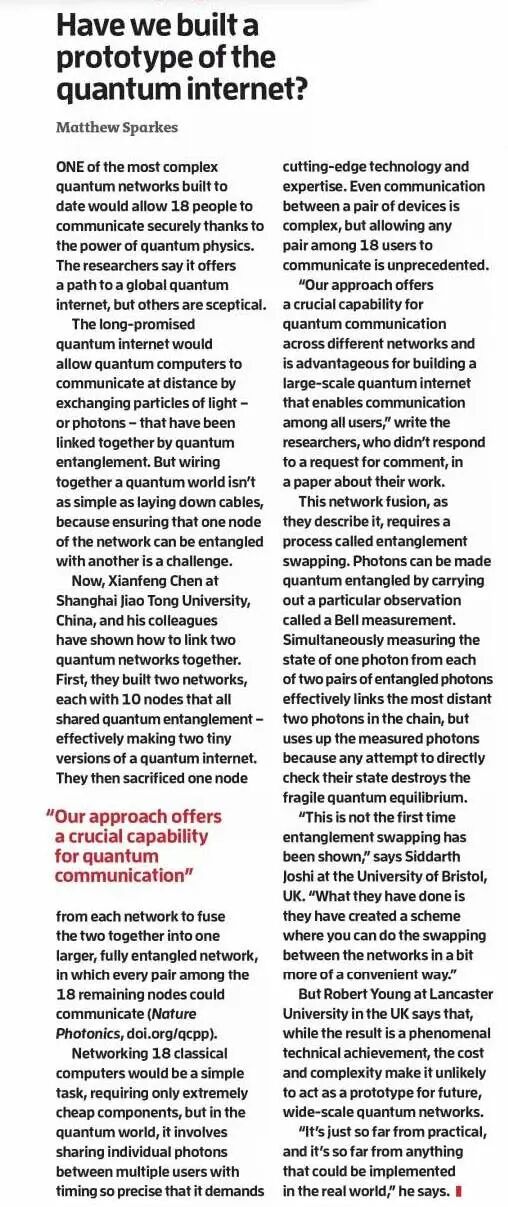
Now, Chen Xianfeng and his colleagues from Shanghai Jiao Tong University in China have demonstrated how to connect two quantum networks. First, they constructed two networks, each with four nodes sharing quantum entanglement, effectively forming two mini-networks, or a small quantum internet. Then, they sacrificed one node from each network to connect the two networks, forming a larger, fully entangled network consisting of six remaining nodes. In this network, communication can occur between every pair of nodes (the research results were published in the journal Nature Photonics).
Outlook
Source: The Economist NOV 22nd-28th 2025
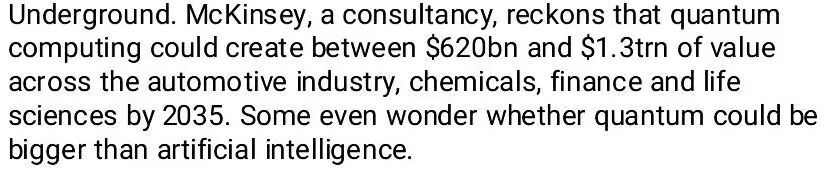
McKinsey & Company predicts that by 2035, quantum computing will create between $620 billion and $1.3 trillion in value across the automotive, chemical, financial, and life sciences sectors. Some even speculate that the potential of quantum technology may surpass that of artificial intelligence.