
In the production line, the handover of workpieces between the elevator and the roller bed often encounters issues such as feeding before stopping, premature activation colliding with workpieces, and overshooting. This PLC coordination logic clarifies the elevator’s deceleration positioning, overshoot protection, and roller bed handover, with clear points and interlocking logic, ready to use directly, ensuring stable handover without rework.
1. Control Requirements of the Case
1. Press the elevator “Up Position/Down Position” button, the device first runs quickly;
2. After triggering the deceleration switch, switch to slow operation, and accurately stop and self-lock after the position switch is triggered;
3. The roller bed start button is only valid when the elevator is stable, with no overshoot/emergency stop faults, allowing for feeding/receiving;
4. When the elevator is running, the roller bed cannot start; when the roller bed is running, the elevator cannot operate;
5. Pressing the emergency stop or triggering the overshoot switch will immediately stop all equipment and trigger an alarm.
2. Point Table (Hardware and Data Correspondence)
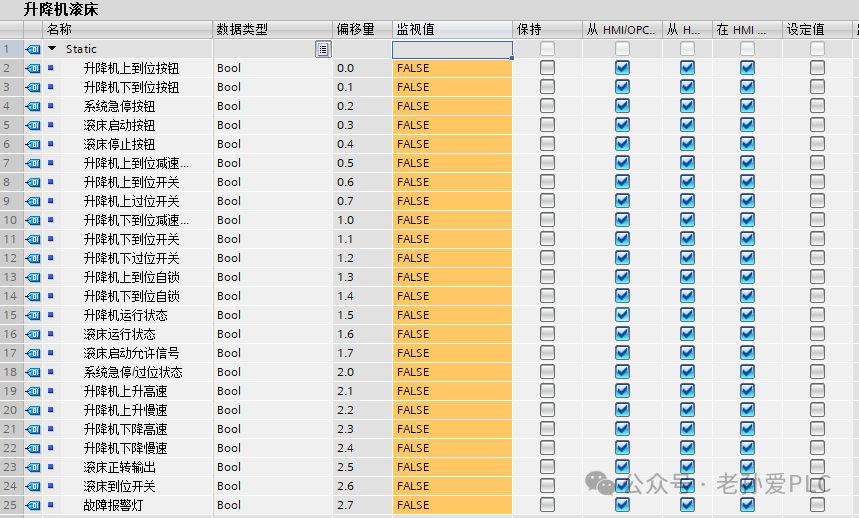
3. Four Steps to Program Elevator and Roller Bed Coordination
Step 1: System Safety Logic
Core Logic: Emergency stop/overshoot has the highest priority, triggering a full stop and alarm.Operation: Series connect “System Emergency Stop (DBX0.2), Elevator Up Overshoot (DBX0.7), Down Overshoot Switch (DBX1.2)”, set 1 “Emergency Stop/Overshoot Status (DBX2.0)” and self-lock, while driving “Fault Alarm Light (DBX2.7)”, and connect the normally closed contact of DBX2.0 in all output circuits, prohibiting startup in case of faults.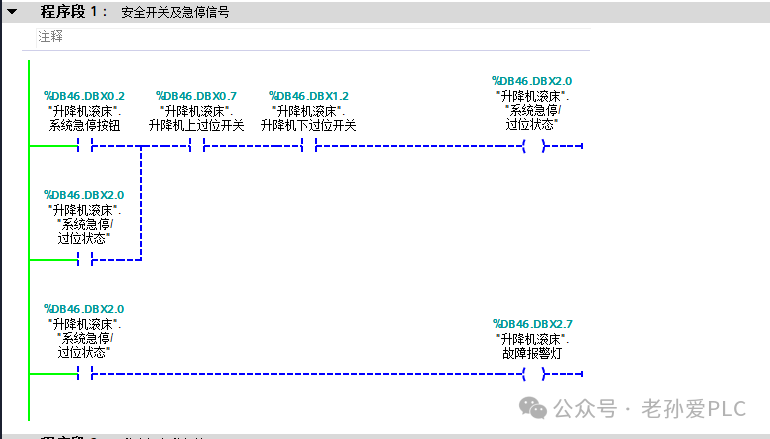
Step 2: Elevator Up Conditions
Core Logic: Button trigger → Fast → Slow → Stop and self-lock, emergency stop/roller bed operation prohibited. Operation:
1. Series connect “Emergency Stop Normally Closed (DBX2.0), Up Position Button (DBX0.0), Down Position Self-lock Normally Closed (DBX1.4)”, trigger “Elevator Up High Speed (DBX2.1)”, while resetting the Down Position Self-lock;2. Trigger “Upward Deceleration Switch (DBX0.5)”, reset high speed, set “Upward Low Speed (DBX2.2)”;3. Trigger “Up Position Switch (DBX0.6)”, set “Up Position Self-lock (DBX1.3)”, reset low speed, and the elevator stops steadily.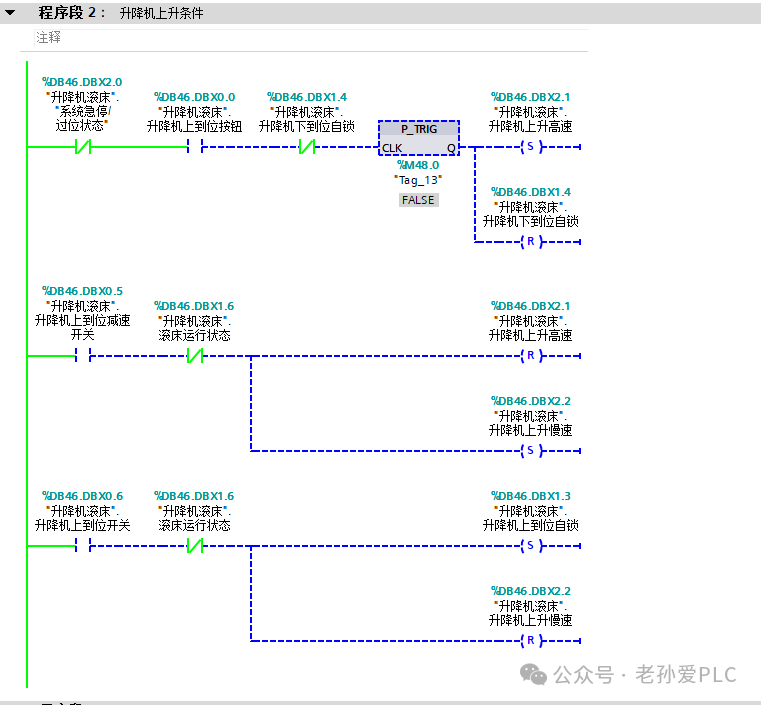
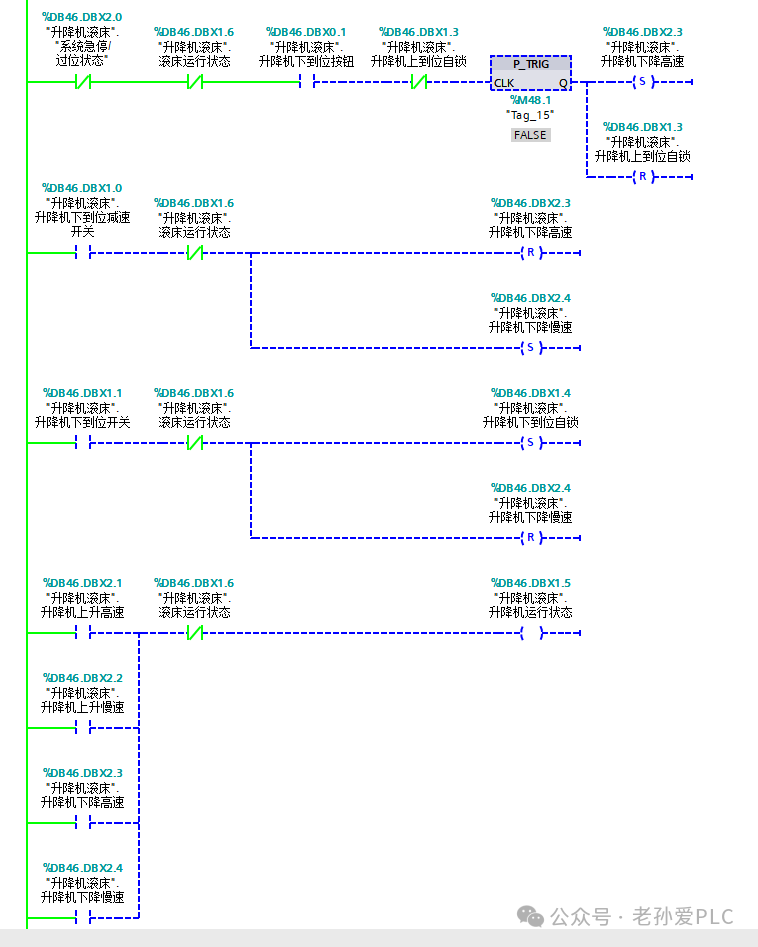
Step 3: Elevator Down Conditions
Core Logic:
1. Symmetrical to the upward process, achieving “Fast → Slow → Stop and self-lock”. Operation: Series connect “Emergency Stop Normally Closed, Down Position Button (DBX0.1), Up Position Self-lock Normally Closed (DBX1.3)”, trigger “Down High Speed (DBX2.3)”;
Trigger “Downward Deceleration Switch (DBX1.0)” to switch to “Down Low Speed (DBX2.4)”; trigger “Down Position Switch (DBX1.1)” to set “Down Position Self-lock (DBX1.4)”, reset low speed. Parallel connect the elevator high/low speed contacts, trigger “Elevator Running Status (DBX1.5)”.
Step 4: Roller Bed Running Conditions
Core Logic: The roller bed is allowed to start only after the elevator has stopped, while locking the elevator.
Operation:
1. Parallel connect “Up/Down Position Self-lock (DBX1.3/1.4)”, series connect “Elevator/Roller Bed Running Normally Closed (DBX1.5/1.6), Emergency Stop Normally Closed”, set 1 “Roller Bed Start Allowed (DBX1.7)”;2. Series connect “Roller Bed Start Button (DBX0.3), Allow Signal (DBX1.7), Stop Button (DBX0.4), Position Normally Closed (DBX2.6)”, trigger “Roller Bed Forward (DBX2.5)” and self-lock;3. Roller Bed Forward sets 1 “Roller Bed Running Status (DBX1.6)” locking the elevator, while the position/stop button cuts off the self-lock to stop the roller bed, and resets the allow signal.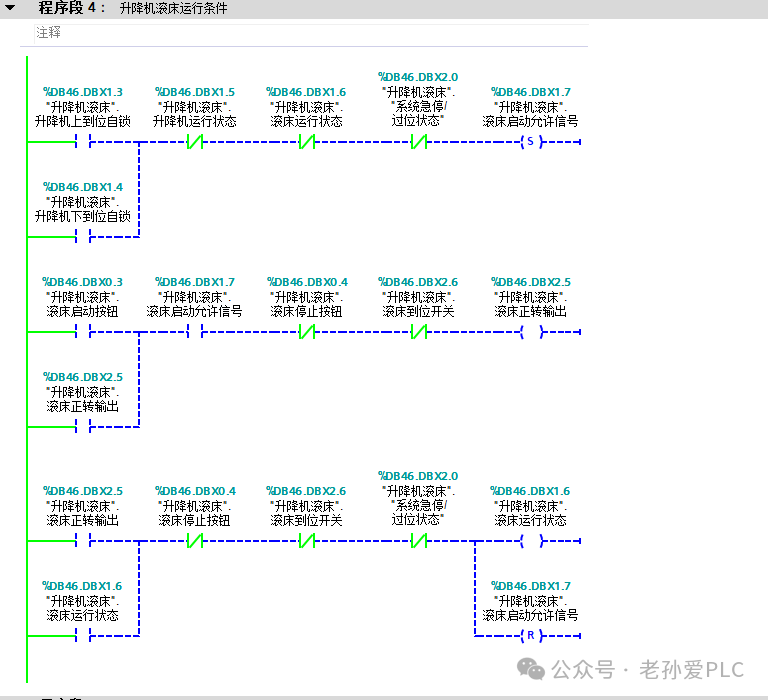
4. Core Logic of Elevator and Roller Bed Coordination (Two Points for Beginners)
1. Three-level Protection: First, rely on the deceleration switch to allow the elevator to transition smoothly from “fast to slow”; then use the position switch + self-lock to stop accurately and prevent slipping; finally, use overshoot detection + emergency stop as a safety net, immediately cutting off all actions in case of overtravel, covering all safety risks.
2. Interlocking + Allowance: The elevator and roller bed are mutually interlocked—when one operates, the other cannot start; then rely on the “roller bed start allowed signal” to restrict conditions, allowing the roller bed to start only when the elevator is stable and without faults, fundamentally avoiding collisions, making it stress-free for beginners to debug!
Solidly learn technology, making progress every day! Doing my best to help more people!