Click the top left corner “MDPI Engineering Science” to follow us for more latest news.
The aeroengine, as a highly complex and multidisciplinary deeply coupled engineering machinery system, operates over a wide envelope, with its operational state exhibiting strong dynamic characteristics influenced by the environment and working conditions. It serves for long periods in extreme environments characterized by high temperatures, high pressures, and strong vibrations, subjecting its control system components to significant nonlinear dynamic load impacts. Among these, sensors are critical components of the engine control system and are prone to failures, which can directly jeopardize the safe and reliable operation of the aircraft, potentially leading to major flight accidents. Therefore, developing a high-precision intelligent fault diagnosis system for sensors is of significant engineering importance for ensuring the safety and reliability of the engine control system throughout its operational process. Traditional intelligent fault diagnosis methods are often limited to steady-state conditions of the engine, making it difficult to effectively distinguish abnormal signals caused by faults from normal signal variations due to the engine’s inherent characteristics (such as thrust changes and transient speeds) under dynamic conditions, leading to a decline in diagnostic performance. Furthermore, the inherent “black box” nature of traditional deep learning models often results in outputs that violate physical laws, limiting their engineering credibility and application value. Therefore, addressing how to integrate physical mechanisms with data-driven advantages to construct a reliable intelligent fault diagnosis model for the strong dynamic operating scenarios of aeroengines is a critical technical bottleneck that needs to be overcome. Dr. Huihui Li from the Intelligent Control Research Institute of Northwestern Polytechnical University published an article in the Aerospace journal proposing an intelligent fault diagnosis method based on Physics-Guided Neural Networks (PGNN), which is of great significance for improving the operational safety and economic feasibility of aeroengines.
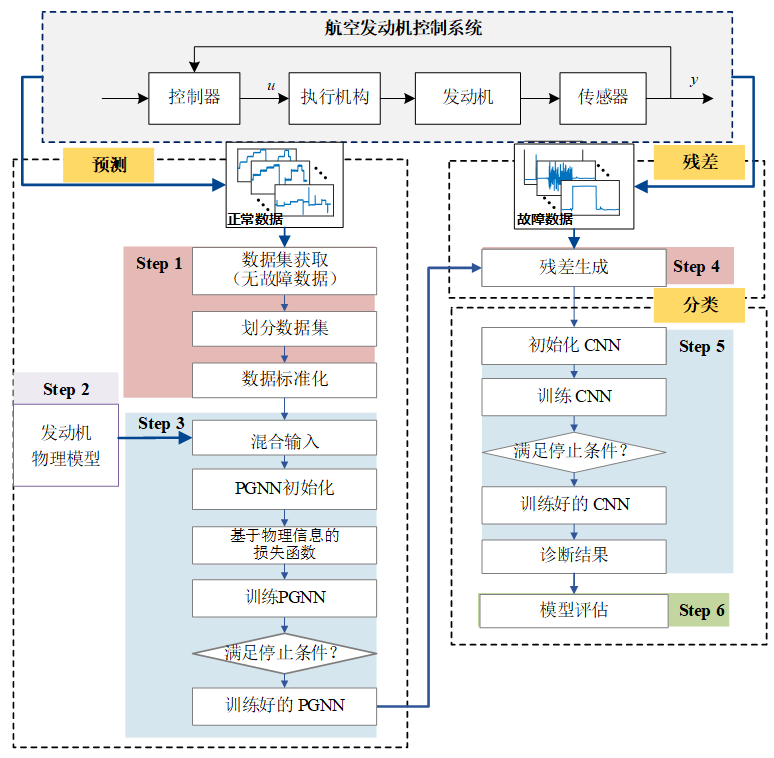
Flowchart of the intelligent fault diagnosis method for aeroengine control system sensors based on Physics-Guided Neural Networks.
Research Process and Results
The author proposes a dynamic intelligent fault diagnosis method for aeroengine control system sensors based on a model and data hybrid drive. The core of this method consists of a PGNN prediction model and a CNN-based residual analysis. The author first constructs a PGNN-based engine performance prediction model, designing a hybrid input strategy that maps signals through a model channel (based on the engine’s physical model) and a data channel (raw measurement data) in parallel to the target space; using a high-fidelity engine physical model, simulation generates system behavior data covering healthy states and typical fault modes, effectively enhancing the training dataset. The physical equations that characterize the intrinsic relationship between output parameters and system states are embedded as regularization terms in the physics-informed enhanced loss function, reducing physical inconsistencies caused by measurement noise and model errors. Through iterative optimization to minimize the loss function, high-precision dynamic predictions of key engine performance parameters such as speed, temperature, and pressure are achieved. On this basis, the author proposes a residual generation and evaluation method based on Convolutional Neural Networks (CNN), transforming the measurement parameter feature space into a residual feature space, effectively suppressing the interference of dynamic changes in the engine’s flight state on diagnostic signals. To address the challenge of high similarity in data features among multiple fault types, which is easily affected by noise, a CNN-based intelligent fault recognizer is constructed to deeply mine high-dimensional, abstract fault patterns in the residual feature space, achieving high-precision multi-fault detection and isolation.
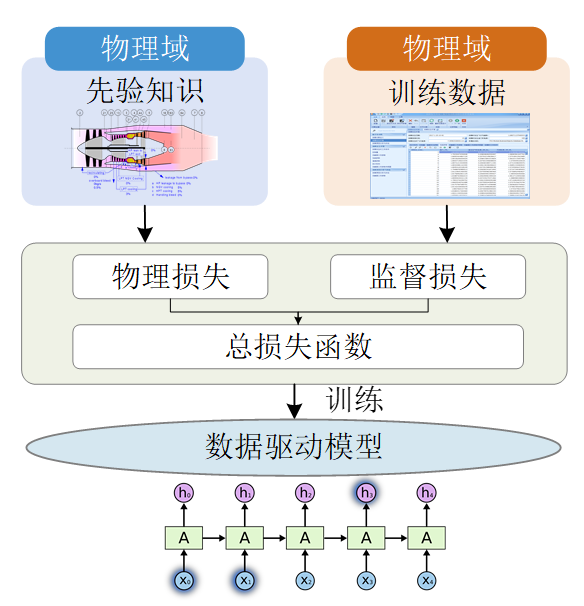
Structure diagram of the PGNN-based engine performance prediction model.
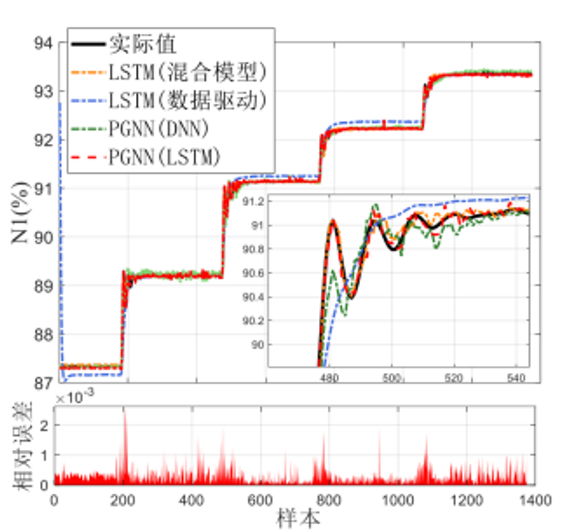
To verify the effectiveness of the proposed method, the author constructed a comprehensive dataset consisting of integrated digital simulation fault data, hardware-in-the-loop test fault data, and semi-physical fault data, conducting case analyses for single sensor fault diagnosis and multi-fault diagnosis of sensors and actuators. In the single sensor fault diagnosis case, the proposed PGNN prediction model achieved a prediction RMSE of 0.9897, with an average diagnostic accuracy of 95.9%. In the multi-fault diagnosis case for sensors and actuators, the average diagnostic accuracy was 98.285%. The research results indicate that the proposed model and data-driven hybrid structure can fully utilize the implicit relationships between inputs and outputs, improving the fault diagnosis accuracy of aeroengines under dynamic conditions. It is important to note that the increased model complexity of the PGNN-CNN method results in longer training times, necessitating a reasonable trade-off between diagnostic performance and computational resource expenditure in practical engineering applications.
(a)
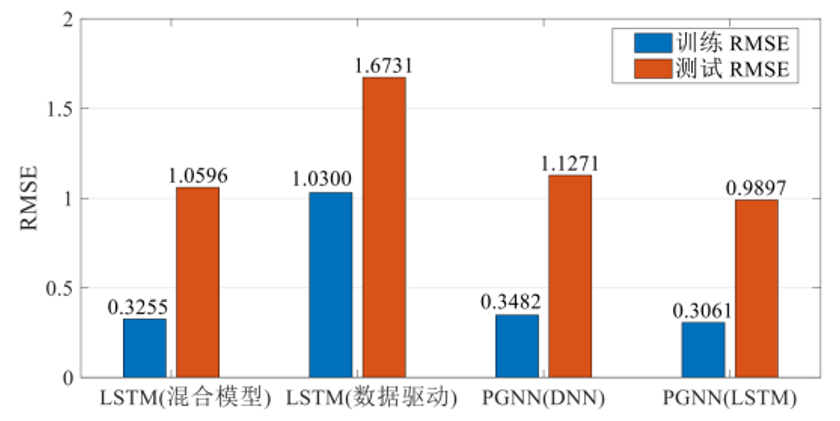
(b)
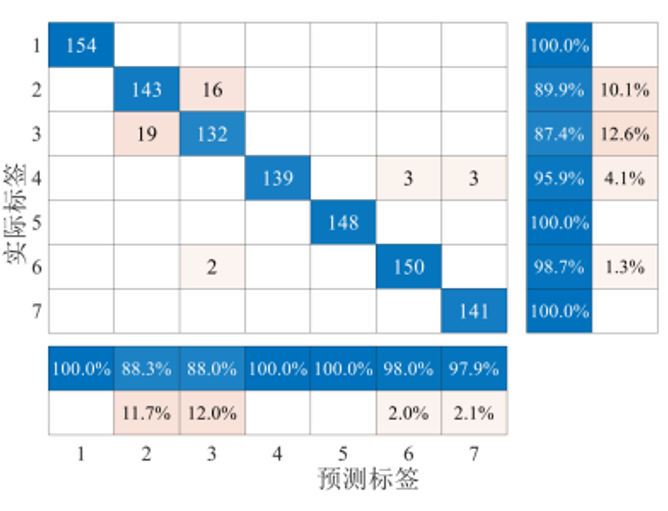
(c)
Simulation results of the single sensor fault diagnosis case: (a) PGNN prediction results; (b) Comparison of PGNN prediction errors; (c) Fault diagnosis results.
Research Summary
This paper focuses on the highly dynamic operational state of aeroengine control systems, aiming to address the challenges of intelligent fault diagnosis under dynamic conditions. Based on PGNN and CNN networks, it proposes a dynamic intelligent fault diagnosis method driven by a model and data hybrid approach. The innovation of this method lies in the introduction of a physics-data hybrid input strategy and a physics-informed PGNN loss function, forming a mixed information source composed of data and prior knowledge, explicitly embedding the physical mechanisms of the engine as regularization constraints, further constraining the model solution space to eliminate physical inconsistencies. Simulation results indicate that this method can be effectively applied to fault diagnosis of aeroengine control systems under dynamic operating conditions, reducing the root mean square error of predictions by 40.84% and improving diagnostic accuracy by 23.55% compared to purely data-driven models.
Original Information

Scan the QR code
Read the original English text
Li, H.; Gou, L.; Li, H.; Liu, Z. Physics-Guided Neural Network Model for Aeroengine Control System Sensor Fault Diagnosis under Dynamic Conditions. Aerospace 2023, 10, 644.

Aerospace Journal Introduction
Editor-in-Chief:
Konstantinos Kontis, University of Glasgow, UK
Aerospace journal is dedicated to publishing innovative research related to aerospace science, engineering, and technology, covering aircraft design, propulsion systems, flight control, advanced materials, space science, avionics, unmanned aerial systems (UAS), urban air mobility (UAM), sustainable aviation, aviation safety, and cutting-edge technologies. It encourages interdisciplinary research to promote the development of aerospace technology and welcomes original contributions and reviews from experimental, simulation, and theoretical studies.
|
2024 Impact Factor |
2.2 |
|
2024 CiteScore |
4.0 |
|
Time to First Decision |
20.9 Days |
|
Acceptance to Publication |
2.5 Days |

Scan the QR code,
Subscribe to the latest news from the journal.
Featured Videos
Related Articles Recommended
Wang Feng’s team from the China Flight Test Research Institute: Latest research progress on AI-based intelligent air combat technology verification framework | MDPI Aerospace
Recommended MDPI Related Public Accounts
MDPI Recruitment
MDPI recruitment official public account, the latest recruitment information awaits you.
Copyright Statement:
*This article was translated and written by the MDPI China office. The translation portion of the paper is a summary and conveyance based on the translator’s personal understanding; for details and accurate information, please refer to the original English text. This article complies with the CC BY 4.0 license (https://creativecommons.org/licenses/by/4.0/). For reprints, please consult through the public account.
Due to updates in WeChat subscription account push rules, it is recommended that you set “MDPI Engineering Science” as a starred account, so you can easily find us in the message bar and stay updated on the latest open publishing dynamics!
Click the bottom left “Read the original text” to read the original English text.

Like today’s content? Why not give a “three-hit combo” ☞【Share, Like, Forward】