Breaking the Fragmentation, Reconstructing the Integrated Learning System
Currently, there exists a fourfold fragmentation in programming, signal processing, and AI books: theory and practice, modules and systems, knowledge and scenarios, tools and engineering. This book is project-driven, using problems to illustrate theories, analyzing code line by line, and integrating multiple technologies through comprehensive projects to grasp theoretical knowledge, solidify engineering skills, and help readers become full-chain technical practitioners.
Table of Contents
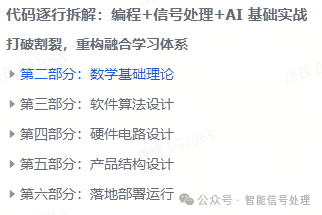
Intelligent Signal and AI System Development
Fundamentals -> Complete Practical Guide
Part Two: Mathematical Foundations
Chapter 2 Linear Algebra and Applications
2.1 Core Mathematical Concepts
2.1.1 Matrix Operations
-
Matrix Multiplication and Properties
-
Methods for Solving Inverse Matrices
-
Calculating Eigenvalues and Eigenvectors
2.1.2 Vector Spaces
-
Linear Dependence and Independence
-
Concepts of Basis and Dimension
-
Applications of Orthogonal Projections
2.2 Engineering Application Practices
2.2.1 Practical Use of NumPy Matrix Library
-
Array Creation and Operations
-
Matrix Operation Functions
-
Relation to Programming Data Processing
2.2.2 PCA Dimensionality Reduction Principles
-
Principal Component Analysis Algorithm
-
Signal Feature Compression Techniques
-
Relation to Signal Processing
2.2.3 Deep Learning Weight Updates
-
Matrix Operations in AI Applications
-
Mathematical Principles of Weight Updates
-
Training of Related Models
Chapter 3 Probability Theory and Mathematical Statistics
3.1 Basics of Probability and Distributions
3.1.1 Classical Probability Models
-
Derivation of Bayes’ Theorem
-
Calculating Conditional Probabilities
-
Real-World Application Scenarios
3.1.2 Common Distributions
-
Gaussian Distribution
-
Bernoulli Distribution
-
Poisson Distribution
3.2 Statistical Analysis and Applications
3.2.1 Calculation of Statistics
-
Expected Value
-
Variance and Covariance
-
Correlation Analysis
3.2.2 Estimation
-
Maximum Likelihood Estimation
-
Principles of Parameter Estimation
-
Applications in Signal Processing
-
Case Studies
Chapter 4 Calculus and Numerical Computation
4.1 Core Calculus
4.1.1 Derivatives and Partial Derivatives
-
Application of the Chain Rule
-
Derivatives of Multivariable Functions
-
Gradient Calculation
4.1.2 Applications of Integrals
-
Solving Definite Integrals
-
Fourier Integral Principles
-
Relation to Signal Frequency Domain Analysis
4.2 Engineering Numerical Computation
4.2.1 Principles of Gradient Descent
-
Mathematical Foundations of Optimization Algorithms
-
Relation to AI Optimizers
-
Applications in Deep Learning
4.2.2 SciPy Numerical Integration
-
Numerical Computation Methods
-
Signal Time Domain Analysis
-
Programming Practice Techniques
Chapter 5 Foundations of Discrete Mathematics
5.1 Sets and Logic
5.1.1 Set Operations
-
Intersection, Union, Complement
-
Set Relationship Judgments
-
Real-World Applications
5.1.2 Logical Reasoning
-
Basics of Propositional Logic
-
Advanced Predicate Logic
-
Relation to Algorithm Logic
5.2 Graph Theory and Applications
5.2.1 Basic Concepts of Graphs
-
Definitions of Nodes and Edges
-
Paths and Connectivity
-
Properties of Graphs
5.2.2 Graph Algorithms
-
Dijkstra’s Shortest Path
-
Principles of Floyd’s Algorithm
-
Relation to Data Structures
5.2.3 Graph Neural Networks
-
Basic Concepts of GNN
-
Relation to AI Object Detection
-
Real-World Application Cases
Part Three: Software Algorithm Design
Chapter 6 Programming Fundamentals
6.1 Core Programming Languages
6.1.1 Advanced Python
-
Functional Programming Paradigms
-
Advanced Uses of Decorators
-
Multithreading Programming Techniques
6.1.2 Core C/C++
-
Detailed Explanation of the STL Standard Library
-
Memory Management Mechanisms
-
Multiprocessing Programming
6.1.3 Cross-Language Collaboration
-
Cython Usage Guide
-
PyBind11 Configuration
-
Practical Python Calls to C++
6.2 Data Structures and Algorithms
6.2.1 Basic Structures
-
Comparison of Arrays and Linked Lists
-
Applications of Stacks and Queues
-
Tree and Graph Structures
6.2.2 Core Algorithms
-
Sorting Algorithm Optimization
-
Comparison of Search Algorithms
-
Practical Dynamic Programming
6.2.3 Algorithm Practice
-
Classic LeetCode Problems
-
Applications in Signal Processing Scenarios
-
Integration of AI Algorithms with Practice
6.3 Development Tools and Engineering
6.3.1 Version Control
-
Git Command Operations
-
GitHub Project Management
6.3.2 Environment Configuration
-
Using the Linux Terminal
-
Anaconda Environment Management
-
Docker Container Deployment
6.3.3 Debugging and Optimization
-
Debugging Features of PyCharm
-
Performance Analysis Tools
Chapter 7 Signal Processing
7.1 Basics of Signal Processing
7.1.1 Signal Processing Theory
-
Time Domain Analysis Methods
-
Frequency Domain Analysis Techniques
-
Implementation of Filtering Principles
7.1.2 Signal Feature Analysis
-
Mean and Variance Calculations
-
Frequency Spectrum Feature Extraction
-
Feature Selection Methods
7.1.3 Signal Classification
-
Time-Frequency Localization Techniques
-
Parameter Estimation Methods
-
Applications of Classification Algorithms
7.2 Practical Tools and Integration
7.2.1 Signal Processing Tools
-
Using the SciPy Library
-
Audio Processing with librosa
-
Image Processing with OpenCV
7.2.2 Programming Integration
-
Signal Generation in Python
-
Data Preprocessing Techniques
-
Real-Time Processing Implementation
7.2.3 AI Integration
-
Feature Vector Construction
-
Model Input Design
-
Data Pipeline Construction
Chapter 8 Artificial Intelligence
8.1 Basics of AI Knowledge
8.1.1 Basics of Machine Learning
-
Model Evaluation Metrics
-
Overfitting Identification and Handling
-
Solutions for Underfitting
8.1.2 Deep Learning Frameworks
-
Introduction to PyTorch
-
Building Neural Networks
-
Optimizing Training Processes
8.2 Core Algorithms and Applications
8.2.1 Machine Learning Algorithms
-
Practical Linear Regression
-
Applications of Decision Trees
-
SVM Classifiers
8.2.2 Advanced Deep Learning
-
Principles and Implementation of CNNs
-
RNNs for Time Series Processing
-
Basics of Transformers
8.2.3 Specialized Directions
-
Introduction to Reinforcement Learning
-
Techniques for Few-Shot Learning
-
Unsupervised Learning Methods
-
Advanced Object Detection
8.3 AI Tools and Engineering
8.3.1 Training Visualization
-
Using TensorBoard
-
PyTorch Profiler
-
Performance Monitoring and Analysis
8.3.2 Model Deployment
-
ONNX Runtime
-
Practical C++ Deployment
8.3.3 Qt Integration
-
PyQt/Qt Interface Development
-
AI Result Visualization
-
Implementation of Interactive Features
Chapter 9 Software Development
9.1 Core Qt Technologies
9.1.1 Basics of Qt
-
Signal and Slot Mechanism
-
Using UI Components
-
Layout Management Techniques
9.1.2 Advanced Qt
-
Database Operations
-
Multithreading Programming
-
Implementing Network Communication
9.2 Cross-Module Practice
9.2.1 Signal Processing Interface
-
Waveform Display Components
-
Feature Analysis Tools
-
Real-Time Monitoring Interface
9.2.2 AI Interface Development
-
Object Detection Display
-
Model Parameter Configuration
-
Result Visualization
Chapter 10 Image Processing
Chapter 11 Large Language Models
11.1 Basics of Fine-Tuning Large Models
-
Core Logic of Fine-Tuning
-
Technology Stack Relations
11.2 Setting Up Fine-Tuning Environment
-
Hardware Configuration
-
Tool Deployment
-
Environment Verification
11.3 Data Preparation and Processing
-
Building Domain Corpora
-
Data Format Specifications
-
Practical Preprocessing
11.4 Implementation and Optimization of Fine-Tuning
-
Parameter Configuration
-
Mode Selection
-
Code Implementation:
-
Building Data Loading Pipelines
-
Initializing Trainers and Configuring Gradient Checkpoints
-
Monitoring Training Processes and Recovery from Interruptions
11.5 Model Evaluation and Deployment
-
Evaluation Metrics
-
Practical Deployment
Part Four: Hardware Circuit Design
Chapter 12 Introduction to Hardware Circuits and Core Principles
-
12.1 Core Concepts of Circuit Basics
-
Explanation of basic electrical quantities such as voltage, current, resistance, and fundamental circuit laws like Ohm’s Law and Kirchhoff’s Laws, enabling readers to grasp the foundational theories of circuit analysis.
-
Introduction to the characteristics of DC and AC circuits, analyzing the distribution laws of voltage and current in simple circuit examples (e.g., series and parallel circuits).
-
12.2 Detailed Explanation and Selection of Electronic Components
-
Detailed explanation of the working principles and parameter indicators (e.g., resistance values and power ratings for resistors, capacitance values and voltage ratings for capacitors) of resistors, capacitors, inductors, diodes, transistors, and integrated circuits (e.g., operational amplifiers, microcontrollers).
-
In conjunction with the needs of intelligent signal and AI systems, explaining how to select suitable components for different functional modules (e.g., signal acquisition, signal amplification, control modules), such as choosing high-precision ADC chips for the signal acquisition part.
-
12.3 Basics of Hardware and Software Collaboration
-
Introduction to the interaction methods between hardware circuits and software (e.g., embedded programs, upper computer programs), such as data transmission and control through communication protocols like GPIO, serial, I2C, SPI.
-
Using a simple LED control circuit as an example, explaining how to control hardware circuits through software programming (e.g., using Arduino or STM32 development environments), establishing a preliminary understanding of hardware and software collaboration.
Chapter 13 Analog Circuit Design and Practice
-
13.1 Analog Signal Conditioning Circuits
-
Explaining methods for conditioning analog signals (e.g., voltage signals output from sensors), including the design of amplification circuits (e.g., inverting and non-inverting amplifier circuits based on operational amplifiers) and filtering circuits (low-pass, high-pass, band-pass filters).
-
In conjunction with the preprocessing needs of raw signals in intelligent signal systems, designing analog circuits for signal amplification and noise filtering, and verifying through circuit simulation software like Multisim.
-
13.2 Power Circuit Design
-
Introduction to the working principles and design methods of different types of power supplies (e.g., DC regulated power supplies, switch-mode power supplies), including rectification, filtering, and regulation.
-
Designing suitable power circuits to meet the power supply needs of different modules (e.g., sensor modules, control modules, AI computing modules) in intelligent signal and AI systems, ensuring stable power supply to each module.
Chapter 14 Digital Circuits and Embedded Systems
-
14.1 Digital Logic and Digital Circuits
-
Explaining the basics of digital logic, including the working principles of basic digital circuit units such as logic gates (AND, OR, NOT gates), flip-flops (D flip-flops, JK flip-flops), registers, and counters.
-
Introducing design methods for combinational logic circuits and sequential logic circuits, such as designing a simple digital quiz circuit to deepen understanding of digital circuits.
-
14.2 Basics of Embedded Systems
-
Introducing the components of embedded systems, including embedded processors (e.g., ARM Cortex-M series microcontrollers) and peripheral interfaces (e.g., ADC, DAC, serial ports).
-
Using the STM32 microcontroller as an example, explaining the development process of embedded systems, including setting up the development environment (e.g., Keil MDK), writing programs (based on C language), downloading, and debugging, laying the foundation for subsequent hardware system development.
-
14.3 Hardware-in-the-Loop and Project Research
-
Introducing the concept and methods of Hardware-in-the-Loop (HIL) simulation, verifying software algorithms on actual hardware by combining embedded hardware with simulation software.
-
Using an intelligent signal acquisition module as an example, conducting HIL simulation to simulate the process of signal acquisition and processing, identifying issues in hardware-software collaboration in advance, preparing for subsequent practical projects.
Chapter 15 Hardware System Integration and PCB Design
-
15.1 Basics of PCB Design
-
Explaining the composition of printed circuit boards (PCBs), selection of layers (single-sided, double-sided, multi-layer), and the basic process of PCB design (schematic design, PCB layout, routing, copper pouring, etc.).
-
Introducing the use of PCB design software (e.g., Altium Designer, KiCad), starting from drawing simple schematics to gradually mastering PCB design operations.
-
15.2 Hardware System Integration
-
Explaining how to integrate analog circuits, digital circuits, and embedded systems into a complete hardware system, considering issues such as electromagnetic compatibility (EMC) and signal integrity between different parts.
-
Using the hardware platform of intelligent signal and AI systems as an example, conducting system integration design, including connection methods for each module, power distribution, etc., ensuring stable system operation.
-
15.3 Hardware Debugging and Testing
-
Introducing common tools for hardware debugging (e.g., multimeters, oscilloscopes, logic analyzers), their usage methods, and the processes and techniques for hardware debugging.
-
Debugging and testing the designed hardware system, checking whether the power supply is normal, whether the signals are complete, and whether each module can operate normally, preparing for integration with software and algorithms.
Part Five: Product Structural Design
Chapter 16 Basics of Structural Design and Material Selection
-
16.1 Core Concepts of Structural Design
-
Introducing the basic principles of structural design, including statics (force balance, stress analysis of members) and material mechanics (strength, stiffness, toughness, and other performance indicators of materials).
-
Explaining common structural forms (e.g., frame structures, shell structures) and their application scenarios in product design.
-
16.2 Material Selection and Processing Techniques
-
Detailing the performance characteristics, applicable scenarios, and processing techniques (e.g., cutting, casting, 3D printing, injection molding) of various commonly used structural materials (e.g., metal materials: aluminum alloys, stainless steel; non-metal materials: plastics, composite materials).
-
In conjunction with the needs of intelligent signal and AI products (e.g., weight, strength, cost, appearance), explaining how to select suitable materials and processing techniques, such as choosing lightweight aluminum alloys or engineering plastics for portable smart devices.
Chapter 17 Structural Modeling and Simulation Analysis
-
17.1 Application of 3D Modeling Tools
-
Introducing commonly used 3D modeling software (e.g., SolidWorks, AutoCAD, Creo), starting from drawing simple parts (e.g., brackets, shells) to gradually mastering modeling methods for complex products.
-
Using the shell of intelligent signal and AI products as an example, conducting 3D modeling to determine the dimensions, shapes, and other parameters of each part.
-
17.2 Finite Element Analysis (FEA)
-
Explaining the basic principles and processes of finite element analysis, including mesh division, load application, and boundary condition settings.
-
Using finite element analysis software (e.g., Ansys, Abaqus) to conduct mechanical analysis (e.g., stress, strain analysis) and thermal analysis on structural models, verifying whether the strength and stiffness of the structure meet requirements and optimizing structural design.
Chapter 18 Collaborative Design of Structure, Hardware, and Algorithms
-
18.1 Collaboration between Structure and Hardware
-
Explaining how to reserve installation space, wiring channels, and heat dissipation holes for hardware circuits (e.g., PCB boards, sensors, power modules) in structural design, ensuring that hardware modules can be installed smoothly without affecting the stability of the structure.
-
Using the hardware platform of intelligent signal and AI systems as an example, conducting collaborative design of structure and hardware, adjusting structural dimensions and layouts to accommodate hardware modules.
-
18.2 Collaboration between Structure and Algorithms
-
Introducing how structural design affects algorithm performance, such as how the shape and size of the structure may influence signal acquisition (e.g., the installation structure of acoustic sensors affecting sound signal acquisition) and AI model deployment (e.g., heat dissipation structures affecting the operating temperature of AI computing modules, thereby influencing the running speed and accuracy of algorithms).
-
Using specific cases to explain how to consider algorithm requirements in structural design for collaborative optimization.
Chapter 19 Structural Processes and Productization
-
19.1 Mold Design and Manufacturing
-
Introducing the design principles and manufacturing processes of molds (e.g., injection molds, die-casting molds), explaining the design methods of key parts in mold design such as parting surfaces, pouring systems, and cooling systems.
-
Using the plastic shell of intelligent signal and AI products as an example, providing a preliminary explanation of mold design, illustrating the relationship between structural design and mold design.
-
19.2 Structural Assembly and Product Testing
-
Explaining the assembly processes and methods of product structures, including assembly sequences, selection of assembly tools, and control of assembly accuracy.
-
Introducing product testing methods, including structural strength testing, waterproof and dustproof testing, and electromagnetic compatibility testing, ensuring that products meet design requirements and relevant standards.
Part Six: Ground Deployment and Operation
Chapter 20 Practical Project: Intelligent Signal Analysis and Processing System
-
20.1 Project Requirements and Overall Design
1. Clarifying project requirements:
Implementing the acquisition, conditioning, digital processing, analysis, and display of specific analog signals (e.g., temperature sensor output signals, audio signals) / RF signals; for complex processing scenarios involving RF signals and multi-channel high-frequency analog signals, introducing DSPs (e.g., TI TMS320 series) as core processing units to enhance real-time filtering, FFT frequency domain analysis, and multi-channel data synchronization capabilities, while also supporting subsequent AI large model analysis needs in conjunction with upper computers.
2. Hardware system design:
3. Structural design:
4. Software algorithm design:
-
20.2 Hardware and Structural Implementation
-
Hardware circuit production:
1. Schematic design:
2. PCB production:
3. Component soldering and debugging:
Structural processing and assembly:
1. 3D model design:
2. Structural processing:
3. Assembly:
-
20.3 Software and Algorithm Development
-
Communication Module:
-
AI Large Model Analysis Module:
-
Storage and Visualization Module:
-
Embedded program writing (taking TI TMS320F28377D as an example, using Code Composer Studio for development):
1. DSP initialization program:
2. Signal acquisition program:
3. Signal processing program:
4. Data interaction program:
-
20.4 System Integration and Testing
Integrating hardware (DSP core board, sensors, display), and software (DSP programs, upper computer programs) to ensure the interaction of each module: sensor acquires analog signals → signal conditioning circuit processes → DSP acquires and executes filtering/FFT/feature extraction → DSP sends data to the display (real-time display) and upper computer → upper computer executes AI large model analysis and stores results.