Introduction
In today’s world, if there is anyone who can simultaneously play the role of “Chief Product Manager” in the four critical arenas determining the future of humanity—artificial intelligence, robotics, space exploration, and global communication—it is undoubtedly Elon Musk.
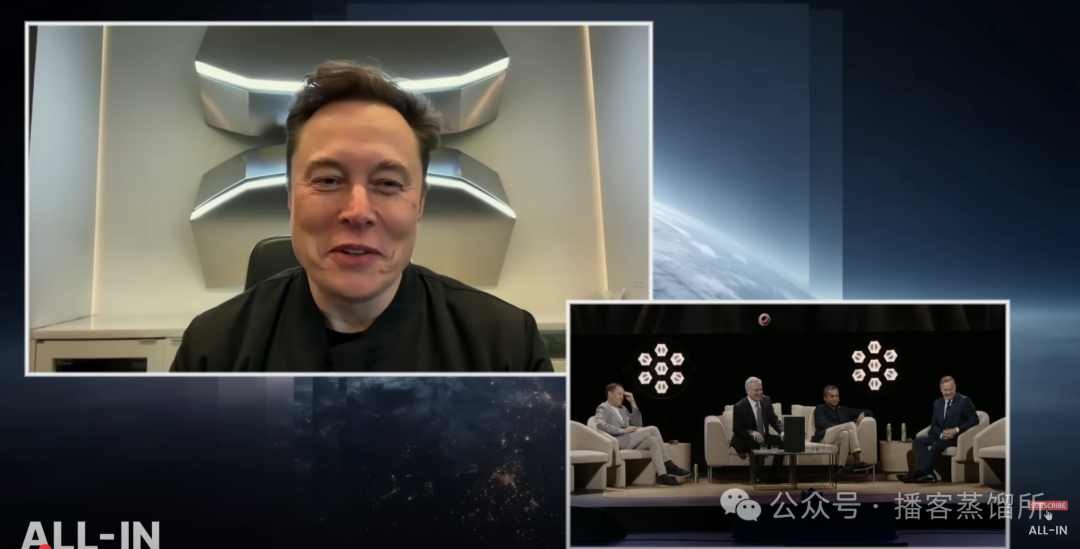
Recently, he participated in a highly information-dense deep interview on the well-known podcast “All-In.” This was not just a simple conversation, but rather a “product roadmap” and “strategic release” about the future. He elaborated on the remarkable progress of the Optimus robot, the 40-fold performance leap of AI chips, the commercialization timeline of Starship, and his deep concerns about “the suicide of Western civilization”.
This article will thoroughly summarize all the highlights of this interview, presenting not only the future vision Musk paints but also delving into the business principles, lessons from failures, and industry insights that we can learn from.
Part 1: Overview of Core Podcast Content
🤖 Optimus: The Greatest Product Ever, Costing $20,000
Musk asserts, “If successful, Optimus will be the greatest product in human history.” He revealed that the design of the third-generation Optimus is nearing completion and features three disruptive characteristics:
-
Human-level dexterous hands: With 27-28 degrees of freedom, the hands can perform delicate tasks such as threading a needle, a core capability currently missing from all robot companies.
-
An AI brain that understands reality: Not just executing commands, but truly understanding the physical world and navigating autonomously.
-
Designed for mass production: The goal is to produce one million units annually, with the production cost dropping to an astonishing $20,000 or so.
What is the biggest challenge? Building the supply chain from scratch. Musk emphasized that all actuators required for Optimus cannot be purchased from the existing market; they must be designed and manufactured entirely from first principles.
🧠 AI & FSD: A Leap in Computing Power and “Sentient” Cars
Tesla’s autonomous driving and AI capabilities are about to undergo a qualitative change. The core driving force is the next-generation AI chip—AI5.
-
40-fold performance improvement: You heard it right, not 40%, but 40 times! Musk explained that this exponential improvement is not merely about stacking computing power, but comes from the “fine-grained collaborative design” of the software and hardware teams, directly addressing the bottlenecks of software algorithms at the chip level.
-
“Sentient” cars: The upcoming software version 14 will be the largest upgrade in history. Musk predicts that by the end of this year, Tesla cars will feel “sentient” due to advancements in AI.
He also made an astonishing prediction:As early as next year, AI may surpass the smartest humans in any single task; by 2030, it could surpass the total intelligence of all humanity.
🛰️ Starlink and Starship: Connecting Earth and Colonizing Mars
-
Starlink direct connection to mobile phones: SpaceX plans to utilize newly acquired wireless spectrum to achieve direct high-bandwidth connections between satellites and mobile phones. This means that in about two years, new mobile phones will be able to directly use the Starlink network to watch videos from anywhere on Earth. Starlink has the potential to become a global telecommunications operator, challenging AT&T and Verizon.
-
Commercialization of Starship: SpaceX’s goal is to achieve full reusability of Starship by next year, with each launch capable of sending over 100 tons of payload into orbit. The biggest technical hurdle is developing an “orbital heat shield”—a feat never achieved in the history of human spaceflight.
🤯 Grok & The Future of the West: Correcting Reality and the “Suicide” of Civilization
-
Grokpedia: Musk’s AI company XAI is doing something interesting with its large model Grok: using AI reasoning capabilities to analyze and correct errors, biases, and missing information in training data sources like Wikipedia, creating a “Grokpedia” that is closer to the truth.
-
The suicide of the West: The conversation turned philosophical as Musk expressed deep concerns about the current state of Western civilization, pointing out the declining birth rates and pervasive pessimism, with behaviors akin to “suicide.”
-
The ultimate significance of Mars colonization: To combat this pessimism, he proposed the “philosophy of curiosity”. Mars colonization is the ultimate practice of this philosophy. He believes that establishing a self-sustaining city on Mars within the next 25-30 years is crucial. This is not only for exploration but also to provide a “backup” for human “consciousness,” achieving “planetary redundancy” to cope with any potential disasters on Earth.
Part 2: Musk’s Money-Making Principles: Four Rules for Building a Trillion-Dollar Empire
The interview revealed not just small-scale money-making techniques but the underlying logic of building grand enterprises.
-
Rule One: Solve Fundamental, Physical World Problems Musk targets arenas—labor (robots), energy transportation (electric vehicles), communication (Starlink), survival (space exploration)—that are fundamental to the survival of human civilization. He always aims to solve the most difficult and foundational problems of the physical world.
-
Rule Two: Extreme Vertical Integration, Building a Moat from Scratch When the product is revolutionary, existing supply chains cannot meet the demand. Musk’s answer is not compromise, but to “become the supply chain”. From the actuators of Optimus to AI chips, everything is self-researched and self-produced. This requires significant initial investment, but once successful, it builds a moat that competitors cannot cross.
-
Rule Three: Integration of Software and Hardware for Exponential Performance Leap The 40-fold performance improvement of the AI5 chip is a perfect embodiment of this rule. When software and hardware teams sit together to design chips, they can create a “super engine” tailored for specific algorithms. This offers unparalleled efficiency and cost advantages compared to companies that merely purchase generic chips.
-
Rule Four: Become the Platform and Standard, Not Just a Participant The goal of Starlink is not to become just another telecom service provider, but to become a global communication platform, fundamentally changing the rules of the game. This is a way of thinking that represents “dimensional ascension” in strategy.
Part 3: ⚠️ Lessons from Failures & Pitfall Avoidance Guide
Musk mentioned a key failure case in the interview, sounding the alarm for all entrepreneurs and project managers.
-
Real Pitfall:The “pseudo” reusable heat shield of the Space Shuttle. It was nominally reusable, but required expensive repairs lasting up to 9 months after each flight, which was not truly economically viable reusability.
-
Heavy Cost: This led to uncontrolled project costs, extremely low launch efficiency, and ultimately forced the termination of the entire Space Shuttle program, severely delaying human space exploration.
-
Fundamental Cause: The problem was not fundamentally solved from materials science and engineering, but rather a “patchwork” maintenance approach was taken, avoiding the core issues.
-
Avoidance Method:Confront the most challenging physical problems and pursue ultimate solutions from day one. The goal must be “fully and rapidly reusable” from the project’s inception, investing resources in fundamental scientific research. Any attempt to take shortcuts will ultimately be crushed by heavy technical debt.
Part 4: 🕵️ Industry Insights & Unwritten Rules
-
The Real Challenge of Humanoid Robots: The industry insight is that the core technological bottleneck of robots is not walking or balancing, but rather the fine motor skills of the “hands” and forearms. This is the fundamental distinction between toys and tools, and the problem that most companies are avoiding.
-
The Rules of Disruptive Innovation: True disruption inevitably comes with extreme vertical integration. Expecting external suppliers to provide revolutionary core components is wishful thinking. You must have the capability and determination to become the “chain master” of the entire industry chain.
-
The Driving Force of Top Talent: Attracting the world’s top engineers and scientists is no longer about salary. It is about a vision grand enough to change the world—for example, sending humans to Mars.
-
The Real Hidden Barrier: It is not capital, nor resources, but the ability to think from the first principles of physics. This is a threshold of thinking patterns and organizational capabilities, requiring seamless integration of scientists, engineers, and production experts.
Conclusion: Curiosity is the Ultimate Engine of Human Civilization
After listening to the entire interview, you will find that whether it is robots, AI, or rockets, they are merely tools for Musk to achieve his ultimate goals. His core driving force is a pure “philosophy of curiosity”—a desire to understand the essence of the universe and expand the boundaries of human consciousness.
He proposed a “key test” for the success of Mars colonization—”If Earth supply ships stop, can Mars continue to thrive?”—which is not just a technical question but a philosophical one. It questions whether our civilization has the capacity to survive and reproduce independently.
Amidst the daily hustle and bustle, never forget to look up at the stars, maintain curiosity about the unknown, and bravely pose and answer those ultimate questions about where we come from and where we are going.
Because this is the ultimate engine driving personal growth and the progress of civilization.