Banner
Introduction
Display technology has become significant and ubiquitous in our daily lives, widely applied in augmented reality (AR)/virtual reality (VR) devices, smartphones, tablets, monitors, televisions, and more. Currently, Liquid Crystal Displays (LCD) and Organic Light Emitting Diodes (OLED) are the two mainstream display technologies. Other emerging display fields include Micro-LED displays, quantum dot (QDs)/perovskite light-emitting displays, and 3D displays. In display technology, the demand for high-quality color representation is closely related to the growing visual expectations of users. Colors in displays are typically reproduced by mixing the three primary colors of red, green, and blue, which can be done in two main ways: independent emission of RGB trichromes and color conversion display technology. Among these, color conversion display technology achieves colorization of displays by utilizing high-energy blue light to generate red and green light. The color conversion technology can fully leverage the luminous advantages of color conversion materials, offering high brightness, wide color gamut, improved contrast, and a simplified manufacturing process, injecting new vitality into various display technologies.
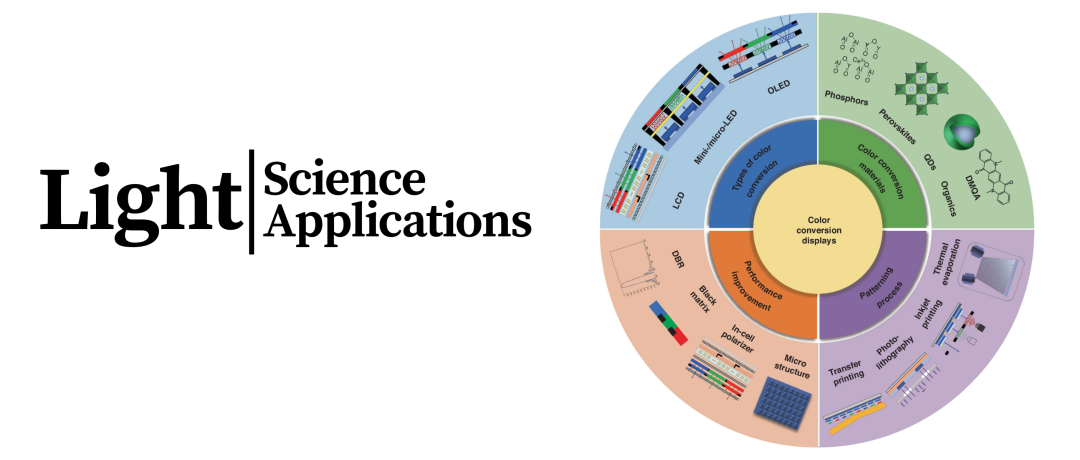
Recently, Professors Li Guijun from Shenzhen University, Chen Enguo from Fuzhou University, and Guo Haicheng from Hong Kong University of Science and Technology published a review paper titled “Color-Conversion Displays: Current Status and Future Outlook” in Light: Science & Applications, comprehensively summarizing the types of color conversion display technology, color conversion materials, patterning processes, strategies for enhancing display performance, and discussing the future prospects and key roles of color conversion. This work was supported by the National Natural Science Foundation, the Fujian Provincial Natural Science Foundation Outstanding Youth Project, the Shenzhen Science and Technology Plan Project, and the Mindu Laboratory Project.
Types of Color Conversion Displays
Passive Emissive Displays: The use of color conversion technology in traditional LCD devices mainly divides into backlight units (Backlight Units) and color filter units (CF Units). The application of color conversion technology enhances the color gamut and optical efficiency.
Active Emissive Displays: In OLED displays, a simplified panel design can be achieved by using only blue OLED pixels, overcoming challenges in large-scale manufacturing. In 2022, Sony and Samsung launched Quantum Dot OLED (QD-OLED) technology. QD-OLED displays showcase a wide color gamut of up to 90% Rec.2020, increasing the color space by 1.5 times compared to traditional OLED displays. Micro-LED, as a next-generation display technology, is receiving extensive attention from both industry and academia. Using blue Micro-LED chips combined with red/green conversion for full-color display has become a promising strategy, significantly simplifying the manufacturing process and production speed, and is a feasible solution to challenges such as driving circuit design and color stability.
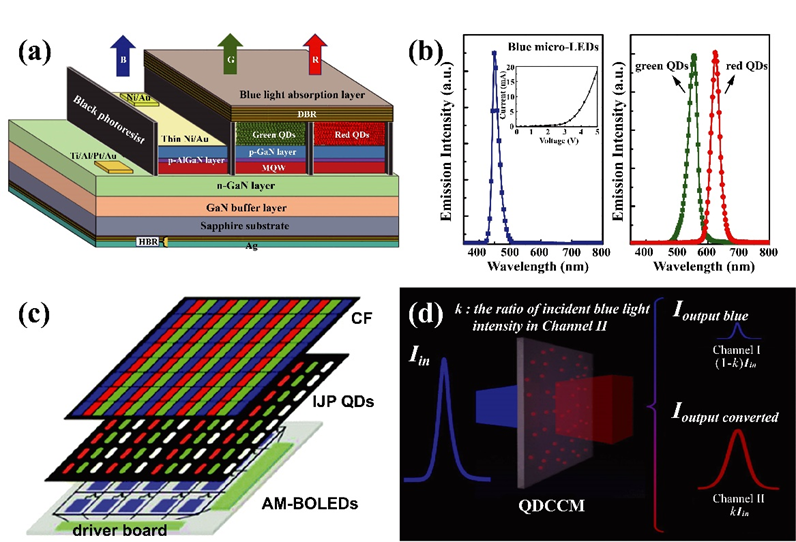
Figure 2: Structure and spectral characteristics of color conversion displays
Color Conversion Materials
Currently available color conversion materials include organic fluorophores, inorganic phosphors, quantum dots (QDs, 2023 Nobel Prize in Chemistry), and metal halide perovskites (MHPs). Among these, quantum dots (QDs) are replacing traditional phosphors and becoming the preferred color conversion materials to enhance the color performance of various displays such as LCD, OLED, and Micro-LED. Currently, companies like Innolux, Sitron, Raystar, and Sifluos are using quantum dots to manufacture color conversion Micro-LED displays. Metal halide perovskites (MHPs) have emerged as a promising candidate material that can fully meet the Rec.2020 color gamut requirements for ultra-high-definition displays. Additionally, MHPs can be synthesized in a simple and low-cost manner and have found numerous applications in photovoltaics, LEDs, and lasers.
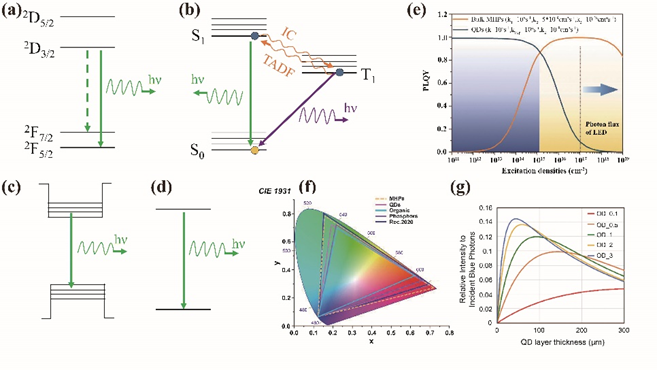
Figure 3: Color conversion materials
Patterning Processes
In full-color displays, the size of subpixels can range from 50–100μm in large panel displays to 3–5μm in micro-displays. Efficient and low-cost processes are required to pattern the red/green/blue color conversion unit pixels. Currently, several typical patterning technologies exist, among which inkjet printing (IJP) is compatible with solution-processed color conversion materials, suitable for large-scale production in the display industry. However, the color conversion inks for inkjet printing need to be carefully designed to prevent coffee ring effects and nozzle clogging. Pixel sizes are typically limited to tens of micrometers (greater than 10 micrometers), which is insufficient for augmented reality (AR), virtual reality (VR), and extended reality (XR) applications. Electrowetting printing (EHD) can significantly reduce pixel sizes to even sub-micrometer levels (greater than 1 micrometer), but it has drawbacks in material selection, and the efficiency and capability for large-scale production have yet to be validated. Photolithography is mature, easy to operate, and suitable for large-scale industrialization and commercialization, but the solvents used in the photolithography process may damage color conversion materials, reducing the optical performance of the displays.
Enhancing Display Performance
Optical Microstructures: Introducing appropriate microstructures or micro-patterns in the color conversion layer can enhance its optical performance. Enhanced optical coupling can achieve higher photoluminescence intensity, serving energy-saving and efficiency-enhancing functions. In quantum dot color conversion displays, with the introduction of microstructures or micro-patterns, lower concentrations of quantum dots can achieve the same photoluminescence intensity, thereby reducing the issue of quantum dot reabsorption.
Built-in Polarizers: Placing polarizers outside the liquid crystal unit presents multiple challenges such as depolarization, additional reflections, and parallax effects. Adding built-in thin-film polarizers can address these issues. Built-in polarizers are placed between the substrate glass of the liquid crystal unit. This effectively decouples the depolarization effects of the liquid crystal layer and the color filter (CF), significantly reducing light leakage and enhancing the contrast of the display. Built-in polarizers in LCDs can achieve more efficient, thinner designs and improve resolution.
Black Matrix: The black matrix is used to isolate the three primary color quantum dot subpixels, preventing color crosstalk and improving the contrast of the display. Recovering or reusing the light energy absorbed by traditional black matrices has significant practical implications for improving the light conversion efficiency of LED displays.
Distributed Bragg Reflectors: One potential issue in color conversion display technology is insufficient absorption of blue light by the color conversion unit, leading to blue light leakage. To reduce blue light leakage and improve light utilization, Distributed Bragg Reflectors (DBR) are introduced into color conversion displays. The application of DBR brings significant improvements in light intensity and blue light suppression effects.
Conclusion and Outlook
Color conversion display technology injects new vitality into various display technologies, becoming an important technology in today’s display industry. Currently, color conversion LCDs have reached a mature stage in the market. However, further development is still needed in high resolution, low cost, and high reliability. Using built-in thin-film polarizers can solve the depolarization, additional reflection, and parallax effect problems associated with traditional external polarizer methods. In terms of color conversion OLED, companies like Samsung and Sony have already commercialized color conversion OLEDs. Currently, broader research is focused on color conversion Micro-LED displays, as this method is considered a feasible pathway for the commercialization of Micro-LED displays, gaining increasing research and application attention. Although the improvement in the optical performance of color conversion materials provides opportunities for their application in Micro-LED displays, uncertainties still exist in the manufacturing processes and structural designs of color conversion Micro-LEDs. Additionally, the stability and protection methods of color conversion materials need improvement to meet the stringent stability requirements for commercial displays. Therefore, further research into industry-compatible patterning processes and packaging technologies is crucial for advancing the development of commercial display products in this field.
Article Information
Li, G., Tseng, MC., Chen, Y. et al. Color-conversion displays: current status and future outlook. Light Sci Appl 13, 301 (2024).
https://doi.org/10.1038/s41377-024-01618-8
Highly Cited Article Statistics
The following data comes from Web of Science, with the number of highly cited articles in Light: Science & Applications leading among similar domestic journals. As of now:
Articles with over 2000 citations: 1 article
https://doi.org/10.1038/lsa.2014.99
Articles with over 1000 citations: 3 articleshttps://doi.org/10.1038/s41377-019-0194-2https://doi.org/10.1038/lsa.2014.30Articles with over 800 citations: 4 articleshttps://doi.org/10.1038/lsa.2016.133Articles with over 700 citations: 8 articleshttps://doi.org/10.1038/lsa.2014.48https://doi.org/10.1038/lsa.2017.141https://doi.org/10.1038/lsa.2017.168https://doi.org/10.1038/s41377-020-0341-9
Articles with over 600 citations: 9 articles
https://doi.org/10.1038/lsa.2013.28
Articles with over 500 citations: 17 articleshttps://doi.org/10.1038/lsa.2015.67https://doi.org/10.1038/lsa.2014.60https://doi.org/10.1038/lsa.2013.26https://doi.org/10.1038/lsa.2014.46https://doi.org/10.1038/s41377-018-0078-xhttps://doi.org/10.1038/s41377-021-00658-8https://doi.org/10.1038/s41377-020-0326-8https://doi.org/10.1038/lsa.2015.30Articles with over 400 citations: 34 articles
https://doi.org/10.1038/lsa.2014.42
https://doi.org/10.1038/lsa.2016.17
https://doi.org/10.1038/lsa.2015.97https://doi.org/10.1038/lsa.2015.131https://doi.org/10.1038/s41377-018-0060-7https://doi.org/10.1038/lsa.2017.39
https://doi.org/10.1038/lsa.2016.76
https://doi.org/10.1038/lsa.2012.1https://doi.org/10.1038/s41377-020-0264-5https://doi.org/10.1038/lsa.2017.146https://doi.org/10.1038/s41377-020-0268-1https://doi.org/10.1038/lsa.2014.94
https://doi.org/10.1038/s41377-019-0148-8
https://doi.org/10.1038/lsa.2014.22
https://doi.org/10.1038/lsa.2015.137
https://doi.org/10.1038/lsa.2014.58
https://doi.org/10.1038/s41377-022-00714-x
Articles with over 300 citations: 60 articles
Articles with over 200 citations: 147 articles
Articles with over 100 citations: 364 articles
Articles with over 50 citations: 707 articles
Welcome to submit promotional drafts for the research group.
Please scan the QR code to contact the duty editor.

👇 Follow Me 👇
Light up the “Like” and “Looking” buttons, so you don’t miss article updates.