Note: The content is adapted from Antarctic Bear
One of the increasingly popular fields for 3D printing is dentistry. 3D printing in the dental field is a manufacturing tool that can create the desired products based on the needs and shapes of each patient. Whether through resin additive manufacturing or powder bed fusion additive manufacturing, it opens new doors for professionals in dental clinics and laboratories. Moreover, dental 3D printing often goes hand in hand with other digital solutions, such as new CAD tools for capturing the anatomical structure of patients’ teeth or dental 3D scanners. In short, this new technology brings extensive benefits to dentistry. Below are the main applications of 3D printing in the dental field.
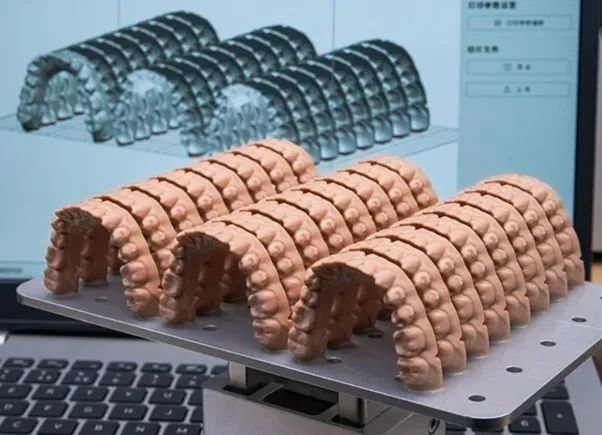 ● Dental 3D Scanning
Although this is not a dental 3D printing application itself, we cannot overlook the use of 3D scanning. The use of 3D scanners has become increasingly common in dental 3D printing. This is the first step in the digital workflow, where medical professionals can digitize the inside of a patient’s mouth using intraoral scanners or digitize impressions using laboratory scanners. A digital file of an impression is created and can be exported in STL format for 3D printing. One of the advantages of using a 3D dental scanner is high precision. It also allows for the production of customized devices based on the different shapes of patients’ teeth. For example, if a patient needs an emergency prosthetic, there is no need to leave new model data, as these models have already been digitized in previous treatments, greatly saving time for both the patient and healthcare professionals.
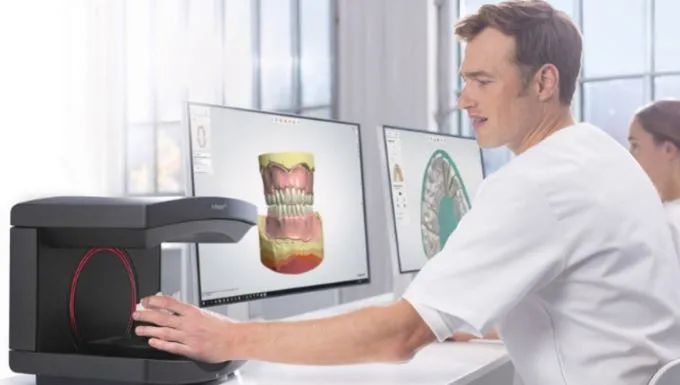 △ Dental 3D Scanner Image Source: 3Shape ● Crowns and Bridges
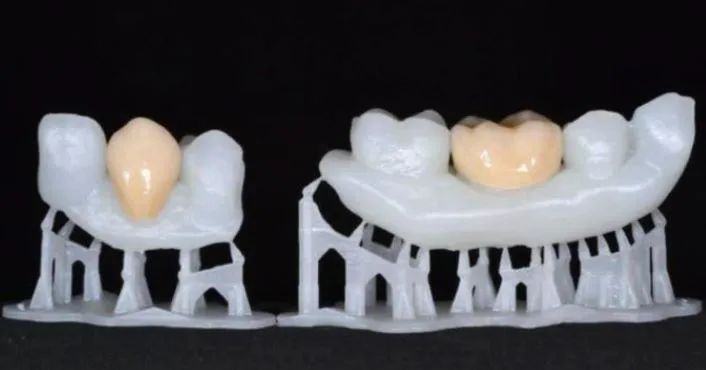
Crowns and bridges are the most common products in dental treatment because they can be used to replace missing teeth. The essential difference between the two is that crowns are used to cover damaged or decayed teeth and can be placed on top of the damaged area. They can also cover dental implants in the absence of teeth. Bridges are used to replace missing teeth and consist of two crowns (one at each end) and some false teeth in between. The role of 3D printing in dentistry is becoming increasingly widespread, as it can produce temporary, high-precision, and aesthetically pleasing 3D printed crowns and bridges using resin 3D printing. This technology is becoming more popular because it is more cost-effective and faster than traditional milling processes.
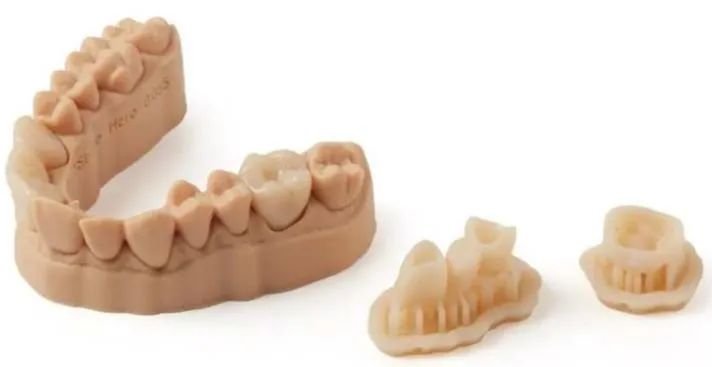 △ Markforged Image Source: Formlabs ● Aligners and Retainers
Additive manufacturing is producing an increasing number of dental devices, which not only improves manufacturing speed but also achieves personalization, a very important aspect in this field since everyone’s teeth are different. Retainers or aligners are devices used to move patients’ teeth. First, healthcare professionals scan the patient’s mouth, then use CAD software to obtain the required files and export them to the 3D printer for printing. The most commonly used technology is resin 3D printing, such as SLA, DLP, or MSLA. Depending on user needs, some parameters can be changed, such as printing time, print area, etc.
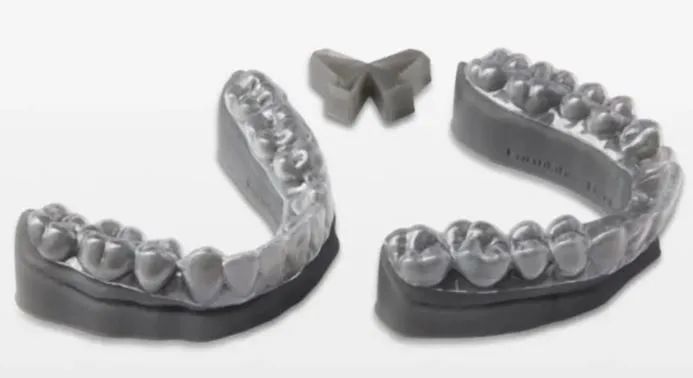
△ Image Source: Formlabs
● Implants
Whenever we lose a tooth, we need to undergo quick treatment with implants; otherwise, the area surrounding the missing tooth will degenerate due to insufficient pressure. With the help of additive manufacturing, dental implants can not only be produced on demand, thus speeding up the process, but also be personalized. This is especially important in dental care, as everyone’s mouth and smile are unique to them. With the precise manufacturing methods of 3D printing used for implant surgery, patients’ biting ability or chewing function is not limited. Moreover, 3D printing is also considered a more economical method, continuously improving through innovation, making the production of implants easier.
 △ Image Source: Formlabs
● Surgical Guides
One of the particularly valuable uses of 3D printing in dentistry is for surgical guides for dental implants. This is one of the latest advancements that has revolutionized the surgical process, even outside of dentistry. During surgery, due to inconvenient angles and lack of visibility, dentists sometimes find it difficult to place implants in the correct position. As a result, many implants are placed incorrectly, which can lead to numerous oral health complications. Surgical guides are used to solve these problems. Specifically, the guide helps dentists place dental implants in the correct position. It is a disposable device that can be directly placed on the patient’s teeth and has a hole through which the implant can be placed at the correct angle and depth. This method provides higher precision, approximately three times that of manual placement.
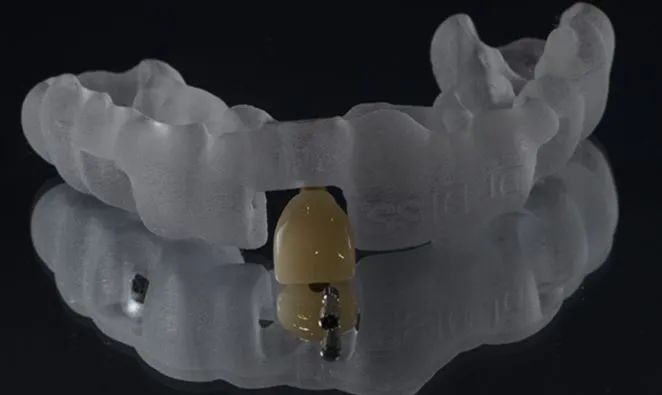 △ Image Source: Arenas Dental ● Anatomical Replicas and Models
In dentistry, anatomical models refer to the jaw or mouth. Models are used to plan and discuss surgical procedures between patients and clinicians, and between clinicians. They provide detailed images of the required areas and can reduce the risk of operational errors, as dentists have a physical anatomical structure to work with. What does 3D printing specifically do in this context? Traditionally, creating plaster models for crowns and dentures is a slow manual process that requires waiting for the models to be ready. 3D printing can be used to generate models quickly and efficiently based on intraoral scans, as it is built layer by layer by the printer. For basic models, FDM can be used with filament, but for more complex replicas, SLA can produce resin models.
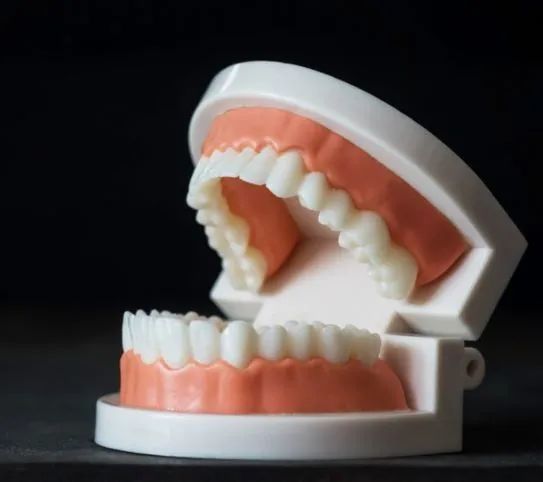
△ Oral Anatomical Model Image Source: freepik.com
● Dentures
The production of dentures using 3D printing is an emerging technology that simplifies the process. The traditional method of making dentures is through milling a resin base, which is very complex and time-consuming, requiring multiple visits to the dentist. 3D printing can produce dentures faster and cheaper. Although this method is not yet perfect, limited by aesthetics and low-resolution printers, many developments have already been made. Recently, new materials for producing dentures have received CE marking (indicating safety in the EEA), and patient studies show that dentures are acceptable to users. Companies like Formlabs have already offered customized denture solutions, suggesting savings of more than half compared to fully milled teeth.
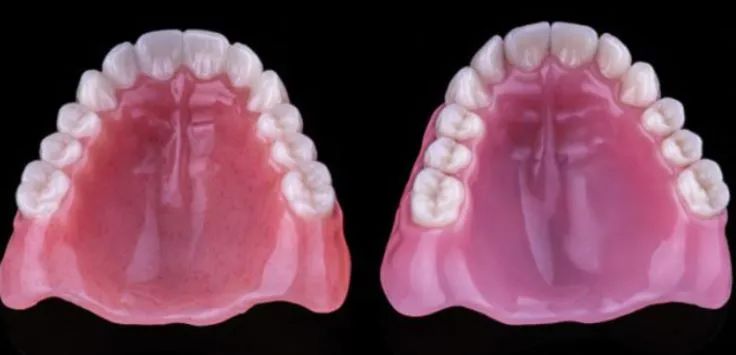 △ 3D Printed Denture Set (Left) and a Milled Set (Right). Image Source: Aegis Dental Network ● Casting Models
3D printing can also be used for indirect dental procedures. Typically, 3D printing can be used to manufacture final-use components in dentistry, including crowns and bridges, inner crowns, and substructures, but it also plays a role in manufacturing casting models. Dental casting models are precise three-dimensional replicas of patients’ teeth, which can be used not only for studying the oral cavity but also for making crowns, fixed bridges, and dentures. Anyone who has undergone orthodontic work or visited a dentist has experienced biting down on uncomfortable wax to make such molds. Through 3D scanning and printing, the process has been simplified, creating high-precision molds through printing, cleaning, support removal, sintering, etc., resulting in the final product.
The article is for learning and communication purposes only; all rights belong to the original author. If there are any copyright issues, please contact us for removal.