 This article is from: IoT TalkC114’s new media on the Internet of Things, providing comprehensive coverage of IoT trendsFollow us
Hello everyone, today we are discussing the main topic of edge computing.

Edge computing refers to an open platform that integrates network, computing, storage, and application core capabilities at the edge of the network, close to the source of objects or data, providing edge intelligence services nearby to meet the critical needs of industry digitization in agile connectivity, real-time business, data optimization, application intelligence, and security and privacy protection.
Can’t understand the long notes?
No worries, just grasp the keywords:Close to the network edge, providing services nearby. This makes it easier to understand the origin of edge computing.
When cloud computing was booming, some believed that terminals only needed a display to transmit data to the cloud center, where the computing process would be completed and then returned to the user terminal. However, this viewpoint is like a bubble, unable to withstand the scrutiny of reality. Over-reliance on the cloud center results in inefficiency, especially in scenarios with strict latency requirements, making IoT deployment meaningless.
For example, in security monitoring, cameras upload the video information they capture to the cloud center for processing. Facing a large amount of potentially useless data, high-speed bandwidth is required, which also increases the operational burden on the cloud center. To reduce processing costs, shorten processing times, and improve processing efficiency, researchers began to enhance cameras with recognition capabilities, storage capabilities, and video processing capabilities, filtering the collected information before transmitting it to the cloud center.
Thus, these terminals with intelligent processing capabilities have become edge computing products.
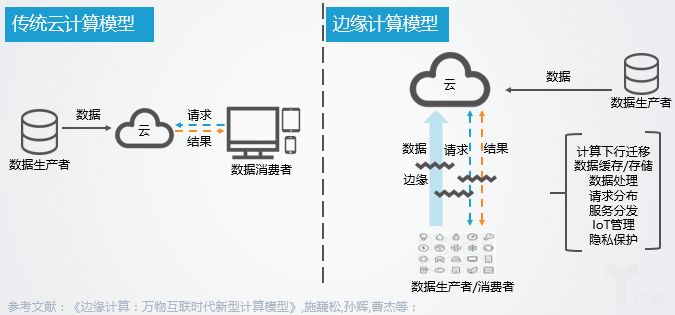
It is estimated that by 2020, the number of intelligent IoT devices installed will exceed 20 billion. With a large number of devices connected to the IoT after installation, the amount of data to be processed is continuously increasing, and relying solely on cloud computing cannot provide real-time responses; it requires the dual drive of edge computing.
If cloud computing is the brain of a computer intelligent system, then edge computing is the eyes, ears, mouth, nose, and limbs of this system. While the core server enables the intelligent system to possess artificial intelligence, if this system is deaf and blind, its role will be limited.
Some compare computer systems to an army, where cloud computing is the commanding officer, and edge computing consists of the lower-level officers. If every decision requires consulting the commander, frequent interactions not only incur high costs but also deplete the commander’s resources; meanwhile, if the lower-level officers are empowered to make subjective judgments and decisions, presenting filtered information to the command center, this greatly alleviates communication pressure. Moreover, if the command center (cloud computing) experiences a network issue and goes offline, having lower-level officers (edge computing) means that even if communication with the command center is temporarily lost, they can still make some decisions independently.
Furthermore, edge computing has various types—personal edge, business edge, and cloud edge.
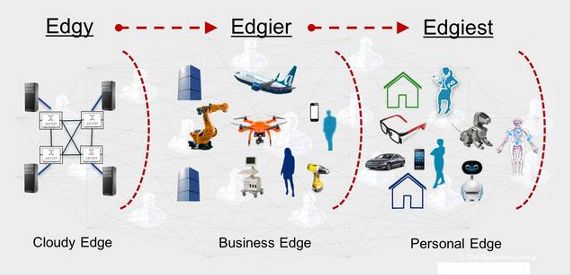
Personal Edge
Products related to personal edge computing are generally mobile, such as smartphones, smart speakers, wearable devices, and medical sensors, which need to consider features like battery life, network switching, and offline conditions during use.
The application scenarios of personal computing are mainly in households.
Business Edge
Machines and people connected at the business edge gather and process information. Such devices are used to support information aggregation, interaction, and processing within a regional scope.
Business edge applications are primarily found in offices or other open spaces. Business edge is also the most focused type of edge computing.
Cloud Edge
Cloud edge provides data parsing, data interaction, and data collaboration at different cloud platform sides, with the rise of vertical cloud platforms such as voice processing, facial recognition, and medical artificial intelligence, enhancing the intelligence of the IoT.

Unlocking various forms of edge computing, close to the device end that generates data, has created a series of “inherent advantages”.
Lower Costs
At the device end, the data that needs to be processed is relatively “small”, so edge computing has a cost advantage in data computation and storage.
More Real-Time and Rapid Data Processing
With fewer intermediate transmission processes, the speed of data processing is faster.
Lower Network Bandwidth Requirements
Edge computing transmits filtered data to cloud servers, and the data, after “shrinking”, does not occupy much network bandwidth.
Stronger Data Privacy Protection
Data collection and processing are completed at the device end, avoiding the leakage of sensitive information during network transmission. In May 2018, the EU passed the strictest data protection laws in history.
Increased Efficiency
When data processing is faster, network transmission pressure is lower, and costs are lower, the efficiency of applications will also greatly improve.
In Which Fields is Edge Computing Applicable?
Internet of Things
Edge computing in the IoT focuses on sensor data analysis and aggregation.
Autonomous Vehicles
Processing data closer to the vehicle using sensors minimizes system response time during driving.
Healthcare
People wear devices that monitor health status, providing data references to doctors whether connected to the cloud or offline; the ability to process data quickly will greatly benefit healthcare management.
Edge computing is also applied in AR/VR, manufacturing, agriculture, energy, and power grids, making device terminals smarter as its “landing point”.
The crazy exploration at the network edge has allowed edge computing to carve out a niche; are you ready to challenge it?!

 If you find this article interesting, feel free to give it a thumbs up.