Optimization Scheme for Cutting Parameters of Gear Discs Based on ELM and NSGA-III
1. Core Idea
The core idea of this scheme is to utilize the rapid modeling capability of ELM and the powerful multi-objective optimization capability of NSGA-III to form a collaborative system of “surrogate model-optimizer”.
-
ELM (Surrogate Model): Replaces time-consuming physical experiments or complex finite element simulations to quickly and accurately predict processing results (such as surface quality, tool wear, processing efficiency, etc.) under different cutting parameters.
-
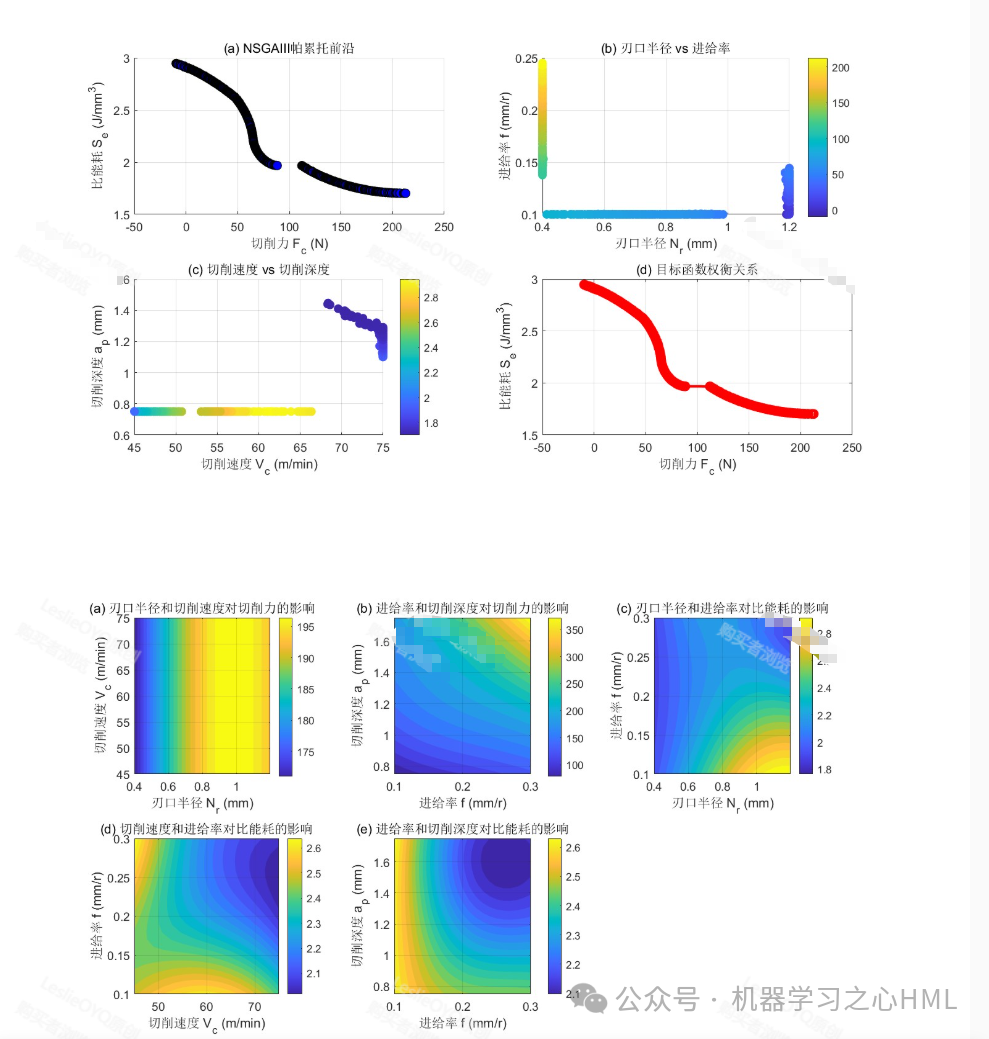
NSGA-III (Optimizer): Based on the predictive model established by ELM, it simultaneously optimizes multiple conflicting objectives (such as maximizing material removal rate, minimizing surface roughness, minimizing cutting force) and identifies a series of balanced optimal solution sets (Pareto optimal front).
2. Overall Process
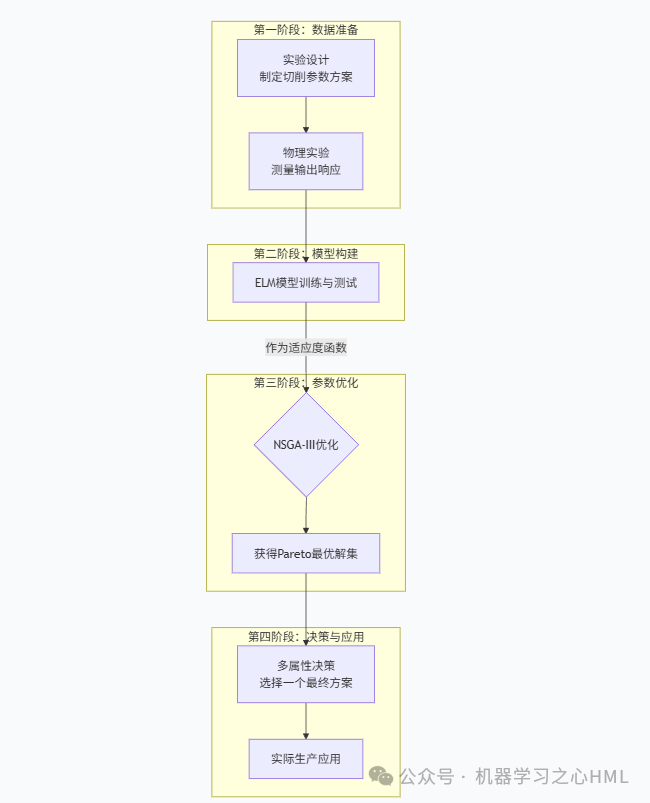
The entire optimization process can be divided into four main stages, as shown in the figure below:
Stage One: Data Preparation and Experimental Design
-
Determine Optimization Variables (Cutting Parameters):
-
Spindle speed (n, rpm)
-
Feed rate (f, mm/min)
-
Cutting depth (ap, mm)
-
(Optional) Coolant parameters, etc.
Determine Optimization Objectives (Response Variables):
-
Surface roughness (Ra): A key indicator of processing quality, the goal is to minimize.
-
Material removal rate (MRR): A key indicator of processing efficiency, the goal is to maximize.
-
Cutting force (F): Affects tool wear, processing accuracy, and machine tool energy consumption, the goal is to minimize.
-
Tool life (T): The goal is to maximize.
Experimental Design and Data Collection:
-
Use experimental design methods (such as full factorial design, central composite design, or Latin hypercube sampling) to scientifically arrange cutting experiments, ensuring that data is evenly and representatively distributed in the parameter space.
-
Conduct cutting experiments under each parameter combination and measure the corresponding response values (Ra, MRR, F, etc.). This constructs a dataset for training ELM
<span>{Input: n, f, ap -> Output: Ra, MRR, F}</span>.
Stage Two: Construction of Surrogate Model Based on ELM
-
Data Preprocessing: Normalize the input and output data, scaling them to the range [0, 1] or [-1, 1] to accelerate ELM training and improve accuracy.
-
ELM Model Training:
-
Split the dataset into training and testing sets.
-
Construct a single hidden layer feedforward neural network (SLFN). The characteristic of ELM is that the weights and biases of the hidden layer can be randomly generated and do not require adjustment.
-
Directly calculate the output layer weights β by solving the generalized inverse matrix (Moore-Penrose). This makes ELM training extremely fast, far exceeding traditional backpropagation neural networks.
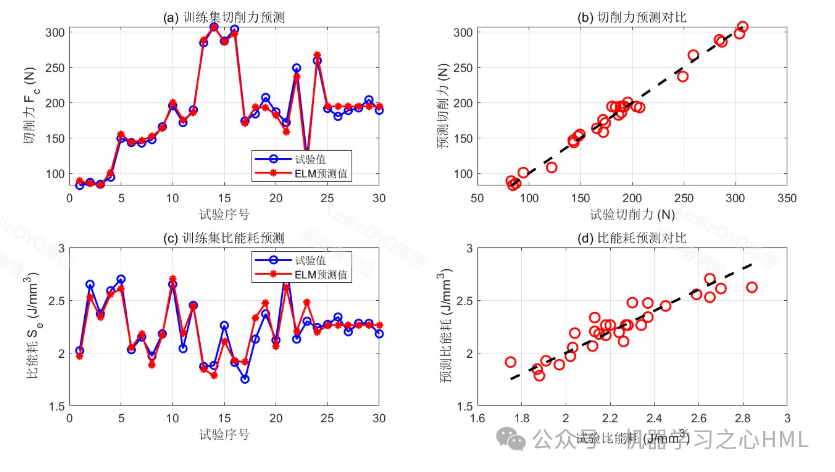
Model Validation: Use the testing set to evaluate the trained ELM model, using metrics such as root mean square error (RMSE) and coefficient of determination (R²) to ensure the model’s predictive accuracy meets requirements.
Stage Three: Multi-Objective Optimization Based on NSGA-III
-
Problem Definition:
-
<span>Minimize: Ra = ELM_ra(x)</span> -
<span>Maximize: MRR = ELM_mrr(x)</span>(usually transformed to<span>Minimize: -MRR</span>) -
<span>Minimize: F = ELM_force(x)</span>
-
Decision Variables:
<span>x = [n, f, ap]</span>, each variable has its feasible upper and lower limits. -
Objective Functions:
-
Constraints: (Optional) For example, maximum cutting power, maximum cutting temperature, etc.
NSGA-III Optimization Process:
-
Evaluation: For each individual in the population (i.e., a set of cutting parameters), substitute it into the trained ELM model to predict its corresponding multiple objective values (Ra, MRR, F).
-
Non-Dominated Sorting: Based on the objective values of individuals, the entire population is divided into different non-dominated levels (Front). The individuals in the first level are not dominated by any other individuals, i.e., Pareto optimal solutions.
-
Reference Points and Normalization: The core of NSGA-III. A set of uniformly distributed reference points is predefined in the objective space. The population is mapped onto a normalized hyperplane, and individuals are associated with these reference points to maintain population diversity.
-
Selection, Crossover, Mutation: Use genetic operators (simulated binary crossover, polynomial mutation, etc.) to produce a new generation of subpopulations.
-
Initialization: Randomly generate an initial population in the decision variable space.
-
Evolution Cycle:
-
Termination: Repeat the evolution cycle until the preset maximum number of iterations or convergence criteria are met.
-
Output: The final output is all solutions in the first non-dominated level, i.e., the Pareto optimal solution set. This solution set contains various optimal cutting parameter schemes that balance multiple objectives.
Stage Four: Decision and Verification
-
Multi-Attribute Decision Making: From the Pareto optimal solution set, based on actual production needs (for example, prioritizing quality or efficiency), use decision methods such as TOPSIS, entropy weight method, etc., to select the most suitable final parameter scheme.
-
Experimental Verification: Conduct actual cutting experiments with the selected optimal parameter scheme to verify whether the results align with model predictions, thereby confirming the reliability of the entire optimization system.
3. Advantages of the Scheme
-
High Efficiency: The training speed of ELM is extremely fast, avoiding the time-consuming iterative process of traditional neural networks. NSGA-III can efficiently handle high-dimensional optimization problems with three or more objectives.
-
High Precision: ELM has good generalization ability, capable of accurately fitting the complex nonlinear relationship between cutting parameters and processing results.
-
Strong Practicality: Provides a “solution set” rather than a single solution, offering decision-makers flexible multiple choices that align with engineering practices.
-
Cost Reduction: Significantly reduces the number of “trial cutting” experiments needed to find optimal parameters, saving time and costs.
Conclusion
The optimization method for cutting parameters of gear discs based on ELM and NSGA-III combines rapid modeling technology with advanced multi-objective evolutionary algorithms, systematically and automatically finding the optimal balance among conflicting objectives such as processing quality, efficiency, and cost. This is a very promising technology for achieving intelligent manufacturing and process optimization.
Code Access (non-public, please do not misuse)