Guo Yipu from Aofeisi Quantum Bit Report | Public Account QbitAI
Harvesting crops with machines is not a new concept; suitable machines exist for wheat and potatoes.
However, compared to these robust grain crops, harvesting delicate vegetables seems much more challenging.
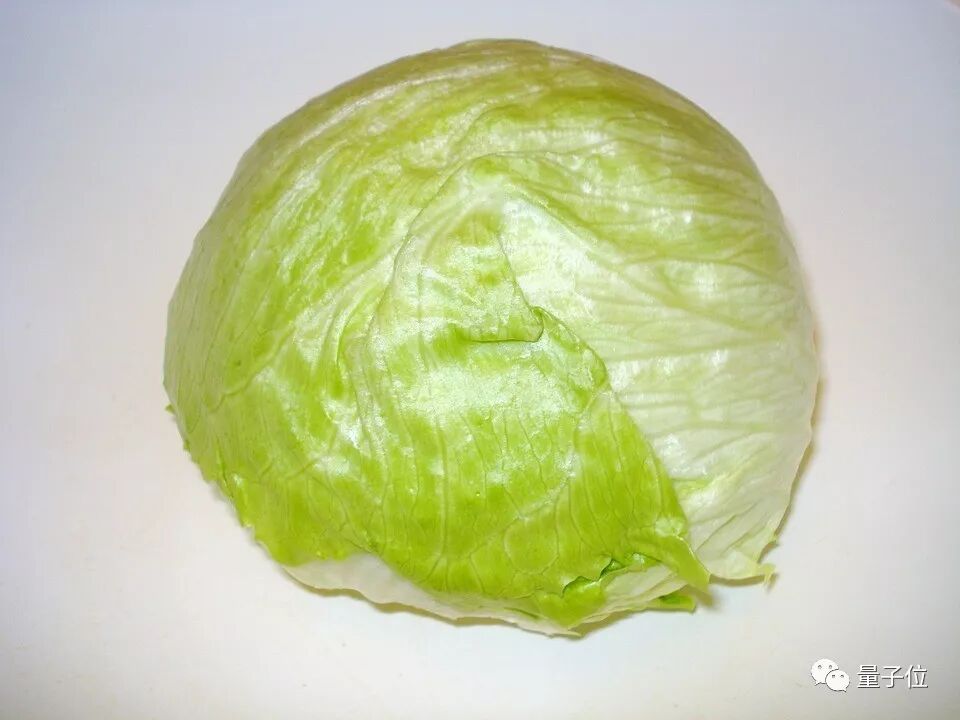
For instance, the butterhead lettuce, a tender and fragile crop, is difficult to harvest mechanically. If harvested carelessly, half of the lettuce head could be cut off, making it unsellable.
Now, a research team in Cambridge has achieved the ability for robots to harvest butterhead lettuce using AI.
Compared to human labor, robots can reduce the workload for farmers, allowing them to avoid the strenuous task of manually harvesting lettuce.
Moreover, robots can implement a more flexible harvesting approach. Humans typically harvest once during the ripening season, leaving unripe vegetables to waste. In contrast, robots do not have the notion of “not harvesting back crops”; they can return later to harvest as the crops mature and even harvest according to specific order requirements.
Lettuce Harvesting Robot
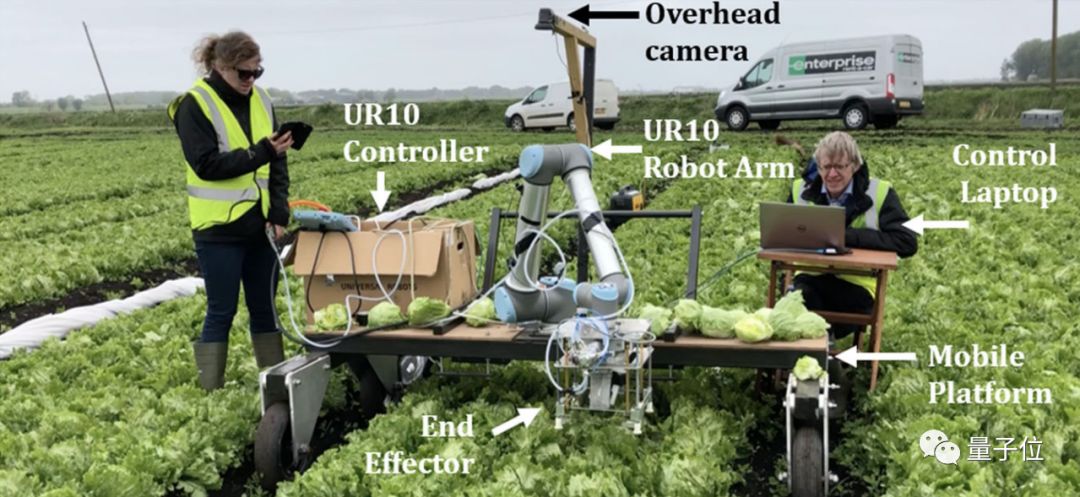
This robot, named Vegebot, includes a standard six-degree-of-freedom UR10 robotic arm, two cameras, and a specially designed cage-like end effector. Additionally, it requires a laptop to run control software.
These devices operate on a wheeled platform, with the wheel spacing perfectly fitting the aisles between two rows of lettuce, allowing it to function as a walking harvesting assistant.
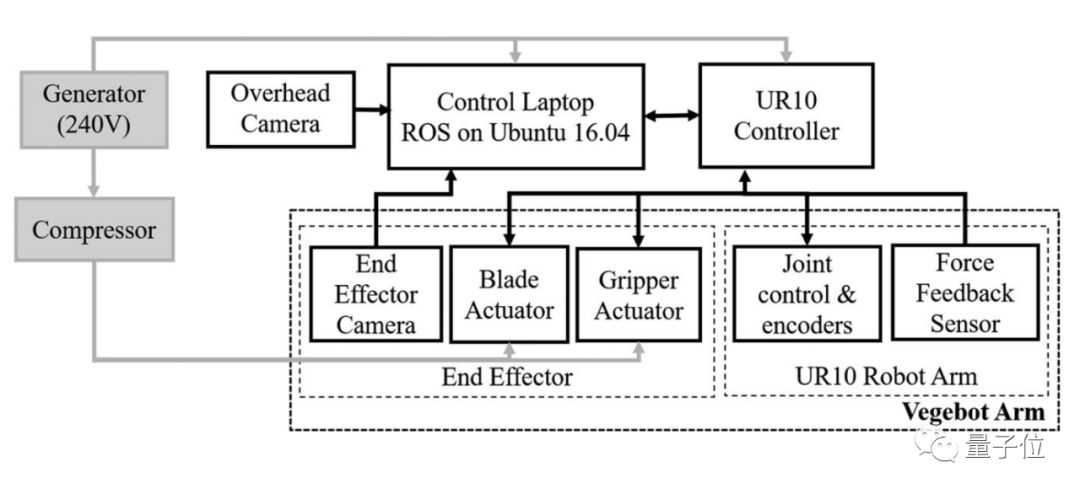
During the harvesting process, signals are collected by the overhead camera, while the laptop and the UR10 controller coordinate to control the end effector and the robotic arm.
How to Harvest Lettuce
Although the butterhead lettuce in supermarkets appears perfectly round and intact, a large lettuce field is not so uniform.
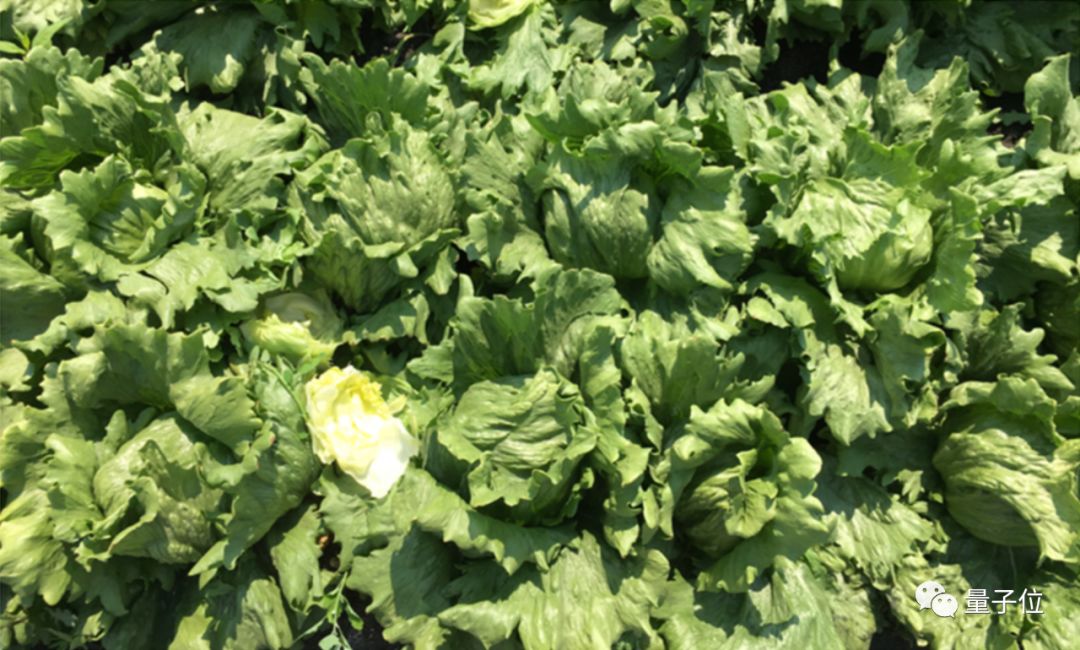
Where is the lettuce head? It is hidden among a sea of green leaves, so the first task is to locate the position of the lettuce heads.
Thus, the first camera must use computer vision to identify all the lettuce heads. The research team employed the YOLOv3 algorithm due to its speed.
Simultaneously, the research team created a lettuce dataset:
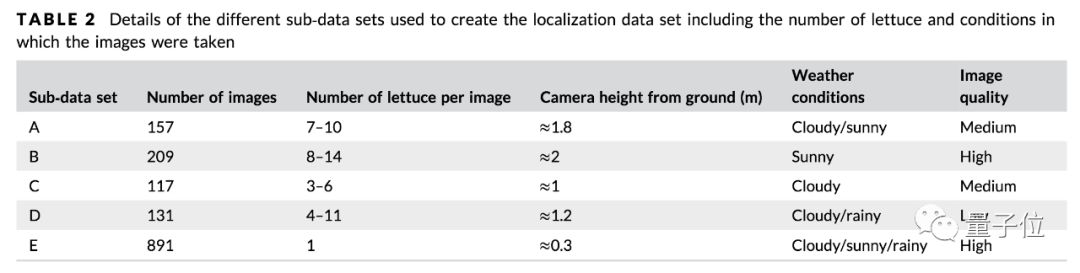
Combining this with the University of Cambridge’s 2015 Deepfarm dataset, they trained a lettuce object detection model to pinpoint where the lettuce heads are distributed.
Once identified, it is not enough, as lettuce heads are not standardized; they vary in size. Larger heads can be harvested for sale, while smaller ones need to be left to grow.
However, among the mature lettuce heads, there may be unhealthy ones. Harvesting these could infect the healthy ones, which must be avoided at all costs.
Therefore, it is essential to classify the lettuce and select those worth harvesting.
The researchers collected 665 photos of butterhead lettuce to create a dataset, using 87.5% for training and 12.5% for testing, training a classification model with the Darknet classifier.
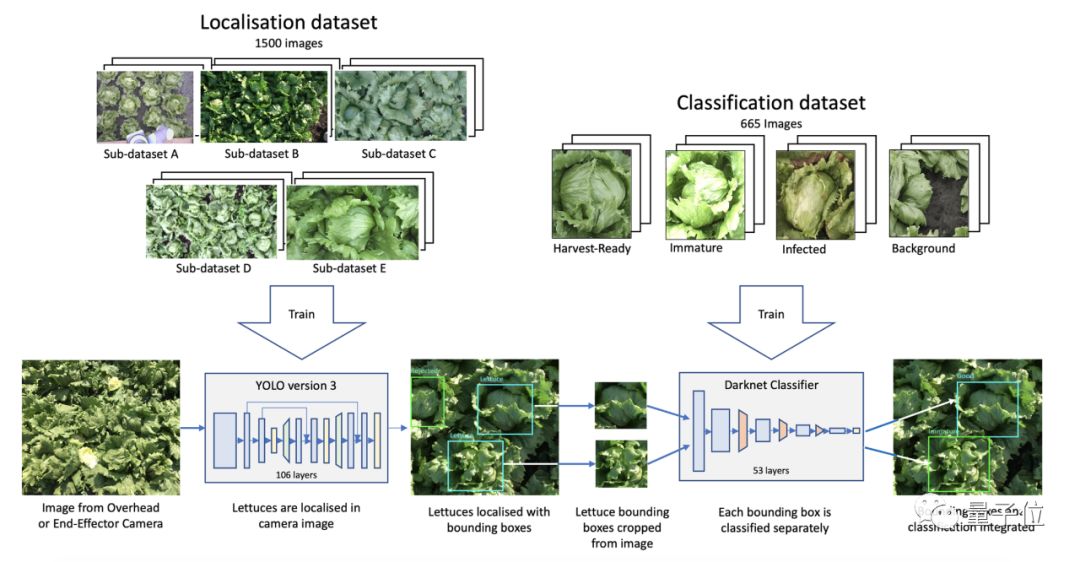
Now, you have found a complete, plump, mature, and healthy lettuce head, and it is time to cut it.
Before cutting, the position of the end effector must be calibrated using an Aruco marker. Then, the end effector is placed on the lettuce head, gently grasping it to ensure it is not crushed.
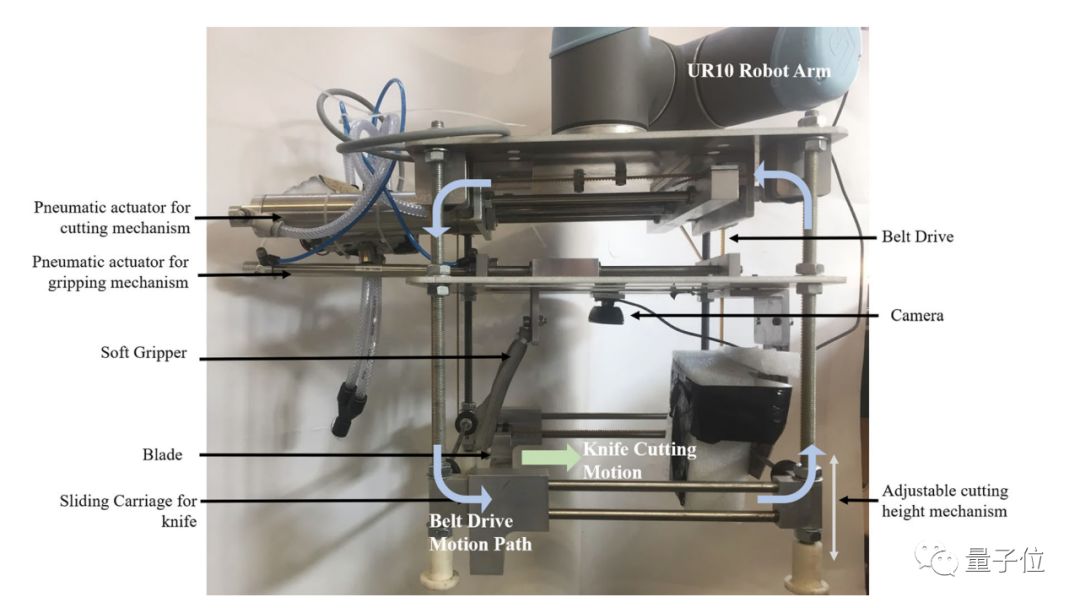
According to supermarket requirements for harvesting vegetables, the robot uses a belt drive and dual pneumatic drives, cutting straight down along the lettuce stem under the supervision of the second camera.
Congratulations, you have successfully harvested butterhead lettuce.
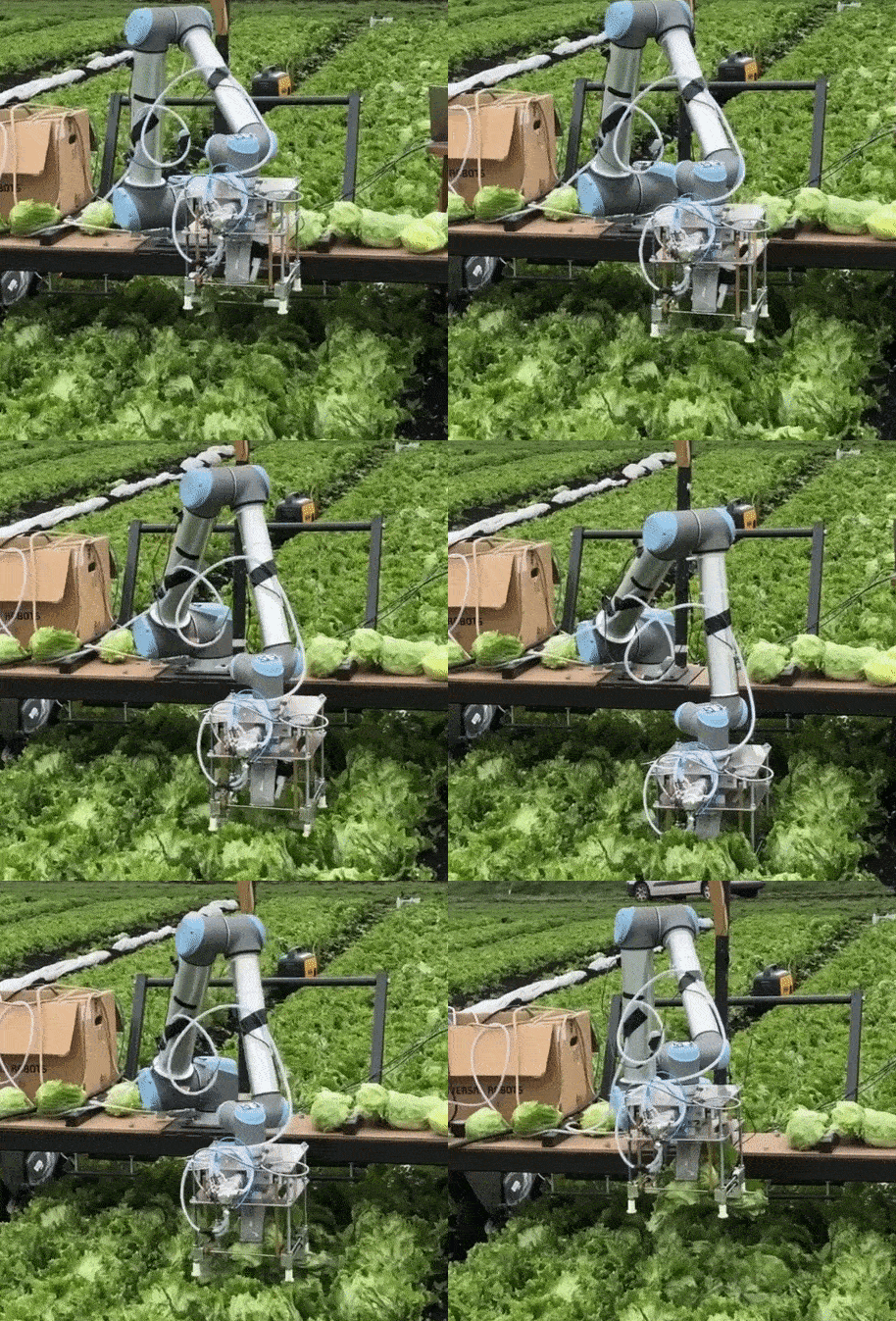
The final harvesting success rate is approximately 88%.
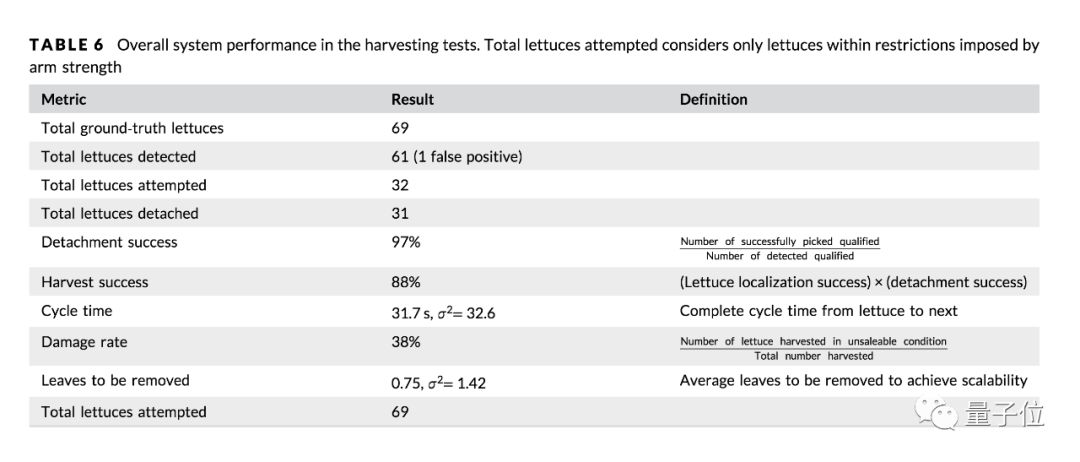
Produced in Cambridge
The authors of this research are from the Department of Engineering at the University of Cambridge, with Simon Birrell as the first author. He graduated with a master’s degree from Cambridge in the 1980s and later became an entrepreneur, founding three companies in fields such as business intelligence, consumer consulting, film production, and entertainment. In 2016, at the age of 50, he returned to his alma mater to pursue a PhD in AI and robotics.

The researchers have high hopes for this robot, aiming to develop machines that can be used not only for butterhead lettuce but also for other ground crops.
Additionally, based on the data collected by the robot during harvesting, there are extra functionalities: estimating lettuce yield and assessing soil fertility.
Portal
Paper: https://onlinelibrary.wiley.com/doi/full/10.1002/rob.21888
— The End —
AI Community | Engage with Outstanding Individuals
Mini Program | Comprehensive AI Learning Tutorials

Quantum Bit QbitAI · Author on Toutiao
Tracking new developments in AI technology and products
If you like it, please click “Looking”!