1. Core Challenges of Real-Time Task Scheduling
The real-time requirements of embedded systems dictate that tasks must be completed within strict time limits. This means that scheduling algorithms must consider not only the priority of tasks but also the deadline, execution time, and system resource utilization. Traditional scheduling algorithms such as Rate-Monotonic Scheduling (RMS) and Earliest Deadline First (EDF) perform well in certain scenarios but often struggle with multi-core, heterogeneous, or dynamic loads.
1.1 Limitations of Traditional Algorithms
-
RMS: A fixed-priority scheduling algorithm suitable for periodic tasks, but it can suffer from priority inversion issues when handling aperiodic tasks or dynamic loads.
-
EDF: A dynamic priority scheduling algorithm that is theoretically optimal, but in practice, due to the uncertainty of task execution times, it can lead to system overload.
2. Optimization Approach: From Static to Dynamic, From Single-Core to Multi-Core
2.1 Dynamic Priority Adjustment
Traditional scheduling algorithms typically use static priority assignments, but in real systems, the priority of tasks may need to be adjusted based on the real-time status of the system. For example, the Adaptive EDF (AEDF) algorithm can maintain a high scheduling efficiency by dynamically adjusting the priorities of tasks as system load changes.
// AEDF Pseudocode Example
void aedf_scheduler(Task *tasks, int num_tasks) {
    while (1) {
        for (int i = 0; i < num_tasks; i++) {
            if (tasks[i].deadline < current_time()) {
                tasks[i].priority = HIGH_PRIORITY;
            } else {
                tasks[i].priority = LOW_PRIORITY;
            }
        }
        schedule_tasks(tasks, num_tasks);
    }
}
2.2 Multi-Core Scheduling and Load Balancing
As embedded systems evolve towards multi-core architectures, scheduling algorithms need to consider how to distribute tasks among different cores to achieve load balancing. Partitioned EDF (P-EDF) and Global EDF (G-EDF) are two common multi-core scheduling strategies.
-
P-EDF: Tasks are assigned to fixed cores, with each core running an independent EDF scheduler. This method is simple to implement but can lead to load imbalance.
-
G-EDF: All cores share a global task queue, allowing tasks to migrate between different cores. This method better utilizes system resources but increases scheduling overhead.
// G-EDF Pseudocode Example
void g_edf_scheduler(Task *tasks, int num_tasks, int num_cores) {
    while (1) {
        Task *next_task = find_earliest_deadline_task(tasks, num_tasks);
        int core_id = find_least_loaded_core(num_cores);
        assign_task_to_core(next_task, core_id);
    }
}
3. Implementation Details: From Theory to Code
3.1 Precise Modeling of Task Models
When implementing scheduling algorithms, it is essential to accurately model tasks. A typical real-time task can be represented as:
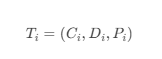
Where:
-
Ci is the execution time of the task,
-
Di is the deadline of the task,
-
Pi is the period of the task.
3.2 Implementation of the Scheduler
The core of the scheduler is the management of the task queue and the implementation of scheduling decisions. Below is a simple example of an EDF scheduler implementation:
typedef struct {
    int id;
    int execution_time;
    int deadline;
    int period;
} Task;

Task task_queue[MAX_TASKS];
int num_tasks = 0;

void edf_scheduler() {
    while (1) {
        Task *next_task = NULL;
        int earliest_deadline = INT_MAX;

        // Select the task with the earliest deadline
        for (int i = 0; i < num_tasks; i++) {
            if (task_queue[i].deadline < earliest_deadline) {
                earliest_deadline = task_queue[i].deadline;
                next_task = &task_queue[i];
            }
        }

        if (next_task) {
            execute_task(next_task);
            next_task->deadline += next_task->period; // Update deadline
        }
    }
}
4. Optimization Practices: From Algorithms to Hardware
4.1 Hardware Acceleration and Scheduler Collaboration
In modern embedded systems, hardware accelerators (such as GPUs and FPGAs) can significantly enhance task execution efficiency. Scheduling algorithms need to consider how to allocate tasks to suitable hardware resources. For instance, the Heterogeneous Earliest Finish Time (HEFT) algorithm predicts task execution times on different hardware to select the optimal hardware resource for allocation.
4.2 Energy Optimization
Embedded systems often have strict energy consumption requirements. Scheduling algorithms can reduce system energy consumption through Dynamic Voltage Frequency Scaling (DVFS) technology while ensuring real-time performance. For example, the Energy-Aware EDF (EA-EDF) algorithm takes into account the energy characteristics of tasks when scheduling, selecting the optimal voltage-frequency combinations.