Source: 21ic Electronic Network (ID: weixin21ic)
1. VxWorks
VxWorks is a high-performance, scalable real-time operating system designed and developed by Wind River in the United States in 1983. It provides the latest generation of development and execution environment for embedded real-time applications and supports almost all processors on the market. Due to its excellent reliability and outstanding real-time performance, it is widely used in high-tech fields requiring high real-time performance, such as satellite communications, military exercises, ballistic guidance, and aircraft navigation.
2. Nucleus
Nucleus is a product developed by Accelerated Technology Incorporated in the United States and is one of the most popular embedded operating systems in the world. Its main feature is that about 95% of its code is written in ANSI C, making it very portable and capable of supporting most types of processors. It also provides support for modules such as networking, graphical user interfaces, and file systems.
3. QNX
QNX is a commercial, POSIX-compliant real-time operating system produced by QNX in Canada. It is one of the most successful microkernel operating systems and has been widely applied in the automotive field, such as in the music and media control systems of Porsche sports cars and the control systems of the U.S. Army’s unmanned Crusher tank, as well as in RIM’s Blackberry PlayBook tablet. It features a unique microkernel real-time platform that is real-time, stable, reliable, and extremely fast.
4. Windows CE
Windows CE is an embedded operating system launched by Microsoft in the United States, supporting numerous hardware platforms. Its main feature is that it has a program development interface consistent with the desktop Windows family, allowing programs developed for the desktop Windows family to run directly on Windows CE. It is mainly used in consumer electronics such as PDAs (Personal Digital Assistants), tablets, and smartphones. However, embedded operating systems pursue efficiency and resource savings, and Windows CE is clumsy in this regard, as it consumes too much memory and has large applications.
5. RT-Linux
RT-Linux is an embedded real-time operating system based on Linux developed by the Mexican Institute of Technology in the United States. It is an open-source free software that provides source code. RT-Linux uses a sophisticated kernel and treats the standard Linux core as a real-time core process, scheduling it together with user real-time processes. This results in minimal changes to the Linux kernel and allows for full utilization of the rich software resources available under Linux.
6. uc/OS-II
Originally uc/OS, it was first designed and developed by American embedded systems experts in 1992. UC/OS-II has features such as high execution efficiency, small footprint, excellent real-time performance, and strong scalability, with a minimum kernel that can be compiled to 2KB. UC/OS-II has been ported to almost all well-known CPUs and is one of the most widely studied embedded real-time operating systems in China.
7. FreeRTOS
FreeRTOS is a small embedded real-time operating system that uses a mini kernel. Since embedded real-time operating systems require a certain amount of system resources (especially RAM), only a few real-time operating systems like QNX, uc/OS-II, and FreeRTOS can run on small RAM microcontrollers. Compared to commercial operating systems like QNX and uc/OS-II, FreeRTOS is a completely open-source operating system that features open code, portability, modularity, and flexible scheduling policies, making it easy to port to various microcontrollers.
8. RT-Thread
China has also made certain achievements in the research and development of embedded real-time operating systems. RT-Thread, developed by the Chinese open-source community, not only includes a real-time operating system kernel but also has a complete application ecosystem, including various components related to embedded real-time operating systems: TCP/IP protocol stack, file system, libc interface, graphical user interface, etc., with considerable development potential.
9. MQX
MQX originated from a company located in Ottawa, Canada. With the system kernel, interrupt management system, semaphore, queue, and memory management system loaded, MQX occupies only 6KB of ROM storage space, resulting in minimal hardware resource overhead. MQX is comparable in scale to UC/OS-II but far exceeds uc/OS-II in terms of user experience and the richness of system services.
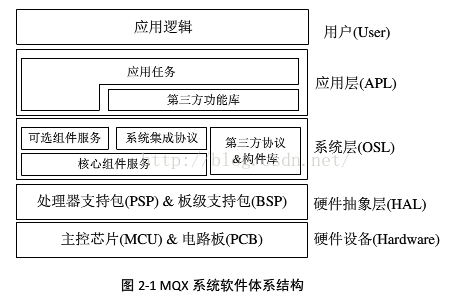
PSP mainly focuses on the processor core, implementing core functions of the operating system such as context switching and hardware interrupt response. The differences in PSP among different chips with the same processor architecture are minimal.
BSP primarily focuses on hardware device modules and peripheral circuits outside the processor core, providing device driver and other extended services for the MQX system software. A typical example is the system tick generated by timer interrupt cycles, which serves as the basis for providing time services for the system.
Recommended Reading:
1. JTAG Embedded Debugging Technology
2. Summary of Embedded System Knowledge and Interface Technologies
http://mp.weixin.qq.com/s?__biz=MzI4MTEyNDU1MA==&mid=2651180200&idx=1&sn=8caf534cf151a6ef3db08acb39c41270&chksm=f05f6701c728ee17d3e9945ac55bebce8f8679981299953f4808e1717038eba4430e8d59d084&scene=0#rd