Special Topic Directory
(Host/Reporter Jiang Hong)
-
Noteworthy Warehouse Dock Management
-
Analysis of Key Points in Warehouse Dock Planning and Design
-
Advance Planning + Real-Time Scheduling for Efficient Dock Resource Utilization
-
ProLogis Aids Digital Transformation in the Industry with Smart Dock Management
-
Upgrading Development of Loading and Unloading Technologies at Warehouse Docks
-
Planning and Application of Automated Loading and Unloading Systems in the Automotive Industry
-
Analysis of Fast Loading Technology Demand in the Home Appliance Industry
Written by: Fuller Technology Consulting Service Director
Jiang Weiwei
The efficient use of docks is a systematic project. By leveraging information systems, collaborative management of various resources including suppliers, vehicles, docks, receiving and shipping personnel, and warehouse operational equipment can be achieved, reducing vehicle waiting times, improving loading and unloading efficiency, enhancing the planning of warehouse operations, and increasing the utilization of warehouse capacity.
Docks are a scarce resource in warehouses, and effective utilization of this resource cannot be managed solely by focusing on the docks themselves.It is actually a systematic project that requires collaborative management of various resources including suppliers, vehicles, docks, receiving and shipping personnel, and warehouse operational equipment.“Advance Planning + Real-Time Scheduling” is the fundamental measure to achieve effective dock utilization and avoid resource waste.
For example, in the case of supplier deliveries, without advance appointments, the warehouse’s receiving operations lack planning, which inevitably leads to several issues:
The workload of dock and warehouse personnel and equipment is uneven, and capacity is not fully utilized.
Delivery vehicles queue for long periods, wasting drivers’ effective working time and causing congestion in the logistics park.
Goods cannot be shelved in a timely manner, leading to congestion in the receiving buffer area.
Based on this management need, the FLUX WMS warehouse management system suite includes two core modules: one is Appointment for advance planning of dock resources, and the other is Yard Management for real-time scheduling of vehicles and dock operations.
System Functions and Key Processes
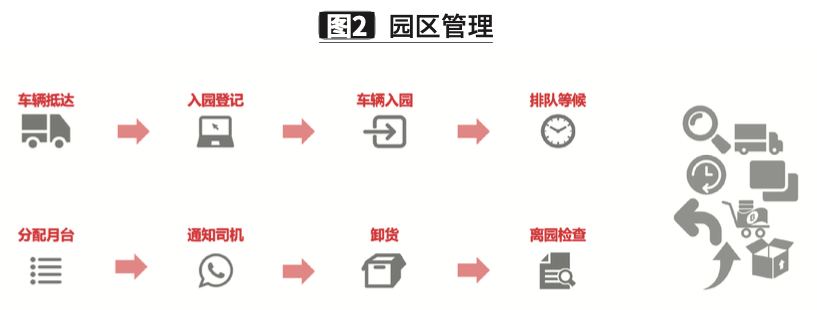
Docks can be categorized into three types based on function: receiving docks, shipping docks, and shared docks for receiving and shipping.From the perspective of using receiving docks, suppliers first schedule production or prepare stock based on purchase orders, and then make advance appointments for deliveries to the logistics center according to their production or preparation progress.
Before allowing suppliers to make appointments, the FLUX WMS system first defines how many receiving docks the warehouse will open, the type of each dock (to match different vehicle types), and the operational hours of the docks.The FLUX WMS system provides all suppliers with an appointment portal, where suppliers need to make appointments for the corresponding quantity and delivery time at least one day in advance. Dock resources are generally allocated on a first-come, first-served basis, but it also needs to support the requirement for fixed resources reserved for certain VIP suppliers.
To improve appointment efficiency, FLUX WMS adopts a graphical appointment method, allowing suppliers to intuitively see available dock resources (horizontal axis) and available time slots (vertical axis), determining their delivery time by dragging on the graph, as shown in Figure 1.
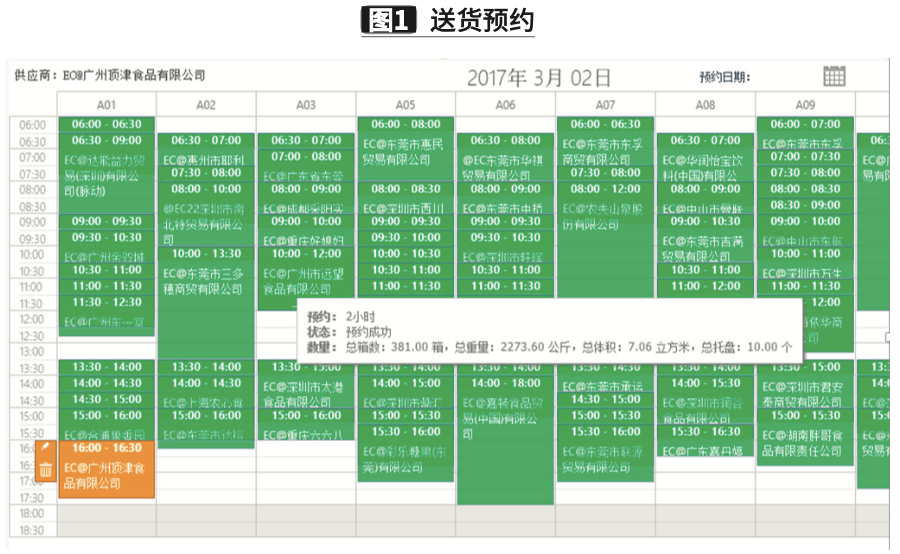
Regarding the duration of operations, specifically the time delivery vehicles occupy the docks, FLUX WMS automatically calculates the estimated operation duration based on the type of goods and corresponding quantity specified during the supplier’s appointment, using historical data analysis and algorithms.
Once all suppliers complete their appointments, the warehouse can basically determine the total workload for that date, allowing for scheduling of warehouse personnel.
Vehicles need to arrive in advance according to the appointment time. For vehicles that do not provide the license plate number in advance, entry registration is required, followed by manual release.To improve efficiency, FLUX WMS offers a WeChat mini-program, allowing drivers to pre-register for entry before arrival, combined with the park’s automatic gate, enabling automatic license plate recognition and entry release.After entering the park, vehicles wait in designated parking areas for unloading notifications.
If a driver arrives early or late, the system needs to perform real-time vehicle scheduling based on appointment data and the current dock usage situation, promptly allocating a dock for abnormal vehicles without affecting other timely arriving vehicles.
The FLUX WMS system allocates suitable docks to vehicles based on a complex set of algorithm rules, using multiple factors such as suppliers, vehicle types, and cargo types as constraints, aiming to maximize dock utilization and minimize vehicle waiting times. After allocating docks, drivers are notified to unload at the designated dock.FLUX WMS integrates various technical means to provide timely notifications to drivers, including electronic screens, voice broadcasts, text messages, automatic phone calls, and WeChat public account notifications.

Vehicles arrive at the designated dock to begin unloading operations.For docks equipped with automatic doors, the system can automatically control the opening and closing of the doors and record the start and end times of unloading operations, as well as information on the types and quantities of goods.This data will be used for subsequent analysis of operational efficiency and for more accurate predictions of dock operation times.
After unloading is completed, vehicles leave the park, with gates automatically or manually released.
In the warehouse’s shipping process, the warehouse needs to arrange transportation routes and vehicle scheduling based on the daily received shipping orders through the FLUX TMS transportation management system, generating operational waves for the warehouse based on the transportation plan.Goods pass through replenishment, picking, packing, and consolidation operations in an orderly manner, waiting to be loaded for shipment in the consolidation area.
The planning and allocation of consolidation positions are crucial, directly affecting the efficiency of final loading.Depending on different business characteristics, there can be various types of consolidation such as by route, by station, or by recipient, and different consolidation positions are allocated accordingly.When allocating consolidation positions, the loading sequence must also be considered to ensure that earlier deliveries are loaded first while also taking into account the efficiency of loading and unloading.Many warehouses experience chaos in the final loading and shipping phase due to a lack of sufficient consolidation buffer space or rigorous management in the consolidation area.
The FLUX WMS system completes advance planning of shipping docks based on the following four types of data, notifying drivers of the dock allocation results and loading times through various methods such as electronic screens, operational tickets, and WeChat mini-programs.
-
Waybills generated from route, vehicle, and driver scheduling
-
Consolidation areas corresponding to various route orders
-
Estimated completion time for operational waves
-
Dock types and vehicle types
Application Cases
Meiyijia is one of the largest convenience store companies in China, and its strong logistics support behind thousands of stores comes from its sibling company Shijie Logistics, which belongs to the Dongguan Sugar and Wine Group.In supporting Meiyijia’s rapid growth, Shijie Logistics continuously upgrades and optimizes its logistics system, and the newly built Chashan Logistics Center has become a benchmark project in the domestic chain retail logistics sector due to its high level of automation and efficient, precise operations.
The Chashan Logistics Center of Shijie Logistics has a total construction area of over 90,000 square meters, planning nearly 100 receiving and shipping docks, with over 200 delivery vehicles and more than 400 shipping vehicles operating daily, indicating a busy level of operations.By applying the appointment and yard management functions of FLUX WMS, over 80% of delivery vehicles can arrive on time, achieving almost zero waiting time to enter the dock for unloading operations, improving delivery efficiency and reducing waiting times, with vehicles entering and exiting the park in a busy yet orderly manner, eliminating congestion.The planning of warehouse operations is enhanced, and the seamless connection between unloading and shelving increases the utilization of warehouse capacity.
In addition to Shijie Logistics, the appointment and yard management functions of FLUX WMS have been widely applied in logistics centers covering various industries such as retail, clothing, pharmaceuticals, e-commerce, and 3PL, including Beijing Hualian, Dingshi Logistics (Family Mart business), Beiguo Shopping Mall, Boma Clothing, Senma Clothing, Thailand’s CJ Express, Malaysia’s GDEX, Indonesia’s Linc Group, and UAE’s IQ Fulfillment.
Future Trends
In the future, logistics centers will not only employ various automated and intelligent logistics equipment and robots within their four walls but will also extensively utilize facilities and equipment integrated with various IoT technologies in the logistics park, including automatic gates, automatic dock doors, adjustment boards, and locators. Combined with mobile internet applications, efficient operational coordination and digital management, as well as intelligent applications between the park and warehouse, will be achieved under the unified command and scheduling of warehouse management systems/dock management systems.

Logistics CircleOver the years, the magazine has successfully held multiple brand events in the clothing, retail, manufacturing, home, and logistics equipment industries, receiving widespread praise. To facilitate communication and networking, we have created five major logistics circles for various industries, including:Retail Logistics Circle、Manufacturing Logistics Circle、Clothing Logistics Circle、Home Logistics Circle、Logistics Equipment Circle. Currently, due to the large number of participants, personal WeChat invitations from the editor are required to join the groups,please indicate your company and position when adding, otherwise, it will not be approved.