Since the concept of ADC was proposed in 1900, it has existed as a new type of cancer treatment method. Although its development has faced many challenges over the past century, top scientists in the relevant fields around the world have been conducting years of experiments and iterations to improve safety, reduce off-target effects, and minimize toxic side effects. Since 2000, the ADC field has gradually begun to be pushed to market, and in recent years, it has emerged rapidly in the field of cancer treatment, ushering in rapid development.
As of now, there are 16 ADCs successfully launched globally. Frost & Sullivan predicted that the global market size for ADCs, which was $1.6 billion in 2017, would grow rapidly and reach $5.5 billion by 2021, with a compound annual growth rate of 35.9%. It is expected that from 2021 to 2030, the ADC market will continue to grow rapidly at a compound annual growth rate of 31.2%, reaching a market size of $63.8 billion by 2030.
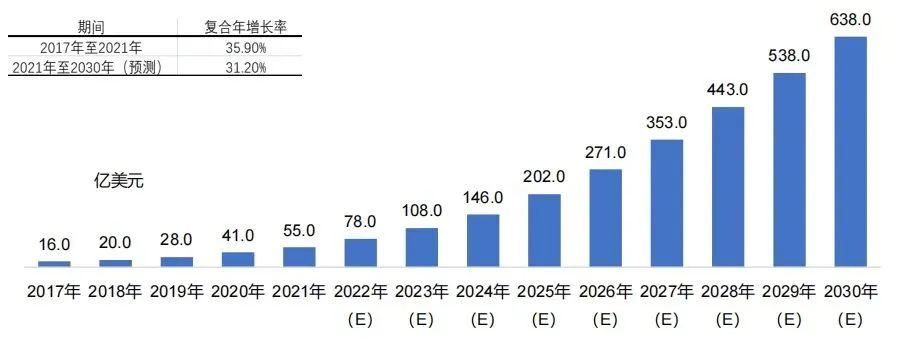
Image Source: Bio Report
With the development of the times, in recent years, although the hot targets in the ADC field are still dominated by HER2, the indications have gradually shifted from hematological tumors to solid tumors, with the number of clinical projects for the latter even matching that of the former several times. However, the number of ADCs in the non-cancer field remains very few, and most are still in the preclinical stage.
Technical Maturity Drives the Exploration of Non-Cancer ADCs
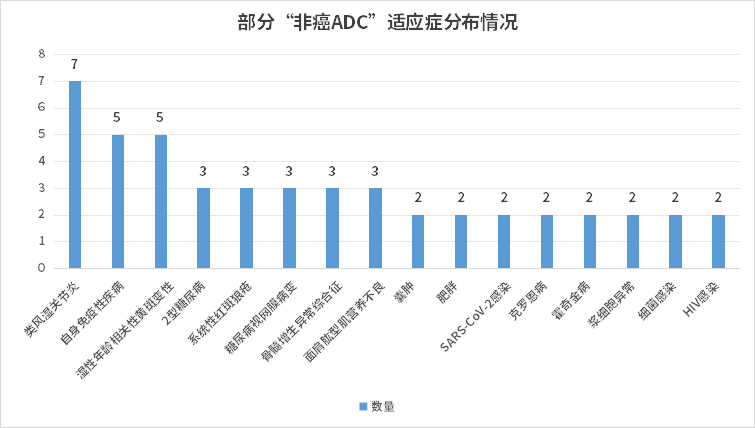
As global enthusiasm for ADC projects continues to ferment, many large pharmaceutical companies are gradually expanding the diseases treated by ADCs into the non-cancer field. Various non-cytotoxic drug payloads have frequently appeared in early research and development projects, with autoimmune diseases becoming the most concentrated field for non-cancer ADC indications. Some projects, such as wet age-related macular degeneration and type 2 diabetes, have even progressed to clinical phase III, with hopes for rapid market entry.
Data Source: Yaozhi Data
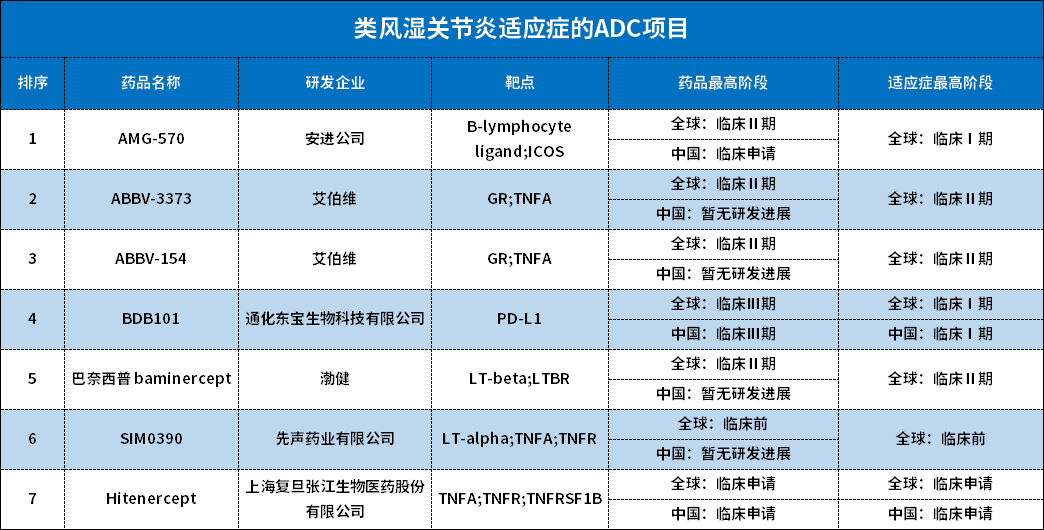
According to relevant data, among the currently known ADC projects for non-cancer indications, the most numerous projects are for rheumatoid arthritis, which include Amgen’s AMG-570, AbbVie’s ABBV-3373 and ABBV-154, Tonghua Dongbao’s BDB101, Boehringer Ingelheim’s banalisib, and Simcere’s SIM0390, as well as Fudan Zhangjiang’s Hitenercept. Among these, AbbVie and Boehringer Ingelheim’s products are slightly ahead in development progress, with clinical trials for indications having entered phase II.
Data Source: Yaozhi Data
AbbVie ABBV-3373 and ABBV-154
As one of the first pharmaceutical giants to enter the ADC field, AbbVie had little success in the ADC field for a long time after it began involvement in 2008. It wasn’t until 2016 that AbbVie acquired Stemcentrx for $5.8 billion, gaining the ADC drug Rova-T, only to abandon its development in 2019 due to Rova-T’s failure, suffering a setback. After more than a decade of exploration, AbbVie successfully built its own ADC pipeline, with eight ADC projects in clinical stages.
As autoimmune diseases have always been AbbVie’s flagship business, it naturally became the main reason for combining ADC with the autoimmune field. Thus, ABBV-3373 and ABBV-154 became AbbVie’s initial foray into the autoimmune ADC field. The former consists of adalimumab and a novel glucocorticoid receptor modulator (GRM), aiming to directly deliver the effective payload GRM to activated immune cells expressing TNFα, thereby regulating TNF-mediated inflammatory pathways.
-
On June 2, 2021, pharmacokinetic data from the phase I portion of the phase IIa trial for rheumatoid arthritis was announced at the 22nd Annual European Congress of Rheumatology (EULAR-2021);
-
In 2023, positive results were obtained in a randomized, double-blind, active-controlled proof-of-concept phase IIa trial, with hopes of becoming the first antibody-drug conjugate in the autoimmune field.
However, good things often encounter obstacles. Due to observed changes in biomarkers for ABBV-154 during the interim trial, along with higher doses of systemic glucocorticoid exposure, the risk-reward ratio was unfavorable. In the past two years, AbbVie has successively terminated clinical studies of ABBV-154 for the treatment of RA, PMR, and CD.
Nevertheless, as a pioneer in the global autoimmune ADC field, it is precisely due to AbbVie’s bold trial-and-error spirit and willingness to experiment that medical science continues to advance and develop.
Different Selectivity of Non-Cancer ADC Payloads
With the transition from tumor eradication to non-cancer indications, the demand for drug payloads in non-cancer ADCs has also changed, no longer limited to traditional cytotoxic agents. Reports indicate that currently, over 90% of the effective payloads in non-cancer indication ADCs are non-cytotoxic drugs, the most prominent of which are immunomodulators, enzymes, and antisense oligonucleotides and siRNA.
Glucocorticoid Receptor Modulators (GRM):
Currently, due to the concentration of non-cancer ADCs in the autoimmune field, the selection of effective payloads mainly focuses on immunomodulators (glucocorticoid receptor modulators). Reported combinations include “targeting E-selectin antibody + dexamethasone”, “targeting CD163 antibody + dexamethasone”, “targeting CD70 antibody + budesonide”, “targeting CD74 antibody + fluticasone propionate”, among others.
AbbVie’s ABBV-3373, which was formed by modifying the linker and payload, is a prominent example. This drug is a novel antibody-drug conjugate (ADC) composed of the antitumor necrosis factor antibody adalimumab (adalimumab) and glucocorticoid receptor modulators (GRM), with a linker of MP-Ala-Ala (maleimide-propionamide-Ala-Ala) and a DAR value of 4, used for the treatment of rheumatoid arthritis (RA) and other immune-mediated diseases. This drug has already completed clinical validation.
Antibiotics:
Antibiotics as a new type of conjugated drug with effective payloads are continuously being developed, representing an ideal method for uniformly eradicating intracellular bacteria. By screening antibodies from infected patients and mice against Staphylococcus aureus, an antibody-antibiotic conjugate (AAC) targeting intracellular bacteria was identified. Using the THIOMATM method, a highly effective antibiotic rifalogue, which is activated only after being released in lysosomes, was specifically conjugated to the V205C site on the light chain of the anti-Staphylococcus aureus antibody. RG-7861 is the exploration result of Genentech in the non-cancer ADC field.
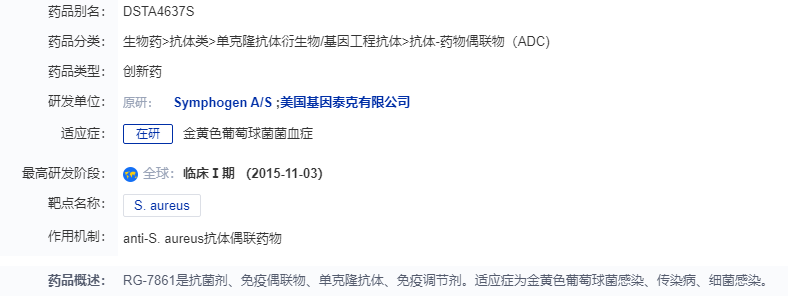
Image Source: Yaozhi Data
LXR Agonists:
According to relevant reports, liver X receptors (LXR) have been shown to regulate immune responses and exert anti-inflammatory effects; however, their toxic reactions have limited development research. Therefore, ADC drug development strategies have been employed to develop LXR agonist effective payloads targeting pathogenic macrophages, effectively avoiding toxicity to normal cells. CD11a, also known as LFA-1a or integrin αL chain, has a molecular weight of 180kD and is expressed on all leukocytes. It belongs to the integrin family and has the structure of an integrin α subunit. The ADC targeting CD11a was designed by connecting the antibody against CD11a with the agonist sulfonamide through a Phe-Lys dipeptide cleavage linker.
In addition, kinase inhibitors, phosphodiesterase (PDE4) inhibitors, and bisphosphonates are also currently major attempts in the range of non-toxic ADC effective payloads, setting an example for the exploration of more effective payloads.
Conclusion
As the saying goes, where there are people, there are rivers and lakes; as long as there is popular drug research and development, there will inevitably be a relatively homogenized competitive landscape in the later stages. Currently, after experiencing a tortuous path in the early development phase, antibody-drug conjugates have shown explosive growth in both the number of therapies and the speed of advancement as technology matures. It is expected that, as usual, there will likely be a situation where indications cluster in the future.
It is precisely this foresight that has led many researchers and companies with advantages in the non-cancer field to begin trying to utilize conjugated drug technology to complete upgrades of new treatment models. This is also a concrete manifestation of differentiated competition and an inevitable path of scientific progress.
In China, we not only need to see how many biopharmaceutical companies are investing in ADC research and development, and how many cancers are covered by indications, but also which domestic pharmaceutical companies are likely to lead MNCs in certain ADC fields in the future and dominate globally.
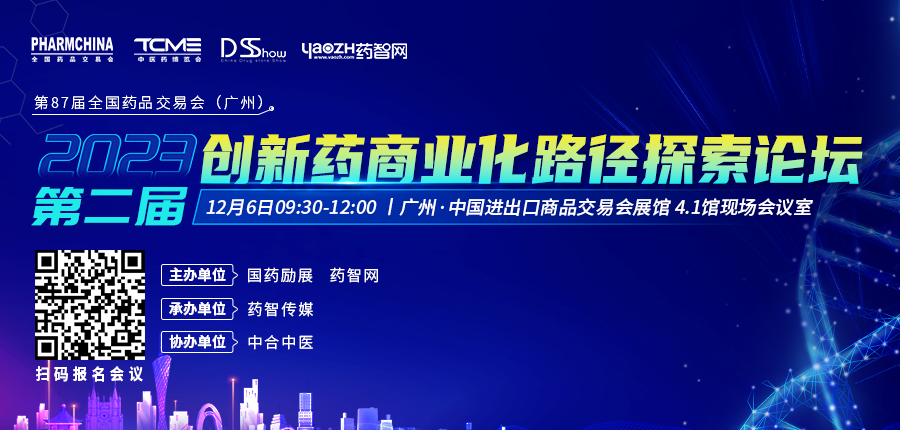
In recent years, the number of new drugs approved for marketing in China has been steadily increasing, and the variety of commercialized products continues to grow. How to successfully commercialize innovative drugs has become one of the core competencies of pharmaceutical companies. The China National Pharmaceutical Group and Yaozhi Network co-hosted the “2023 Second Forum on Exploring Commercialization Paths for Innovative Drugs” to be held at the 87th National Pharmaceutical Trade Fair (Guangzhou). The forum focuses on clinical strategies, new drug development progress, product layout, commercial prospects, and other issues, analyzing new paths for commercializing innovative drugs in China and exploring new models for future cooperation.

December 6, 2023, 09:30-12:00
Guangzhou, China Import and Export Commodities Fair Exhibition Center
Hall 4.1, On-site Conference Room
Disclaimer: The views expressed in this article are solely those of the author and do not represent the position of Yaozhi Headlines. Comments and exchanges are welcome; if you need to reprint, please be sure to indicate the author and source. If there are issues regarding the content, copyright, or other matters, please leave a message on this platform or contact [email protected], and we will address it promptly.
Yaozhi Headlines
Editor | Penicillin
Layout Design | Xi Yi
Media Cooperation | Submission and Reporting | Reproduction Opening White
18523380183 (same as WeChat)
Looking forward to your
sharing
likes
views