Click the blue text above to follow us
1. The Ministry of Industry and Information Technology Issues Strict Control on Low-End PCB Expansion, Accelerating Industry Restructuring
On November 12, 2025, the Department of Electronic Information of the Ministry of Industry and Information Technology (hereinafter referred to as “MIIT”) officially released the “Regulatory Conditions for the Printed Circuit Board Industry (2025 Edition)” (hereinafter referred to as “Regulatory Conditions”) and the “Management Measures for the Announcement of Regulatory Conditions for the Printed Circuit Board Industry (2025 Edition)” in two drafts for public comment. This policy directly addresses the industry’s pain point of “large scale but weak technology” by implementing multiple stringent requirements to accelerate the elimination of backward production capacity and concentrate resources on developing high-end products, thus setting the direction for high-quality development in the core sectors of the electronic industry.
The release of this policy is a revision of the “Regulatory Conditions for the Printed Circuit Board Industry” and the “Interim Measures for the Management of Regulatory Conditions for the Printed Circuit Board Industry.” The “Regulatory Conditions” establish hard standards from three dimensions: capacity control, technological research and development, and green production, with specific implementation methods and regulatory measures accompanying each requirement, forming a closed-loop management system.
In terms of industrial layout, the “Regulatory Conditions” state that enterprises and projects must comply with environmental protection, planning, and other regulations, prohibiting the establishment of new projects in restricted areas, strictly controlling low-level expansion, and encouraging industrial clustering and the development of “specialized, refined, distinctive, and innovative” enterprises. Regarding production scale and technology, enterprises must possess independent production capabilities, with R&D investment not less than 3% of revenue and at least 10 million yuan, and an annual output value per capita of not less than 600,000 yuan, with clear process indicators for different types of products, except for enterprises in special fields such as aerospace and military.
In terms of quality, the “Regulatory Conditions” require enterprises to establish quality traceability and testing systems, encouraging participation in the formulation and revision of standards and intellectual property protection. In terms of intelligent manufacturing, it promotes automation upgrades and the construction of information systems, encouraging the achievement of level two or above in intelligent manufacturing maturity. In terms of green and environmental protection, enterprises must pass clean production audits, control wastewater and other pollutant emissions, encourage resource recycling, build green factories, save land, prohibit the use of backward equipment, and implement environmental protection and emergency requirements.
The core of the policy is to use administrative means to cut off the blood supply to low-end production capacity, forcing resources to strategically shift towards high-end fields. The “Regulatory Conditions” released this time serve as a beacon, accurately guiding the direction of industrial development, preventing low-end production capacity from driving out high-quality production.
2. Industry Investment Activities Decline Year-on-Year, PCB Industry Export Competitiveness Increases
(1) Industry Investment Activities Decline Year-on-Year, Domestic and International Layouts Have Different Focuses
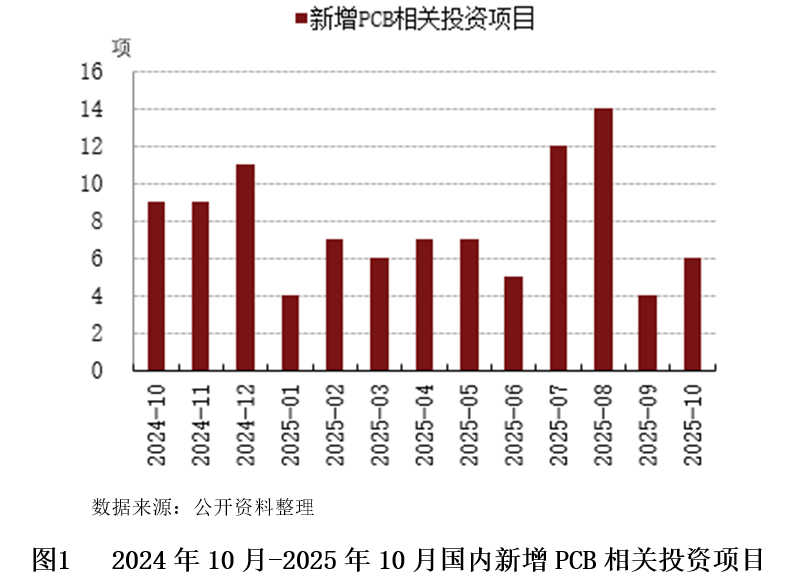
In October 2025, the number of investment projects related to PCBs both domestically and internationally saw a year-on-year decline. In domestic investment, the number of investment projects in October decreased year-on-year. As of the end of October 2025, there were a total of 226 investment projects (including those under construction) by domestic PCB companies, with three new investment projects added in October, including two new contracts and one acquisition. The newly added investment amount in October (only including disclosed amounts) was approximately 957 million yuan, including a proposed acquisition of over 50% equity in Wuxi Huayang Technology Co., Ltd. by Pengding Holdings for 357 million yuan; a contract for a production project of 1 million square meters of high-precision HDI circuit boards signed in Maoming, Guangdong; and a contract for a PCB production project signed in Guigang, Guangxi by Bominsing. Other new investment projects included three additional projects with a disclosed investment amount of approximately 2.88 billion yuan.
In terms of international investment, the overall number of investment projects in October declined year-on-year. In October 2025, there were five new PCB investments from international sources, remaining stable compared to September, coming from Thailand, Malaysia, Vietnam, and Taiwan, China. Mankun Technology plans to raise 760 million yuan for a high-end printed circuit board production base project in Thailand; Malaysia’s GUH Holdings Berhad is entering the high-end PCB field with more than 10 layers; Zhen Ding’s subsidiary in Thailand, Peng Shen Technology (Thailand) Co., Ltd., is building a new factory; a listed PCB manufacturer from South Korea, TLB, is investing in its subsidiary in Vietnam; and Century Minsheng Technology is acquiring shares of Xingyun Computer Co., Ltd. from Xinyi Chemical Industry.
(2) PCB Industry Export Competitiveness Increases, Trade Deficit Gradually Expands
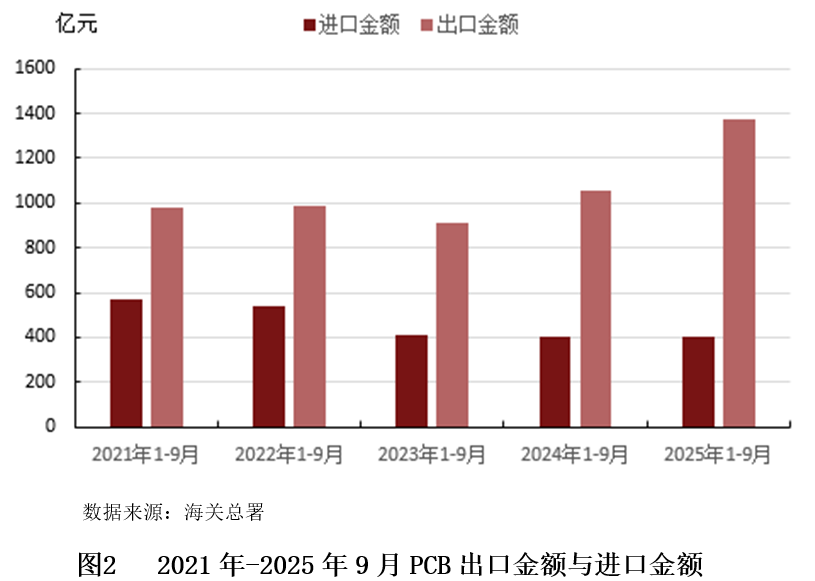
In terms of exports, the overall export value of PCBs has shown a growth trend in the first three quarters of the past five years, with the export value reaching 137.17 billion yuan in the first three quarters of 2025, a year-on-year growth rate of 29.6%, indicating strong growth momentum. The import value has continued to shrink, with the import value in the first three quarters of 2025 being approximately 40.38 billion yuan, with an import growth rate of 0%. The trade surplus between exports and imports has gradually widened, particularly notable in 2025, with a trade surplus of 96.79 billion yuan in the first three quarters. This indicates that domestic enterprises have made significant progress in independent research and development of mid-to-high-end PCBs and core materials (such as high-frequency copper-clad laminates and FC-BGA packaging substrates).
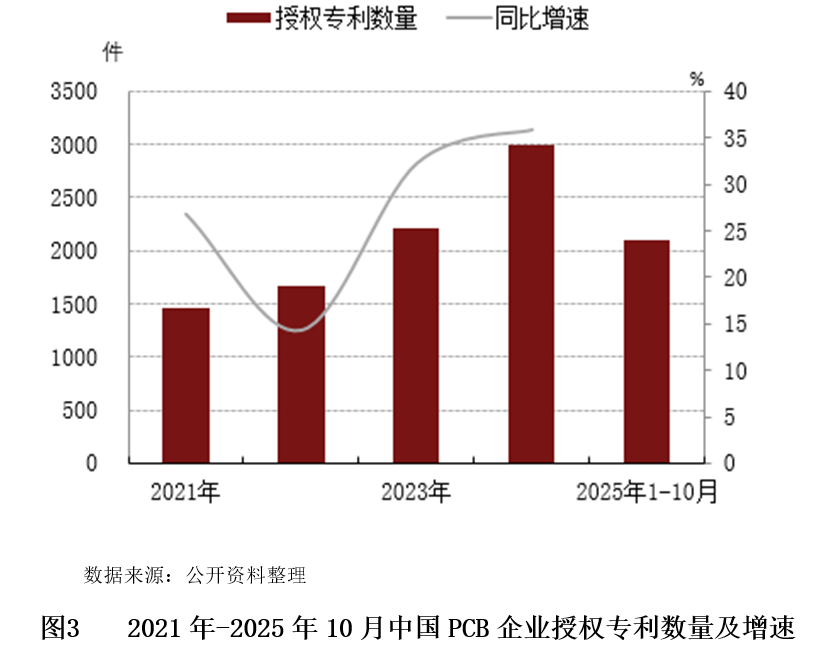
In the past five years, the number of authorized patents for Chinese PCB companies has shown an overall growth trend. The number of authorized patents increased from 1,461 in 2021 to 3,000 in 2024, with a compound growth rate of 27.1%, achieving rapid growth, especially with a growth rate of 35.8% in 2024, reaching a four-year high; from January to October 2025, the number of authorized patents for Chinese enterprises has reached 2,106, and it is expected to further increase in 2025. The technological innovation vitality of Chinese PCB companies continues to be released, with R&D investments in core areas such as high-frequency high-speed copper-clad laminates, advanced HDI processes, and FC-BGA packaging substrates translating into a large number of patent achievements, indicating a trend of the PCB industry shifting from scale expansion to technology-driven transformation.
(3) The AI Wave Drives Demand Surge, High-End Capacity Expansion Becomes Mainstream
The printed circuit board (PCB) industry is entering a golden period. On October 28, PCB companies such as Huadian Co., Ltd. and Shengyi Electronics released their third-quarter reports for 2025. The financial reports show that Huadian Co., Ltd. achieved an operating income of 5.019 billion yuan in the third quarter, a year-on-year increase of 39.92%; net profit was 1.035 billion yuan, a year-on-year increase of 46.25%. Shengyi Electronics reported a third-quarter revenue of 3.060 billion yuan, a year-on-year increase of 153.71%; net profit was 584 million yuan, a year-on-year increase of 545.95%. Driven by the wave of AI development, the demand for PCBs, as the “nerve center” of electronic devices, has significantly increased, and the industry is entering a new round of capacity expansion peak.
3. Industry Restructuring Accelerates, Leading and High-End Enterprises Welcome Development Opportunities
Policies will accelerate the “reshuffling” of the industry, with technology-strong enterprises and those producing high-end products directly benefiting, mainly covering the fields of circuit board manufacturing, upstream materials, and production equipment. The draft for public comment upgrades the “high-end gap” to an “access threshold,” locking in the low-end return path through quarterly inspections and exit mechanisms, directing demand dividends, capital dividends, and policy dividends to leading enterprises and upstream high-end materials/equipment sectors. From 2025 to 2027, the PCB industry will rapidly switch from “scale involution” to a high-quality track characterized by “technology + capital” dual intensiveness.
The “conducting rod” effect of the policy, combined with the “multiplier effect” brought by the explosion of AI technology, constitutes an unstoppable force for change. Leading enterprises such as Huadian Co., Ltd. and Shenghong Technology’s massive investments are not merely responses to trends but also attempts to seize the future industry landscape. The general lack of R&D investment among small and medium-sized manufacturers highlights their vulnerability in structural transformation. In this process of “the strong get stronger, and the weak get weaker,” small enterprises lacking core technology and financial strength will find it difficult to withstand the dual pressures of technological iteration and market competition, facing risks of integration or exit. This will be a brutal “evolution,” but it is also an inevitable path for the industry to mature and move towards the high end of the global value chain.
4. Industry Risk Analysis
(1) Risk of Rising Compliance Costs
Compliance requirements for green production (clean production audits, pollutant emission control), intelligent manufacturing (automation upgrades, level two or above intelligent manufacturing maturity), etc., require enterprises to invest significant funds in equipment updates, system construction, and environmental governance. In the short term, the substantial increase in compliance costs will directly erode enterprise profits, especially for companies with tight cash flow and weak risk resistance, which may trigger risks of cash flow breakage.
(2) Risk of Pain from Industrial Structure Adjustment
Policies promoting the concentration of resources towards “specialized, refined, distinctive, and innovative” enterprises and industrial clusters will trigger a wave of mergers and acquisitions within the industry. In this process, some small and medium-sized enterprises relying on low-end production capacity may exit the market, leading to local supply chain disruptions or cost fluctuations; at the same time, the release of high-end capacity requires a certain period, and if the adjustment pace is too fast, there may be a temporary supply gap where “low-end capacity has exited, but high-end capacity has not yet risen,” affecting overall industry stability.
5. Intervention Strategies
From a banking perspective, banks should implement a differentiated credit strategy of “supporting and controlling,” relying on enterprise credit information sharing platforms to accurately identify the technological strength and compliance potential of enterprises—strengthening support for “specialized, refined, distinctive, and innovative” enterprises that meet R&D investment standards and focus on high-end capacity through separate credit plans, innovative medium- and long-term credit products, and intellectual property pledge loans, while opening financing “green channels”; gradually reducing credit for enterprises relying on low-end production capacity and lagging in environmental protection and R&D indicators, strictly preventing funds from flowing into inefficient expansion areas. At the same time, establish risk-sharing and compensation mechanisms, and collaborate with industrial funds to improve supply chain financial services, strengthening the credit risk defense line while assisting in industrial upgrading.