The Swiss company Corintis is dedicated to advancing a cutting-edge cooling technology based on microfluidics, which achieves efficient heat dissipation by precisely delivering water or other cooling fluids to the heat-generating core areas of chips. In a recent test conducted in collaboration with Microsoft, servers equipped with this technology achieved cooling efficiency three times that of existing cooling methods while running the Teams video conferencing software. Compared to traditional air cooling, microfluidic technology can reduce chip temperatures by over 80%.
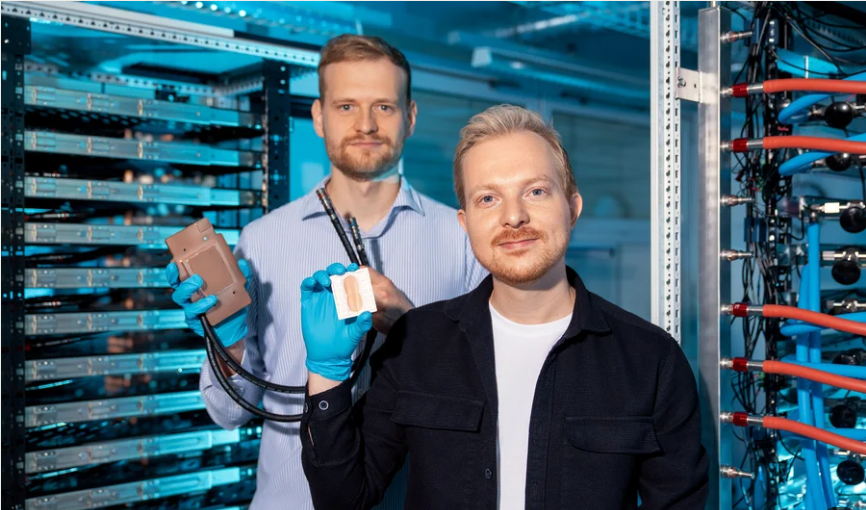
Corintis co-founders Sam Harrison (left) and Remco van Erp (right) holding a cold plate and a microfluidic chip, respectively.
A lower chip temperature not only means higher operational efficiency—chips can execute instructions in a more optimal state, thereby enhancing overall performance—but also effectively reduces energy consumption and failure rates. Furthermore, due to the improved cooling efficiency, data centers can raise the temperature of the cooling air, reducing the frequency of cooling equipment usage, which in turn lowers water consumption while improving overall energy utilization efficiency.
The precise localized cooling method significantly reduces the total demand for cooling fluids. Remco van Erp, co-founder and CEO of Corintis, pointed out that the current industry standard for cooling is approximately 1.5 liters of water consumed per kilowatt of power. As the power of individual chips approaches 10 kilowatts, the cooling demand will soar to 15 liters per minute. This figure undoubtedly exacerbates public concerns about the environmental impact of ultra-large AI factories—especially those planning to deploy projects at the scale of millions of GPUs.
In recent years, the power density of data center racks has rapidly increased. To meet the demands of artificial intelligence and other high-performance computing, operators are continuously integrating more powerful computing capabilities within limited spaces, leading to a surge in power consumption and heat generation per rack, making existing cooling systems increasingly inadequate to cope with this trend.
David Holmes, Global Chief Technology Officer at Dell Technologies, corroborated this: “Eight years ago, the average power per rack was only 6 kilowatts, while today, newly shipped racks have reached 270 kilowatts. It is expected that a 480-kilowatt model will be launched next year, and within two years, we may even see megawatt-level racks.”
Corintis has developed simulation and optimization software that can customize microfluidic cold plates for different chip designs. These cold plates are equipped with a precisely intricate network of channels, inspired by the human circulatory system—similar to the coordinated operation of arteries, veins, and capillaries, with each design striving for precision and efficiency.
The company has expanded its additive manufacturing capabilities, enabling mass production of copper components with channels as fine as a human hair (approximately 70 microns), and its cold plate technology is fully compatible with current mainstream liquid cooling systems. It is estimated that this technology can enhance the cooling performance of cold plates by at least 25%. Furthermore, if collaboration with chip manufacturers can lead to the direct etching of cooling channels into silicon wafers, there is potential for a tenfold breakthrough in cooling performance in the future.
Corintis has produced over 10,000 copper cold plates and is ramping up production capacity, aiming to reach an annual output of 1 million plates by the end of 2026. The company is also developing a prototype production line in Switzerland to create cooling channels directly within chips rather than on cold plates. This technology is currently planned for small-scale production to validate the basic concept, after which it will be promoted to chip manufacturers and cold plate producers.
Following Microsoft’s release of the Teams test version, Corintis promptly announced its capacity expansion plans. Additionally, the company will establish a customer service center in the United States and an engineering office in Munich, Germany. Meanwhile, Corintis has completed a $24 million Series A funding round led by BlueYard Capital, injecting new momentum into subsequent technology development and market expansion.