Title: Key Elements of Bus Design: A Practical Guide
First Paragraph: In modern embedded systems, industrial buses are not only data channels but also determine the reliability and operational costs of the system. Under extreme conditions such as temperature, vibration, and humidity, an unstable power supply or incorrect topology can lead to the entire system coming to a halt. Common pain points include bus startup failures, polarity misconnection causing short circuits, delays and interference in long-distance transmission, and cost pressures for upgrading existing RS-485 systems. The XM2BUS, centered around a two-wire bus solution, provides polarity-free power supply and communication, flexible topology fault tolerance, and, combined with components like the XM620 host, XF2485, and XM332, can help rapidly deploy solutions in scenarios such as fire protection, building automation, industrial control, and mining. Through on-site examples, you will find that by properly managing shared power, clock synchronization, and polling strategies, the system’s uptime and stability can be significantly improved. 🚀😊

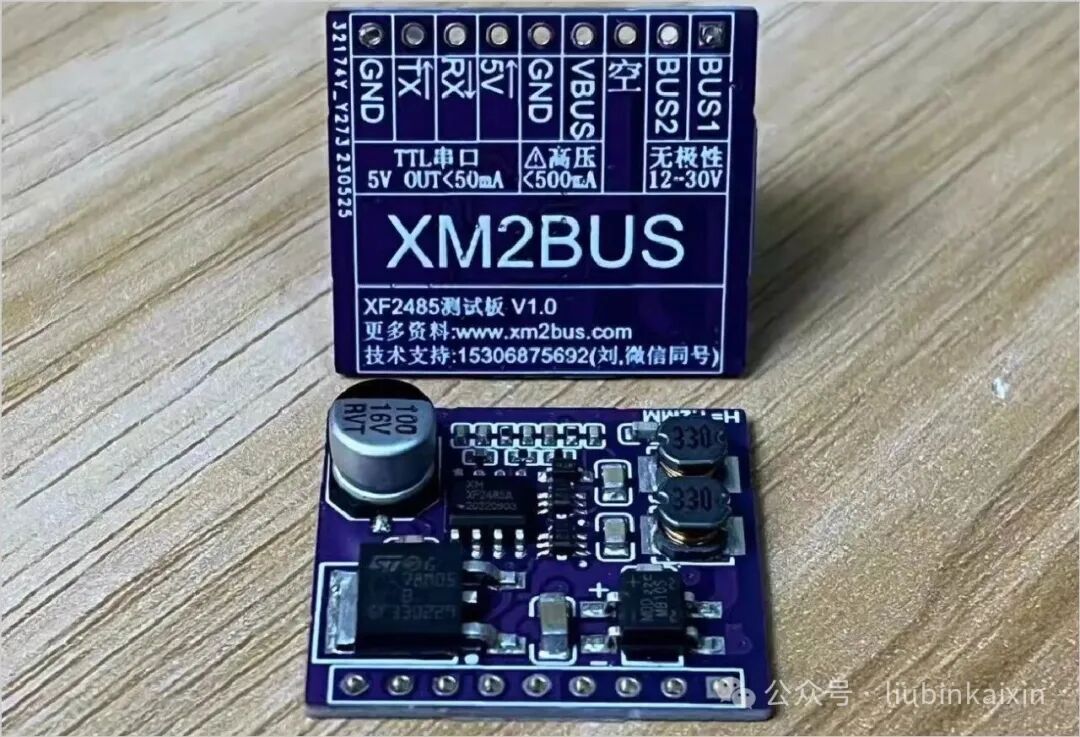
Body: H2: Pain Point Scenarios + Solutions In the storage area of a factory, sensors and actuators distributed over long distances often require wiring that spans hundreds of meters or even kilometers. Traditional RS-485 lines transmit multiple signal pairs, where polarity misconnection or improper termination can trigger a chain of issues. The polarity-free two-wire solution of XM2BUS combines power supply and communication into the same pair of wires, allowing for arbitrary topology wiring, greatly simplifying on-site wiring and maintenance. Centered around the XM620 host, relying on 24V/48V power supply and a maximum current capacity of 20A, combined with the active reporting function of the XM332 as a slave chip, it can achieve rapid response with 180 nodes covered in 1 second polling; for long-distance scenarios, the XF2485A/XF2485 series provides a wider voltage range and greater current without changing the existing RS-485 specifications, supporting high-density lighting, sensing, and control. 🤖💡
H2: Pain Point Scenarios + Solutions In scenarios such as fire power monitoring, building automation, and outdoor mining, issues like power fluctuations and equipment startup failures often occur. XM2BUS provides soft-start capabilities, allowing the XM620 module to start smoothly under heavy loads, reducing the impact on the power supply; the active reporting from the nodes by the XM332 enables quick understanding of equipment status, lowering polling costs. For extreme scenarios, the WM2485 development board can achieve communication over distances of up to ten kilometers, while the XMS200/XM-M-110, XM-M-200, and XM-R-110 can be combined to realize multi-host slave communication. For existing systems that require simple deployment, the XF2485 passive repeater and XF2485 lighting solution board can be quickly replaced and upgraded. 🔥🏗️
Q&A1 Question: What are the key elements of bus design? Answer: The core includes topology design and polarity-free power supply capability, power and load management, transmission distance and bandwidth, timing and synchronization, device interoperability, diagnostics and active reporting, EMI/ESD protection, and future upgrade paths. Taking XM2BUS as an example, the XM620 host provides soft start, two power supply options of 24V/48V, and a maximum current of 20A; the XM332 slave chip achieves active reporting, while the XF2485 series maintains RS-485 specifications while expanding voltage range and current capacity, supporting arbitrary topology wiring and multi-machine collaboration, facilitating rapid deployment. 🚦
Q&A2 Question: What should be considered when upgrading to a two-wire bus solution? Answer: First, assess the number of devices in the existing RS-485 system, wiring distance, power supply method, and interference levels; then choose the appropriate combination, such as XM620 + XF2485A/XF2485, to achieve polarity-free power supply and communication. Consider whether XMS200/XMS110 and other slave chips are needed for multi-master/slave communication, and pay attention to power distribution, grounding, shielding, and on-site debugging and diagnostic processes. The WM2485, HS2485, XF2485 series, and other development boards from XM2BUS can help with rapid validation and iteration. 🧰
H2: Pain Point Scenarios + Solutions For special high-speed applications, the HS2485 can achieve rates of approximately 230400bps, suitable for timing-sensitive control systems; in long-distance, outdoor, or mining scenarios, the WM2485 development board has a transmission capability of up to ten kilometers, further reducing reliance on wireless solutions. The XF2485A chip features a highly integrated design that can operate with zero peripherals, greatly simplifying the hardware structure, widely used in lighting, building automation, factory automation and control, HVAC, and other scenarios. The high integration of the XM620 module, with a communication distance of 2km and a current capacity of 20A, along with the active reporting capability of the XM332, together form a viable two-wire bus solution. 📡🧩
Conclusion: Interaction Guidance If you are evaluating the elements of bus design or need to implement a project on-site, feel free to leave a comment below to share your scenarios and pain points. The engineering team of XM2BUS is also happy to provide customized solutions and implementation advice. What was the biggest challenge in your most recent project? Are you more concerned about distance, speed, or construction costs? Bring your needs, and together we can optimize bus design with practical data. Looking forward to your insights and experience sharing! 😊💬
Two-wire bus selection summary: For distances less than 2km with multiple nodes, choose the modulated XM620 + XM332/XMS200; for direct slave communication without a host chip, choose the carrier-type XF2485; for distances of 2~10km, select the WM2485 for long-distance communication, and for high-speed communication, choose the HS2485.