
Embodied intelligence is an intelligent system that perceives and acts based on a physical body, capable of acquiring information, understanding tasks, making decisions, and executing actions through interaction with the environment. This report first defines the concept of embodied intelligence and analyzes its industrial chain, key links, focus areas, market scale, competitive landscape, and future trends.
01—The Concept of Embodied Intelligence
Embodied intelligence, also known as Embodied AI, is a comprehensive concept that involves artificial intelligence, robotics, cognitive science, and other fields. It was first mentioned in Turing’s 1950 paper “Computing Machinery and Intelligence.” Embodied intelligence emphasizes the close relationship between the agent (such as a robot) and its physical form and environment, suggesting that intelligent behavior arises from the interaction between the body and the environment, and is realized through a cyclical process of perception, decision-making, action, and feedback to achieve “intelligent growth.”
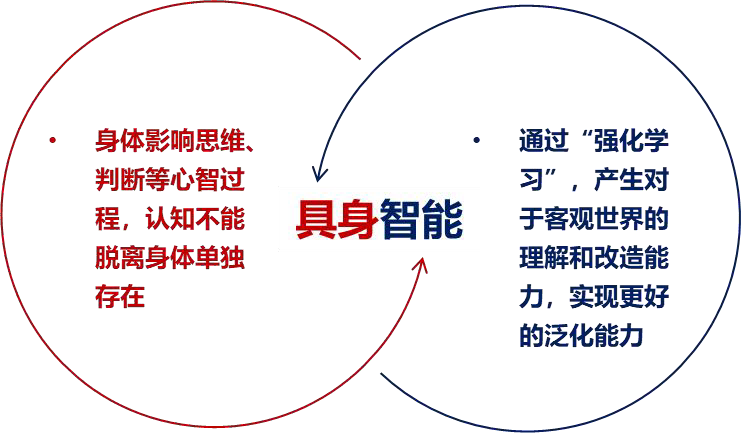
Figure: The Identity of “Embodied” and “Intelligent”
From the perspective of the development of intelligent technology, computer vision and natural language processing are merely tools to achieve embodied intelligence. General artificial intelligence can endow embodied agents with “common sense,” forming a measurable, verifiable, and explainable “closed set” to achieve the ultimate goal of “unity of knowledge and action.” According to Lu Ce Wu’s “Behavioral Cognition and Embodied Intelligence,” embodied intelligence should possess affordance, functionality, and causal chains.
Embodied intelligence involves three core processes: perception, imagination, and execution. Among these, embodied perception supports embodied imagination and embodied execution, encompassing full perception of world models and real-time interactive perception with the environment, continuously refining pre-constructed databases through real interactions to achieve more accurate world understanding and model establishment. Embodied imagination is the behavioral decision-making process, simulating embodied tasks through constructing simulation engines, and providing support for embodied execution of robots by integrating perception data. Embodied execution mainly coordinates the movement of various components based on perceptual information and decision commands to achieve intelligent behavior control.
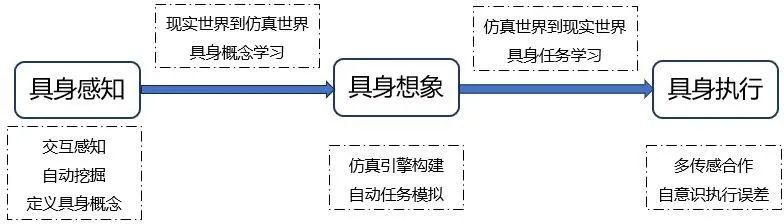
Source: Lu Ce Wu’s “Behavioral Cognition and Embodied Intelligence,” organized by Great Wall Strategy Consulting
Figure: Embodied Intelligence Implementation Plan
The learning method of embodied intelligence differs significantly from traditional intelligence. Embodied intelligence is a proactive first-person intelligence that has the ability to generate intelligence through its own experiences, integrating data collection, model learning, and task execution into autonomous learning in interaction with the environment, i.e., “perceiving the world – modeling the world – taking action – verifying and adjusting the model.”
Table: Comparison of Learning Methods between Traditional Intelligence and Embodied Intelligence
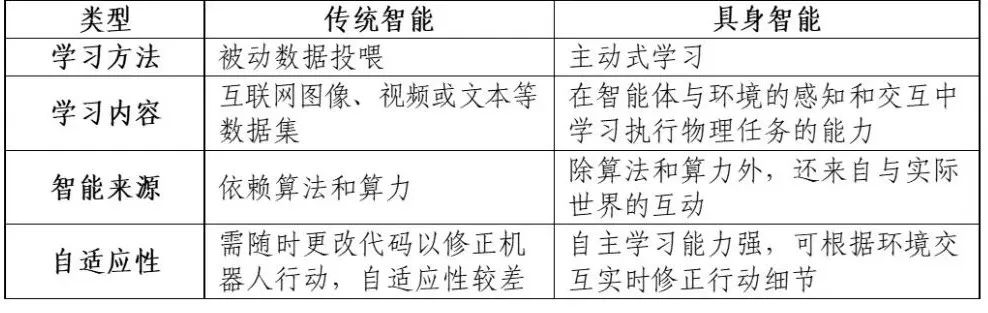 Source: Great Wall Strategy Consulting, compiled from public data
Perception Layer:
Sensors are the core medium for embodied intelligence to accurately perceive internal and external environments, mainly including torque sensors, visual sensors, inertial sensors, etc. Among these, torque sensors are the mainstream choice for embodied intelligence to sense force and torque information, including six-dimensional torque sensors applied to areas requiring high compliance control, such as the wrist and ankle, as well as joint torque sensors applied to other joints. Visual sensors are the core components for embodied intelligence to acquire external image information, mainly including 3D cameras, lidar, and multi-eye vision. Inertial sensors (IMU) are the core components that maintain the body’s balance and achieve precise posture control for embodied intelligence, mainly providing reference data for movement by accurately measuring acceleration, angular velocity, and tilt angle.
Imagination Layer:
Large models are the core for task planning and decision-making in embodied intelligence, and the enhancement of their learning capabilities requires strong algorithm support. The development of rapid training and real-time reasoning capabilities relies on powerful computing power centered on AI chips. The large models of embodied intelligence mainly include large language models (LLM) and multimodal large models (LMM). Among these, large language models provide strong understanding and continuous dialogue capabilities for embodied intelligence, while multimodal large models enhance the perception accuracy of embodied intelligence through multimodal data. Large models mainly have two algorithm types: hierarchical decision-making and end-to-end. The end-to-end approach can utilize a single neural network to complete the entire process from task goal input to control signal output. AI chips are specialized hardware used to accelerate artificial intelligence training and reasoning, mainly including graphics processing units (GPUs), field-programmable gate arrays (FPGAs), and application-specific integrated circuits (ASICs). Among these, GPUs are commonly used for model training, while FPGAs and ASICs are often used in the reasoning phase of deep learning algorithms.
Execution Layer:
The execution of precise actions in embodied intelligence not only requires support from precision components such as motors, reducers, and rolling ball screws but also needs the enhancement of machine learning technologies. Motors are the power source for embodied intelligence, and currently, joint actuators mainly use frameless force motors, while dexterous hands primarily use hollow cup motors. Precision reducers are the most critical components in the rotary actuators of embodied intelligence, mainly including RV reducers applied to large rotary joints such as the hips and harmonic reducers applied to small rotary joints such as the wrists and hands. Rolling ball screws are used to convert rotary motion into linear motion, including planetary rolling screws that convert rotary motion into linear motion and reverse planetary rolling screws that convert linear motion into rotary motion. Imitation learning and reinforcement learning are the two most commonly used methods for enhancing control in embodied intelligence. Among these, imitation learning primarily learns how to perform similar actions in similar situations by mimicking experts or demonstrators. Reinforcement learning is a learning method that involves direct interaction with the environment through trial and error, where behavior is driven by rewards obtained from interactions, continuously iterating action plans in the direction of maximizing rewards.
Table: Comparison of Reinforcement Learning and Imitation Learning
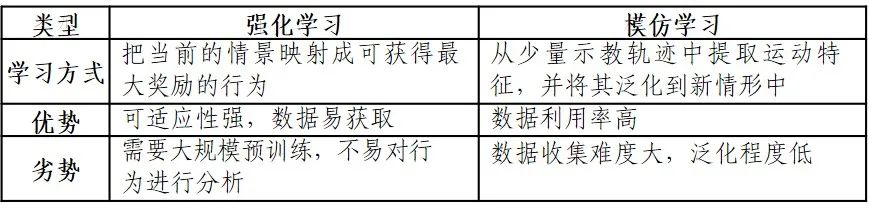 Source: Great Wall Strategy Consulting, compiled from public data
02—Embodied Intelligence’s Industrial Chain
The industrial chain of embodied intelligence mainly includes three links: upstream core components and software systems, midstream complete machine assembly production and system development integration, and downstream industry applications. Among these, the upstream mainly includes core components such as sensors, chips, motors, reducers, rolling ball screws, and the development of algorithms such as perception algorithms and control algorithms. The midstream primarily includes the design of complete machine software and hardware solutions, complete machine assembly and production, and algorithm development integration, while the downstream mainly includes applications in autonomous driving, home assistants, and intelligent manufacturing.
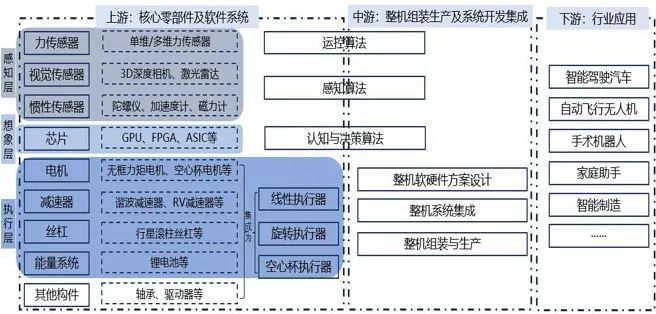
Source: UBTECH’s prospectus, organized by Great Wall Strategy Consulting
Figure: Embodied Intelligence Industrial Chain
03—Key Areas of Embodied Intelligence
Humanoid Robots
Humanoid robots are robots manufactured using artificial intelligence and robotics technology that have human-like appearances and behaviors. In terms of appearance, humanoid robots have heads, torsos, and limbs; in terms of behavior, humanoid robots can walk independently, communicate with humans verbally, and pick up and place objects. They are divided into six levels from L0 to L5 based on their degree of intelligence, currently transitioning from L3 to L4, with Tesla’s Optimus, Fourier’s GR-1, and Xiaomi’s Cyberone being representatives of this stage. For example, Tesla’s Optimus released in December 2023 has strong balance and full-body control capabilities, not only walking steadily but also capable of complex actions such as standing on one leg and squatting, while also having strong posture control capabilities with fingers equipped with tactile sensors to flexibly complete tasks like picking up an egg. Fourier GR-1 has agile obstacle avoidance and the ability to walk up and down slopes, and can communicate well with humans and collaborate to complete tasks.
Table: Introduction to Humanoid Robot Levels L0-L5
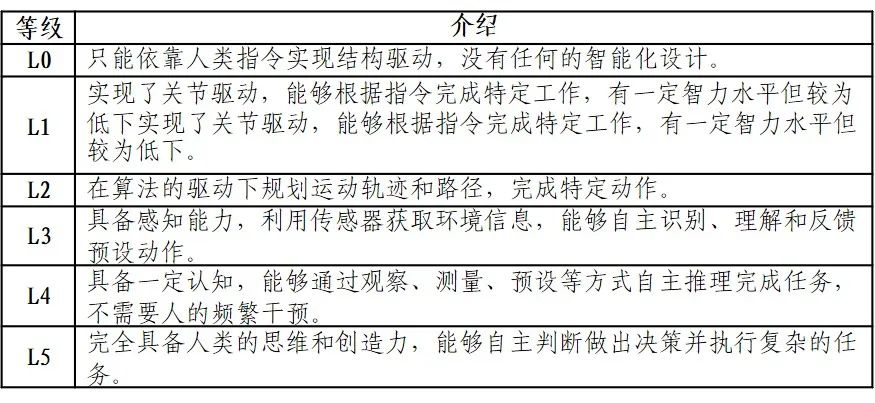 Source: UBTECH official website
Autonomous Vehicles
Autonomous vehicles refer to cars that assist drivers in controlling or even completely replace driver control through devices such as sensors, controllers, and actuators. They are divided into six levels from L0 to L5 based on their automation level. Some models available for sale, such as the Audi A8 and Tesla Model 3, technically possess L3 capabilities, while companies like Mobileye, Tesla, and Baidu have L4 and L5 technical reserves. It is expected that by 2030, L5 full automation will be achieved. In 2023, a joint notice from the Ministry of Industry and Information Technology, the Ministry of Transport, and four other departments allowed approved L3 and L4 vehicles to be driven on the road within limited areas.
Table: Introduction to Autonomous Driving Levels
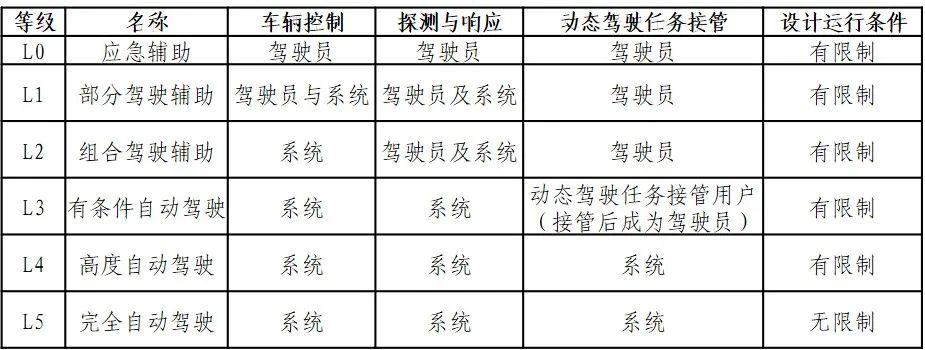 Source: National Ministry of Industry and Information Technology “Automotive Driving Automation Classification”
04—Market Scale and Competitive Landscape of Embodied Intelligence
Humanoid robots and autonomous driving are the two high-growth tracks where embodied intelligence is most likely to be implemented first, with the greatest market prospects. In the field of humanoid robots, a report released by GGII in May 2023 predicts that the global humanoid robot market will reach $2 billion and $20 billion respectively by 2026 and 2030, while the market scale of humanoid robots in China will reach $500 million and $5 billion respectively. In terms of autonomous driving, Preference Research predicts that the global market for autonomous vehicles will reach $2.35393 trillion by 2032, with a compound annual growth rate of 35% from 2023 to 2032. According to EEO Intelligence, the penetration rates of L1-L2, L3, and L4-L5 autonomous vehicles globally by 2025 will be 45%, 30%, and 10%, respectively, while the penetration rates in China will be 65%, 6%, and 1%, respectively.
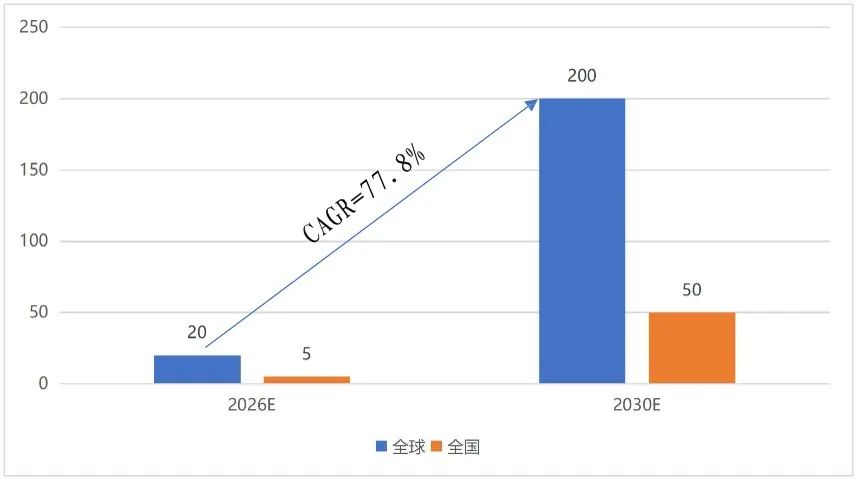 Source: GGII, organized by Great Wall Strategy Consulting
Figure: Global and Chinese Humanoid Robot Market Scale Forecasts for 2026 and 2030 (Unit: $ Billion)
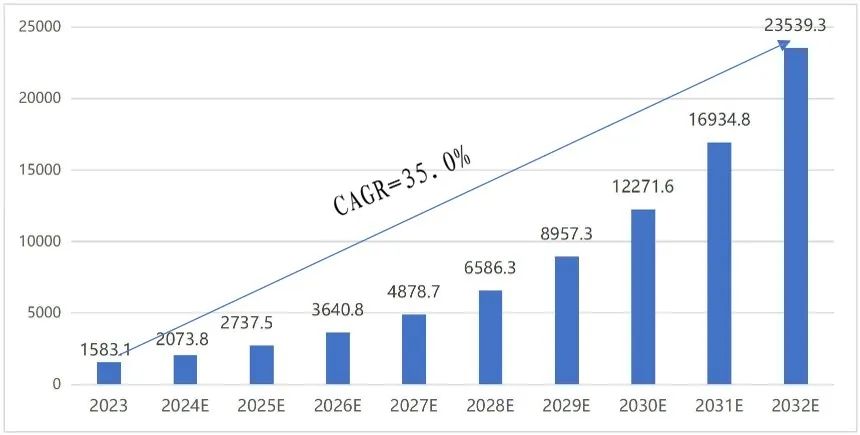 Source: Preference Research official website, organized by Great Wall Strategy Consulting
Figure: Global Autonomous Vehicle Market Scale (Unit: $ Billion)
Humanoid robots and autonomous vehicles are the fields of embodied intelligence that major economies around the world attach great importance to and are highly competitive. In the field of humanoid robots, the global market is still in the early stages of technological exploration and development, and has not yet achieved large-scale commercialization. The market currently presents a development trend of overseas giants leading, with domestic manufacturers rapidly following. Considering the technical strength and mass production costs of various companies, Engineered Arts from the UK is in the first tier, while Tesla and 1X technologies from the USA are in the second tier, and Agility Robotics, Zhi Yuan Robotics, and UBTECH are in the third tier, with Boston Dynamics and Honda in the fourth tier.
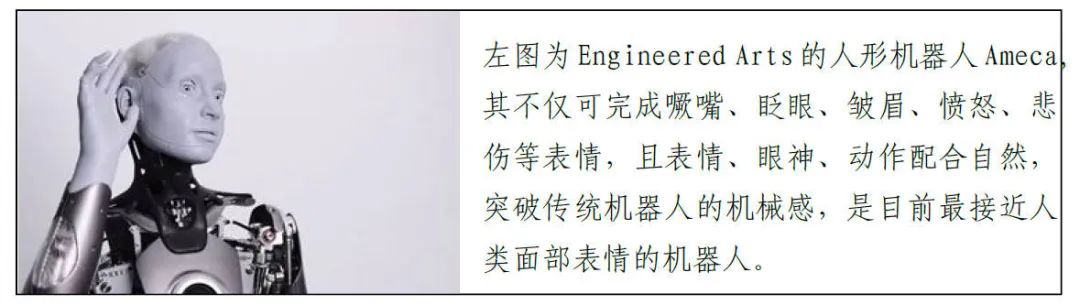
Table: Introduction to Representative Enterprises in Humanoid Robots
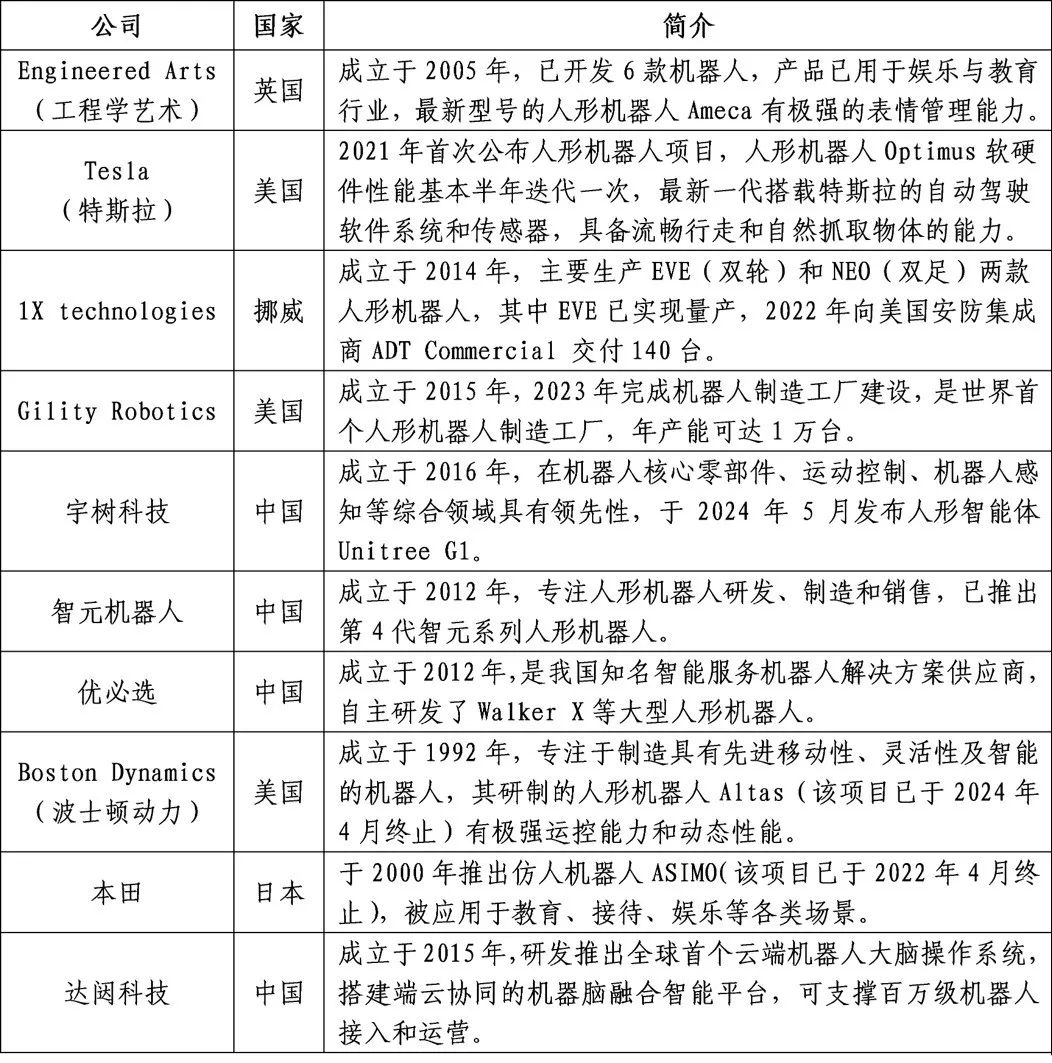 Source: Great Wall Strategy Consulting
In the field of autonomous vehicles, China is at the global leading level. Public and commercial consulting company Guidehouse Insights evaluated 16 autonomous driving companies globally based on execution and strategy capabilities, showing that Mobileye, Waymo, and Baidu are in the first tier, while Motional, Aurora, and WeRide are in the second tier. Autonomous A2Z, May Mobility, and Pony.ai are in the third tier, with Tesla in the fourth tier.
Table: Introduction to Representative Enterprises in Autonomous Driving
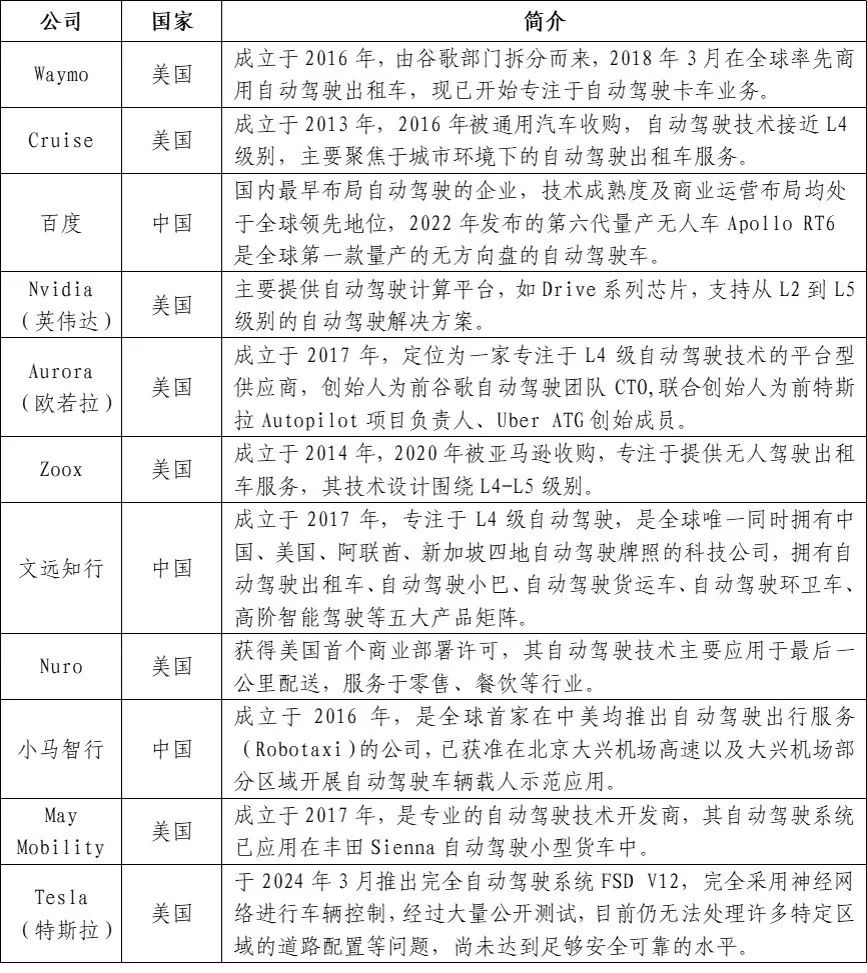 Source: Great Wall Strategy Consulting
05—Future Trends of Embodied Intelligence
First, large models will enhance the adaptability of embodied intelligence. The vast amount of common knowledge in large models gives embodied intelligence a degree of generality, but currently, the adaptability of models transitioning from training environments to application scenarios is poor. In the future, with advancements in model construction, training, and data collection technologies, the intelligent emergence of large models will be further enhanced, thereby improving the environmental adaptability of embodied intelligence.
Second, integrated large computing power chips will significantly improve the real-time response speed of embodied intelligence. The training and reasoning of large models require substantial computing power support, and the stacking of multiple chips cannot achieve a scale increase in computing power while also leading to low energy efficiency issues. Integrated memory-computing chips can effectively solve computing power and energy efficiency problems. With the development of integrated large computing power AI chips, embodied intelligence will be able to respond promptly and smoothly to various scenarios with ample computing power support in the future.
Third, high-precision components will significantly enhance the action accuracy of embodied intelligence. The precision and safety of autonomous vehicle control depend on the accurate perception of sensors, while the completion of large movements such as walking and jumping in humanoid robots relies on the support of motors, reducers, and controllers. In the future, with the development of related materials and processes, the precision of key components will be further enhanced, thus promoting a leap in the action accuracy of embodied intelligence.