Kardome’s edge-based spatial auditory AI uniquely addresses the core challenges of voice interaction in humanoid robots: it can dynamically map the acoustic environment in real-time, compensate for signal variations caused by the robot’s continuous movement, and perform all computations locally, achieving millisecond-level latency. Unlike traditional beamforming solutions that fail completely when the device moves, Kardome’s unique point formation technology dynamically creates adaptive “virtual bubbles” around each sound source, enabling reliable voice interaction even as humanoid robots navigate complex environments. This makes voice user interfaces—the most natural way for humans to interact with robots—truly applicable for autonomous humanoid robot applications for the first time.
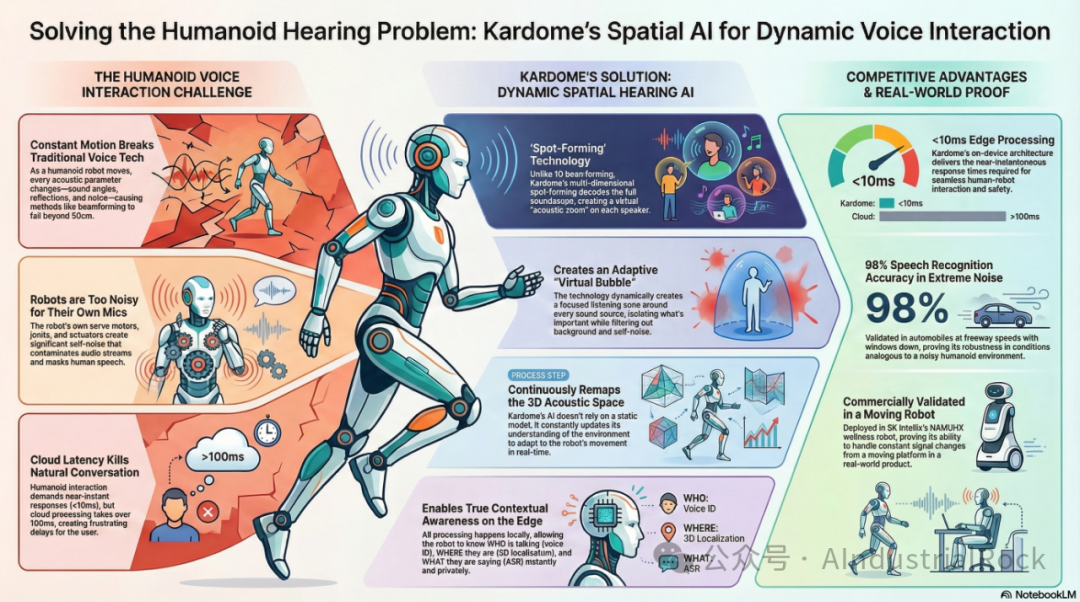
Challenges of Voice Interaction in Humanoid Robots
Acoustic Parameter Variations Due to Movement
Humanoid robots present unique acoustic challenges that static devices have never encountered. As the robot moves, every acoustic parameter changes simultaneously: the angle of the sound source, reflection paths, reverberation characteristics, and background noise distribution. Traditional signal processing methods (such as beamforming) fail completely under these conditions because they rely on one-dimensional “direction of arrival” parameters to model the sound field. In enclosed environments, sound reaches the microphone through direct paths and multiple reflection paths, potentially coming from hundreds of different directions. Beamforming can only focus on a single path, leading to incorrect representations of the sound field and failing to effectively capture speech beyond 50 centimeters.
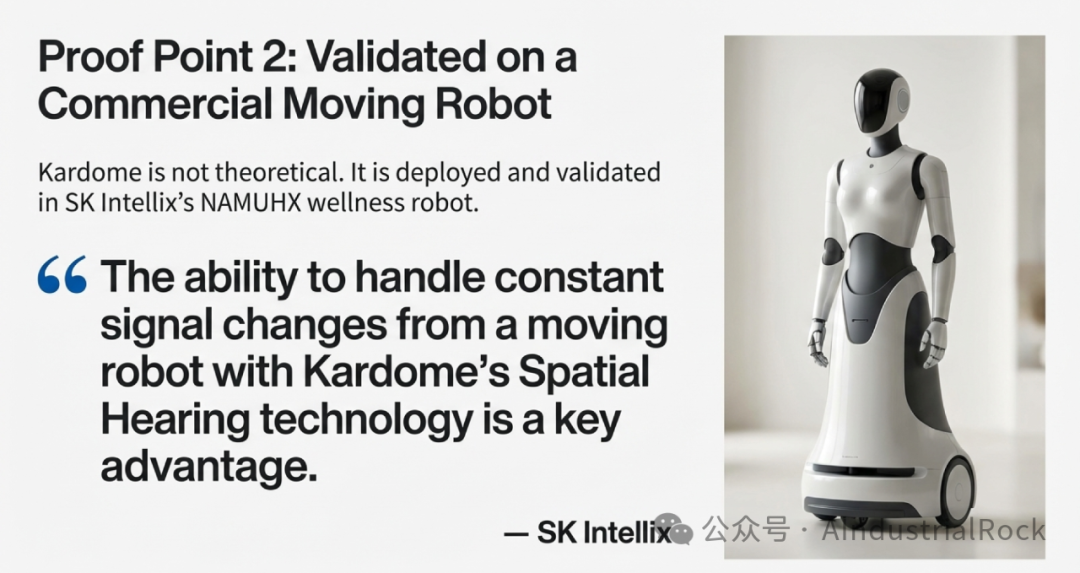
Kardome’s technology directly addresses this limitation. The company collaborated with SK Intellix’s NAMUHX welfare robot to demonstrate that “the ability to process the continuous signal changes brought by mobile robots using Kardome’s spatial auditory technology is a key advantage.” Traditional beamforming struggles in mobile scenarios, while Kardome’s AI-driven approach ensures smooth processing of constantly changing audio inputs, maintaining performance even as the robot moves.
Robot Self-Noise Pollution
Humanoid robots generate significant operational noise—acoustic interference from servo motors, joint movements, and mechanical actuators can overwhelm traditional speech recognition systems. Research on humanoid robot heads indicates that the audio stream contains “robot operational noise and environmental noise,” which can contaminate the speech signal. The multi-degree-of-freedom movements of the robot’s arms and torso produce sounds that mask human speech.
Kardome’s spatial separation capability directly addresses this challenge. The technology continuously maps the acoustic environment, separating human voices from background noise and assigning dialogue content to the correct speaker, thus distinguishing noise generated by the robot itself from human speech based on spatial location and acoustic characteristics.
Real-Time Processing Constraints
Humanoid robot applications require near-instantaneous response times. Edge AI processing can achieve response times of less than 10 milliseconds, while cloud processing takes about 100 milliseconds—this critical difference is essential for avoiding collisions and maintaining a natural interaction flow. Human-computer interaction research confirms that excessive latency can ruin the user experience; studies show that a round-trip time of 4-5 seconds from user speech to response can cause significant frustration.
Kardome’s fully localized architecture eliminates these delays, providing “fast, personalized, and private responses without relying on cloud connectivity.” This edge-based approach ensures reliable operation even in network-constrained or offline environments.
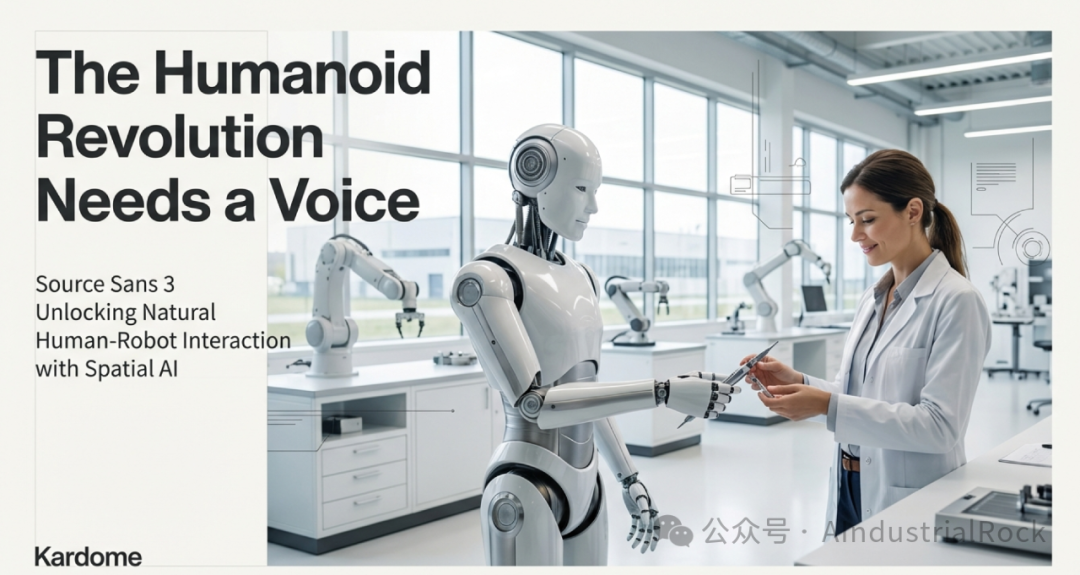
Kardome’s Technological Differentiation for Humanoid Robots
Point Formation: The End of Beamforming
Kardome’s unique point formation technology represents a fundamental breakthrough over traditional beamforming. Beamforming uses one-dimensional directional parameters, while point formation performs multidimensional sound field analysis by extracting spatial cues such as the relative position between sound sources and microphone arrays to decode echoes, overcoming inherent modeling flaws and accurately decoding multidimensional sound fields in enclosed environments.
The practical effect is significant: by installing a single microphone array on the overhead cabin wall, it can achieve acoustic “zoom” for occupants at each seat, capturing the voices of up to six people simultaneously from multiple locations. For humanoid robots, this means the robot can isolate speech from any angle while in motion without needing multiple dedicated microphone arrays.
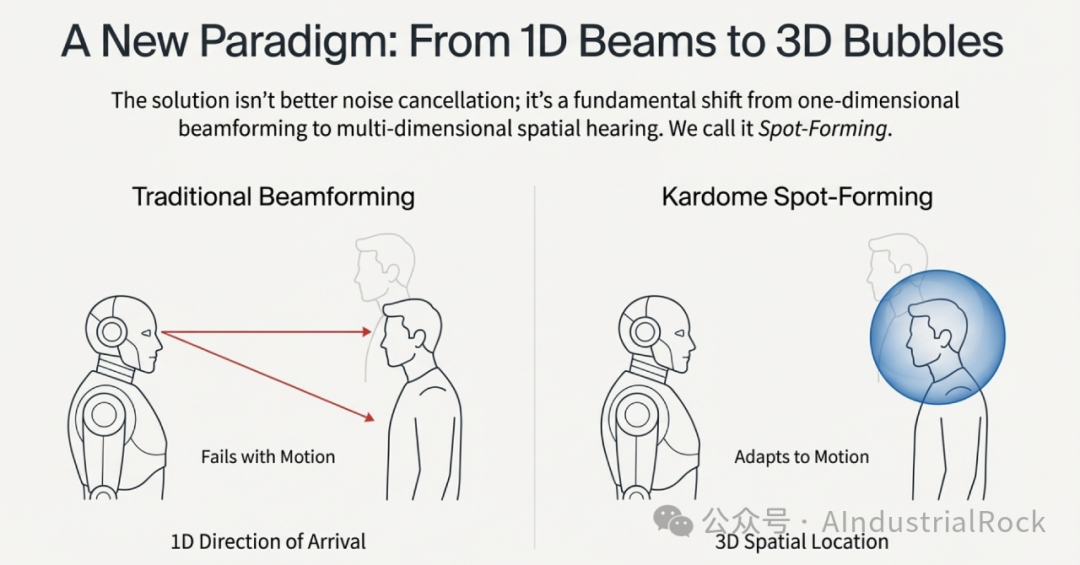
Spatial Hearing Under Dynamic Motion
Kardome’s spatial auditory voice technology “dynamically creates virtual bubbles for each sound source, focusing on important content while reducing background noise, and adapting to changes using voice AI.” This capability directly addresses the challenges of humanoid robots interacting with users in dynamic environments.
Unlike static systems that assume stable acoustic conditions, Kardome continuously remaps the three-dimensional acoustic space. For humanoid robots navigating rooms, approaching different speakers, or operating near reflective surfaces, this real-time acoustic mapping ensures stable voice isolation and speech recognition accuracy.
Edge-Based Context Awareness
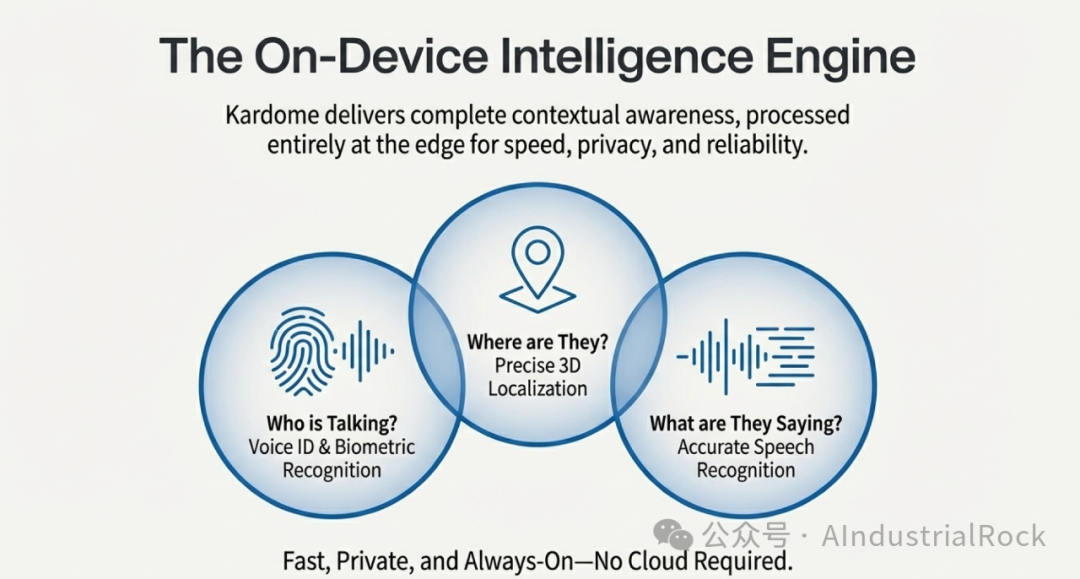
Kardome’s technology enables “devices not only to detect the direction of sound but also to precisely locate its exact position, thereby improving accuracy, speed, and responsiveness while keeping all processing local to protect privacy.” This spatial awareness includes three critical capabilities for humanoid robots:
1. Who is speaking: voice recognition and speaker identification
2. Where they are located: three-dimensional audio analysis with precise localization
3. What they are saying: domain-specific automatic speech recognition
By processing these elements locally, humanoid robots can maintain conversational context without privacy risks or cloud dependency—crucial for both consumer and enterprise deployments.
Why Voice User Interfaces are the Natural Choice for Humanoid Robot Interaction
Hands-Free Operation in Occupied Scenarios
Humanoid robots are designed to physically interact with human environments—moving objects, operating tools, opening doors, and manipulating items. In these scenarios, hands-free voice control is not only convenient but essential. Voice-activated systems enable “hands-free” interaction, suitable for situations where the operator’s hands are occupied or must maintain sterile procedures.
For humanoid robots assisting in medical, industrial, or household scenarios, voice user interfaces allow users to issue commands while their hands are engaged in physical work. The robot can “provide the necessary instruments to the doctor without breaking the sterile procedure by touching a screen or keyboard.”
Adaptive Interaction in Unpredictable Environments
Humanoid robots operate in spaces designed for humans, where acoustic conditions can change unpredictably. Research shows that current voice-enabled systems “perform quite effectively under controlled conditions,” but once environmental noise, speaker variability, and unpredictable user behavior are introduced, they can “completely fail.”
Kardome’s adaptive spatial mapping directly addresses this limitation. The technology performs excellently in “the most demanding real automotive environments”—highway speeds, open windows, and music playing—indicating its robustness can be directly transferred to similar challenge spaces faced by humanoid robots.
Expectations from Social Embodiment
The humanoid form raises higher expectations for natural interaction. Research shows that participants interacting with humanoid robots “expect human-like verbal communication, including turn-taking and role-playing, and feel frustrated when these are not achieved.” Embodiment triggers expectations that the robot’s “body language should reflect its verbal content.”
When voice user interfaces operate reliably, they become the most natural interface to meet these social expectations. Kardome can understand “who is speaking, where they are located, and what they are saying—in any environment,” thus providing the contextual awareness needed for human-like dialogue turn-taking and spatially aware responses.
Real-World Performance Advantages
Real-World Acoustic Performance
Kardome’s automotive applications achieved a 98% speech recognition accuracy rate with the windows open on the highway, demonstrating performance under conditions similar to those faced by humanoid robots (high environmental noise, airflow, and dynamic motion). The system can isolate “voices of up to six different people inside the vehicle,” proving the multi-speaker separation capability required for humanoid robots to interact with groups.
Hardware Flexibility
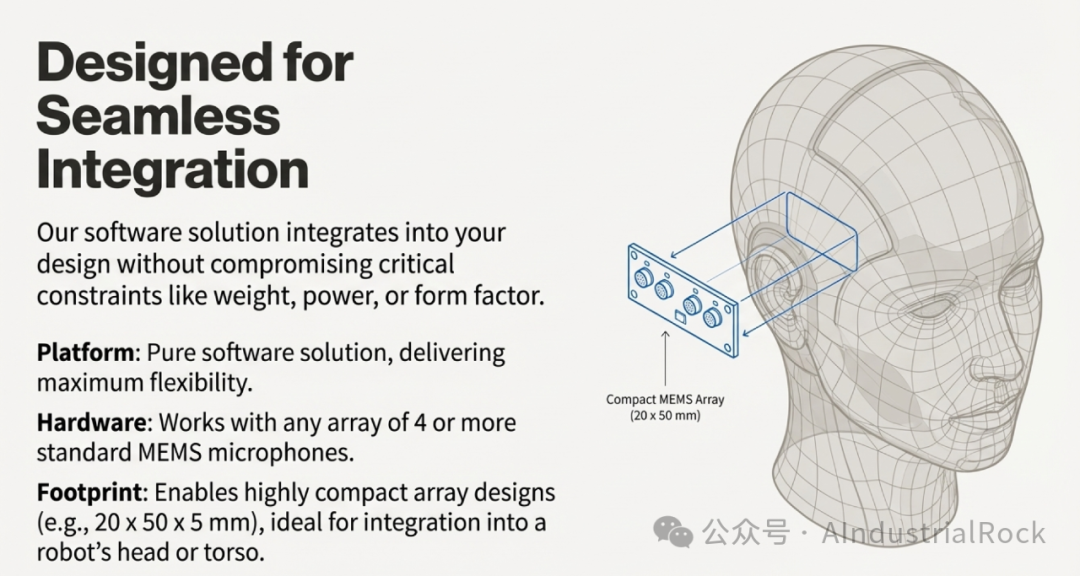
Humanoid robots face stringent design constraints regarding weight, power consumption, and component placement. Kardome’s software solution can work with any four or more microphone arrays, using simple MEMS microphones, with typical array sizes of only 20×50×5 mm, making it easy to integrate into the design of humanoid robot heads or torsos without compromising mechanical requirements.
Motion Compensation Validation
The deployment of the NAMUHX robot specifically validated Kardome’s performance in motion, with SK Intellix noting that the technology’s “ability to handle continuous signal changes in mobile robots” is a key deciding factor for its welfare robot applications. This real-world validation in commercial humanoid products indicates its readiness for broader adoption in humanoid robots.
Competitive Positioning Against Alternatives
| Solution | Limitations in Humanoid Robot Scenarios | Kardome Advantages |
|---|---|---|
| Cloud-Based Automatic Speech Recognition | Over 100ms latency, unable to interact in real-time | <10ms full edge processing |
| Beamforming | Fails beyond 50cm, cannot handle movement | Point formation effective at distance and motion |
| Single Microphone | Cannot separate speakers or isolate noise | Multi-microphone spatial separation |
| Static Acoustic Models | Fails when robots or speakers move | Continuous dynamic remapping |
| Noise Suppression Filters | May filter out useful speech along with robot’s own sounds | Spatial isolation preserves speech |
Kardome’s spatial auditory AI represents the fusion of three key enablers for voice interaction in humanoid robots: motion-adaptive acoustic processing, edge-based real-time computing, and spatial context awareness. Traditional methods treat voice interaction as a static signal processing problem, while Kardome redefines it as a dynamic spatial computing problem—exactly what mobile humanoid robots need.
The technology has been validated in moving vehicles and commercial robots, and combined with its fundamental architectural advantages over beamforming, it positions itself as the optimal solution for humanoid robot applications—where voice user interfaces provide the most natural, efficient, and socially expected interaction paradigm. As humanoid robots transition from controlled laboratories to dynamic human environments, Kardome’s edge-based spatial voice AI offers the reliability needed to make voice interaction truly dependable, with the required latency and adaptability.