On September 24, 2025, at 3:56 PM, the Jielong-3 rocket successfully launched another satellite into space over the sea near Rizhao, Shandong. This time, it carried 12 satellites into orbit.
Among them, 11 are part of the Geely constellation, and 1 is an experimental satellite developed by Peking University.
Once these satellites are successfully placed into orbit, the first phase of the Geely constellation, consisting of 72 satellites, will be fully operational.After the completion of the third phase, regardless of where you are in the world, even in remote areas without ground base stations, you will be able to connect to the internet in real-time.
The system can handle 340 million communications per day, and over 20 million users can connect simultaneously without any issues. Moreover, the speed of this launch is astonishing.
This is the third launch of the Jielong-3 in just 45 days, with the previous two occurring on August 9 and September 9.
Previously, a launch would require a wait of 30 days, but now it can be done in just 15 days, setting a new record for sea launches. Even more impressive are the small technological breakthroughs.
This time, for the first time, “one-click timing data analysis” was used, which previously took a lot of time to generate reports and troubleshoot issues; now it can be completed in just a few minutes.
In aerospace, saving time means saving costs, and this step has been taken very solidly.The experimental satellite from Peking University is also busy.
It is testing the “co-frequency full-duplex communication” technology, which essentially increases the signal utilization efficiency of the satellites.
Additionally, it is testing Bluetooth direct connection, which means that in the future, our mobile phones and tablets may connect directly to satellites without relying on base stations.
Some may wonder, what is the use of so many satellites? The most direct application is in the Internet of Vehicles.
Geely’s brands, such as Zeekr and Lynk & Co, will be able to achieve centimeter-level high-precision positioning using these satellites, which is particularly beneficial for autonomous driving.
If you happen to drive into an area with no signal, you can still maintain communication via satellite. Besides automobiles, this technology can also be applied in marine fisheries, emergency communications, and transportation logistics.
Currently, testing is underway in Southeast Asia, the Middle East, and Africa, with a communication success rate of 99.15%, ensuring reliability.The Jielong-3 rocket, responsible for launching the satellites, is quite capable. It uses a four-stage solid rocket engine and can carry 1.5 tons to a 500-kilometer sun-synchronous orbit.
It also supports a rapid response mode known as “three flat and one vertical,” allowing for quick launches without long waits. The Dongfang Spaceport in Shandong has also played a significant role, having completed 19 sea launches and accurately placed 127 satellites into orbit.
Being able to launch at such high frequencies indicates that the supporting capabilities are certainly robust. The Geely constellation plan does not stop here.
With the first phase of 72 satellites now completed, the second phase will involve launching 264 satellites, allowing mobile phones to connect directly to satellites without relying on ground base stations.
The third phase is even more ambitious, aiming to launch over 5,000 satellites to establish a global low-earth orbit broadband communication network. During the launch yesterday, tens of thousands of visitors gathered by the seaside in Rizhao, including groups of participants from the Hangzhou Marathon, all expressing their amazement.
Geely also organized a limited edition prize draw with satellite models and first-day covers, which helps raise public awareness of aerospace, which is quite commendable. In fact, the completion of the Geely constellation network is not just a milestone for China’s commercial space industry; it also signifies that we have gradually moved from the “technical experimentation” phase to the stage where we can provide “global services” in the aerospace field. As technology matures, satellite communication may become a commonplace occurrence.
For instance, if you travel to a remote area or encounter a natural disaster that disrupts ground signals, you can still contact your family via satellite.
This sense of security, knowing you will “never lose contact,” is reassuring to think about. Have you ever thought about what you would most want to do using satellite connectivity when there are no base stations?
End.
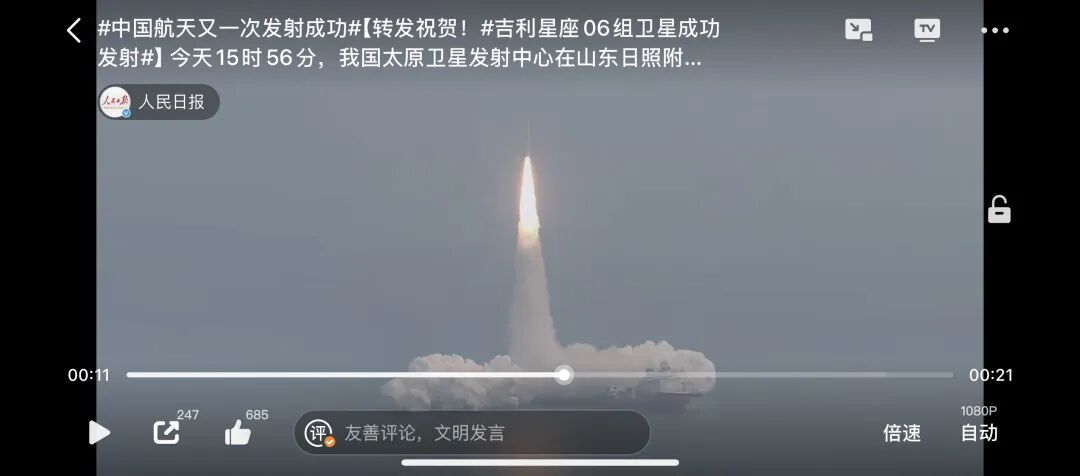
Image source: People’s Daily Weibo